
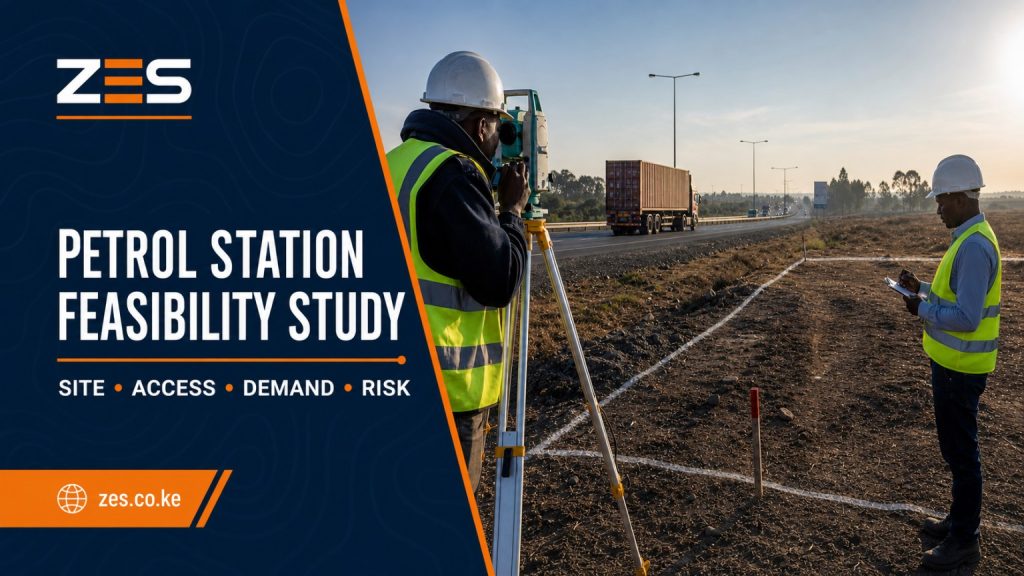
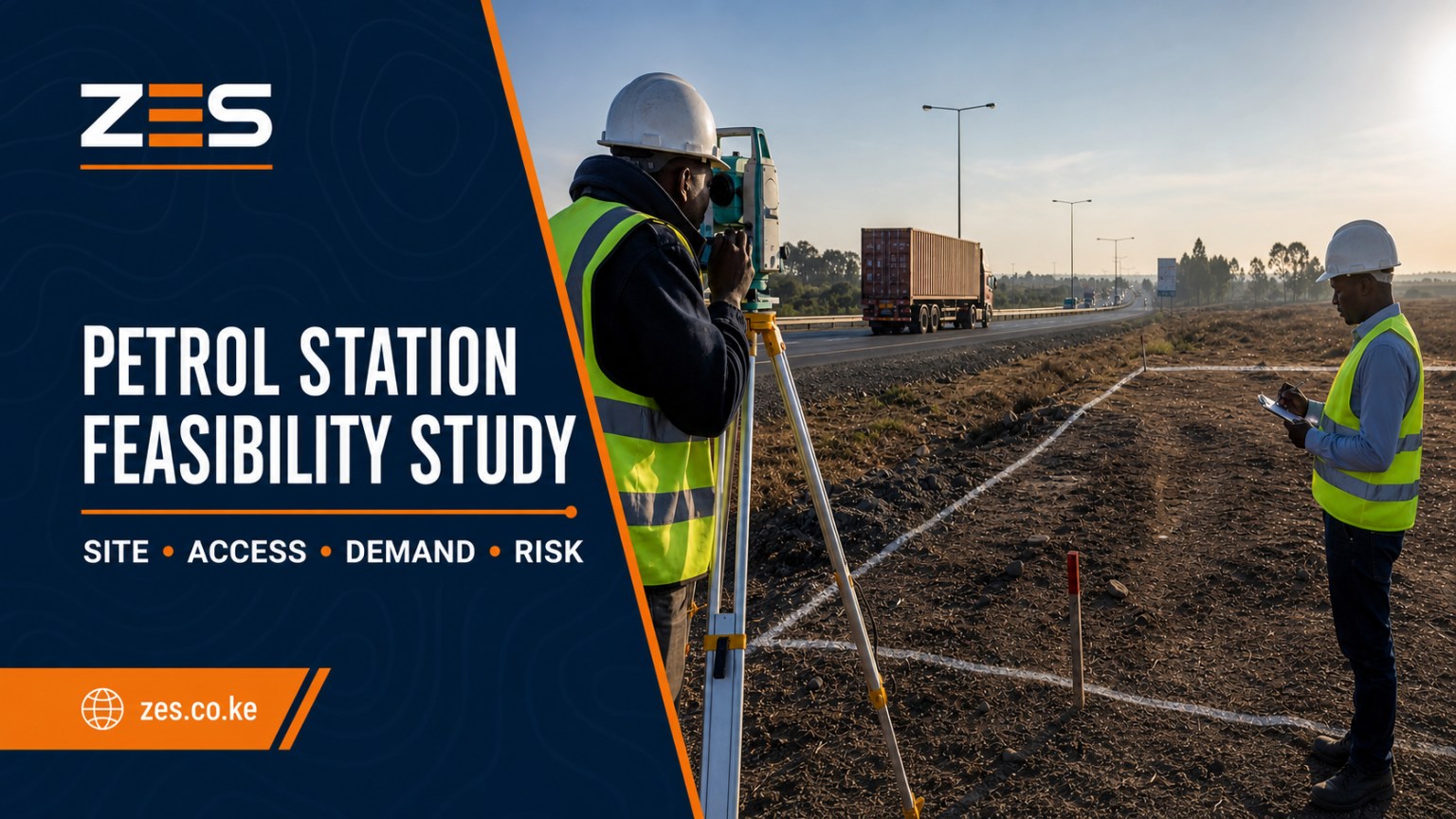
Petrol station feasibility study services Kenya investors commission should answer a hard commercial question before expensive design and construction begin: does this particular site, under realistic assumptions and current constraints, justify the capital and operating commitment? A useful study combines location screening, road access, customer demand, competitive supply, preliminary engineering, approval risk and financial modelling. It does not sell certainty. It gives the investor evidence, assumptions and decision points for a disciplined go, revise, hold or no-go decision.
Fuel retail can look deceptively simple from the roadside. Vehicles enter, buy fuel and leave. Behind that transaction are land commitments, access geometry, storage capacity, tanker logistics, working capital, regulated prices, staffing, utilities, maintenance, environmental controls and several approval processes. A busy road is not automatically a bankable station, and an apparently cheap plot can become expensive when drainage, earthworks, turning lanes or unsuitable access are properly considered.
Zama Engineering Systems (ZES) uses engineering and operational thinking to help clients frame these issues before they commit to a full build. The final investment decision remains the client’s, supported where appropriate by legal, financial, environmental, planning, traffic and other independent advisers.
What a petrol station feasibility study is—and is not
A feasibility study is a structured pre-investment assessment. It tests whether the proposed project can plausibly work on the identified land, for the intended market and business model, within the investor’s risk and funding limits. The report should disclose where data came from, what has been verified, what remains an assumption and which questions must be resolved by authorities or specialists.
It is not an EPRA construction permit, a NEMA environmental licence, a county development permission, a roads-authority access approval, a property valuation or a guarantee of sales. It is also not merely a spreadsheet that starts with the owner’s desired revenue and works backwards. A sound study allows downside results to appear. If access, spacing, land use, environmental sensitivity or economics are weak, that finding can save far more than the study costs.
Why feasibility comes before detailed design
Detailed engineering needs a stable project brief. Feasibility helps create that brief by testing the likely customer mix, product demand, storage strategy, dispensing positions, ancillary services and site constraints. Without this step, an investor may design a station larger than the market can support, underprovide tanker or customer circulation, misjudge working capital, or discover late that the preferred entrance needs a different road solution.
A positive preliminary result does not mean “start digging.” It means the project has earned the next level of investigation: verified surveys, formal land and planning checks, environmental assessment, access engagement, professional design, permit applications and updated pricing. Explore ZES’s next-stage petrol station engineering services when the concept is ready to progress.
Current legal and agency filters in Kenya
A current feasibility study must reflect Legal Notice 188 of 2025, the Petroleum (Retail Dispensing Site Construction and Licensing) (No. 2) Regulations. Published and commenced on 14 November 2025, the regulations govern retail dispensing site construction and petroleum retail licensing. They state that construction or modification is to proceed in accordance with a valid construction permit issued by the Authority.
Regulation 7 provides a crucial early screen. A proposed site on a class A road is not to be adjacent to or within two kilometres of a retail dispensing site under construction or operation. On other road classes, the stated vicinity is 0.5 kilometres. The Authority may consider site suitability after assessment and determines the application. The feasibility team can map known competitors and site coordinates, but only the Authority can decide how the rule applies to an application and whether the site is suitable.
The First Schedule also shows why commercial, land and engineering feasibility are inseparable. Construction-permit requirements include an outline of financing, relevant land or lease information, geographic coordinates, county development permission, road-authority approval for acceleration or deceleration lanes, mechanical and civil engineering drawings, professional practising certificates, a priced bill of quantities, a valid NEMA EIA licence and an environment liability policy.
If the plot fronts a national highway, consult the applicable authority early. KeNHA’s official FAQs list access-road approvals and direct applicants to an online permit process. A different authority may control an urban, rural or county road. The requirement should be identified, not assumed. Similarly, NEMA explains that EIA examines environmental effects and mitigation, while the Authority decides the appropriate environmental review and outcome. No feasibility consultant can guarantee these decisions.
Core scope of petrol station feasibility study services in Kenya
1. Investor objectives and business model
The study begins by defining the decision. Is the client comparing two plots, testing an existing site, seeking funding, planning an independent brand, negotiating with an oil marketing company, or adding a station to a wider commercial development? The required return, investment horizon, funding structure, preferred products, non-fuel offer and appetite for phased development should be recorded. A report cannot judge feasibility if “success” has not been defined.
2. Land, location and planning review
Preliminary land review records plot identifiers, ownership or lease position, boundaries, tenure, permitted use information, easements, wayleaves, neighbouring uses and any documents supplied by the owner. This is a screening exercise unless a lawyer, surveyor or planner has been expressly appointed to verify the relevant matter. The study should flag missing searches, owner consent, change-of-user questions, lease duration, subdivision, encumbrances and county planning requirements for further due diligence.
Location analysis also considers visibility, approach direction, nearby junctions, median restrictions, terrain, flood history, drainage outfalls, utilities, sensitive receptors, security, future road works and competing land uses. A plot that looks large on a title plan may lose usable area to setbacks, access geometry, levels, circulation or drainage.
3. Road access and traffic behaviour
Traffic volume is only one input. The study should examine vehicle direction, turning opportunity, traffic speed, peak periods, local versus through traffic, commercial-vehicle presence, public-transport activity, junction influence and the convenience of rejoining the route. Where suitable and within scope, observation or a formal traffic study can inform capture assumptions.
A station on the “wrong” side of a divided road may see substantial traffic but capture little of it. A busy entrance can also be unsafe or impossible to approve. Preliminary access geometry, tanker turning and queue storage should therefore be tested early, followed by engagement and technical submissions to the relevant roads authority as the project advances.
4. Competition and catchment assessment
Competitor mapping should go beyond counting pins on a map. Record their distance, road side, brand, apparent size, products, operating hours, congestion, access convenience, ancillary services and condition. Distinguish direct competitors from sites that serve another movement pattern or customer group. The current spacing provisions must be checked separately from the commercial competition assessment.
The customer catchment may include residents, commuters, boda boda operators, matatus, delivery fleets, agricultural users, construction traffic, institutions or long-haul vehicles. Interviews and field observations can improve understanding, but the report should avoid presenting a small convenience sample as a statistically certain forecast.
5. Demand and sales scenarios
A defensible forecast states its method. It can combine observed traffic, reasonable capture ranges, transaction assumptions, local fleet information, competitor evidence and phased market growth. Product mix should reflect the actual catchment rather than a generic national ratio. Non-fuel revenue—shop sales, lubricants, wash, service bay, food or rent—should be modelled only when the site plan, market and operating capability support it.
Use at least downside, base and upside scenarios. Test a slower ramp-up, weaker capture, lower throughput, delayed opening and changes in ancillary revenue. The point is not to find the most exciting result; it is to see which assumptions control viability and how much adversity the project can absorb.
6. Preliminary engineering concept
A feasibility-level layout checks whether the business idea physically fits. It can test entrances and exits, dispenser islands, indicative tanks, tanker standing, shop and parking, drainage routes, utilities, safety space and possible future expansion. This is not an issue-for-construction drawing. It establishes quantities and constraints sufficiently to inform cost and risk.
Ground levels, soil and groundwater matter. A sloping or flood-prone plot may need retaining, fill, storm-water works or a different tank solution. When uncertainty could materially alter cost, the study should recommend topographical, geotechnical, hydrological or other specialist investigation rather than hide the risk in a small contingency.
7. Approvals pathway and risk register
The report should map the likely sequence and dependencies for land/planning work, county development permission, environmental assessment, roads approval, professional designs, EPRA construction-permit application, construction, testing and retail-licence requirements. The specific path depends on the site and current directions from the agencies. A risk register should name each issue, its potential effect, responsible party, evidence needed and next action.
Useful categories include land, access, spacing, environmental sensitivity, drainage, utilities, ground conditions, community interface, design coordination, procurement, construction, schedule, licensing and commercial performance. Calling everything “medium risk” is not useful; prioritise the few issues that can stop or substantially reshape the investment.
8. Capital cost, operating cost and funding
Feasibility cost estimates should be traceable to a concept, quantities, current budget quotations or clearly stated benchmarks. Capital items may include surveys and professional services, statutory charges, earthworks, tanks, piping, dispensers, canopy, buildings, paving, drainage, oil-water separation, road access, power, backup, water, fire and safety systems, automation, security, branding, testing and contingency.
Operating assumptions can include staffing, power, connectivity, security, insurance, rent or financing, maintenance, calibration, environmental and safety obligations, cleaning, waste management and administrative costs. Fuel stock and other inventory require working capital separate from construction. Financing assumptions should distinguish equity, debt, interest during development and any conditions attached to drawdown.
9. Financial model and sensitivity testing
The model should show volumes, revenue, gross contribution assumptions, operating expenses, working capital, tax treatment as advised, financing and cash flow over an appropriate period. Key outputs may include break-even throughput, payback, net present value or internal rate of return, but these figures are only as credible as their inputs.
Sensitivity testing reveals which variables matter most: opening delay, construction overrun, throughput, margin, rent, finance cost, working capital or non-fuel performance. The report should identify any assumptions that need confirmation from an accountant, lender, oil marketer or supplier. Regulated pump prices do not remove commercial uncertainty because dealer terms, throughput, costs and capital structure still vary.
What the final feasibility report should contain
- an executive decision summary with clear conditions and unresolved issues;
- the investor brief, study scope, limitations and sources;
- site, land, planning and road-access screening;
- current regulatory and environmental pathway;
- catchment, traffic and competitor findings;
- demand method with downside, base and upside scenarios;
- a feasibility-level layout and indicative system capacities;
- capital, operating and working-capital assumptions;
- financial outputs and sensitivity results;
- a prioritised risk register and mitigation actions;
- a next-stage action plan, responsibility matrix and information gaps.
Ask for editable assumptions or a transparent calculation appendix if the model will be used for later design or lender discussions. A polished PDF with no traceable inputs is difficult to update when quotes, road requirements or product plans change.
How much does a petrol station feasibility study cost?
Pricing for petrol station feasibility study services Kenya investors request depends on the decision being supported. A desktop screen of one documented plot costs less than a multi-site comparison involving field counts, competitor surveys, concept layouts, cost enquiries, financial modelling and specialist inputs. Travel, survey work, traffic counts, legal searches, planning advice, EIA services, geotechnical work and valuation may be separate.
When comparing proposals, ask how many sites and scenarios are included, whether fieldwork is planned, who prepares the preliminary layout and estimate, whether the model is transparent, which external data must be purchased, and how one review meeting or revision is handled. The lowest fee has little value if the report excludes the site constraints or cost drivers that control the investment.
ZES prepares a quotation after reviewing the location, documents, project stage and intended use of the report. We do not advertise a standard success probability or promise that savings, sales, payback or licensing will meet a particular outcome.
Buyer’s pre-study checklist
- Share the plot number, coordinates, survey plan and current land documents.
- Identify the road and road class if confirmed; do not guess where it controls a legal test.
- List known stations nearby, including sites under construction where known.
- State whether land purchase, lease or an oil-marketer agreement is being negotiated.
- Define the intended products, approximate capacity, dispenser plan and ancillary uses.
- Provide the investment budget range, funding concept and required decision date.
- Disclose previous applications, refusals, environmental reports or agency correspondence.
- Say whether the report is for an internal decision, partner, lender or land negotiation.
- Agree which assumptions require independent legal, tax, valuation or environmental advice.
Common feasibility mistakes to avoid
Buying because the road is busy: access direction, safe entry, approvals, competitor position and customer purpose matter as much as raw traffic. Using a single optimistic forecast: one number hides risk; scenarios expose it. Ignoring working capital: a completed forecourt still needs product, stock and cash to operate. Pricing from a generic station: earthworks, road access, drainage and utilities are site-specific. Treating an EIA as paperwork: environmental conditions can reshape design and operations. Calling preliminary screening an approval: only the relevant authority can decide an application.
Frequently asked questions
Can a feasibility study confirm whether EPRA will approve my site?
No. It can screen the site against current published requirements, identify gaps and prepare evidence for the next stage. EPRA retains discretion to assess suitability and determine an application under the law.
Does the study include a full petrol station design?
Usually it includes only enough concept planning to test fit, circulation, capacities and budget. Detailed mechanical, civil, electrical and safety designs follow after the project passes its investment gate and the required surveys and briefs are confirmed.
Can you compare more than one plot?
Yes. A comparative study can score sites using consistent regulatory, access, market, engineering, cost and risk criteria. The proposal should define the number of sites, fieldwork and level of financial analysis.
How accurate will the sales forecast be?
A forecast is an estimate, not a promise. Its usefulness depends on data quality, method and transparent assumptions. Scenarios and sensitivity analysis are more decision-useful than a single precise-looking number.
Should I commission the study before signing a land agreement?
Ideally, screen feasibility and obtain legal advice before making an unconditional commitment. Where commercial timing requires an agreement, ask your lawyer about appropriate due-diligence, approval and exit conditions.
Can an existing station use a feasibility study for expansion?
Yes. The analysis can test additional tanks, dispensers, non-fuel services, access changes or automation against current capacity, downtime, compliance, demand and return. Modifications may require permits or approvals, so confirm the current pathway before work.
Official sources to check
- Kenya Law: Legal Notice 188 of 2025
- EPRA: petroleum licences and permits application guides
- NEMA: Environmental Impact Assessment guidance
- NEMA: Summary Project Report guidance
- KeNHA: access-road permit guidance
Laws, forms, fees, road responsibilities and agency processes may change. Verify the current requirements for the specific plot with the relevant authority and qualified advisers.
Request a feasibility-study proposal
Before you commit construction capital, contact Zama Engineering Systems with the proposed location, land documents available, road relationship, nearby stations, target capacity and the decision you need the report to support. We will define an evidence-based scope, identify specialist inputs and quote for the agreed level of site, engineering and commercial assessment.
A petrol station feasibility study Kenya investor commissions should test the site, market, approvals, engineering constraints and commercial assumptions before detailed design. A positive-looking traffic count does not resolve land rights, access approval, tanker circulation, utilities, drainage, environmental risk or the capital needed for a workable station.
Procure a decision document with stated assumptions
The study brief should identify the proposed site, ownership or lease position, target customers, fuel and non-fuel concept, investment horizon and decisions the report must support. Required inputs may include topographical and traffic information, competitor observations, utility checks, planning and environmental review, preliminary layout, access concept, high-level equipment scope, cost range and risk register. Road concerns should be developed through the road access design guide.
Proposals should name data sources, survey dates, professional roles, exclusions and deliverables. Financial scenarios need transparent throughput, margin, operating cost, ramp-up, financing and contingency assumptions rather than a guaranteed return. Compare preliminary capital scope with the construction cost drivers.
Accept a report that exposes uncertainty
The final report should show evidence, calculations, concept constraints, authority dependencies, sensitivity cases and unresolved investigations. Reviewers should be able to see how a change in volume, access, site works or equipment affects the conclusion. A recommendation can be proceed, redesign, investigate further or stop; it should not be forced to justify a prior investment decision.
Acceptance should include editable schedules or appendices agreed in the scope, a presentation to decision-makers and a register of next actions with responsible parties. Approval remains with the relevant authorities. Request a ZES feasibility scope with the site pin, land information and intended station model.
Investment-decision checkpoint
Decision-makers should meet after the draft report and agree which assumptions are acceptable, which require more evidence and which risks change the project concept. Record the chosen scenario and the conditions that must be satisfied before land commitment, detailed design or equipment procurement. If access, approval or ground information remains uncertain, attach a budget and programme allowance rather than hiding it in optimistic wording. This checkpoint gives later designers and cost consultants the same commercial baseline. It also prevents a feasibility conclusion from being reused after the site, capacity or market assumptions have materially changed.