
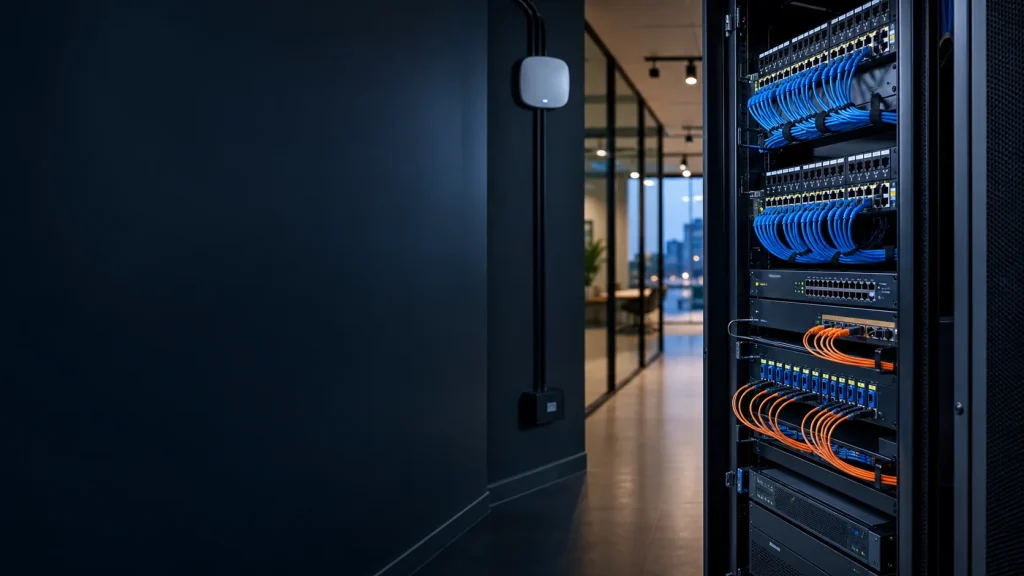
ZES provides enterprise Wi-Fi installation in Kenya for organisations that need measurable coverage, capacity, roaming and secure operational ownership. Zama Engineering Systems designs wireless service around users, devices, applications and the building instead of advertised access-point range. The scope can include surveys, structured cabling, switching, access points, controller or cloud configuration, segmentation, testing, documentation and support.
Enterprise Wi-Fi is not a larger version of a home router. Hotels, schools, offices, hospitals, warehouses, retail sites and campuses have different densities, materials, movement and service expectations. A correct design begins with the experience that must work in each area.
Enterprise Wi-Fi services
- New wireless network surveys and design
- Coverage, capacity and roaming assessments
- Access-point location and mounting plans
- Structured cabling, PoE switching and fibre dependencies
- Staff, guest, operational and device-network segmentation
- Controller or authorised cloud-management configuration
- Existing Wi-Fi troubleshooting and optimisation
- Coverage validation, documentation, training and support
The technical schedule identifies equipment, licences, subscriptions, customer-supplied internet, identity or firewall dependencies, test depth and exclusions. Coverage and capacity targets are agreed for the specified areas and device assumptions; no installer can responsibly guarantee every future device or building change.
Coverage, capacity and roaming are separate requirements
Coverage asks whether a usable signal reaches a location. Capacity asks whether the network can serve the expected users and applications at the same time. Roaming asks whether mobile devices can move between cells without unacceptable interruption. A design can appear strong on a phone signal icon and still fail scanners, voice, video or a crowded conference.
ZES records device types, user density, applications, complaint areas and mobility. Older handhelds and specialist devices may support different bands, channels or authentication from current laptops. The design should support the business fleet actually in use.
Predictive, passive and active survey work
A predictive model uses floor plans, materials and access-point assumptions to develop an initial design. A passive survey observes the radio environment. An active survey tests service using a client connection. New and existing sites may need different combinations depending on the question, access and stage of construction.
Drawings alone cannot reveal every source of attenuation or interference. Finished walls, furniture, racks, stock, cold-room panels, moving vehicles and neighbouring networks affect real conditions. The proposal should state whether post-installation validation is included and what success criteria will be used.
Access-point placement and mounting
More access points do not automatically create better Wi-Fi. Excessive overlap, poor channel planning and inappropriate power can increase contention or encourage sticky-client behaviour. Placement should consider user areas, ceiling height, obstructions, serviceability, cabling distance, mounting surface and visual constraints.
Access points need suitable wired uplinks and power. ZES coordinates them with structured cabling installation and checks switch port and PoE assumptions. Outdoor, industrial or high-bay areas may require equipment and mounting suitable for those conditions.
Segmentation, guest access and ownership
Staff, guests, cameras, building systems, scanners and other devices should not be placed onto one shared network merely for convenience. Network segmentation can support policy and fault control, but it must align with routing, firewall, identity, addressing and support ownership.
Guest access design should identify authentication, acceptable use, bandwidth policy, isolation, session handling and authorised data practices. ZES implements the agreed network configuration; the customer’s authorised IT or security lead approves access policy, identities and data retention.
Hotel Wi-Fi installation
A hotel Wi-Fi installation in Kenya should be designed around guest rooms, corridors, reception, restaurants, conference areas, back office and outdoor amenities. Room construction, doors, bathrooms, shafts and furniture can weaken signals in ways a corridor-only design misses.
Guest density changes during conferences and peak occupancy. The brief should include expected concurrent devices, business applications, guest-service expectation, internet capacity, staff networks and support hours. ZES separates the internal wireless design from the internet provider service and any captive-portal or property-system integration.
Warehouse Wi-Fi installation
A warehouse Wi-Fi installation in Kenya must consider tall metal racks, changing stock, narrow aisles, forklifts, scanners, printers, loading bays and external yards. An empty-building survey may not represent the operating facility. Antenna choice, mounting height and device roaming are especially important.
Serious buyers should begin with the ZES warehouse Wi-Fi site survey guide and provide scanner models, work routes, rack layouts and complaint zones. Where wired infrastructure is more reliable for fixed equipment, the design should say so rather than move everything onto Wi-Fi.
School and campus Wi-Fi
Schools and campuses combine classrooms, administration, libraries, laboratories, halls, boarding areas and outdoor spaces. Density can rise sharply between lessons or during events. The project should define staff, learner, guest and operational device access with the institution’s authorised policy owners.
Cabinet security, safe mounting, content policy, authentication and administration are as important as coverage. ZES confirms the installed network and handover responsibilities without assuming responsibility for every endpoint or online service.
Office and high-density business Wi-Fi
Open offices, meeting suites, voice calls, collaboration tools and many personal devices can create contention. Floor plans should identify work areas, meeting-room capacities, wall materials and future changes. Wired connections may remain appropriate for fixed, high-throughput or critical devices.
The wireless design should coordinate with the wider business network installation, internet service, switching, security policy and monitoring. Wi-Fi cannot compensate for an undersized uplink or unstable provider circuit.
Installation and commissioning process
- Discovery: identify users, devices, applications, coverage areas, density and support expectations.
- Survey: inspect construction, existing signals, pathways, cabinets, power and mounting access.
- Design: propose access-point positions, cabling, switching, management, segmentation and acceptance criteria.
- Quotation: state hardware, licences, subscriptions, installation, testing, documentation and exclusions.
- Deployment: install approved cabling and equipment, configure authorised settings and label assets.
- Validation: test agreed areas, device scenarios, roaming or capacity checks within the project scope.
- Handover: deliver asset locations, settings ownership, diagrams, limitations, training and support contacts.
Performance evidence and handover
Handover should show installed access points, switch connections, management ownership, SSID and segmentation summary, coverage or validation results, known limitations and outstanding actions. Administrative access goes to authorised customer representatives. Default or shared installer credentials should not remain as the operating model.
If a device or application was not available for testing, the report should say so. Future furniture, partitions, stock or device changes can justify a follow-up survey.
Wi-Fi maintenance and support
Wireless environments change. New neighbouring networks, device updates, access-point faults, layout changes and rising density can affect service. Maintenance may include controller health, access-point status, capacity trends, complaint-zone tests, account review and planned optimisation.
ZES can include the wireless assets within a defined network maintenance and support contract. Monitoring alerts, response priorities, remote access, licences and site attendance must be stated explicitly.
How to compare enterprise Wi-Fi quotations
- Which areas, users, devices and applications define success?
- Is the design based on drawings, onsite survey or both?
- Are cabling, PoE switching, fibre and cabinets included?
- Which licences, subscriptions and cloud services recur?
- How are staff, guest and device networks separated?
- What post-installation validation and report are supplied?
- Who owns configuration, credentials, updates and support?
- What assumptions could change coverage or capacity?
Africa and multi-country Wi-Fi projects
Organisations seeking enterprise Wi-Fi installation in Africa need more than remote equipment selection. They should evaluate site-survey capability, local cabling, material lead time, regulatory and building access, configuration governance, regional support and replacement logistics. ZES reviews multi-country requests individually and confirms service areas, partners and response arrangements in writing for each project.
Frequently asked questions
How many access points does our building need?
The answer depends on construction, area, device capability, user density, applications, interference and mounting. A survey and capacity model are required.
Can ZES improve an existing Wi-Fi network?
Yes. ZES first gathers complaints, layout, equipment, configuration access and measured conditions so the proposal addresses the actual cause.
Does enterprise Wi-Fi include internet service?
Not automatically. ZES designs the customer-side wireless and network infrastructure and can coordinate the handoff to the selected internet provider.
Can one SSID cover several branches?
It may be possible with compatible platforms and governance, but addressing, authentication, internet breakout, licences, monitoring and support must be designed for the organisation.
Plan Wi-Fi around real users and work areas
Send ZES the site location, floor plans, device types, user estimates, critical applications, complaint zones and target date for a survey-led enterprise Wi-Fi proposal.
Ready to plan your system?
Get a clear scope and quotation for your site.
Tell our engineers what you need. We will review your requirements, recommend the right solution and respond with the next practical step.
Discuss this solution with ZES
Request a site assessment and a quotation designed for your property.
Request a Quote