
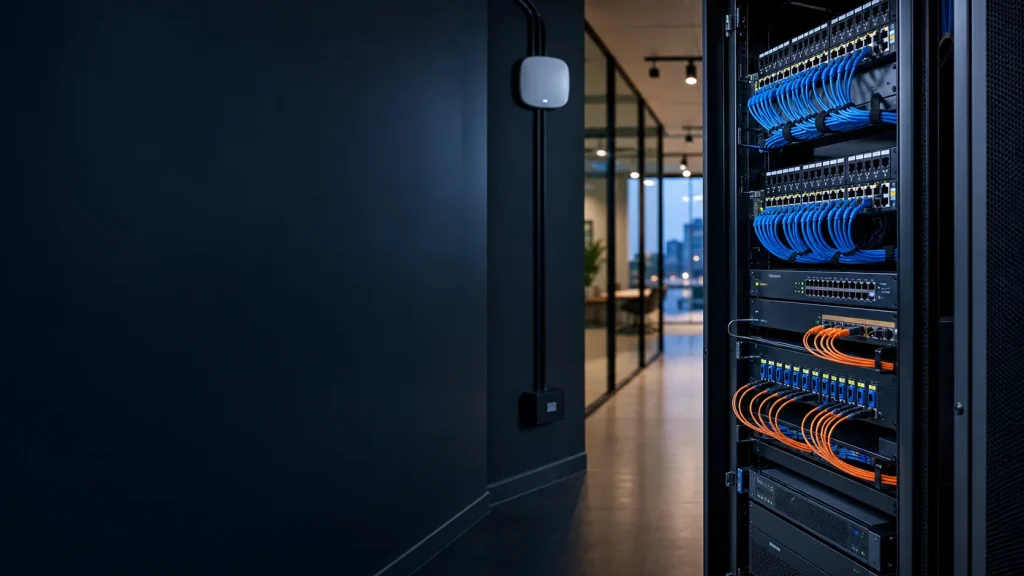
ZES plans and installs server rooms, network racks and data-centre cabling for organisations that need secure, maintainable technology infrastructure. Zama Engineering Systems coordinates rack layouts, copper and fibre, cable management, UPS and power dependencies, cooling interfaces, access control, monitoring and handover around the equipment and uptime requirement. The scope is defined after a site and capacity assessment.
A room with racks is not automatically a data centre. Its suitability depends on load, environment, power, cooling, access, fire and building considerations as well as network hardware. ZES identifies the work it can deliver and the items that require customer consultants, licensed contractors, manufacturers or other specialists.
Server-room and data-centre infrastructure services
- Existing room and cabinet condition assessments
- Rack quantity, size, location and elevation planning
- Copper and fibre backbone and equipment cabling
- Patch panels, fibre enclosures and cable management
- Switch, router, firewall and server mounting coordination
- UPS, power-distribution and environmental dependencies
- Cooling, airflow, access-control and CCTV coordination
- Labelling, testing, as-built records and maintenance planning
The final proposal states which engineering, electrical, cooling, fire, civil, structural or regulatory work is included and which party is responsible. Website copy is not a substitute for project-specific designs and approvals.
Begin with equipment, load and growth
The survey should record current and planned racks, equipment dimensions, weight where relevant, port and fibre counts, heat output information, power demand, autonomy expectations, criticality and expansion. An apparently empty rack can become unusable if depth, rails, airflow or cable access do not suit the equipment.
The customer should classify critical systems and acceptable downtime. This guides resilience, maintenance access, spare capacity and monitoring. ZES does not promise a tier or availability class unless the project is formally designed, constructed and independently assessed to the stated requirement.
Network rack installation
A network rack installation in Kenya should provide secure mounting, practical front and rear access, airflow, patching, power distribution and room for growth. Wall cabinets may suit small edge locations; floor-standing cabinets can support deeper and heavier equipment. The correct choice depends on the installed assets and environment.
Rack elevations show where patch panels, switches, fibre enclosures, power units and management spaces belong. Heavy equipment and manufacturer airflow requirements must be respected. Cabinet locks should form part of an access procedure, not create an emergency barrier with unknown keys.
Data-centre cabling
Organisations looking for a data centre cabling company in Kenya should ask how copper, fibre, power and pathways will be separated, identified and maintained. High-density patching needs clear source and destination naming, service loops, bend management and changes recorded after handover.
The design should specify media, interface, distances, capacity and acceptance tests. Fibre counts and transceiver assumptions must align. Copper category and link configuration should match the application. ZES coordinates dedicated structured cabling and fibre installation and testing within the room and connected sites.
Power and UPS dependencies
Network and server equipment need stable, appropriately designed power. The assessment can record device loads, available supplies, UPS condition indicators and distribution needs within scope. Electrical load measurement, protection, earthing, generator integration and statutory work must be assigned to appropriately authorised personnel.
UPS autonomy depends on actual load, battery condition, design, temperature and operating mode. A brochure value should not be treated as a project guarantee. The quotation should state whether supply, installation, testing, battery work, bypass, monitoring and maintenance are included.
Cooling and airflow
Heat affects availability and equipment life. Cabinet placement, blanking, cable congestion, supply and return airflow, room sealing, equipment load and cooling duty must be considered together. A comfort air-conditioner selected without heat-load assessment may not provide the required operating resilience.
ZES coordinates network layout with the appointed mechanical or cooling specialist where required. Temperature or environmental monitoring can provide earlier warning, but alerts need named recipients and response procedures.
Physical security and authorised access
The room should restrict entry to authorised personnel while preserving safe emergency access. Door control, visitor logs, cabinet locks and CCTV may support this policy. The customer defines roles, retention and incident procedures; ZES can integrate the infrastructure with CCTV and access-control scopes.
Shared keys and administrator passwords undermine accountability. Handover should assign physical and system access to named customer custodians. Remote-management paths should be approved by the authorised IT or security lead.
Fire, water, dust and building risks
Roof leaks, plumbing, unsealed openings, dust, pests, external windows, adjacent heat sources and uncontrolled storage can threaten equipment. The site assessment records visible conditions but does not replace structural, fire or building-services engineering where those are required.
Fire detection, suppression, escape and statutory compliance must be designed by competent authorised parties for the specific room and jurisdiction. ZES coordinates interfaces and avoids generic claims that one product makes a room compliant.
Server room installation process
- Business brief: identify equipment, critical services, growth, downtime and handover requirements.
- Site survey: inspect room, access, structure, pathways, power, cooling, security and existing systems.
- Coordinated design: prepare layouts, rack elevations, cabling, equipment and specialist dependencies.
- Implementation plan: agree shutdowns, temporary service, safety, access, procurement and change control.
- Installation: prepare racks and pathways, place cabling and equipment, label and protect work.
- Testing: complete agreed cabling, power-interface, monitoring and functional checks.
- Migration and handover: move authorised services, provide records, train custodians and list outstanding items.
Migration in a live environment
Moving active services introduces risk. The customer and ZES should identify dependencies, backups, rollback, provider links, configuration ownership, application contacts and approved outage windows. Cables and devices must not be disconnected because labels appear correct; critical paths should be verified.
A staged migration can reduce impact. Each phase should have acceptance checks and a decision point before the next begins. Temporary arrangements must be documented and removed or formalised at completion.
Testing and handover records
- Room layout and rack elevations at the agreed detail
- Asset, serial, cabinet and position schedule
- Copper outlet, patching and test records
- Fibre endpoint, core allocation and agreed results
- Power, UPS, cooling and monitoring responsibilities
- Approved topology and provider demarcation records
- Access ownership, configuration custody and support contacts
- Defects, limitations, warranty and maintenance plan
Documents should reflect installed conditions. Sensitive topology, credentials and settings need controlled delivery to authorised staff, not public or informal sharing.
Maintenance and capacity planning
Server rooms require periodic inspection of racks, patching, UPS status, environmental alarms, cleanliness, access, asset records and capacity. Specialist electrical, cooling, fire and equipment maintenance schedules should be coordinated so one contractor does not compromise another system.
ZES can include network and rack assets in a network maintenance contract. The agreement states covered equipment, visits, response priorities, monitoring, parts and exclusions.
How to compare server-room quotations
Compare room preparation, racks, power, UPS, cooling, fire dependencies, access control, CCTV, copper, fibre, active equipment, migration, tests, documentation and maintenance. A low equipment total may omit design, safe migration or building work.
Ask which disciplines have been assessed, which calculations or measurements support the proposal, who provides statutory approvals and what must be supplied by the customer. Product brand alone does not resolve coordination risk.
Africa data-centre infrastructure requests
Businesses seeking a data centre infrastructure company in Africa should evaluate local survey capability, power and cooling context, logistics, material lead times, specialist partners, documentation and post-handover support. ZES reviews regional projects individually. It confirms countries, responsibilities and response arrangements only after assessing the actual site and delivery model.
Frequently asked questions
Can ZES upgrade an operating server room?
Yes, subject to assessment, authorised access, dependency mapping, backups, migration plan and agreed outage or staging arrangements.
Does ZES supply servers?
Supply depends on the written scope and available products. This service primarily coordinates the room, racks, network and related infrastructure; exact equipment and warranty sources are quoted project by project.
Can an office air-conditioner cool a server room?
Suitability depends on heat load, operating hours, redundancy, airflow and environmental requirement. A competent cooling assessment is needed.
Can ZES certify a data centre tier?
No generic website statement can do that. Any formal design or facility certification requires the applicable specialist process and independent evidence defined for the project.
Plan a maintainable server room or network rack installation
Send ZES the site, room photographs or drawings, rack and equipment list, power and cooling information, critical services, migration window and target date for a coordinated assessment.
Ready to plan your system?
Get a clear scope and quotation for your site.
Tell our engineers what you need. We will review your requirements, recommend the right solution and respond with the next practical step.
Discuss this solution with ZES
Request a site assessment and a quotation designed for your property.
Request a Quote