
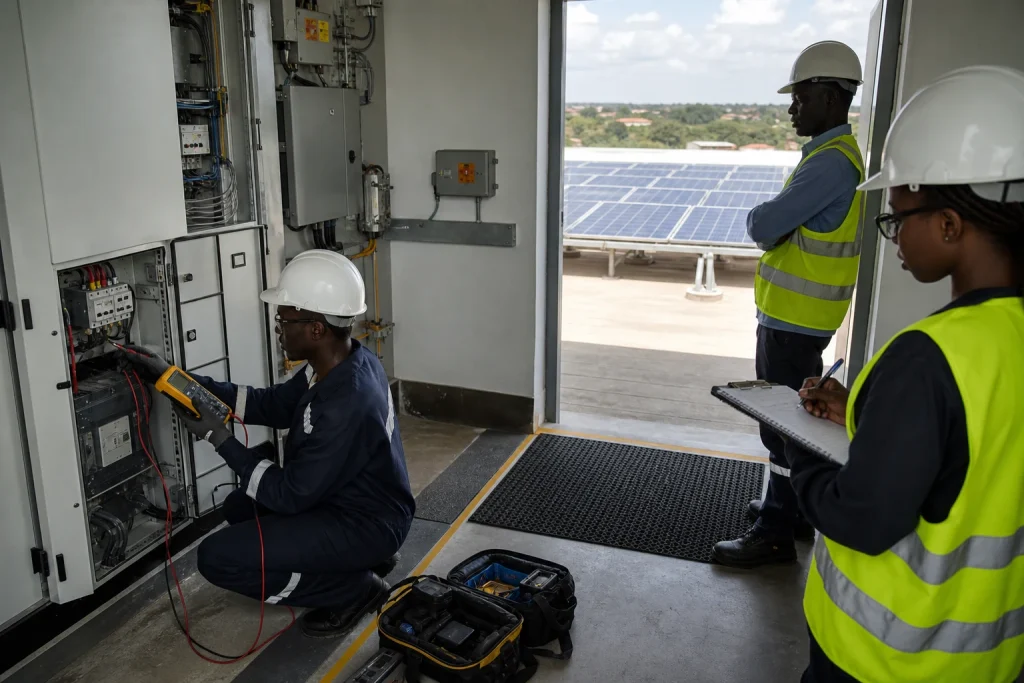
Solar PV testing and commissioning Kenya project owners procure is the controlled process that demonstrates whether an installed system is ready to be accepted against its approved design and agreed scope. It is not a ceremonial switch-on, an inverter screenshot or a sunny-day output figure. Buyers need documented prerequisites, competent testing, traceable results, functional checks, a managed defect list and a complete handover package before operational responsibility changes.
The broader solar installation services Kenya guide places commissioning within the full project lifecycle; the acceptance steps here deal specifically with test evidence, defects and operational handover.
Define solar PV testing and commissioning Kenya acceptance early
Commissioning requirements should be written before installation, not invented when the contractor asks for final payment. The employer’s requirements or scope schedule should state which documents, inspections, measurements, simulations and functional demonstrations are required; who performs them; who may witness them; and what constitutes a pass, conditional acceptance or failure. Each requirement should connect to the approved design, equipment documentation or applicable rule rather than to an informal preference.
Create an acceptance matrix that lists the asset or function, reference document, method, expected evidence, responsible tester, witness and status. It should include structural and mounting interfaces, DC circuits, inverter and AC equipment, protection, earthing, monitoring, communications, labels, shutdown or isolation functions, and any battery, generator or export interface included in the project. Work that is outside the contract should be identified so it does not disappear between suppliers.
Payment milestones should be tied to objective evidence. Mechanical completion, energisation permission, successful tests, defect closure, training and final document delivery are different events. Separating them reduces pressure to treat an energised but undocumented system as fully handed over.
Confirm commissioning prerequisites before energisation
A pre-commissioning review should confirm that the issued design and approved revisions are available at site. Required documents may include layouts, single-line diagrams, equipment schedules, cable schedules, protection settings, structural details, method statements, equipment instructions and an agreed test plan. Serial numbers and ratings should be compared with the approved schedule so substitutions or unrecorded changes are resolved before results are interpreted.
Physical work should reach a defined completion state. Modules, mounting, fasteners, cable support, enclosures, isolators, inverters, distribution equipment, earthing, labels, barriers and weather seals should be visually inspected. Roof, drainage, fire-route, access and housekeeping interfaces also need attention. Electrical tests cannot compensate for loose mounting, damaged containment, blocked drainage or an inaccessible isolation point.
Safety prerequisites include authorised access, appropriate isolation, test equipment suited to the task, current calibration or verification records where required, weather limits, site communication and controls for energisation. The project team should conduct a readiness meeting when several contractors or live electrical systems are involved. No person should be asked to witness from an unsafe position or approve work they are not competent or authorised to assess.
Inspect and test the DC installation
The DC-side plan should follow the approved design and relevant equipment instructions. Depending on the installation and responsible method, records may address conductor identification and polarity, continuity where applicable, circuit voltage, current, insulation condition, string arrangement, connector compatibility, cable support, isolation, protection, labels and earthing or bonding interfaces. This list is not a test procedure; the licensed and competent project parties must select and perform the appropriate tests for the actual system.
Results need traceability. A value should identify the array, string or circuit, test date, instrument, tester, environmental or operating context where relevant, expected criterion and outcome. A table with unlabeled readings cannot show that every installed circuit was assessed. If a result is outside the acceptance criterion, record the investigation, correction and retest rather than overwriting the first value.
Test the AC connection, protection and earthing
The AC commissioning plan should cover the installed connection from inverter outputs to the agreed point of connection. Depending on scope, evidence may address conductor identification, continuity, insulation, earthing, protective devices, isolation, phase arrangement, voltage, frequency, equipment settings and distribution-board modifications. Results should be checked against the approved design and the responsibilities of the licensed electrical parties.
Protection and control settings require disciplined change control. Record the approved value, installed value, person authorising it, date and evidence. Do not copy settings from another site simply because the equipment appears similar. Supply characteristics, connection agreements, system capacity and the wider electrical arrangement can differ.
If the solar installation interfaces with a standby generator, automatic transfer arrangement, battery system or other controls, the commissioning sequence should test defined operating modes and transitions without improvising on a live facility. Review the existing generator and backup-power arrangement and agree who controls each system during tests. A PV system should not be assumed compatible with an existing generator or changeover scheme until the design has addressed the interface.
Demonstrate operation, monitoring and safe controls
Functional commissioning shows how the complete system behaves under the conditions that can safely be demonstrated. Confirm start-up, normal operation, authorised isolation, alarm indication, loss of communications, monitoring data and recovery steps as applicable. The witness should understand which behaviours are physically tested, which are simulated and which are confirmed by document review. Dangerous or disruptive scenarios should not be created merely to tick a generic checklist.
Monitoring handover should establish account ownership, administrator rights, user access, asset names, time settings, communication paths and data availability. Compare visible platform values with local readings where appropriate, and record any known delay or estimation. The owner should not receive a system whose only administrator account remains with an individual installer or whose communications depend on an unexplained personal subscription.
Control defects and preserve an audit trail
Not every finding has the same consequence. Classify defects according to the project’s acceptance rules, with safety-critical or compliance-related items clearly preventing energisation or handover where appropriate. Each entry should show location, description, evidence, required action, owner, target, retest need and closure approval. Photographs should supplement, not replace, a precise written description.
Changes made during commissioning must be reflected in controlled documents. If a cable route, device, label, setting or equipment location changes, update the applicable drawing or schedule and obtain the required review. A project cannot rely on “as built on site” as a substitute for an as-built record that the facilities team can use later.
Assemble a useful handover package
The owner should receive an indexed package containing approved as-built drawings, single-line diagrams, equipment and serial-number schedules, relevant calculations, test forms, instrument information, settings, commissioning records, defect closure, equipment manuals, warranties, monitoring access, operating instructions and maintenance requirements. Include approval or connection records applicable to the particular project. File formats, naming and storage location should be agreed so records remain accessible after the project team leaves.
Training should be role-based. Operators need to recognise normal status, alarms and the correct escalation route. Facilities staff need boundaries for visual checks, cleaning coordination and isolation by authorised personnel. Management may need reporting and warranty information. Training does not turn an unlicensed person into a solar worker or electrician, and it should never encourage staff to open live equipment outside their authority.
Confirm licensed roles and any grid-export conditions
EPRA provides business and licensing processes and renewable-energy information and registers. The project quotation and commissioning plan should identify the applicable licensed solar PV contractor, licensed solar worker and electrical arrangements for the specific scope. Current credentials and permitted roles should be checked through official sources before regulated testing, energisation or sign-off occurs.
Where export or net-metering is part of the approved project, commission only against the actual connection requirements and agreements. Kenya’s Energy (Net-Metering) Regulations, 2024 are an official reference, but they do not make every installation automatically eligible. This article does not promise grid approval, export permission, a credit or a particular metering outcome.
Coverage across Kenya’s 47 counties
Baringo, Bomet, Bungoma, Busia, Elgeyo-Marakwet, Embu, Garissa, Homa Bay, Isiolo, Kajiado, Kakamega, Kericho, Kiambu, Kilifi, Kirinyaga, Kisii, Kisumu, Kitui, Kwale, Laikipia, Lamu, Machakos, Makueni, Mandera, Marsabit, Meru, Migori, Mombasa, Murang’a, Nairobi City, Nakuru, Nandi, Narok, Nyamira, Nyandarua, Nyeri, Samburu, Siaya, Taita-Taveta, Tana River, Tharaka-Nithi, Trans Nzoia, Turkana, Uasin Gishu, Vihiga, Wajir and West Pokot.
ZES considers enquiries across Kenya subject to scope, logistics, site access, responsible licensed arrangements, equipment availability and scheduling. This coverage statement does not mean ZES has an office, commissioning team, stock, completed solar project or immediate availability in every county.
Frequently asked questions
Is switching on an inverter the same as commissioning?
No. Energisation is one controlled stage. Commissioning also checks prerequisites, installed condition, test results, settings, functions, monitoring, defects, records and operator handover against an agreed plan.
Who should witness solar PV tests?
The acceptance plan should identify qualified testers, authorised witnesses and the owner’s representative. Some buyers also appoint an independent technical representative. Witnessing does not transfer the tester’s responsibility, and attendees must remain within their competence and site-safety controls.
Can commissioning prove annual solar savings?
No single commissioning day can prove annual results. It can establish documented operating condition and a baseline. Annual energy and financial outcomes depend on weather, load, tariffs, outages, maintenance, degradation, controls and the agreed analysis method.
What happens when a test fails?
Record the result, make the system safe, investigate the cause, approve and implement the correction, then repeat the relevant test under controlled conditions. Preserve both the original and retest evidence instead of deleting the failed record.
Should monitoring passwords be part of handover?
The owner should receive appropriate administrator ownership and documented user access through a secure transfer process. Credentials should not be placed in a general handover report or shared with unnecessary recipients. Agree account governance, recovery and access removal for departing personnel.
Prepare the acceptance plan before installation finishes
Collect the approved design, contract requirements, asset schedule and existing electrical information, then define the acceptance matrix with the responsible project parties. Review the industrial electrical services context and book a site survey, request a commissioning quotation or contact ZES. Require a written method, evidence schedule, exclusions and project-specific licensed arrangements rather than accepting a generic certificate.