
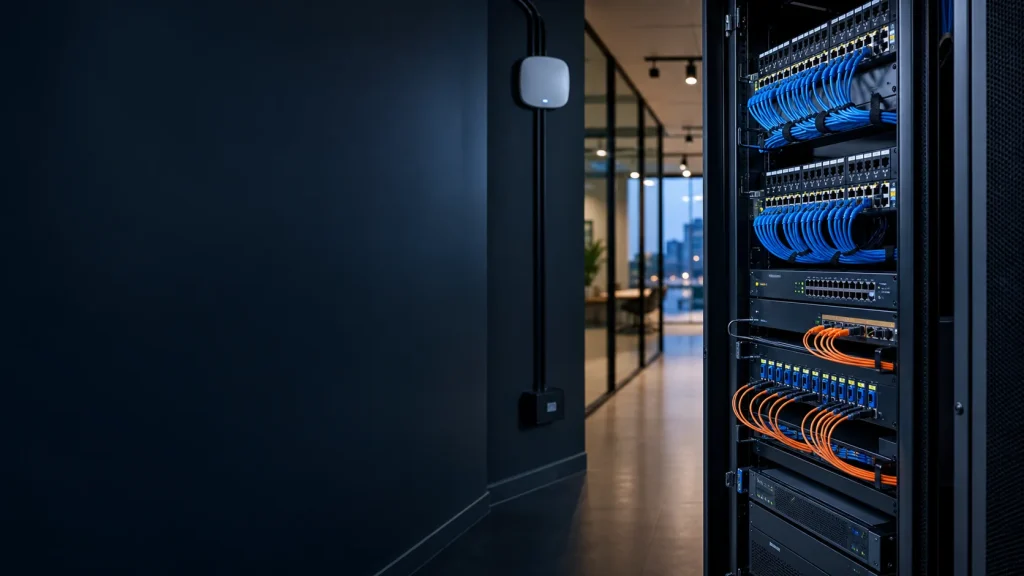
Zama Engineering Systems is a network installation company in Kenya for organisations that need dependable, documented business connectivity. ZES assesses the site, translates operational requirements into a practical LAN, WAN and wireless scope, coordinates structured cabling and active equipment, tests the agreed functions and hands the network to authorised customer staff. The objective is not to sell the largest device list; it is to build infrastructure that supports users, applications, security systems and future growth.
This service is suited to offices, schools, hotels, hospitals, warehouses, factories, retail sites, residential developments and multi-branch organisations. Each environment has different coverage, uptime, access, safety and support needs. A responsible proposal therefore begins with discovery and a site survey rather than a generic price per point or access point.
Business network installation scope
A complete business network can include copper and fibre pathways, cabinets, patching, switching, routing, wireless access, internet handoff, branch links, UPS dependencies, monitoring and documented configuration. ZES can deliver these elements as one coordinated scope or work on a clearly defined part of an existing environment.
- New office and building network installation
- LAN design, switching and authorised segmentation
- WAN and branch-connectivity coordination
- Structured copper and fibre backbones
- Enterprise Wi-Fi surveys and deployment
- Network racks, patch panels and cable management
- Connectivity for CCTV, access control, voice and business systems
- Testing, asset records, diagrams, training and support
Products are selected after capacity, compatibility, availability, lifecycle and budget have been discussed. Any recurring licence, cloud, connectivity or support cost should be shown separately in the quotation.
Start with users, applications and operating risk
The discovery meeting should identify the number and type of users, locations, working hours, devices, critical applications, expected growth and current faults. A warehouse scanner, hotel guest, teacher, office workstation, IP camera and industrial controller do not create identical traffic or mobility requirements.
The customer should also identify what happens when the network fails. If a core switch outage stops dispatch, payment, access control or CCTV recording, the design and support plan should treat that dependency visibly. Resilience, spares and response arrangements are commercial decisions as well as technical ones.
Site survey and existing-infrastructure assessment
ZES inspects communications rooms, pathways, cabinets, available power, internet handoffs, existing cabling, wireless conditions and access constraints within the agreed scope. Drawings, device lists, provider details and previous fault reports improve the assessment, but site conditions still need verification.
Existing equipment can sometimes be retained. Condition, capacity, software support, configuration access and compatibility must be checked first. The proposal distinguishes reusable assets, customer-owned dependencies, items requiring further investigation and equipment recommended for replacement.
LAN and WAN installation explained
A local area network connects devices within a site through switching, cabling and Wi-Fi. A wide area network connects sites or external services through provider circuits, internet, private links or secure overlays. Increasing internet bandwidth does not fix poor internal cabling or congested Wi-Fi; replacing a switch does not repair an unstable provider circuit. Fault demarcation matters.
For a LAN and WAN installation in Kenya, ZES documents the customer-side topology and coordinates provider handoffs, addressing and authorised routing requirements with the nominated IT team. Security policy, firewall rules, identities and application access remain controlled by authorised customer representatives unless a separate managed scope is agreed.
Structured cabling and fibre backbone
Reliable connectivity begins with organised physical infrastructure. Outlet quantities, cable category, fibre type, routes, distances, containment, racks and power-over-Ethernet demand should match the applications and environment. ZES provides a dedicated structured cabling service for new buildings, renovations and upgrades.
Building-to-building, campus and high-capacity links may require fibre. Cable construction, fibre count, terminations, optical budget, active interfaces and acceptance tests must be specified. See the fibre optic installation, splicing and testing guide for the evidence buyers should request.
Switching, routing and active equipment
Switch capacity is more than port count. Uplink speed, power-over-Ethernet budget, stacking or resilience, management, environmental conditions and future devices all affect selection. Routers and firewalls must match provider services, traffic, required interfaces and the organisation’s security ownership.
ZES states the proposed models or performance class, licences, assumptions and customer-supplied dependencies in the technical schedule. Administrator credentials and configuration backups should be handed to authorised customer staff through an agreed method, not left in shared installer accounts.
Office network installation
An office network installation in Kenya may support workstations, phones, meeting rooms, printers, cloud services, CCTV, access control and guest Wi-Fi. The design should anticipate staff growth, workstation moves and hybrid work without creating uncontrolled small switches and trailing patch leads.
Floor plans help place outlets, access points and communications rooms. The project should coordinate with furniture, ceilings, electrical work and occupancy dates. A clean handover includes outlet schedules, patching records, device ownership and user-support contacts.
School and campus network installation
A school network installation in Kenya must consider classrooms, administration, laboratories, libraries, boarding facilities, CCTV, access control and managed guest or student access. Coverage and filtering policy are only part of the requirement; cabinet security, safe pathways, device density, power, timetable and authorised administration also matter.
ZES confirms which areas and user groups are in scope. Safeguarding, content policy and identity management remain the institution’s responsibility unless separately contracted to an appropriate provider.
Warehouse, hotel and industrial connectivity
Warehouses introduce metal racks, moving devices, high ceilings and changing stock. Hotels add guest density, room layouts, roaming, privacy and round-the-clock expectations. Industrial sites introduce dust, heat, vibration, electrical noise and operational change controls. These environments should not be designed as ordinary open-plan offices.
Where wireless performance is central, use the dedicated enterprise Wi-Fi installation service. Warehouse buyers can also review the warehouse Wi-Fi site survey guide.
CCTV, access control and connected building systems
IP cameras, door controllers, biometric terminals, intercoms and monitoring devices depend on suitable cabling, switching, addressing, power and access controls. The network design should reserve capacity and clarify system ownership without putting every device onto one unmanaged segment.
ZES can coordinate network dependencies with CCTV installation services and other engineering scopes. The customer or authorised security lead should approve remote access, retention and user permissions.
Delivery process
- Discovery: confirm sites, users, applications, risks, growth and current assets.
- Survey: inspect routes, rooms, power, wireless conditions, providers and access.
- Design: prepare topology, capacity, equipment, cabling, addressing assumptions and acceptance tests.
- Quotation: state materials, labour, configuration, documentation, recurring costs, exclusions and programme.
- Installation: work through approved access, safety and change-control arrangements.
- Commissioning: test agreed links, devices, coverage and failover functions where included.
- Handover: supply records, credentials to authorised staff, training, defects and support contacts.
Acceptance and handover documents
- Asset and equipment schedule
- Cabinet, outlet, patch-panel and fibre records
- Physical and logical topology at the agreed detail
- Copper, fibre and wireless results included in the contract
- Approved configuration and backup ownership
- Provider circuit and demarcation details
- Known limitations, outstanding work and warranty terms
- Support, escalation and preventive-maintenance responsibilities
Maintenance and lifecycle support
Network value declines when no one maintains labels, backups, software, spares and records. ZES can propose a network maintenance and support contract after the asset baseline is agreed. Response priorities, service windows, remote access, travel, parts and third-party dependencies are documented rather than implied.
Kenya and East Africa project requests
Customers searching for a network installation company in East Africa should examine mobilisation, material availability, local permits, support coverage, cross-border logistics and the person accountable after handover. ZES can assess Kenya and regional requests individually. Countries, response times and partner responsibilities are confirmed only in the project proposal; the website does not create a blanket service guarantee.
Frequently asked questions
How much does a business network installation cost?
Cost depends on sites, users, outlet and access-point quantities, routes, fibre, cabinets, active equipment, provider dependencies, access, testing and support. A survey is needed for a defensible quotation.
Can ZES improve an existing network?
Yes. The starting point is an authorised network audit or targeted assessment to separate cabling, Wi-Fi, active-equipment and provider issues.
Does ZES supply internet bandwidth?
ZES can coordinate the customer-side network and provider handoff. Any internet service, public addressing, service-level agreement and provider charge should be contracted with the selected licensed provider.
Will all existing equipment be compatible?
Not necessarily. Models, interfaces, software support, licences, capacity and configuration access must be checked before reuse is promised.
Plan a dependable business network
Send ZES the site location, floor plans, user and device estimates, critical applications, existing equipment and target programme for an assessment-led proposal.
Ready to plan your system?
Get a clear scope and quotation for your site.
Tell our engineers what you need. We will review your requirements, recommend the right solution and respond with the next practical step.
Discuss this solution with ZES
Request a site assessment and a quotation designed for your property.
Request a Quote