
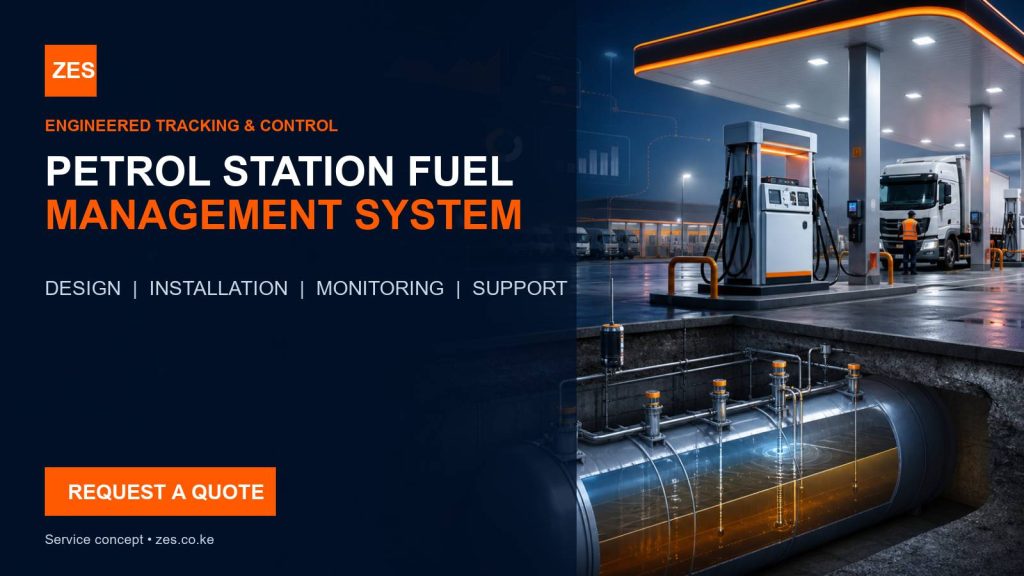
Petrol Station Fuel Management System helps petrol stations, fleet depots and private fuel installations gain practical visibility and control through tank-level monitoring, delivery reconciliation, dispensing visibility, loss detection and operational reporting. Zama Engineering Systems (ZES) provides consultation, system design, installation, configuration, training and support for solutions selected around the customer’s actual operating requirements.

Understanding the service: Petrol Station Fuel Management System Kenya
A dependable Petrol Station Fuel Management System Kenya is not simply a map on a screen. It is an operational control that helps petrol stations, fleet depots and private fuel installations turn daily activity into information that can be checked, discussed and acted upon. Planning also considers coverage, device placement, power conditions, data availability, user roles, installation access, privacy, maintenance and future expansion. This reduces avoidable surprises during commissioning and handover. Where regulations, insurer conditions or industry rules apply, the customer should confirm the current requirements with the relevant authority. ZES will then design the technical scope around the verified obligation.
For organisations evaluating Petrol Station Fuel Management System, the strongest result comes from matching technology to real workflows rather than buying equipment first and deciding how to use it later. Useful information must be understandable. Dashboards, reports and alerts should answer specific questions, such as where an asset is, whether a route was followed, which event needs investigation and what evidence is available. A phased rollout can be useful for larger fleets. A pilot establishes installation standards and reporting routines before the remaining assets are scheduled, helping teams learn from real operating conditions.
ZES approaches Understanding the service as an engineering and implementation question. The objective is to establish useful visibility without adding unnecessary complexity to the people responsible for vehicles, cargo, fuel or field operations. ZES can coordinate consultation, site or fleet assessment, solution design, equipment selection, installation, configuration, testing, user orientation and continuing technical support. Final equipment and integrations depend on the approved project scope. The result should be a controlled system that supports accountability while remaining realistic for daily users. Performance is reviewed against agreed objectives rather than against impressive but irrelevant feature lists.
Operational problems the system can address: Petrol Station Fuel Management System Kenya
Every deployment has different vehicles, routes, risk levels, reporting expectations and support requirements. A practical design therefore begins with the operating environment and the decisions managers need to make. The solution scope may include tank-level monitoring, delivery reconciliation, dispensing visibility, loss detection and operational reporting. These functions should be configured around clear responsibilities, sensible alert thresholds and an agreed response process so that the platform supports work instead of creating noise. Before procurement, ZES documents assumptions and identifies any third-party requirements. This creates a clearer basis for quotations, responsibilities, acceptance testing and future service support.
A dependable Petrol Station Fuel Management System Kenya is not simply a map on a screen. It is an operational control that helps petrol stations, fleet depots and private fuel installations turn daily activity into information that can be checked, discussed and acted upon. Planning also considers coverage, device placement, power conditions, data availability, user roles, installation access, privacy, maintenance and future expansion. This reduces avoidable surprises during commissioning and handover. Where regulations, insurer conditions or industry rules apply, the customer should confirm the current requirements with the relevant authority. ZES will then design the technical scope around the verified obligation.
For organisations evaluating Petrol Station Fuel Management System, the strongest result comes from matching technology to real workflows rather than buying equipment first and deciding how to use it later. Useful information must be understandable. Dashboards, reports and alerts should answer specific questions, such as where an asset is, whether a route was followed, which event needs investigation and what evidence is available. A phased rollout can be useful for larger fleets. A pilot establishes installation standards and reporting routines before the remaining assets are scheduled, helping teams learn from real operating conditions.
How the technology works: Petrol Station Fuel Management System Kenya
ZES approaches How the technology works as an engineering and implementation question. The objective is to establish useful visibility without adding unnecessary complexity to the people responsible for vehicles, cargo, fuel or field operations. ZES can coordinate consultation, site or fleet assessment, solution design, equipment selection, installation, configuration, testing, user orientation and continuing technical support. Final equipment and integrations depend on the approved project scope. The result should be a controlled system that supports accountability while remaining realistic for daily users. Performance is reviewed against agreed objectives rather than against impressive but irrelevant feature lists.
Every deployment has different vehicles, routes, risk levels, reporting expectations and support requirements. A practical design therefore begins with the operating environment and the decisions managers need to make. The solution scope may include tank-level monitoring, delivery reconciliation, dispensing visibility, loss detection and operational reporting. These functions should be configured around clear responsibilities, sensible alert thresholds and an agreed response process so that the platform supports work instead of creating noise. Before procurement, ZES documents assumptions and identifies any third-party requirements. This creates a clearer basis for quotations, responsibilities, acceptance testing and future service support.
A dependable Petrol Station Fuel Management System Kenya is not simply a map on a screen. It is an operational control that helps petrol stations, fleet depots and private fuel installations turn daily activity into information that can be checked, discussed and acted upon. Planning also considers coverage, device placement, power conditions, data availability, user roles, installation access, privacy, maintenance and future expansion. This reduces avoidable surprises during commissioning and handover. Where regulations, insurer conditions or industry rules apply, the customer should confirm the current requirements with the relevant authority. ZES will then design the technical scope around the verified obligation.
Core capabilities and configuration: Petrol Station Fuel Management System Kenya
For organisations evaluating Petrol Station Fuel Management System, the strongest result comes from matching technology to real workflows rather than buying equipment first and deciding how to use it later. Useful information must be understandable. Dashboards, reports and alerts should answer specific questions, such as where an asset is, whether a route was followed, which event needs investigation and what evidence is available. A phased rollout can be useful for larger fleets. A pilot establishes installation standards and reporting routines before the remaining assets are scheduled, helping teams learn from real operating conditions.
ZES approaches Core capabilities and configuration as an engineering and implementation question. The objective is to establish useful visibility without adding unnecessary complexity to the people responsible for vehicles, cargo, fuel or field operations. ZES can coordinate consultation, site or fleet assessment, solution design, equipment selection, installation, configuration, testing, user orientation and continuing technical support. Final equipment and integrations depend on the approved project scope. The result should be a controlled system that supports accountability while remaining realistic for daily users. Performance is reviewed against agreed objectives rather than against impressive but irrelevant feature lists.
Every deployment has different vehicles, routes, risk levels, reporting expectations and support requirements. A practical design therefore begins with the operating environment and the decisions managers need to make. The solution scope may include tank-level monitoring, delivery reconciliation, dispensing visibility, loss detection and operational reporting. These functions should be configured around clear responsibilities, sensible alert thresholds and an agreed response process so that the platform supports work instead of creating noise. Before procurement, ZES documents assumptions and identifies any third-party requirements. This creates a clearer basis for quotations, responsibilities, acceptance testing and future service support.
- tank-level monitoring
- delivery reconciliation
- dispensing visibility
- loss detection and operational reporting
Planning and needs assessment: Petrol Station Fuel Management System Kenya
A dependable Petrol Station Fuel Management System Kenya is not simply a map on a screen. It is an operational control that helps petrol stations, fleet depots and private fuel installations turn daily activity into information that can be checked, discussed and acted upon. Planning also considers coverage, device placement, power conditions, data availability, user roles, installation access, privacy, maintenance and future expansion. This reduces avoidable surprises during commissioning and handover. Where regulations, insurer conditions or industry rules apply, the customer should confirm the current requirements with the relevant authority. ZES will then design the technical scope around the verified obligation.
For organisations evaluating Petrol Station Fuel Management System, the strongest result comes from matching technology to real workflows rather than buying equipment first and deciding how to use it later. Useful information must be understandable. Dashboards, reports and alerts should answer specific questions, such as where an asset is, whether a route was followed, which event needs investigation and what evidence is available. A phased rollout can be useful for larger fleets. A pilot establishes installation standards and reporting routines before the remaining assets are scheduled, helping teams learn from real operating conditions.
ZES approaches Planning and needs assessment as an engineering and implementation question. The objective is to establish useful visibility without adding unnecessary complexity to the people responsible for vehicles, cargo, fuel or field operations. ZES can coordinate consultation, site or fleet assessment, solution design, equipment selection, installation, configuration, testing, user orientation and continuing technical support. Final equipment and integrations depend on the approved project scope. The result should be a controlled system that supports accountability while remaining realistic for daily users. Performance is reviewed against agreed objectives rather than against impressive but irrelevant feature lists.
Equipment and installation considerations: Petrol Station Fuel Management System Kenya
Every deployment has different vehicles, routes, risk levels, reporting expectations and support requirements. A practical design therefore begins with the operating environment and the decisions managers need to make. The solution scope may include tank-level monitoring, delivery reconciliation, dispensing visibility, loss detection and operational reporting. These functions should be configured around clear responsibilities, sensible alert thresholds and an agreed response process so that the platform supports work instead of creating noise. Before procurement, ZES documents assumptions and identifies any third-party requirements. This creates a clearer basis for quotations, responsibilities, acceptance testing and future service support.
A dependable Petrol Station Fuel Management System Kenya is not simply a map on a screen. It is an operational control that helps petrol stations, fleet depots and private fuel installations turn daily activity into information that can be checked, discussed and acted upon. Planning also considers coverage, device placement, power conditions, data availability, user roles, installation access, privacy, maintenance and future expansion. This reduces avoidable surprises during commissioning and handover. Where regulations, insurer conditions or industry rules apply, the customer should confirm the current requirements with the relevant authority. ZES will then design the technical scope around the verified obligation.
For organisations evaluating Petrol Station Fuel Management System, the strongest result comes from matching technology to real workflows rather than buying equipment first and deciding how to use it later. Useful information must be understandable. Dashboards, reports and alerts should answer specific questions, such as where an asset is, whether a route was followed, which event needs investigation and what evidence is available. A phased rollout can be useful for larger fleets. A pilot establishes installation standards and reporting routines before the remaining assets are scheduled, helping teams learn from real operating conditions.
Dashboards, alerts and reporting: Petrol Station Fuel Management System Kenya
ZES approaches Dashboards, alerts and reporting as an engineering and implementation question. The objective is to establish useful visibility without adding unnecessary complexity to the people responsible for vehicles, cargo, fuel or field operations. ZES can coordinate consultation, site or fleet assessment, solution design, equipment selection, installation, configuration, testing, user orientation and continuing technical support. Final equipment and integrations depend on the approved project scope. The result should be a controlled system that supports accountability while remaining realistic for daily users. Performance is reviewed against agreed objectives rather than against impressive but irrelevant feature lists.
Every deployment has different vehicles, routes, risk levels, reporting expectations and support requirements. A practical design therefore begins with the operating environment and the decisions managers need to make. The solution scope may include tank-level monitoring, delivery reconciliation, dispensing visibility, loss detection and operational reporting. These functions should be configured around clear responsibilities, sensible alert thresholds and an agreed response process so that the platform supports work instead of creating noise. Before procurement, ZES documents assumptions and identifies any third-party requirements. This creates a clearer basis for quotations, responsibilities, acceptance testing and future service support.
A dependable Petrol Station Fuel Management System Kenya is not simply a map on a screen. It is an operational control that helps petrol stations, fleet depots and private fuel installations turn daily activity into information that can be checked, discussed and acted upon. Planning also considers coverage, device placement, power conditions, data availability, user roles, installation access, privacy, maintenance and future expansion. This reduces avoidable surprises during commissioning and handover. Where regulations, insurer conditions or industry rules apply, the customer should confirm the current requirements with the relevant authority. ZES will then design the technical scope around the verified obligation.
Driver, rider and operator workflows: Petrol Station Fuel Management System Kenya
For organisations evaluating Petrol Station Fuel Management System, the strongest result comes from matching technology to real workflows rather than buying equipment first and deciding how to use it later. Useful information must be understandable. Dashboards, reports and alerts should answer specific questions, such as where an asset is, whether a route was followed, which event needs investigation and what evidence is available. A phased rollout can be useful for larger fleets. A pilot establishes installation standards and reporting routines before the remaining assets are scheduled, helping teams learn from real operating conditions.
ZES approaches Driver, rider and operator workflows as an engineering and implementation question. The objective is to establish useful visibility without adding unnecessary complexity to the people responsible for vehicles, cargo, fuel or field operations. ZES can coordinate consultation, site or fleet assessment, solution design, equipment selection, installation, configuration, testing, user orientation and continuing technical support. Final equipment and integrations depend on the approved project scope. The result should be a controlled system that supports accountability while remaining realistic for daily users. Performance is reviewed against agreed objectives rather than against impressive but irrelevant feature lists.
Every deployment has different vehicles, routes, risk levels, reporting expectations and support requirements. A practical design therefore begins with the operating environment and the decisions managers need to make. The solution scope may include tank-level monitoring, delivery reconciliation, dispensing visibility, loss detection and operational reporting. These functions should be configured around clear responsibilities, sensible alert thresholds and an agreed response process so that the platform supports work instead of creating noise. Before procurement, ZES documents assumptions and identifies any third-party requirements. This creates a clearer basis for quotations, responsibilities, acceptance testing and future service support.
Security, privacy and access control: Petrol Station Fuel Management System Kenya
A dependable Petrol Station Fuel Management System Kenya is not simply a map on a screen. It is an operational control that helps petrol stations, fleet depots and private fuel installations turn daily activity into information that can be checked, discussed and acted upon. Planning also considers coverage, device placement, power conditions, data availability, user roles, installation access, privacy, maintenance and future expansion. This reduces avoidable surprises during commissioning and handover. Where regulations, insurer conditions or industry rules apply, the customer should confirm the current requirements with the relevant authority. ZES will then design the technical scope around the verified obligation.
For organisations evaluating Petrol Station Fuel Management System, the strongest result comes from matching technology to real workflows rather than buying equipment first and deciding how to use it later. Useful information must be understandable. Dashboards, reports and alerts should answer specific questions, such as where an asset is, whether a route was followed, which event needs investigation and what evidence is available. A phased rollout can be useful for larger fleets. A pilot establishes installation standards and reporting routines before the remaining assets are scheduled, helping teams learn from real operating conditions.
ZES approaches Security, privacy and access control as an engineering and implementation question. The objective is to establish useful visibility without adding unnecessary complexity to the people responsible for vehicles, cargo, fuel or field operations. ZES can coordinate consultation, site or fleet assessment, solution design, equipment selection, installation, configuration, testing, user orientation and continuing technical support. Final equipment and integrations depend on the approved project scope. The result should be a controlled system that supports accountability while remaining realistic for daily users. Performance is reviewed against agreed objectives rather than against impressive but irrelevant feature lists.
Integration with existing operations: Petrol Station Fuel Management System Kenya
Every deployment has different vehicles, routes, risk levels, reporting expectations and support requirements. A practical design therefore begins with the operating environment and the decisions managers need to make. The solution scope may include tank-level monitoring, delivery reconciliation, dispensing visibility, loss detection and operational reporting. These functions should be configured around clear responsibilities, sensible alert thresholds and an agreed response process so that the platform supports work instead of creating noise. Before procurement, ZES documents assumptions and identifies any third-party requirements. This creates a clearer basis for quotations, responsibilities, acceptance testing and future service support.
A dependable Petrol Station Fuel Management System Kenya is not simply a map on a screen. It is an operational control that helps petrol stations, fleet depots and private fuel installations turn daily activity into information that can be checked, discussed and acted upon. Planning also considers coverage, device placement, power conditions, data availability, user roles, installation access, privacy, maintenance and future expansion. This reduces avoidable surprises during commissioning and handover. Where regulations, insurer conditions or industry rules apply, the customer should confirm the current requirements with the relevant authority. ZES will then design the technical scope around the verified obligation.
For organisations evaluating Petrol Station Fuel Management System, the strongest result comes from matching technology to real workflows rather than buying equipment first and deciding how to use it later. Useful information must be understandable. Dashboards, reports and alerts should answer specific questions, such as where an asset is, whether a route was followed, which event needs investigation and what evidence is available. A phased rollout can be useful for larger fleets. A pilot establishes installation standards and reporting routines before the remaining assets are scheduled, helping teams learn from real operating conditions.
Implementation and commissioning process: Petrol Station Fuel Management System Kenya
ZES approaches Implementation and commissioning process as an engineering and implementation question. The objective is to establish useful visibility without adding unnecessary complexity to the people responsible for vehicles, cargo, fuel or field operations. ZES can coordinate consultation, site or fleet assessment, solution design, equipment selection, installation, configuration, testing, user orientation and continuing technical support. Final equipment and integrations depend on the approved project scope. The result should be a controlled system that supports accountability while remaining realistic for daily users. Performance is reviewed against agreed objectives rather than against impressive but irrelevant feature lists.
Every deployment has different vehicles, routes, risk levels, reporting expectations and support requirements. A practical design therefore begins with the operating environment and the decisions managers need to make. The solution scope may include tank-level monitoring, delivery reconciliation, dispensing visibility, loss detection and operational reporting. These functions should be configured around clear responsibilities, sensible alert thresholds and an agreed response process so that the platform supports work instead of creating noise. Before procurement, ZES documents assumptions and identifies any third-party requirements. This creates a clearer basis for quotations, responsibilities, acceptance testing and future service support.
A dependable Petrol Station Fuel Management System Kenya is not simply a map on a screen. It is an operational control that helps petrol stations, fleet depots and private fuel installations turn daily activity into information that can be checked, discussed and acted upon. Planning also considers coverage, device placement, power conditions, data availability, user roles, installation access, privacy, maintenance and future expansion. This reduces avoidable surprises during commissioning and handover. Where regulations, insurer conditions or industry rules apply, the customer should confirm the current requirements with the relevant authority. ZES will then design the technical scope around the verified obligation.
- Consultation and requirements definition
- Asset, vehicle or site assessment
- Solution design and quotation
- Installation and configuration
- Testing and acceptance
- User training and support handover
Testing and acceptance: Petrol Station Fuel Management System Kenya
For organisations evaluating Petrol Station Fuel Management System, the strongest result comes from matching technology to real workflows rather than buying equipment first and deciding how to use it later. Useful information must be understandable. Dashboards, reports and alerts should answer specific questions, such as where an asset is, whether a route was followed, which event needs investigation and what evidence is available. A phased rollout can be useful for larger fleets. A pilot establishes installation standards and reporting routines before the remaining assets are scheduled, helping teams learn from real operating conditions.
ZES approaches Testing and acceptance as an engineering and implementation question. The objective is to establish useful visibility without adding unnecessary complexity to the people responsible for vehicles, cargo, fuel or field operations. ZES can coordinate consultation, site or fleet assessment, solution design, equipment selection, installation, configuration, testing, user orientation and continuing technical support. Final equipment and integrations depend on the approved project scope. The result should be a controlled system that supports accountability while remaining realistic for daily users. Performance is reviewed against agreed objectives rather than against impressive but irrelevant feature lists.
Every deployment has different vehicles, routes, risk levels, reporting expectations and support requirements. A practical design therefore begins with the operating environment and the decisions managers need to make. The solution scope may include tank-level monitoring, delivery reconciliation, dispensing visibility, loss detection and operational reporting. These functions should be configured around clear responsibilities, sensible alert thresholds and an agreed response process so that the platform supports work instead of creating noise. Before procurement, ZES documents assumptions and identifies any third-party requirements. This creates a clearer basis for quotations, responsibilities, acceptance testing and future service support.
Training and change management: Petrol Station Fuel Management System Kenya
A dependable Petrol Station Fuel Management System Kenya is not simply a map on a screen. It is an operational control that helps petrol stations, fleet depots and private fuel installations turn daily activity into information that can be checked, discussed and acted upon. Planning also considers coverage, device placement, power conditions, data availability, user roles, installation access, privacy, maintenance and future expansion. This reduces avoidable surprises during commissioning and handover. Where regulations, insurer conditions or industry rules apply, the customer should confirm the current requirements with the relevant authority. ZES will then design the technical scope around the verified obligation.
For organisations evaluating Petrol Station Fuel Management System, the strongest result comes from matching technology to real workflows rather than buying equipment first and deciding how to use it later. Useful information must be understandable. Dashboards, reports and alerts should answer specific questions, such as where an asset is, whether a route was followed, which event needs investigation and what evidence is available. A phased rollout can be useful for larger fleets. A pilot establishes installation standards and reporting routines before the remaining assets are scheduled, helping teams learn from real operating conditions.
ZES approaches Training and change management as an engineering and implementation question. The objective is to establish useful visibility without adding unnecessary complexity to the people responsible for vehicles, cargo, fuel or field operations. ZES can coordinate consultation, site or fleet assessment, solution design, equipment selection, installation, configuration, testing, user orientation and continuing technical support. Final equipment and integrations depend on the approved project scope. The result should be a controlled system that supports accountability while remaining realistic for daily users. Performance is reviewed against agreed objectives rather than against impressive but irrelevant feature lists.
Maintenance and technical support: Petrol Station Fuel Management System Kenya
Every deployment has different vehicles, routes, risk levels, reporting expectations and support requirements. A practical design therefore begins with the operating environment and the decisions managers need to make. The solution scope may include tank-level monitoring, delivery reconciliation, dispensing visibility, loss detection and operational reporting. These functions should be configured around clear responsibilities, sensible alert thresholds and an agreed response process so that the platform supports work instead of creating noise. Before procurement, ZES documents assumptions and identifies any third-party requirements. This creates a clearer basis for quotations, responsibilities, acceptance testing and future service support.
A dependable Petrol Station Fuel Management System Kenya is not simply a map on a screen. It is an operational control that helps petrol stations, fleet depots and private fuel installations turn daily activity into information that can be checked, discussed and acted upon. Planning also considers coverage, device placement, power conditions, data availability, user roles, installation access, privacy, maintenance and future expansion. This reduces avoidable surprises during commissioning and handover. Where regulations, insurer conditions or industry rules apply, the customer should confirm the current requirements with the relevant authority. ZES will then design the technical scope around the verified obligation.
For organisations evaluating Petrol Station Fuel Management System, the strongest result comes from matching technology to real workflows rather than buying equipment first and deciding how to use it later. Useful information must be understandable. Dashboards, reports and alerts should answer specific questions, such as where an asset is, whether a route was followed, which event needs investigation and what evidence is available. A phased rollout can be useful for larger fleets. A pilot establishes installation standards and reporting routines before the remaining assets are scheduled, helping teams learn from real operating conditions.
Procurement and quotation planning: Petrol Station Fuel Management System Kenya
ZES approaches Procurement and quotation planning as an engineering and implementation question. The objective is to establish useful visibility without adding unnecessary complexity to the people responsible for vehicles, cargo, fuel or field operations. ZES can coordinate consultation, site or fleet assessment, solution design, equipment selection, installation, configuration, testing, user orientation and continuing technical support. Final equipment and integrations depend on the approved project scope. The result should be a controlled system that supports accountability while remaining realistic for daily users. Performance is reviewed against agreed objectives rather than against impressive but irrelevant feature lists.
Every deployment has different vehicles, routes, risk levels, reporting expectations and support requirements. A practical design therefore begins with the operating environment and the decisions managers need to make. The solution scope may include tank-level monitoring, delivery reconciliation, dispensing visibility, loss detection and operational reporting. These functions should be configured around clear responsibilities, sensible alert thresholds and an agreed response process so that the platform supports work instead of creating noise. Before procurement, ZES documents assumptions and identifies any third-party requirements. This creates a clearer basis for quotations, responsibilities, acceptance testing and future service support.
A dependable Petrol Station Fuel Management System Kenya is not simply a map on a screen. It is an operational control that helps petrol stations, fleet depots and private fuel installations turn daily activity into information that can be checked, discussed and acted upon. Planning also considers coverage, device placement, power conditions, data availability, user roles, installation access, privacy, maintenance and future expansion. This reduces avoidable surprises during commissioning and handover. Where regulations, insurer conditions or industry rules apply, the customer should confirm the current requirements with the relevant authority. ZES will then design the technical scope around the verified obligation.
Scalability for growing operations: Petrol Station Fuel Management System Kenya
For organisations evaluating Petrol Station Fuel Management System, the strongest result comes from matching technology to real workflows rather than buying equipment first and deciding how to use it later. Useful information must be understandable. Dashboards, reports and alerts should answer specific questions, such as where an asset is, whether a route was followed, which event needs investigation and what evidence is available. A phased rollout can be useful for larger fleets. A pilot establishes installation standards and reporting routines before the remaining assets are scheduled, helping teams learn from real operating conditions.
ZES approaches Scalability for growing operations as an engineering and implementation question. The objective is to establish useful visibility without adding unnecessary complexity to the people responsible for vehicles, cargo, fuel or field operations. ZES can coordinate consultation, site or fleet assessment, solution design, equipment selection, installation, configuration, testing, user orientation and continuing technical support. Final equipment and integrations depend on the approved project scope. The result should be a controlled system that supports accountability while remaining realistic for daily users. Performance is reviewed against agreed objectives rather than against impressive but irrelevant feature lists.
Every deployment has different vehicles, routes, risk levels, reporting expectations and support requirements. A practical design therefore begins with the operating environment and the decisions managers need to make. The solution scope may include tank-level monitoring, delivery reconciliation, dispensing visibility, loss detection and operational reporting. These functions should be configured around clear responsibilities, sensible alert thresholds and an agreed response process so that the platform supports work instead of creating noise. Before procurement, ZES documents assumptions and identifies any third-party requirements. This creates a clearer basis for quotations, responsibilities, acceptance testing and future service support.
Common mistakes to avoid: Petrol Station Fuel Management System Kenya
A dependable Petrol Station Fuel Management System Kenya is not simply a map on a screen. It is an operational control that helps petrol stations, fleet depots and private fuel installations turn daily activity into information that can be checked, discussed and acted upon. Planning also considers coverage, device placement, power conditions, data availability, user roles, installation access, privacy, maintenance and future expansion. This reduces avoidable surprises during commissioning and handover. Where regulations, insurer conditions or industry rules apply, the customer should confirm the current requirements with the relevant authority. ZES will then design the technical scope around the verified obligation.
For organisations evaluating Petrol Station Fuel Management System, the strongest result comes from matching technology to real workflows rather than buying equipment first and deciding how to use it later. Useful information must be understandable. Dashboards, reports and alerts should answer specific questions, such as where an asset is, whether a route was followed, which event needs investigation and what evidence is available. A phased rollout can be useful for larger fleets. A pilot establishes installation standards and reporting routines before the remaining assets are scheduled, helping teams learn from real operating conditions.
ZES approaches Common mistakes to avoid as an engineering and implementation question. The objective is to establish useful visibility without adding unnecessary complexity to the people responsible for vehicles, cargo, fuel or field operations. ZES can coordinate consultation, site or fleet assessment, solution design, equipment selection, installation, configuration, testing, user orientation and continuing technical support. Final equipment and integrations depend on the approved project scope. The result should be a controlled system that supports accountability while remaining realistic for daily users. Performance is reviewed against agreed objectives rather than against impressive but irrelevant feature lists.
Why work with ZES in Kenya: Petrol Station Fuel Management System Kenya
Every deployment has different vehicles, routes, risk levels, reporting expectations and support requirements. A practical design therefore begins with the operating environment and the decisions managers need to make. The solution scope may include tank-level monitoring, delivery reconciliation, dispensing visibility, loss detection and operational reporting. These functions should be configured around clear responsibilities, sensible alert thresholds and an agreed response process so that the platform supports work instead of creating noise. Before procurement, ZES documents assumptions and identifies any third-party requirements. This creates a clearer basis for quotations, responsibilities, acceptance testing and future service support.
A dependable Petrol Station Fuel Management System Kenya is not simply a map on a screen. It is an operational control that helps petrol stations, fleet depots and private fuel installations turn daily activity into information that can be checked, discussed and acted upon. Planning also considers coverage, device placement, power conditions, data availability, user roles, installation access, privacy, maintenance and future expansion. This reduces avoidable surprises during commissioning and handover. Where regulations, insurer conditions or industry rules apply, the customer should confirm the current requirements with the relevant authority. ZES will then design the technical scope around the verified obligation.
For organisations evaluating Petrol Station Fuel Management System, the strongest result comes from matching technology to real workflows rather than buying equipment first and deciding how to use it later. Useful information must be understandable. Dashboards, reports and alerts should answer specific questions, such as where an asset is, whether a route was followed, which event needs investigation and what evidence is available. A phased rollout can be useful for larger fleets. A pilot establishes installation standards and reporting routines before the remaining assets are scheduled, helping teams learn from real operating conditions.
Frequently asked questions about Petrol Station Fuel Management System Kenya
How much does the system cost?
Pricing depends on the number and type of assets, required functions, installation conditions, connectivity, platform period, integrations and support scope. ZES prepares a quotation after confirming these requirements.
Can the solution be installed on an existing fleet?
In many cases, yes. Compatibility and installation access are assessed for each vehicle or asset category before a final rollout schedule is approved.
Can managers receive alerts and reports?
Available alerts and reports depend on the selected equipment and platform. ZES configures agreed functions, user permissions and escalation routines during commissioning.
Does ZES provide installation and support?
ZES can provide assessment, installation, configuration, testing, training and technical support within the agreed scope and service terms.
Can the system grow with the organisation?
The architecture can be planned for additional assets, users, locations and integrations. Expansion requirements should be discussed early to avoid avoidable redesign.
How do we begin?
Request a consultation or site survey and share the asset types, quantities, locations, operating challenges and reporting outcomes you want to achieve.
Plan your Petrol Station Fuel Management System Kenya project
Talk to ZES about your vehicles, cargo, fuel operation or monitoring requirements. We will help define a practical scope and quotation.
A petrol station fuel management system should help managers explain stock movement, not only display a tank level. The control model needs opening stock, deliveries, dispenser sales, transfers, authorized adjustments and closing stock, with a clear source for each value. User roles and exception thresholds should match the station’s operating procedures and approval limits.
Define data ownership before procurement
List every data source: tank gauge, delivery record, forecourt controller, POS, accounting platform and manual input. The supplier should show how records are matched, how late or corrected transactions are handled and which system remains authoritative. Use the existing fuel management buyer guide to prepare requirements and the inventory monitoring guide to define routine reconciliation.
A proposal should specify supported interfaces, branch and tank limits, licences, hosting, connectivity, security roles, backups, audit trails, report exports, implementation services, training, support and recurring costs. The buyer should request sample exception workflows rather than accept a demonstration populated with perfect data.
Accept the system with a controlled stock period
Commissioning should confirm tank, grade, pump and user mappings before a supervised operating period. Test deliveries, normal sales, shift closure, authorized adjustments, missing readings, communications loss and variance escalation. Finance and operations should agree that totals trace back to source records and that no user can change critical data without an audit entry.
Required handover items include the data-flow diagram, integration register, approved master data, user and approval matrix, configuration backup, report definitions, test evidence, training, warranty and support contacts. Contact ZES for a fuel-control discovery session using sample shift, delivery and variance records from the real operation.
Variance-ownership checkpoint
Management should approve who reviews daily variance, what tolerance prompts investigation, which source records are checked and who may close an exception. The workflow should preserve comments and evidence rather than replace an original value. Different products, tanks or operating conditions may require different review thresholds, subject to technical and accounting advice. During acceptance, introduce a known missing or delayed record and confirm that it remains visible until resolved. The practical value of the platform lies in directing attention to explainable exceptions, not presenting every difference as theft or silently hiding inconvenient data.
Ready to plan your system?
Get a clear scope and quotation for your site.
Tell our engineers what you need. We will review your requirements, recommend the right solution and respond with the next practical step.
Discuss this solution with ZES
Request a site assessment and a quotation designed for your property.
Request a Quote