
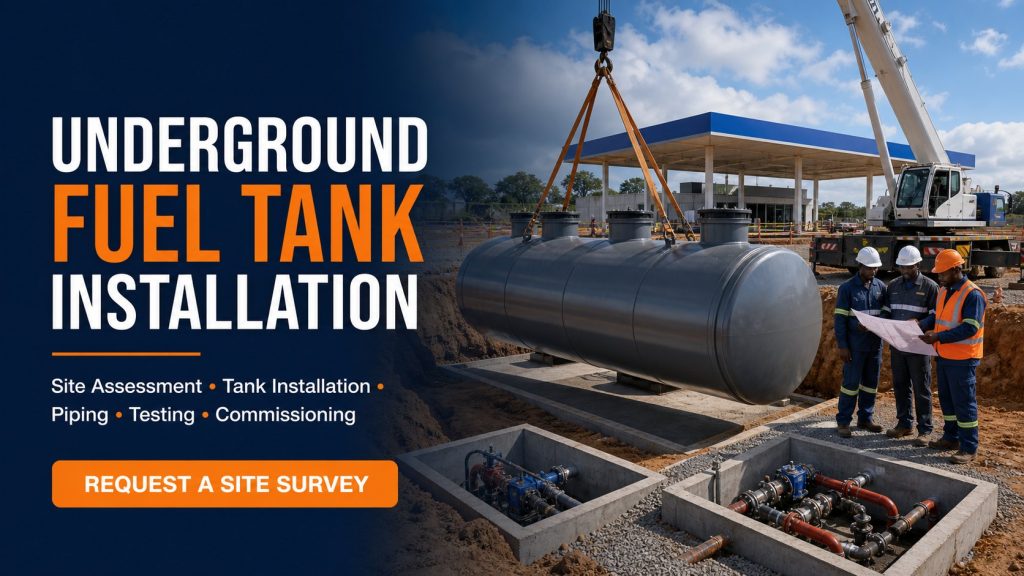
Underground fuel tank installation is a high-risk engineering project that must coordinate storage capacity, tank construction, excavation, foundations, anchoring, fuel piping, venting, spill containment, leak monitoring, electrical systems, testing and regulatory approvals. Zama Engineering Systems (ZES) helps petrol-station developers, fleet operators, factories, hospitals, hotels, farms, construction companies and other commercial facilities plan a complete installation instead of purchasing disconnected components.
A successful project begins before excavation. The tank system must fit the fuel type, expected consumption, tanker-delivery pattern, site traffic, groundwater conditions, future expansion and the approvals applicable to the facility. This guide explains the decisions serious buyers should make before requesting a quotation and shows how ZES approaches underground petroleum storage as an integrated engineering scope.
Underground fuel tank installation services
ZES can assess and coordinate an underground tank project from the initial site review through testing and handover. The final scope is tailored to the project and may include tank-capacity planning, layout review, excavation coordination, prepared foundations or bedding, tank placement, anti-buoyancy measures, fill and vent connections, product pipework, containment chambers, leak-detection interfaces, automatic tank gauging, electrical and earthing work, dispenser connections, integrity testing, documentation and operator training.
Not every customer needs the same configuration. A retail petrol station has different dispensing, traffic and stock-reconciliation requirements from a generator-fuel installation at a hospital or data centre. A fleet yard may require driver or vehicle identification, controlled dispensing and consumption reporting. The site survey is therefore used to define the operating outcome before equipment is selected.
Who needs an underground fuel storage system?
Underground tanks can preserve usable surface space while supporting secure bulk storage. Typical projects include new and upgraded petrol stations, transport and logistics yards, bus and truck depots, factories, mines, farms, airports, construction camps, hospitals, hotels, schools, universities, shopping centres, government facilities and sites with standby generators. Suitability still depends on ground conditions, environmental risk, access for fuel deliveries, required capacity and the applicable approval path.
Owners should compare underground and above-ground storage during feasibility rather than assuming one arrangement is automatically better. Underground storage can improve space utilisation and protect the tank from vehicle impact, but excavation, groundwater, corrosion protection, leak detection and future access require careful design. Above-ground storage can simplify inspection, but it needs suitable space, separation, containment and impact protection. ZES can help document these trade-offs for the intended operation.
What a complete site assessment should examine
The site assessment determines whether the proposed position and construction approach are workable. It should review boundaries, buildings, roads, drainage, utilities, delivery-tanker turning, dispenser positions, future construction and sensitive receptors. Existing drawings are useful, but critical underground services and dimensions should be confirmed on site.
- Fuel demand: products, daily consumption, delivery frequency, reserve stock and expected growth.
- Ground conditions: soil, rock, groundwater, flooding, drainage and excavation stability.
- Traffic loading: whether the tank area will carry cars, trucks or delivery tankers.
- Access: crane position, excavation equipment, tanker offloading and maintenance access.
- Existing services: electrical cables, water, sewer, drainage and communications routes.
- System interfaces: dispensers, generators, pumps, fuel-management software and remote monitoring.
A written site-survey report makes quotations easier to compare. It also reduces the risk of discovering major civil, electrical or access requirements only after procurement.
Choosing the tank capacity and configuration
Tank capacity should be calculated from consumption, delivery lead time, safe operating stock, delivery-compartment sizes, working volume and growth—not simply from the largest tank that fits the plot. A system that is too small increases delivery frequency and stock-out risk. An oversized system ties up capital, may keep fuel for longer than planned and can increase construction cost.
Projects may use a single tank, multiple tanks or compartmentalised storage depending on the number of products and the required operational resilience. The design team should confirm the tank material, wall arrangement, access fittings, lifting provisions, compatibility with the intended fuel and the monitoring method. Final specifications must follow the approved design, manufacturer requirements and applicable standards; a web article cannot replace project-specific engineering.
Excavation, bedding and tank placement
Excavation is more than digging a hole. The contractor must consider safe slopes or temporary support, water control, working clearance, spoil management, neighbouring structures and access for lifting equipment. The prepared base or bedding must provide uniform support and match the selected tank system. Poor preparation can create concentrated loads, movement or difficult pipe alignment after installation.
The lifting plan should use the tank manufacturer’s approved lifting points and suitable certified equipment. The tank is inspected before placement and positioned to match the approved orientation, access chambers and pipe routes. No person should work beneath a suspended load. Once placed, levels and positions are checked before piping and backfilling proceed.
Anchoring and groundwater protection
An empty or partly filled underground tank can be exposed to buoyancy where groundwater rises. Anti-flotation measures must be based on the site conditions and selected tank, not improvised during excavation. Depending on the design, the system may use an engineered base, hold-down arrangement or other manufacturer-approved anchoring method.
Groundwater also affects excavation safety, bedding, backfill and long-term chamber performance. Dewatering during construction does not prove that the permanent site will remain dry. Drainage and monitoring provisions should therefore be considered during design. Where water is found in containment or monitoring spaces, operators need a documented inspection and response procedure.
Fuel fill, vent and product piping installation
The underground tank is only one part of the fuel system. Fill points, vents, product lines, return lines where applicable, isolation valves, pumps, dispensers and monitoring equipment must work together. Pipe material, jointing method, containment, routing, slope, protection and access should be defined before work starts.
Fill arrangements should support controlled tanker delivery and spill management. Vents must terminate in the approved position and be protected from obstruction or accidental damage. Product lines should be routed to minimise unnecessary joints and remain accessible at designated chambers. Any penetration through a chamber or sump must preserve containment. Testing requirements should be agreed before backfilling hides the installation.
Spill containment, overfill protection and leak detection
A professional underground fuel tank installation should manage credible release points rather than relying on the tank shell alone. The design may include delivery-point spill containment, containment sumps, monitored interstitial spaces, pipework containment, overfill controls and sensors in selected chambers. The correct combination depends on the system design and risk assessment.
Leak detection is only useful when alarms reach a responsible person and trigger a defined response. The handover should state what each alarm means, who receives it, which actions are safe and when the installation must be taken out of service. Sensors, probes and consoles also require inspection and functional testing as part of preventive maintenance.
Automatic tank gauging and fuel inventory control
An automatic tank gauging system can provide product level, calculated volume, water indication, delivery information and alarm status when compatible equipment is correctly installed and configured. Tank dimensions or calibration data, probe position and product settings affect the usefulness of the results. Gauging should be commissioned against the approved tank information.
For commercial fleets and generator sites, the tank data can be connected with controlled dispensing and transaction records. This allows managers to compare delivered fuel, opening stock, issues and closing stock. It does not eliminate the need for disciplined receiving, reconciliation and investigation of exceptions. ZES can assess links between automatic tank gauging, fuel inventory monitoring and a fleet fuel management system.
Electrical, earthing and emergency-control requirements
Pumps, dispensers, gauges, monitoring consoles, lighting and communications require coordinated electrical infrastructure. Distribution, isolation, cable routing, equipment interfaces, earthing, bonding, surge protection and emergency shutdown should be included in the design rather than added after mechanical installation.
Equipment selection and installation must suit the relevant location and risk classification. Electrical work should be performed by appropriately qualified personnel under the approved project design. Testing records, circuit identification and operating instructions form part of a usable handover package.
Integrity testing before backfilling and commissioning
Testing should occur at defined hold points while critical components remain visible. The method depends on the tank, piping and manufacturer requirements. The team should record the equipment tested, test medium or procedure, acceptance criteria, results, date and responsible parties. A failed test must be investigated and corrected before the installation is concealed.
Commissioning should verify more than fuel flow. It may cover pumps, dispensers, emergency isolation, tank gauges, alarms, sensors, communications, user permissions, transaction capture and reconciliation. The owner should receive relevant drawings, equipment information, warranties, test records, settings, maintenance requirements and training.
Kenya approvals and compliance planning
Regulatory responsibilities depend on whether the project is a retail dispensing site, commercial storage installation, own-use facility or modification. The Energy and Petroleum Regulatory Authority petroleum application guides should be checked for the current permit and licensing route. Kenya’s Petroleum (Retail Dispensing Site Construction and Licensing) Regulations, 2025 state that retail dispensing-site construction or modification requires a valid construction permit from EPRA.
Environmental approval must be considered early. NEMA identifies management of hydrocarbons, including storage of combustible or explosive fuels, among activities subject to environmental assessment requirements. The official NEMA environmental impact assessment guidance explains that an EIA, where required, is part of project development and should precede commencement.
Applicable county approvals, construction requirements, workplace safety obligations, fire-safety provisions, professional designs and Kenya Standards may also apply. ZES does not promise automatic approval; the proposal should identify which party prepares, submits and obtains each document and which third-party professionals or inspectors are required.
How much does underground fuel tank installation cost?
A reliable price cannot be calculated from tank capacity alone. Cost depends on tank construction, number of products, excavation depth, rock or groundwater, engineered foundations, anchoring, backfill, chambers, piping distance, dispensers, pumps, electrical work, gauging, leak detection, automation, permits, professional services, testing, transport and reinstatement.
For a useful quotation, provide the site location, intended use, fuel types, estimated consumption, proposed capacity, available drawings, project stage and target completion date. A site survey can then identify missing information and produce a scope that competing quotations can be evaluated against.
Questions to ask an underground fuel tank contractor
- Will you conduct and document a site assessment before final pricing?
- Who is responsible for design, approvals, excavation, tank supply, lifting, piping and electrical work?
- How will groundwater and tank buoyancy be assessed?
- Which leak-detection and overfill measures are included?
- What testing will be witnessed before backfilling?
- Are tank gauging, monitoring and fuel-management integrations included?
- What drawings, certificates, test records and training will be handed over?
- What are the exclusions, provisional items, warranties and maintenance requirements?
Why choose ZES for underground fuel tank installation?
ZES brings together petroleum equipment, civil coordination, mechanical piping, electrical infrastructure, automatic tank gauging, leak monitoring, networking, CCTV and fuel-management systems. This integrated approach helps owners avoid gaps between contractors and ensures that access, power, communications, controls and maintenance are considered while the system is still being designed.
Every project begins with assessment. Final equipment brands, capacity, installation method, programme and regulatory responsibilities are confirmed in the quotation. Where specialist professional or statutory inputs are required, these are identified rather than hidden behind a generic turnkey promise.
Frequently asked questions
Can ZES install tanks for both petrol stations and private commercial facilities?
Yes. ZES can assess retail fuel sites and own-use commercial installations for fleets, factories, farms, generators and other facilities. The design and approval route will depend on the project type and storage capacity.
Can an existing underground fuel tank be connected to new monitoring?
Possibly. Compatibility, condition, access fittings, tank information and the existing pipework must be assessed. A survey is required before recommending automatic gauging or leak-detection equipment.
How long does installation take?
The programme depends on approvals, procurement, excavation conditions, tank configuration, associated civil work and testing. ZES provides a project-specific schedule after the scope and responsibilities are confirmed.
Does ZES provide fuel dispensers and automation?
ZES can include compatible dispensers, pumps, tank gauging, controlled fuel issue, networking and management reporting within an agreed integrated scope.
Can ZES work across Kenya?
ZES can assess projects across Kenya. Site location, travel, logistics and local project conditions are confirmed during quotation.
Underground fuel tank installation Kenya starts with ground conditions, tank compatibility and a maintainable connection layout. Capacity alone is not a specification. The design must consider excavation support, groundwater, anchoring where required, cradle and backfill materials, corrosion protection, access chambers, fill points, vents, suction or pressure lines and space for inspection. The competent designers should confirm the site-specific requirements before any tank is ordered.
Procure the tank and buried system together
Ask the supplier for manufacturer drawings, material and coating data, compartment details, connection schedule, handling instructions, serial identification, warranty conditions and compatible accessories. The tank, pipework, chambers, sensors and dispenser arrangement should be reviewed as one system. Use the fuel piping contractor guide to define routes, joints and integrity testing, and examine the leak-detection options against the actual containment design.
The construction method should define lifting points, temporary storage, excavation safety, base preparation, level and orientation checks, anchoring details, backfill sequence and protection from other trades. Substitutions to backfill, pipe or chamber components require engineering approval; they should not be accepted because the specified material was unavailable on delivery day.
Use hold points before work is buried
Acceptance evidence should be collected while the work remains visible. Hold points can cover excavation and base inspection, tank condition on delivery, placement and level, anchors, pipe connections, vents, access chambers, sensor installation, integrity tests and backfill. Photographs should be dated and tied to the drawing or asset identifier. Test procedures and acceptance criteria must be agreed before testing begins.
The final pack should include the installed tank data, serial numbers, approved drawings, tests, inspection records, photographs, tank chart or configuration information where applicable, warranties and safe operating guidance. Contact ZES for a site assessment; the proposal will state the confirmed engineering and specialist responsibilities.
Backfill-release checkpoint
The backfill release should be a signed inspection event involving the parties responsible for tank placement, piping, civil works and quality records. Inspectors should verify that all required tests are complete, open defects are resolved and photographs show every connection and protection detail. The survey or measurement needed for the as-built record should be captured before access is lost. The team should also check that later compaction and forecourt work will not damage vents, chambers, pipework or monitoring cables. Once buried, correction becomes disruptive and expensive, so schedule pressure is not a sound reason to skip this hold point.
Request an underground fuel tank installation site survey
Send ZES your site location, intended fuel, estimated storage capacity, project stage, available drawings and required completion date. Our team will review the requirement and prepare the next practical step.
Request a Site Survey View Petrol Station Engineering Services