
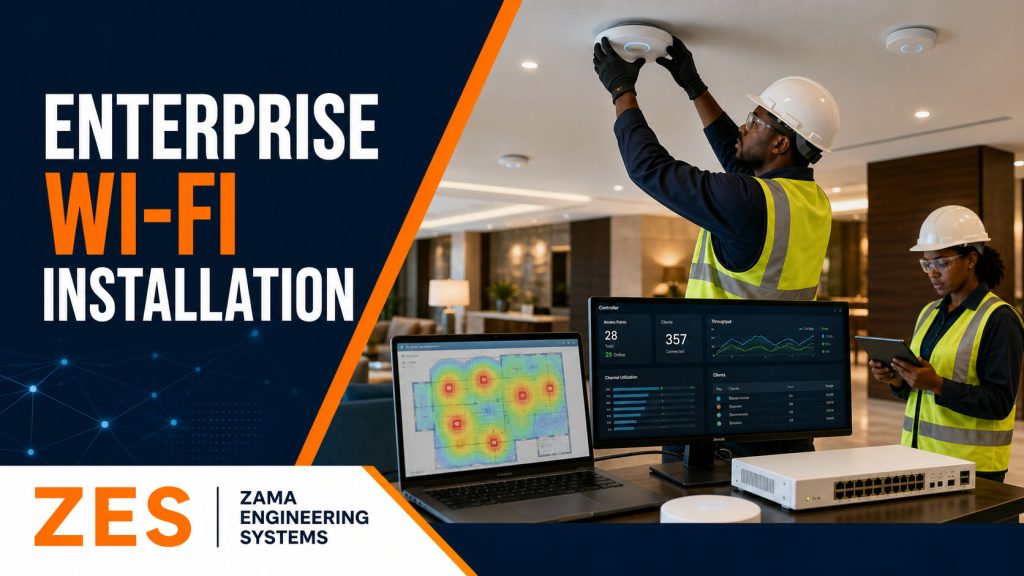
An enterprise Wi-Fi procurement checklist prevents buyers from comparing access-point counts while ignoring users, devices, capacity, roaming, licences and wired-network dependencies. The right proposal explains what experience must work, where, for which devices and how it will be tested. This guide helps organisations evaluate a new installation or an upgrade.
ZES provides the commercial service through its enterprise networking and Wi-Fi team. Use the checks below to create a better brief before requesting a survey and final quotation.
1. Define successful service by area
List offices, rooms, classrooms, guest areas, warehouse aisles, yards and other zones. For each, record device types, expected concurrent users, applications and mobility. A reception desk, conference hall, guest room and scanner aisle need different capacity and roaming consideration.
Avoid “full coverage” without criteria. The proposal should state important assumptions and the post-installation test approach.
2. Provide the real device mix
Phones, laptops, scanners, printers, cameras, TVs and specialist terminals can support different bands, channels, security and roaming behaviour. A network optimised only for the newest laptop may fail older operational devices.
Ask users and department leads which devices cause problems today. Include models for business-critical handhelds where possible.
3. Ask which survey method is included
Predictive design, passive survey, active survey and post-installation validation answer different questions. New construction may begin with plans and material assumptions; an operating warehouse may need measurements with stock and devices present.
The bidder should state areas surveyed, access limitations, tools, device assumptions and deliverables. One signal reading beside an access point is not an enterprise survey.
4. Check the wired network and power
Access points need cabling, switch ports, uplink capacity and an adequate PoE budget. High-speed wireless connected through a constrained uplink will still perform poorly. The design must also account for cabinets, fibre backbones, UPS dependencies and internet service.
Ask whether the quotation includes structured cabling, switches, racks and testing or assumes they already exist.
5. Review segmentation and identity ownership
Staff, guests and operational devices should not automatically share one password and one network. The customer should define groups, authorised access, guest policy, identity systems and administrative ownership. ZES can implement the approved segmentation and authentication design.
Any captive portal, cloud identity or external integration needs compatibility, subscription, data and support responsibilities stated in writing.
6. Identify licences and recurring costs
Some Wi-Fi platforms use controllers, cloud management, subscriptions, security licences or support entitlements. Ask what happens if a subscription expires, who owns the tenant, how administrators are added and whether management continues during an internet outage.
The customer should receive authorised administrative ownership at handover. A hidden recurring charge can make an apparently low hardware quotation expensive over its lifecycle.
7. Specify performance validation
Agree the areas, device scenarios, coverage, roaming, capacity or application checks included. Performance can be affected by future stock, partitions, neighbouring networks, device updates and internet capacity, so the report should record test conditions and limitations.
Where a warehouse is involved, review the ZES warehouse Wi-Fi site survey requirements. High racks and moving scanners create conditions an office checklist may miss.
8. Define support after handover
Ask who monitors access-point health, reviews alerts, manages updates, handles administrator access and responds to complaints. Clarify remote access, service hours, response priorities, travel, replacement parts and licences.
A written network maintenance contract is preferable to an undefined promise of “support included.”
Sector-specific questions
Hotels
Provide room count and construction, conference capacities, guest and staff areas, peak occupancy, back-office systems, internet service and round-the-clock support expectations. Ask whether room-level validation is sampled or comprehensive.
Schools and campuses
Identify classrooms, laboratories, libraries, administration, boarding and outdoor areas; staff, learner, guest and device groups; timetable peaks; cabinet security and authorised content or identity policy.
Warehouses
Provide rack layout and height, stock type, aisles, loading areas, scanner and printer models, forklift routes, cold rooms, yard coverage and operational complaint locations.
Offices
Provide staff numbers, meeting-room capacities, voice and collaboration use, floor materials, guest access, personal-device policy, wired workstation needs and planned growth.
Quotation comparison table
| Question | Evidence |
|---|---|
| Who and what must connect? | User, device, application and density schedule |
| Where must it work? | Marked floor plans and coverage zones |
| How was the design developed? | Survey method, assumptions and access-point plan |
| What supports the access points? | Cabling, switch, PoE, uplink and rack schedule |
| How is access controlled? | SSID, segmentation, identity and ownership summary |
| What recurs? | Licence, cloud, internet and support charges |
| How is success checked? | Validation method, locations, devices and report |
| What happens after handover? | Credentials, monitoring, support and lifecycle plan |
Warning signs
- Access-point quantity selected from square metres alone
- Coverage promised without device or wall assumptions
- No switch, PoE, cabling or internet capacity review
- All users and devices placed on one shared password
- Cloud licences omitted from lifecycle cost
- No post-installation validation allowance
- Administrator ownership retained by an unnamed installer account
- No support or replacement process
Information to send with an RFQ
- Site address, floors and usable drawings
- Coverage areas and excluded spaces
- Users, concurrent devices and critical applications
- Device models for scanners or other specialist clients
- Existing access points, switches, cabling and internet service
- Staff, guest and operational-network requirements
- Known complaint zones and busy times
- Programme, access, test and support expectations
Frequently asked questions
Can a supplier guarantee a specific speed everywhere?
Performance depends on device capability, radio conditions, user load, wired uplinks, internet or application services and future changes. Agree realistic measured criteria and test conditions instead of an unqualified guarantee.
Should we request Wi-Fi 6, 6E or another generation?
Select equipment after checking device support, spectrum availability, capacity, licences, wired uplinks, lifecycle and budget. A generation label alone does not create a good design.
Is a heat map enough?
A heat map is useful evidence, but its value depends on method, assumptions and the question. Capacity, roaming and application experience may require additional tests.
Can existing access points be reused?
Potentially. Models, support status, licences, configuration access, placement, capacity and compatibility must be assessed first.
Prepare an enterprise Wi-Fi proposal based on evidence
Send ZES the plans, user and device estimates, complaint zones, applications, existing equipment and support requirements for a survey-led design.