
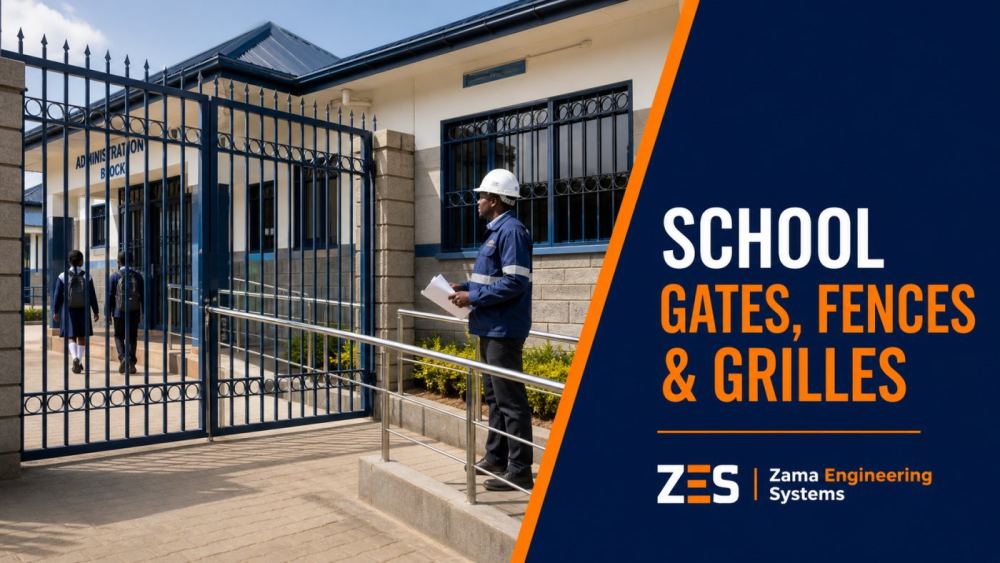
School gate and fence fabrication must balance security with safe arrival, crowd movement, supervision and emergency escape. ZES helps education clients survey the real campus, separate vehicle and pedestrian risks, verify openings and prepare a controlled fabrication scope. Window grilles and handrails are included where appropriate, but every detail must follow the approved safety, accessibility and building requirements for the site.
Survey how people actually move
Observe the busiest arrival and collection periods. Record pedestrians, school vehicles, buses, boda bodas, deliveries and visitors. A wider gate does not automatically solve congestion if children still cross the vehicle path or the leaf blocks the footway. The brief should state clear opening, direction of swing or slide, queuing space, supervision point, lock arrangement and what happens during a power or hardware failure.
Check ground levels, drainage, wall and post condition, underground services and the space needed for hinges, rollers or a sliding-gate tail. Existing foundations should not be assumed adequate for a heavier replacement. Automated gates introduce electrical, sensing and operational requirements beyond metal fabrication.
Perimeter fencing that supports supervision
Fence height, spacing, visibility, climbability, corrosion exposure and maintenance access affect the detail. Avoid sharp projections or footholds where children can reach them. Posts, panels and foundations need a consistent system, particularly where terrain changes. Agree interfaces with walls, drains, landscaping and neighbouring property.
The quotation should identify linear metres, panel type, post spacing, gates, foundations, coating and removal of existing fencing. Provisional lengths should be measured before order. If electric fencing or security electronics are required, coordinate them with the competent specialist rather than hiding them in a generic welding price.
Classroom window grilles and emergency escape
A grille can deter intrusion but can also trap occupants if it blocks a required escape opening. The school’s fire and building-safety plan must govern the arrangement. Confirm which windows are fixed, which provide ventilation or escape, how releases operate if permitted and how emergency services gain access.
Measure every opening; repeated classroom blocks can still vary. Fixings and surrounding masonry matter as much as bar size. External grilles need drainage and maintainable coating. Internal details should avoid snagging, sharp edges and interference with curtains or window operation.
School handrails and circulation metalwork
Handrail height, grasp, continuity, returns, clearances and support spacing should follow the approved accessibility and stair/ramp design. A rail must not create a climbable edge, reduce required width or end with a projection that catches clothing. Survey ramps, stairs, landings and level changes as a complete route.
During installation, protect students from open drill holes, loose components and incomplete rails. Check anchors in the actual substrate and record concealed fixings. Final inspection includes alignment, firmness, safe ends, clear passage and coating touch-up.
School procurement and maintenance
- Approve drawings or a sample detail before batch fabrication.
- Plan delivery and hot work outside student access.
- Test every gate and lock in its installed condition.
- Record master-key or emergency-opening responsibility.
- Inspect hinges, rollers, latches, anchors and coating each term.
- Log impact, sagging or sharp damage for prompt repair.
This specialist page supports the broader school metal fabrication service. Furniture and dormitory requirements belong on the school desks, chairs and bunk-beds guide.
Gate design inputs
Document clear opening, leaf or sliding arrangement, user groups, vehicle size, expected cycles, wind exposure, ground level, drainage and lock or control method. Show pedestrian routes separately. An automated or very large gate requires the appropriate structural, electrical and safety input, including manual release and safe detection where applicable.
Confirm gatepost and foundation information rather than assuming the existing wall can carry new weight and dynamic forces. Allow for paving and future surfacing levels. Stops, guides and catches should not create trip or trapping hazards. Locate controls where staff can observe movement while remaining protected.
Fence and grille materials
Specify panel type, section, spacing, height, post system, gates and finish. Consider visibility for supervision, climbability, local impact, corrosion and repair of individual panels. At changes in level, detail the fence so gaps do not grow or sharp stepped tops appear in reach zones.
For grilles, record bar arrangement, frame, fixings and window operation. Select a coating that can be maintained without sealing windows shut. Where masonry is weak or cracked, repair the substrate through the appropriate building scope before relying on anchors.
Emergency escape and accessibility review
The school’s fire and building-safety team must identify required exits and release arrangements. Security improvements should not reduce escape width or require an unavailable key during an emergency. Doors and windows with escape functions need project-specific solutions and approval.
Handrails and gates should preserve accessible routes. Check clear width, opening force, thresholds, ramp circulation and safe rail ends against approved requirements. A low fence or barrier should not become an unnoticed obstacle for a person with visual impairment.
Installation HSE
Fence work may involve excavation, sharp panels, concrete and long open boundaries. Secure incomplete stretches and maintain campus security after each shift. Scan or verify buried services before excavation. Control delivery of long sections near overhead lines and crowded entrances.
Hot work, drilling and grinding need exclusion, fire controls and eye protection for others. Remove offcuts and wire immediately. For term-time work, provide temporary pedestrian routing and staff supervision. A partially hung gate must be mechanically secure, not held only by an unfinished weld.
Inspection and functional testing
Check post alignment, foundation or anchor completion, panel spacing, sharp edges, coating, gate clearances, stops, latches and full operation. Test manual opening by the people responsible for daily and emergency use. Verify that grilles do not block approved escape or window maintenance.
Photograph foundations or anchors before concealment. Record keys, lock models and adjustment points. Close safety defects before the route reopens; finish snagging can follow only if it does not expose students or compromise security.
Handover and inspection routine
Provide asset locations, approved details, hardware information, keys, coating data, operation instructions, defects closed and warranty. Train staff on manual release and daily visual checks for main gates. Establish who may modify locks or automation later.
Inspect busy gates for hinge or roller wear, sagging, anchor movement and unsafe gaps. Check perimeter panels after storms, impact or attempted intrusion. Check rails for looseness and grille fixings for masonry deterioration. Repair coating before corrosion spreads beneath it.
Buyer checklist
- Observe peak arrival and departure movement.
- Verify openings, levels, walls and underground services.
- Preserve emergency and accessible routes.
- Define hardware, locks and any automation interfaces.
- Approve panel and finish samples.
- Plan daily security during construction.
- Function-test every moving asset.
- Keep keys, drawings and maintenance contacts.
Cost drivers
Prices depend on measured length, panel and section, posts and foundations, gates, ground profile, removal, finish, locks, automation coordination, access and term-calendar constraints. Window openings may vary, so count and measure them rather than multiplying one assumed size.
Ask bidders to separate gate, fence, grille and handrail packages. Identify provisional foundations and repairs to old walls. A complete installed comparison is more useful than a rate per metre that excludes corners, level changes, gates and coating.
Scenario-based acceptance tests
Operate the main gate during a supervised peak simulation: confirm pedestrian separation, staff visibility, clear opening, latches and manual control. Walk the perimeter to check ground gaps, sharp points and unfinished transitions. Open every affected window and approved escape release. Walk ramps and stairs while checking clear width and continuous hand support.
Record defects by location and urgency. A loose handrail or blocked release prevents safe handover; a minor colour blemish may be closed under a timed snag. Give staff the keys and demonstrate operation before the contractor leaves.
Questions for school perimeter contractors
- How were peak movements and vehicle routes considered?
- Who approves foundations, gate automation and emergency release?
- How will the boundary remain secure each night?
- What panel, grille and finish sample will be approved?
- How are varied openings and level changes measured?
- What is inspected before foundations or anchors are concealed?
- Which hardware spares and keys are handed over?
Repair after impact or attempted intrusion
Isolate distorted gates, sharp fencing and loose rails. Inspect posts, foundations, anchors, locks and adjoining panels—not only the visibly bent bar. Restore the security function through a controlled temporary measure if the permanent repair needs fabrication. Record the event so repeated vehicle impact or climbing leads to a site-layout review.
Frequently asked questions
Can a school gate be automated?
Potentially, but automation needs its own risk assessment, power, controls, safety devices, manual release and maintenance scope. It should not be treated as welding hardware alone.
Should every classroom window have a security grille?
That decision must follow the site security, fire and building-safety assessment. A grille must not obstruct required emergency escape or ventilation.
When should installation occur?
Holiday and weekend windows are preferable for disruptive or high-risk work. If term-time work is unavoidable, effective segregation and daily safe handback are essential.