
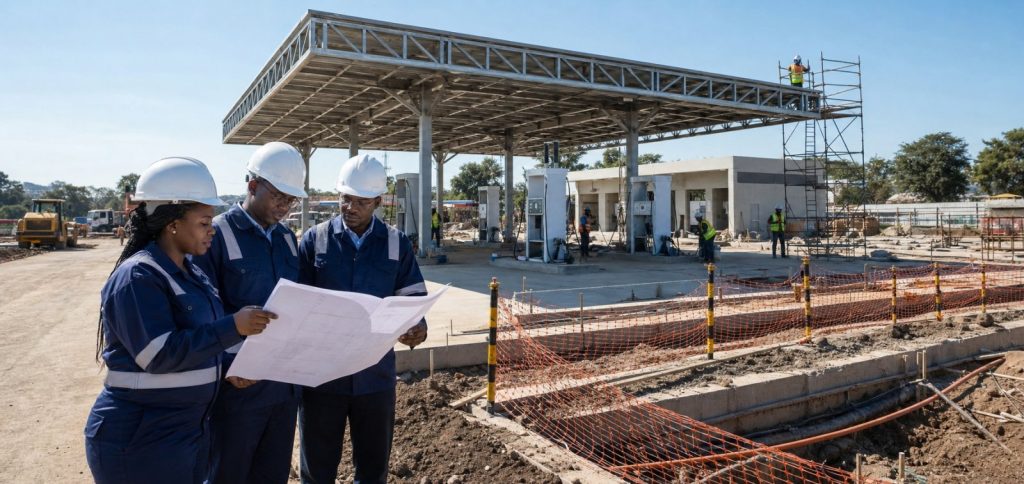
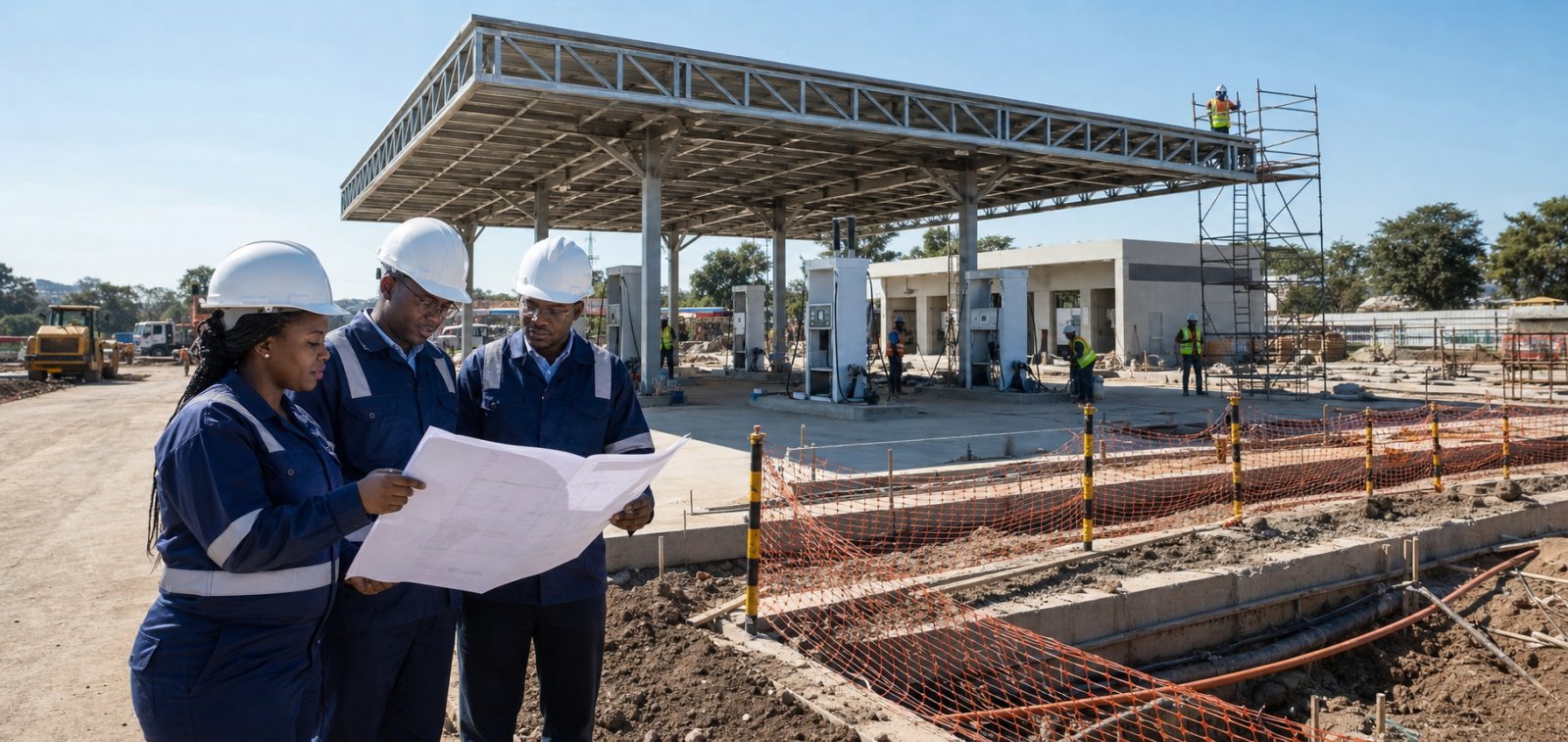
Petrol station construction cost in Kenya cannot be reduced to one responsible flat figure. The final budget changes with the site, tank capacity, number of fuel grades, dispensers, canopy, buildings, drainage, electrical systems, approvals, automation and ground conditions. A serious estimate begins with a site survey, coordinated design and priced bill of quantities rather than a price copied from another project.
This guide shows developers, investors and procurement teams what belongs in a complete petrol station budget, which variables move the price most and how to request quotations that can be compared fairly. It separates construction from land purchase, opening stock and working capital so the project does not begin with a misleading headline number.
Quick answer: the reliable way to establish petrol station construction cost in Kenya is to confirm site viability, define the operating model, prepare the engineering scope and price the same bill of quantities across bidders. Any estimate that omits approvals, professional design, tank and pipework systems, drainage, electrical works, testing or commissioning is not a complete construction budget.
What should a petrol station construction budget include?
The word “cost” is often used for several different numbers. Before comparing estimates, state whether the figure covers only physical construction or the full investment required to open. A useful development budget normally separates the following:
- Land and tenure: purchase, lease, legal due diligence and any land-related finance costs.
- Pre-construction work: surveys, feasibility, professional design, environmental assessment, applications and approvals.
- Construction and equipment: civil works, storage tanks, pipework, dispensers, canopy, buildings, electrical systems and safety infrastructure.
- Testing and opening: commissioning, calibration, documentation, training, snag correction and applicable licensing steps.
- Business funding: initial fuel stock, staffing, insurance, marketing and working capital.
Land, fuel stock and working capital should not be silently added to or excluded from a “construction cost.” Every quotation should state its boundary, taxes, provisional sums and exclusions.
Confirm site viability before fixing the budget
Site selection can change the project economics before any tank or dispenser is ordered. Road access, tanker turning, traffic flow, plot shape, drainage, utilities, neighbouring uses, ground levels, soil and groundwater all affect the design. A cheaper plot can become an expensive build if it needs major access, retaining, drainage or utility work.
Kenya’s current Petroleum (Retail Dispensing Site Construction and Licensing) (No. 2) Regulations, 2025 govern retail dispensing-site construction and modification. The current application framework includes engineering documents, a priced bill of quantities, environmental approval and other project records. Requirements can change, so applicants should check the live EPRA guidance and obtain project-specific professional advice before committing capital.
Environmental review also belongs near the beginning, not after excavation. NEMA’s environmental impact assessment guidance identifies storage of combustible or explosive fuels among activities that may require assessment. County planning, road-authority, construction and other approvals depend on the site and agreed scope.
Petrol station construction cost breakdown
| Budget package | Typical scope | Main cost drivers |
|---|---|---|
| Professional and approval work | Surveys, engineering, drawings, BOQ, environmental and permit documentation | Project complexity, site data, specialists required and approval pathway |
| Civil and forecourt works | Earthworks, foundations, tank excavation, paving, drainage, islands and buildings | Ground conditions, levels, traffic loading, area and architectural scope |
| Fuel storage and transfer | Tanks, fill and vent systems, chambers, pipework, containment and testing | Capacity, products, tank type, distances, groundwater and monitoring |
| Dispensing equipment | Dispensers, pumps, nozzles, hoses, islands and protection | Number of products and hoses, specification, controls and integration |
| Canopy and buildings | Structure, foundations, roofing, fascia, drainage, lighting and site buildings | Footprint, spans, finishes, foundations, services and live-site constraints |
| Electrical and safety systems | Distribution, earthing, emergency controls, lighting, fire and security interfaces | Load, cable routes, equipment interfaces, backup power and project classification |
| Automation and monitoring | Tank gauging, forecourt control, inventory, networking, CCTV and reporting | Number of devices, integrations, communications and required reports |
| Commissioning and handover | Testing, calibration, verification, training, records and snag closure | System count, witness requirements, third parties and documentation standard |
Pre-construction and professional costs
A petrol station needs coordinated civil, mechanical, structural and electrical decisions. Professional costs may include topographical and other surveys, concept and detailed design, environmental work, statutory submissions, a priced BOQ, project supervision and specialist testing. The required disciplines depend on the project.
Cutting design work does not remove the underlying decisions. It shifts them to site, where clashes and changes are more expensive. Tank positions influence pipe routes; pump islands affect canopy columns; drainage affects forecourt levels; and electrical containment must coordinate with civil works. Resolving these interfaces on drawings helps reduce variations and rework.
Civil works, drainage and the forecourt
Civil work can be a major part of the budget because it converts the site into a safe, durable operating environment. The scope can include clearing, excavation, ground improvement, tank support, backfilling, foundations, reinforced slabs, pump islands, access lanes, kerbs, drainage, containment, separator systems, buildings and reinstatement.
Groundwater, rock, weak soil, steep levels or limited construction access can change the method and quantities significantly. Drawings should also reflect delivery-tanker movements, customer circulation and future maintenance access. A BOQ based only on visible surface area will miss important underground and foundation work.
Fuel tanks, piping and containment
The storage package is more than the tank shell. It may include excavation and lifting, foundations or anchoring, fill points, vents, product lines, chambers, valves, containment, leak-detection interfaces and testing. Capacity should be based on products, demand, delivery pattern, working stock and expansion plans.
For a detailed storage scope, see ZES’s guide to underground fuel tank installation. Pipe material, routing, jointing, access and testing should be defined before backfilling. The fuel piping contractor scope should also state which civil openings, chambers and reinstatement items are included.
Dispensers, islands and the canopy
Dispenser cost depends on the number of grades, hoses, flow and control requirements, supported integrations and the selected equipment. Installation also requires correctly prepared islands, protection, product connections, power, communications, testing and calibration. A unit-only price is therefore not an installed system price. Review the complete fuel dispenser installation scope before comparing offers.
The forecourt canopy is a structural, roofing, drainage, lighting and fascia package. Its footprint, clear spans, column positions, foundations, finishes, electrical containment, signage support and erection access all affect cost. ZES’s dedicated petrol station canopy construction guide explains what a canopy quotation should contain.
Electrical, safety and technology systems
Power distribution, isolation, earthing, bonding, lighting, emergency controls, communications and equipment interfaces should be designed as one system. The required scope depends on the approved design and equipment. Read more about petrol station electrical installation.
Technology can include automatic tank gauging, leak monitoring, forecourt control, inventory reporting, CCTV, networking and controlled access. These systems should be selected for an operational outcome—not added as disconnected devices at the end of construction.
Testing, commissioning and opening costs
A complete budget must carry the project through testing and handover. Depending on scope, this can include tank and pipe tests, electrical tests, dispenser commissioning, calibration and verification, alarm tests, emergency-control checks, system integration, operator training, drawings, manuals, certificates and snag correction.
A construction permit and a licence to operate are different project stages. The team should identify who owns every submission, inspection and record so that completed physical work is not delayed by missing documentation.
What changes the total price most?
- Site conditions: rock, groundwater, levels, soil, access and existing services.
- Capacity and product mix: the number and size of tanks, fuel grades and delivery arrangement.
- Dispensing configuration: number of islands, dispensers, hoses and control interfaces.
- Forecourt and building area: paving, drainage, canopy, shop, office and other facilities.
- Infrastructure already available: power, water, sewer, road access and communications.
- Location and logistics: transport, lifting, accommodation, security and material availability.
- Technology level: monitoring, automation, security, backup power and reporting.
- Programme and phasing: accelerated work or construction inside an operating site adds constraints.
How to compare petrol station quotations
Give each bidder the same drawings, equipment schedule and BOQ. Then compare quantities, equipment specifications, taxes, transport, lifting, testing, documentation, warranties, provisional sums and exclusions. Ask who carries design responsibility, approvals, supervision and coordination with third parties.
Be cautious when one quotation is much lower but does not state tank accessories, pipe testing, canopy foundations, drainage, electrical interfaces or commissioning. A low equipment subtotal can become the most expensive project after variations.
How ZES develops a project-specific budget
Zama Engineering Systems begins with the required business outcome and site conditions. The team can help define a coordinated scope across petroleum storage, piping, dispensers, canopy interfaces, electrical infrastructure, monitoring, security and commissioning. Final equipment, responsibilities and commercial terms are confirmed through assessment and quotation.
For the regulatory pathway, use the separate EPRA construction planning guide. For end-to-end delivery considerations, review turnkey petrol station setup and ZES’s petrol station engineering services.
Frequently asked questions
How much does it cost to build a petrol station in Kenya?
There is no defensible universal price. The reliable figure comes from a site-specific design and priced BOQ covering the agreed tanks, pipework, dispensers, canopy, civil works, electrical systems, technology, testing and approvals.
Does petrol station construction cost include land?
Only if the estimate expressly says so. Present land or lease costs separately from physical construction, initial fuel stock and working capital.
Can I get a budget before buying land?
A preliminary feasibility allowance is possible, but road access, approvals, ground conditions, drainage and site layout must be confirmed before treating it as a construction price.
Is the EPRA application fee the full approval cost?
No. An application fee is not the total cost of environmental work, county permissions, professional services, drawings, testing or construction. Check the current official fee schedule when preparing the budget.
What information helps ZES prepare a quotation?
Share the location, land or lease status, project stage, available drawings, planned fuel products, storage capacities, dispenser count, canopy and building requirements, desired monitoring systems and target programme.
Petrol station construction cost Kenya estimates are useful only when their scope, date and assumptions are visible. Site preparation, road access, tank capacity, ground conditions, drainage, canopy, dispensers, electrical systems, automation, shop facilities and approvals can change the budget significantly. A single national price can mislead an investor before surveys and design are available.
Build the estimate by work package
Request separate allowances for investigations and design, permits and professional inputs, enabling works, civil and structural work, tanks and pipework, dispensers, electrical and safety systems, automation and ICT, buildings, signage, testing, training and initial spares. The concept should first be checked through a feasibility study, then developed into the defined scope described in the turnkey setup guide.
Each estimate should state quantities, specification basis, taxes, currency, freight, escalation date, contingency, provisional sums and exclusions. Long-lead imported items need exchange-rate and delivery assumptions. Operating software, connectivity, maintenance and calibration or verification costs should be shown separately from construction.
Use quotations to establish a controlled baseline
Before contract award, normalize bids so the same materials, capacities, interfaces and handover deliverables are compared. Investigate unusually low omissions rather than averaging them into the budget. The accepted contract sum should have a package-level baseline, payment milestones and change procedure; no variation should proceed without scope, price and programme impact.
Cost acceptance continues through the project with committed-cost, forecast and contingency reports tied to physical evidence. The final account should reconcile approved changes and outstanding defects. Share the site and concept with ZES for a scoped quotation, not an unsupported universal price.
Estimate-maturity checkpoint
Label every cost report by its information maturity: early concept, developed design, tender or contract forecast. State the expected accuracy range or uncertainty basis appropriate to the estimators method without presenting it as a guarantee. As surveys, quantities and supplier quotations replace allowances, record what changed and why. Management should not compare an early all-in estimate with a later construction-only tender and call the difference an overrun. This checkpoint creates a consistent cost history and shows which decisions—capacity, equipment standard, phasing or site treatment—are responsible for movement in the forecast.
Request a petrol station project budget review
Send ZES your site location, project stage, proposed products, approximate capacities and available drawings. We will help define the survey, engineering scope and information needed for a comparable quotation.