
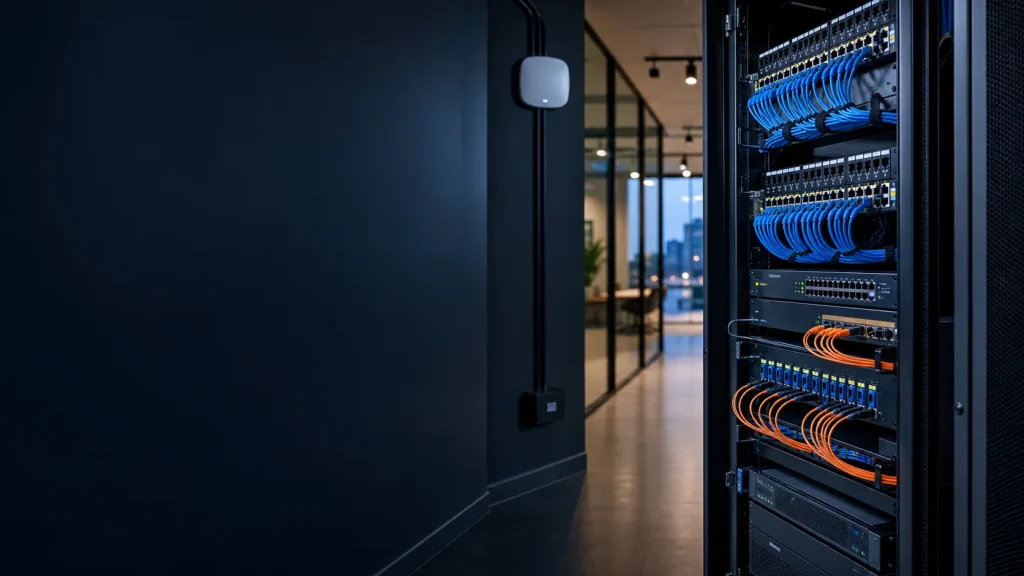
ZES provides structured cabling design and installation for businesses that need an organised, testable foundation for data, voice, Wi-Fi, CCTV, access control and connected equipment. As a structured cabling company in Kenya, Zama Engineering Systems begins with outlet, device, capacity and pathway requirements, then defines copper, fibre, racks, containment, labels, tests and handover records in one scope.
Structured cabling is a building asset, not a bundle of loose network cables. Correct planning makes future moves, faults and expansion easier. Poor routes, mixed categories, unlabelled ports and undocumented patching can create intermittent failures long after the installer has left.
Structured cabling services
- New-build and renovation cabling surveys
- Cat6 and Cat6A copper installations where selected by design
- Fibre backbone routes, enclosures, splicing and agreed testing
- Communications cabinets, racks, patch panels and cable management
- Outlets for workstations, phones, access points, cameras and controllers
- Containment, pathway and equipment-room coordination
- Tracing, relabelling and remediation of existing cabling
- Permanent-link tests, result schedules and as-built records where specified
The quoted service states materials, lengths or quantities, pathways, termination hardware, tests, active-equipment dependencies, civil or electrical exclusions and customer-controlled access.
Define outlet and device requirements before cable quantities
Floor plans should identify users, work areas, phones, printers, access points, cameras, door controllers, meeting rooms, displays and future positions. Spare capacity may be valuable where later access will be difficult, but it should be deliberate rather than a hidden allowance.
Power-over-Ethernet devices also affect switch and cable planning. Camera, access-point and controller power requirements must fit the proposed switching and distance. ZES coordinates the passive cabling schedule with the business network design.
Cat6 cabling installation
Cat6 cabling installation in Kenya is commonly considered for business data, voice and power-over-Ethernet applications. Suitability depends on the link, environment, bandwidth plan, equipment and selected installation standard. A quotation should identify the complete channel components, not only the cable printed category.
Performance can be affected by route, length, termination quality, bundling, bend control, damage, electromagnetic conditions and mixed components. Test results should use the agreed link configuration and limit. A basic continuity check is not full category certification.
Cat6A structured cabling
Cat6A structured cabling in Kenya may be selected where the application, lifecycle, link environment or future capacity justifies it. It can require more pathway space, larger bend radius, compatible jacks and panels, careful bundling and appropriate installation workmanship. It should not be specified only because its name sounds newer.
ZES compares application, distance, equipment, route, heat, power-over-Ethernet, space and budget before recommending a category. Shielded components, where considered, introduce bonding and design questions that must be handled as a complete system rather than by fitting one isolated screened cable.
Backbone fibre and building links
Fibre can connect floors, buildings, distant cabinets and high-capacity sections. The design should state fibre type, count, construction, route, termination, interfaces, enclosures and test method. Copper and fibre labels should follow the same site naming system so technicians can trace services quickly.
For specialist routes and test deliverables, use ZES fibre optic installation, splicing and testing scope. The fibre design must still coordinate with switches, transceivers, patch cords, power and rack capacity.
Pathways, containment and building coordination
A cable route should be accessible, protected and appropriate for the environment. Ceiling congestion, fire compartments, risers, outdoor exposure, water, rodents, machinery, working height and other services affect the method. Builders, electrical contractors, interior teams and network installers should agree route ownership before ceilings and finishes close.
The proposal identifies whether trunking, tray, conduit, core drilling, fire stopping, excavation, access equipment and reinstatement are included. Unverified underground utilities or public routes require proper investigation and approval.
Network racks and patching
Cabinet size should consider current equipment, patching, power, airflow, fibre enclosures, cable management and growth. A rack filled on commissioning day leaves no practical lifecycle. Deep active equipment also needs suitable cabinet depth and safe rear access.
Patch panels, horizontal and vertical managers, labels and appropriate patch cords create a maintainable system. Patch leads should not hang across switch airflow or become an undocumented permanent route. Where a room needs wider power, cooling, security or monitoring work, ZES can prepare a server-room and data-centre assessment.
Testing and cabling certification
Every outlet should receive the tests specified in the contract. For copper, the scope must distinguish continuity or wire mapping from qualification and formal category certification. For fibre, it must distinguish continuity, optical-loss testing and OTDR traces. The customer should receive results matched to outlet and panel labels.
ZES confirms the test method, suitable equipment and acceptance basis available for the project. It does not describe a link as certified merely because it carries traffic. Buyers can use the network audit and cabling certification guide to prepare the test schedule.
Labelling and as-built records
Labels should be unique, durable and consistent across faceplates, cables, patch panels, cabinets and drawings. The convention should work across floors and sites. Port records show which outlet terminates where and which active port it serves at handover.
Useful handover information includes layout or route drawings, cabinet elevations where agreed, outlet schedules, fibre-core allocations, test reports, equipment schedules, photographs, exceptions and warranty details. Documentation must reflect the installed condition, not the tender drawing before changes.
Working in occupied sites
Office, hotel, hospital, school, warehouse and factory projects may need phased access, dust control, noise limits, working-at-height controls, escorts and planned outages. The programme should identify high-risk or disruptive activities and who approves them.
Existing live links should not be disconnected from appearance alone. Cable tracing, customer confirmation, backups and change control reduce accidental service loss. Temporary connections must be documented and removed or formalised at handover.
ZES structured cabling delivery process
- Requirement schedule: record users, devices, rooms, applications, growth and completion date.
- Site survey: verify distances, pathways, cabinets, power, access and environmental conditions.
- Design and quotation: define category, fibre, hardware, routes, labels, tests, quantities and exclusions.
- Sample and approvals: confirm visible containment, outlet positions and naming where required.
- Installation: place pathways and cables, terminate, manage, protect and label.
- Testing: complete agreed link tests, correct failures and retain matched results.
- Handover: deliver records, demonstrate layout and identify outstanding or customer-owned items.
How to compare structured cabling quotations
Compare outlet quantities, cable and component specification, pathway, cabinet scope, fibre, access equipment, testing, labels, documentation, warranty, travel and exclusions. A per-point figure can hide long routes, difficult ceilings, patch panels, cabinets or test requirements.
Ask whether all components form the proposed channel, whether the installer will supply native result files or only a summary, and how failed links are corrected. Any manufacturer-system warranty or installer status should be supported by current project-specific evidence, not assumed from website wording.
Kenya and East Africa delivery
Organisations searching for a structured cabling company in East Africa should compare local survey capability, route and safety knowledge, material lead times, test equipment, documentation, mobilisation and post-handover response. ZES assesses regional projects individually and states country coverage, partners, travel and response commitments in the proposal.
Frequently asked questions
Should we choose Cat6 or Cat6A?
The choice depends on application, distance, environment, active equipment, pathway space, lifecycle and budget. ZES makes a project recommendation after reviewing those factors.
Can ZES reuse existing cables?
Potentially. Identity, route, condition, length, category and test performance must be assessed. Unknown or failed links are not treated as compliant.
Does structured cabling include switches and Wi-Fi?
They can be included in a combined quotation, but passive cabling and active network equipment are itemised so responsibilities and warranties remain clear.
Can ZES work from architectural drawings?
Yes for planning and budgeting, followed by site and coordination checks before final quantities and routes are committed.
Request a structured cabling site survey
Share the location, floor plans, room use, device list, outlet quantities, completion programme and testing expectations. ZES will prepare a scoped copper, fibre, rack and documentation proposal.
Ready to plan your system?
Get a clear scope and quotation for your site.
Tell our engineers what you need. We will review your requirements, recommend the right solution and respond with the next practical step.
Discuss this solution with ZES
Request a site assessment and a quotation designed for your property.
Request a Quote