
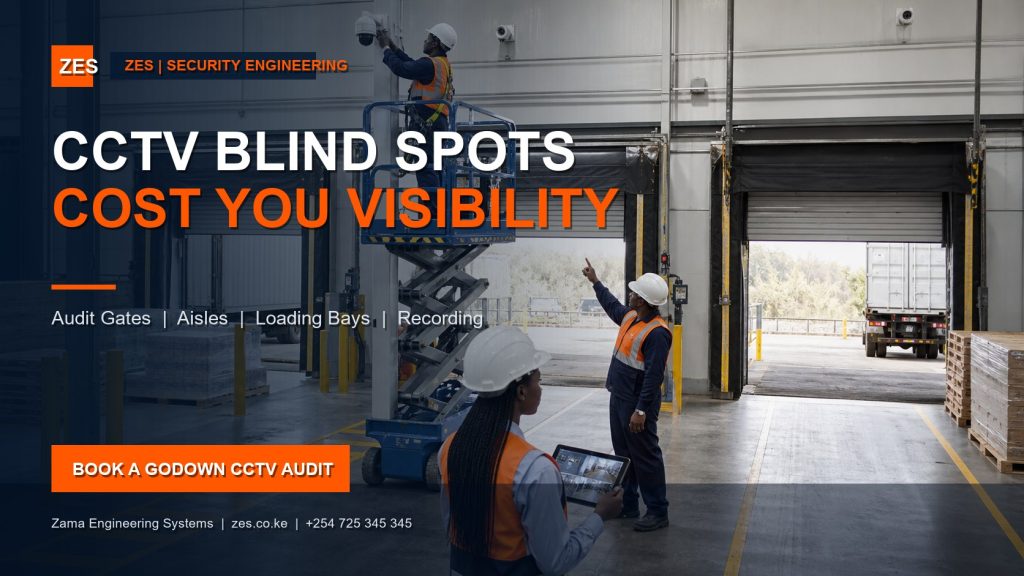
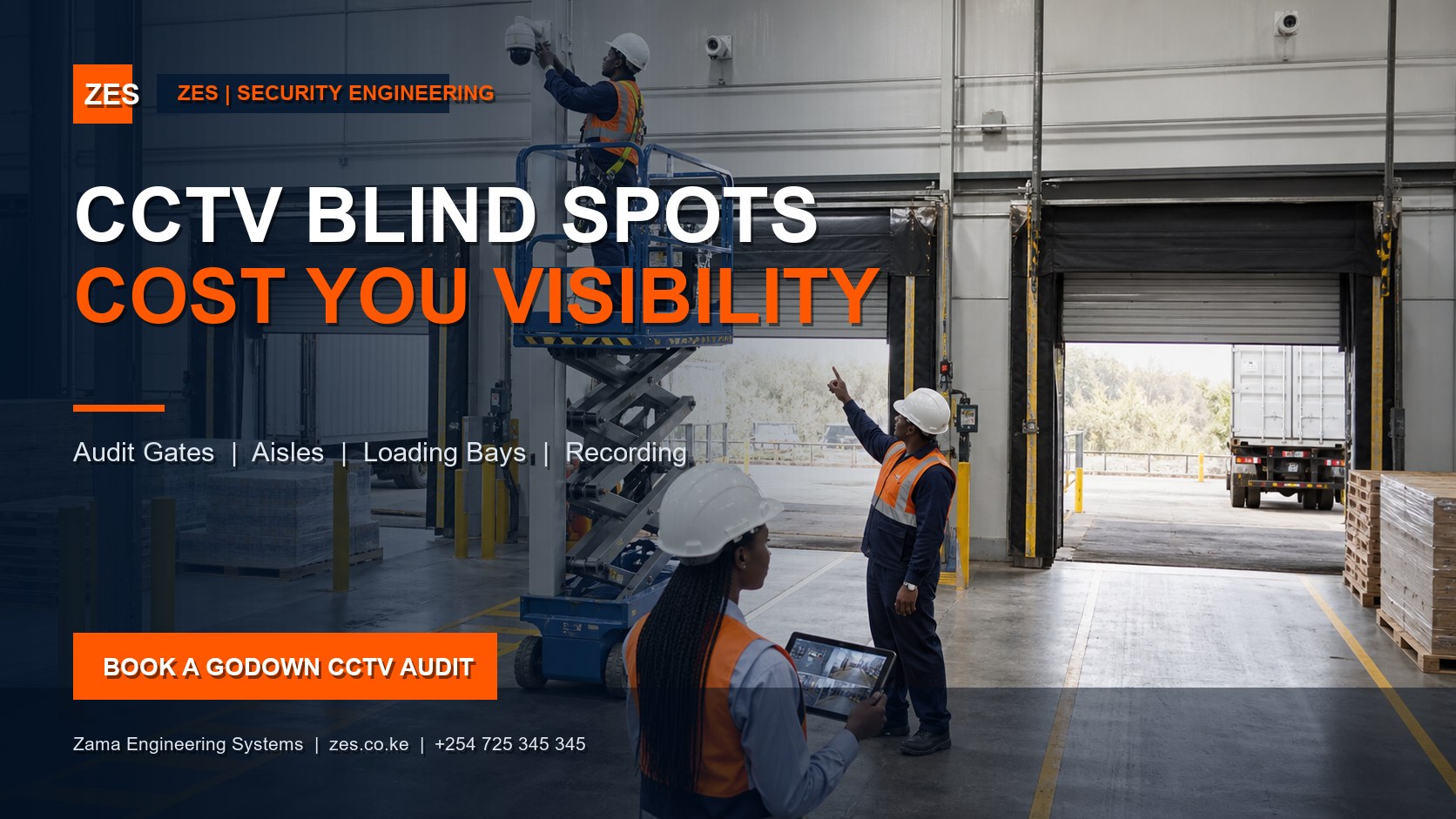
A godown CCTV blind-spot audit tests whether a surveillance system can answer the questions that matter after a loss, collision, unauthorised entry or disputed delivery. Seeing cameras on walls is not enough. Managers need useful views of who entered, what moved, which vehicle was involved, when the event occurred and whether the recording can be retrieved. Zama Engineering Systems (ZES) assesses camera coverage, image quality, lighting, recording, storage, network dependencies and operating procedures as one evidence chain.
This buyer guide is for warehouse owners, logistics operators, wholesalers, manufacturers, property managers and security teams. It helps serious clients scope an audit before buying more cameras. In many facilities, the fastest improvement is not adding devices everywhere. It is correcting the placement, focus, time, retention, lighting or ownership weaknesses that make existing footage unreliable.
What is a CCTV blind spot?
A blind spot is any important event area where the system cannot produce usable evidence. It may be a physically uncovered corner, but it can also be a camera aimed too widely, a face hidden by backlight, a loading position blocked by an open truck, an aisle view concealed by new racking or a recorder retaining fewer days than management expects. A disconnected camera is obvious; an evidence gap that looks acceptable on the live screen is more dangerous.
Warehouses change constantly. Pallet stacks grow, doors are added, lights fail, vehicle routes move and temporary storage blocks views. Cameras installed from a drawing may perform differently when the building is full and operations are active. An audit therefore follows real movements: pedestrian entry, gate processing, receiving, put-away, picking, high-value access, packing, dispatch, returns and waste removal.
High-risk warehouse areas to review
The survey begins with the customer’s incident and process map. A wide overview helps establish context, while detail cameras should cover the places where identification or transaction evidence is needed. The correct combination depends on distance, lighting, lens, resolution, mounting angle and the obstruction expected during normal work.
- Pedestrian gates, staff entrances and access-control doors
- Vehicle gates, guard stations and number-plate approach lanes
- Receiving, checking, weighing and goods-return positions
- Loading bays, dispatch doors and staging areas
- High-value cages, tool stores, server rooms and controlled stock
- Long rack aisles, cross-aisles, staircases and mezzanines
- Cash, document, key and seal-control points
- Fuel tanks, generators, pumps and external service yards
- Waste, scrap and rejected-goods exits
The audit should test views at the busiest time, where practical. A loading bay can appear fully visible when empty but disappear behind a backed-in trailer. A gate camera may capture clear vehicles during the day and unreadable headlights at night. A high-mounted overview may show movement without providing a face or item detail. These are design questions, not simply camera-count questions.
Image quality, angle and identification
Every camera should have a defined purpose. An overview camera explains the scene; an identification camera provides sufficient detail at a controlled point; a transaction camera associates people and goods with a process. Asking one ultra-wide camera to perform all three roles usually produces disappointment. The audit compares the required evidence with the actual image at representative times and distances.
Focus, exposure, lens choice and mounting angle are checked alongside cleanliness and physical stability. Cameras pointed through dusty housings, spider webs or scratched covers may work poorly at night. Strong doorway light can turn a person into a silhouette. Infrared reflection from a wall, roof sheet or enclosure can wash out the subject. Moving a camera, adjusting its field of view or improving scene lighting can be more valuable than increasing nominal resolution.
Night performance and warehouse lighting
Night images must be tested after dark or under the actual low-light condition. Daytime approval does not prove security performance. The audit reviews dark corners, backlight, headlight glare, reflective clothing, moving subjects and the transition between external yards and illuminated interiors. It also checks whether lights are switched off by routine, failed in high areas or placed where racking creates deep vertical shadows.
CCTV and lighting should be planned together. A warehouse high-bay LED lighting upgrade can improve safety and visual evidence when beam patterns and camera scenes are coordinated. Dedicated external lighting may be needed at gates or loading positions. The goal is consistent usable illumination, not maximum brightness. Excessive glare can reduce detail and create discomfort for drivers and staff.
Recording, storage and retention verification
Live video is only one part of surveillance. The auditor should select representative channels and retrieve recordings from recent dates. This confirms that channels are recording, timestamps are credible, playback works and export is understood. Storage health and actual retention must be measured rather than inferred from the number of hard disks. Retention changes with camera count, resolution, frame rate, compression, motion settings and hours of recorded activity.
Management should define the required retention based on business and policy needs. The proposal can then identify whether configuration, additional storage or recorder replacement is appropriate. Critical systems may require UPS protection and a controlled response to disk alerts. Exported evidence should follow the customer’s authorised process; CCTV footage contains sensitive information and should not be copied casually to personal devices.
Network, remote access and account security
IP cameras depend on switches, cabling, wireless links, fibre, routers and power. A blind-spot audit therefore checks device connectivity, PoE capacity, cabinet conditions and obvious single points of failure within the agreed scope. Intermittent links can create gaps that are missed when a technician only checks the live screen. Remote sites may need health monitoring, but alerts should be configured to reach responsible people and not become ignored noise.
Remote viewing must be reviewed with the customer’s IT and security policies. Shared administrator accounts, unknown installer credentials, former-employee access and direct internet exposure create avoidable risk. Authorised users should have appropriate permissions, strong credentials and a documented handover. ZES can coordinate surveillance with business security systems, access control and the existing network without claiming that every brand or legacy device can be integrated.
How ZES carries out the audit
- Pre-audit brief: record site layout, operating hours, stock risks, known incidents, required retention and current equipment information.
- Operational walk-through: follow people, vehicle and goods movements with site representatives and identify the evidence required at each critical point.
- Camera view review: inspect position, obstruction, focus, angle, day and available night performance, mounting and environmental condition.
- Recorder test: review channel status, selected playback, date and time, storage condition, retention and authorised export procedure.
- Infrastructure review: note relevant power, UPS, switch, cabinet, network and remote-access dependencies.
- Gap report: classify urgent failures, quick corrections and planned upgrades with photographs or annotated references where appropriate.
- Remedial proposal: quote only the agreed corrections, new cameras, lighting, storage, network or maintenance work required.
What the customer should receive
A useful audit is a decision document, not a long list of products. It should identify the area, required evidence, observed condition, risk and recommended action. Recommendations can be ranked as critical, high, planned or advisory. The report should distinguish maintenance corrections from expansion and identify assumptions that need further testing, such as night verification or access to locked equipment.
If new cameras are proposed, the scope should state their purpose and approximate view, not only megapixels. It should also address mounting, cabling, power, storage impact, network capacity, configuration, testing, user access and warranty. ZES can provide a separate CCTV installation company proposal after the customer approves priorities.
Common mistakes the audit prevents
- Buying additional cameras while the recorder has no spare channels or storage
- Using one wide view where identification detail is required
- Mounting cameras so high that faces and handled items are too small
- Ignoring night glare, failed lighting or infrared reflection
- Assuming footage exists without testing playback and export
- Leaving critical camera views blocked by pallets, signage or parked vehicles
- Sharing remote-viewing credentials without access ownership
- Failing to maintain cameras after layout and lighting changes
How to compare CCTV audit quotations
Ask whether the quotation includes an operational walk-through, view assessment, playback test, retention measurement, account review, network observations and written priorities. Confirm the number of sites, cameras and recorders included, access equipment, night testing, travel and report format. Corrective parts and installation work should be separated from the independent assessment unless the commercial arrangement clearly states otherwise.
Price varies with facility size, camera count, mounting height, operating schedule, documentation quality, site location and the depth of testing. A small but high-risk warehouse can require more careful evidence planning than a larger low-value store. Provide layout drawings, incident examples and camera lists where available so the audit concentrates on business risk.
Maintenance after blind spots are corrected
Coverage will degrade again if nobody checks it. A maintenance plan can include image and obstruction reviews, camera cleaning, selected night checks, playback tests, retention measurement, disk health, time verification, account review and fault reporting. Changes in racking, doors, yard routes and lighting should trigger a targeted review rather than waiting for the next incident.
ZES can build the audit findings into a preventive schedule under a documented maintenance contract. The contract should define assets, visit frequency, critical faults, response expectations, exclusions and how additional corrective work is approved.
Frequently asked questions
Does a blind-spot audit mean we need to replace all cameras?
No. The purpose is to identify evidence gaps. Some can be corrected through cleaning, repositioning, focus, lighting, configuration, storage or network work. Replacement is proposed only where condition or capability does not meet the agreed purpose.
Can ZES audit a mixed-brand CCTV system?
Yes, subject to safe access and available credentials. Compatibility and diagnostic depth vary by equipment, and unsupported items are clearly identified rather than assumed.
Can the audit include night testing?
Yes, where agreed and operationally practical. Night or low-light testing is recommended for gates, yards, external stores and other areas whose security depends on after-hours images.
How long should CCTV footage be retained?
The customer should define the required period from operational, contractual and policy needs. ZES measures actual retention and sizes technical options around that requirement without giving legal advice.
Do you serve warehouses outside Nairobi?
ZES can quote audits across Kenya, subject to scope, scheduling and mobilisation. Multi-site customers can use a standard audit template while preserving site-specific findings.
Find the blind spots before an incident does
Send ZES the godown location, approximate camera count, recorder details, operating hours and main security concerns for an audit proposal.