
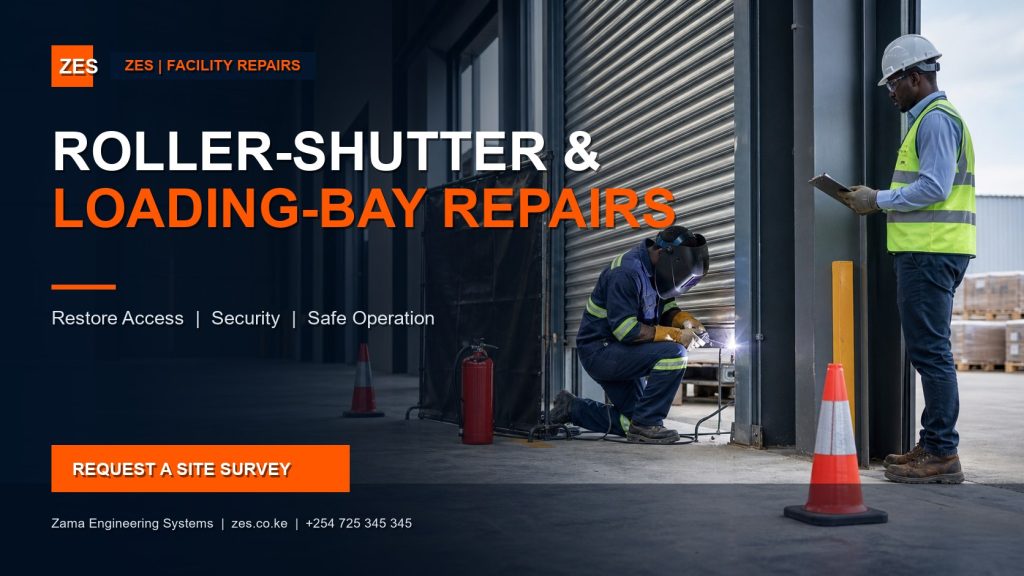
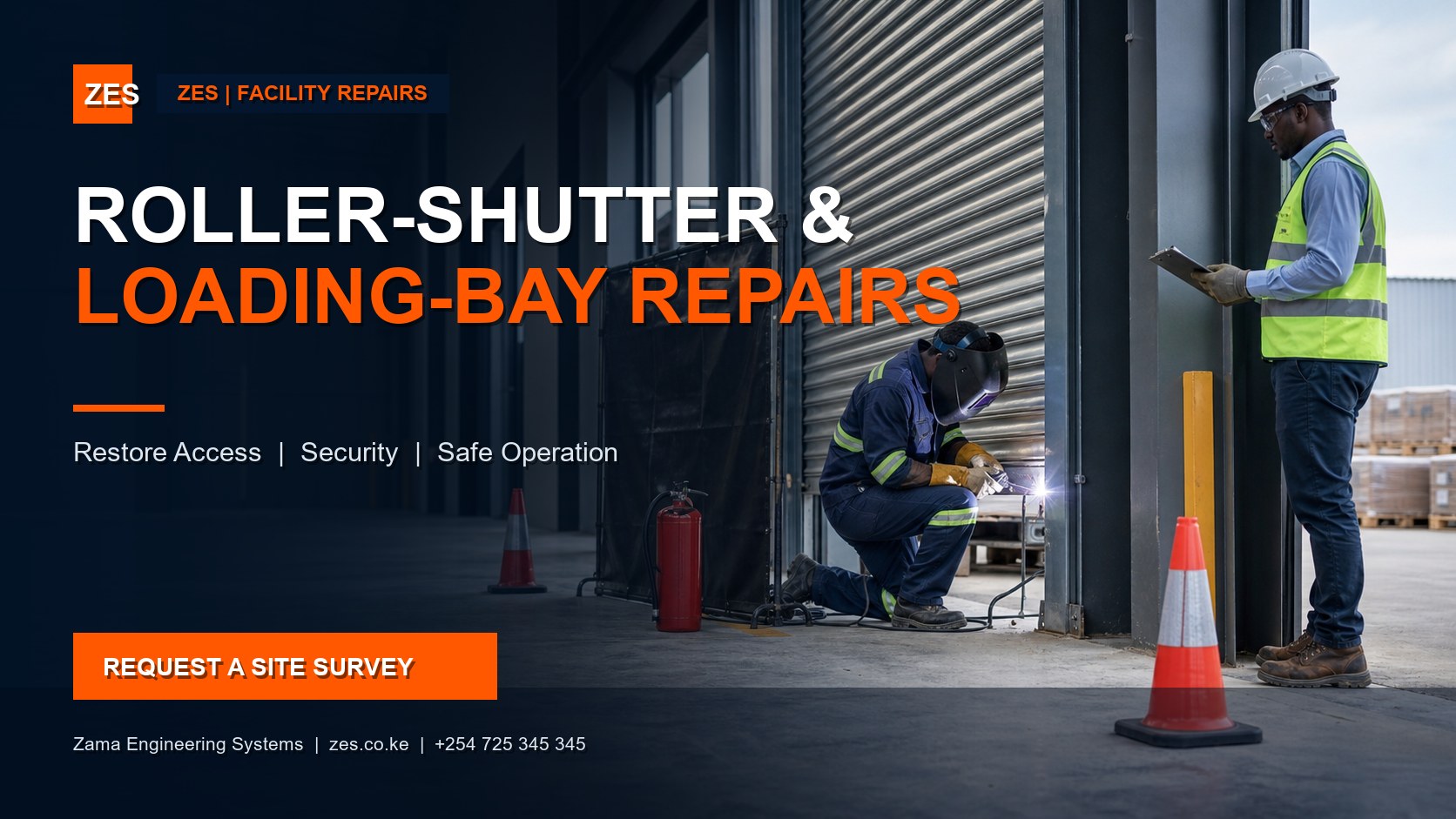
Warehouse roller-shutter and loading-bay repairs protect the point where security, deliveries, people and vehicles meet. A door that jams half open can stop dispatch, expose stock and create an unsafe workaround. A damaged guide, loose support, failed safety device or repeatedly struck bollard may indicate a wider alignment, control or traffic-management problem. Zama Engineering Systems (ZES) assesses the visible condition, operating history and surrounding bay before preparing a repair or improvement scope.
This guide is for warehouse managers, landlords, logistics operators, factories, wholesalers and facility teams that need a dependable technical proposal rather than an unexplained patch. It covers manual and powered shutters, related steelwork, loading approaches, protective fabrication and maintenance planning. Equipment types and responsibilities vary, so the final method is always based on site inspection and manufacturer information where available.
When a roller shutter needs professional attention
Warning signs include uneven movement, scraping, unusual noise, slats moving out of guides, a bottom rail that does not seat, damaged locks, frayed components, unreliable controls, water entry and repeated motor trips. Staff may begin pushing, pulling or striking the door to keep it moving. These behaviours should not become normal operations because they can worsen damage and expose people to uncontrolled movement.
An emergency repair may be required when the opening cannot be secured, the door obstructs a delivery route or components appear unstable. The area should be controlled until a competent assessment is made. Do not place staff beneath a questionable shutter or bypass safety controls to restore convenience. ZES confirms what can be safely inspected, what must be isolated and whether a specialist manufacturer or lifting contractor is required.
Common causes of repeated shutter faults
A failed part may be the result rather than the cause. Vehicle impact can distort guides and supports. Settlement or building movement can change alignment. Dirt and corrosion can increase resistance. An unsuitable motor or control arrangement may be operating beyond its intended duty. Poorly adjusted limits can strain components at the end of travel. Repairs should look for this chain instead of replacing the same item repeatedly.
- Vehicle or forklift impact to guides, frames and bottom rails
- Misalignment, loose anchors or distorted supporting steelwork
- Worn moving parts, inadequate maintenance or contamination
- Corrosion, weather exposure and failed protective finishes
- Electrical supply, isolator, control or limit-setting faults
- Unsafe bypassing of interlocks or protective devices
- Operating frequency beyond the door’s suitable duty
- Drainage or floor-level problems at the threshold
What the site assessment should cover
The survey records the door type, approximate dimensions, operating method, condition, failure symptoms, access and business consequence. It examines visible slats or curtain, guides, bottom rail, supports, fixings, hood, locking, manual release and surrounding structure within the agreed safe scope. Powered systems also require review of isolation, controls, cables, motor behaviour and installed safety features by appropriately competent personnel.
The bay itself matters. Approach alignment, dock level, buffers, bollards, markings, lighting, drainage and driver visibility can contribute to repeated damage. Photographs of the closed and open position, controller, motor details and damaged components help develop the scope. Where proprietary parts are required, exact identification is important; an improvised substitute can create a more expensive future failure.
Repair, partial rebuild or replacement?
A repair is appropriate when damage is localised, compatible parts are available and the remaining system is serviceable. A partial rebuild may address guides, curtain sections, supports, controls or protective steelwork while retaining suitable components. Replacement becomes more reasonable where the door is extensively distorted, unsupported by available parts, unsuitable for operating duty or repeatedly failing because the whole arrangement is deficient.
The proposal should explain the recommendation and assumptions. It should not use replacement as the automatic answer, but it should also avoid spending repeatedly on a worn system whose major components are near end of life. Buyers can ask for a condition summary, immediate make-safe work, repair option, longer-term option and the operational limitations of each.
Powered doors and safety controls
Powered shutters combine mechanical movement, electrical power and control logic. The scope may need to consider emergency stop, local controls, authorised remote controls, limit settings, obstacle detection, warning devices, manual release and isolation. Exact requirements depend on equipment and applicable standards. Safety devices should never be assumed operational because an indicator light is on; agreed functional testing is part of handover.
Access control or automation can be integrated where compatible, but convenience must not weaken safe operation. A remote command should not move a door where the operator cannot manage the risk unless the system is specifically designed with appropriate safeguards. ZES coordinates electrical and control work through qualified personnel and identifies when the original manufacturer or a specialist must be involved.
Loading-bay steelwork and protective fabrication
Loading areas often need more than door repair. Damaged bollards, handrails, cages, steps, ramps, barriers, canopies, guards and support frames can affect safety and future impact resistance. ZES can scope custom metal fabrication and on-site welding for non-proprietary items, including measurement, material selection, finish and fixing. Any load-bearing structure or modification requiring design must be assessed and approved by an appropriately qualified engineer.
Protection should be matched to vehicle routes. A strong bollard in the wrong place can create a new collision point or obstruct emergency movement. Barriers should protect guides, controls and building corners without reducing the usable bay width. High-visibility finish, floor markings, mirrors or lighting may complement the steelwork. The final scope should be coordinated with the customer’s traffic and safety plan.
Lighting, CCTV and access around loading bays
Drivers and staff need clear visibility during approach, positioning, opening, checking and departure. Failed or badly aimed lights increase collision risk and may also reduce CCTV evidence. A repair survey can record obvious lighting gaps for a coordinated warehouse lighting assessment. External fittings and circuits must suit the environment and be installed by qualified personnel.
Loading bays are important security transaction points. Cameras should associate people, vehicles and goods with receiving or dispatch activity. Repairs that move doors, supports or lights can change existing views. ZES can include a targeted CCTV blind-spot review and coordinate authorised access controls where the door protects a controlled area.
Drainage, thresholds and weather protection
Water and debris at a threshold can corrode components, obstruct travel and create slip or equipment hazards. Damaged floors can prevent the bottom rail from seating or cause repeated forklift impact. The site review should identify whether cleaning, drainage, civil repair or weather sealing lies outside the shutter scope and needs another competent contractor.
A new seal cannot compensate for a distorted rail or badly sloped threshold. Likewise, welding a damaged guide without checking alignment may create binding. Responsibilities for civil works, making-good, roofing and waterproofing should be separated clearly in the quotation so the opening is not left partially repaired between contractors.
How ZES handles the repair process
- Fault brief: record the location, door type, dimensions, failure symptoms, recent impacts, operational urgency and available equipment details.
- Safety and condition assessment: inspect accessible components, control the work area and identify any immediate make-safe measures.
- Cause and options: distinguish failed parts from alignment, structure, electrical, control, drainage or traffic causes.
- Detailed quotation: state repair or replacement items, materials, parts, access equipment, electrical work, testing, exclusions and lead time.
- Planned execution: coordinate isolation, bay closure, deliveries, hot-work controls, lifting and protection of nearby stock.
- Testing and handover: demonstrate agreed operation, controls, manual release and safety features; record remaining recommendations.
Hot work and operational coordination
Welding and cutting around a warehouse introduce fire, fume and stock-contamination risks. Work must follow the customer’s permit, isolation, housekeeping and fire-control procedures. Combustible goods may need removal or shielding, and the area may require monitoring after hot work. These arrangements should be confirmed before the team arrives, not improvised at the bay.
Deliveries and emergency routes must also be coordinated. The quotation should state how long the bay is expected to be unavailable and whether the opening will remain secure overnight. If parts have a lead time, a temporary measure may be possible, but its limitations and removal should be documented. ZES does not describe a temporary securing method as a permanent repair.
Preventive maintenance after repair
Planned inspections can identify noise, loose fixings, alignment change, corrosion, control damage and safety-device faults before the door stops during a busy shift. Maintenance frequency depends on usage, environment, door type and manufacturer guidance. High-cycle dispatch doors need a different plan from rarely used emergency openings.
A useful maintenance record includes identification, observed condition, checks, actions, parts and recommendations. Staff should know how to report unusual movement and when to stop using the door. ZES can include shutters and agreed bay assets within preventive maintenance contracts, while specialist proprietary servicing remains allocated where necessary.
What affects repair cost?
Price depends on door dimensions and type, component damage, part availability, access, motor and control condition, supporting steelwork, electrical work, working hours, lifting equipment, hot-work requirements, travel and how urgently the opening must be secured. A photograph can support initial triage but may not reveal alignment, internal wear or structural damage.
Ask quotations to separate labour, replacement parts, fabricated items, electrical work, access equipment, transport, testing, warranty and exclusions. Confirm whether removal of damaged materials, painting, civil work and overnight security are included. The cheapest patch is costly if the same bay fails again during dispatch.
Frequently asked questions
Can ZES repair any roller-shutter brand?
ZES can assess the fault and confirm capability after identifying the equipment. Some proprietary systems require manufacturer parts, tools or specialist support, which will be stated honestly.
Can you secure a shutter that fails after hours?
Emergency attendance depends on location, access and team availability. The first objective may be to make the area safe and temporarily secure; permanent repair can require parts and a planned return visit.
Can damaged guides simply be welded?
Not always. Alignment, distortion, material condition, fixings and safety must be assessed. Welding without addressing the cause can make movement worse or hide the need for replacement.
Can you fabricate loading-bay bollards and guards?
Yes, subject to site measurement, intended protection, vehicle clearance and any engineering requirements. The proposal specifies material, finish and fixing.
Does ZES work outside Nairobi?
ZES can quote warehouse repairs across Kenya subject to scope, scheduling, access and mobilisation. Send photographs and equipment details for initial review.
Restore secure and reliable loading-bay access
Send ZES the site location, door dimensions, photographs, control details, fault symptoms and operational urgency for an assessment.