
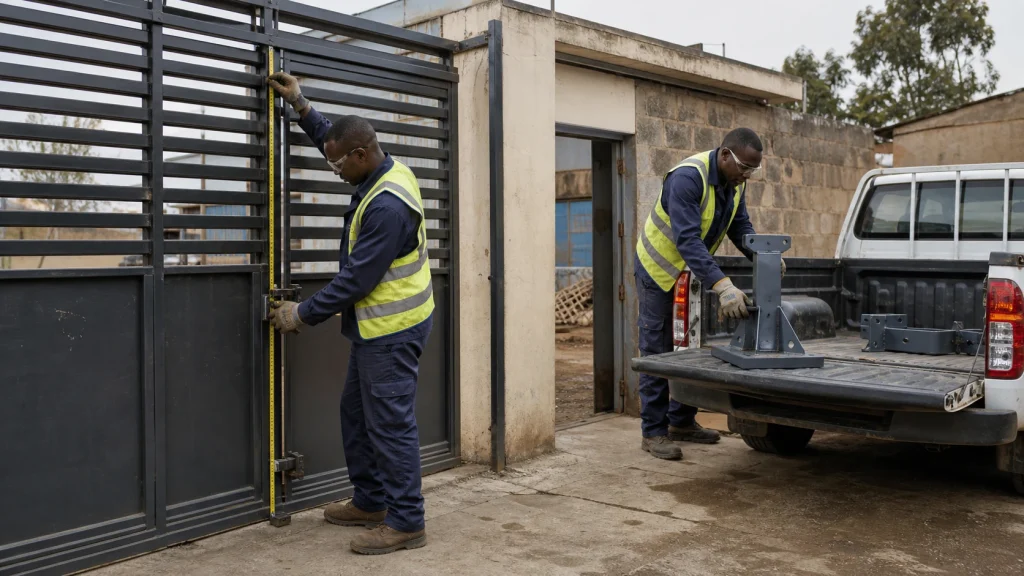
People searching for mobile welding services Nairobi often assume the whole job should be completed where the damaged gate, frame or bracket stands. Sometimes that is practical; at other times, measuring on site and fabricating or repairing in a workshop produces a more controlled result. The best approach may also combine both: site verification, workshop preparation and final installation at the property.
This decision guide helps facilities teams and business owners discuss the method before requesting a quotation. It supports the main ZES mobile and on-site welding service page rather than competing with it.
When site work may be the practical starting point
Installed components can be difficult to remove without affecting walls, equipment or daily access. A large gate, fixed rail, embedded frame or site-specific support may need measurement and controlled fit-up in place. Site work may also help when the final geometry depends on existing conditions that cannot be reproduced reliably in a workshop.
That does not mean every operation belongs on site. Cutting, drilling, repeated assembly and full finishing may be easier elsewhere. A site assessment should separate the minimum necessary site tasks from work that can be prepared before arrival.
For damage, the condition of the surrounding material remains important. A convenient in-place weld is not a sound remedy when corrosion, repeated impact, misalignment or unsuitable base material has not been addressed.
When workshop fabrication may offer better control
A workshop gives access to more working positions, equipment and controlled assembly space. Components can be measured, marked, cut and fitted without obstructing customers or production. Finishes may also be easier to prepare away from dust, rain and occupied areas, subject to the specified system.
Repeated items such as brackets, frames or barrier panels can be checked against one approved template. Trial fitting and dimensional review may occur before delivery. This is especially helpful when several locations must look and operate consistently.
The trade-off is transport and interface risk. Large pieces must fit through Nairobi property gates, streets, loading areas and doors, then align with real supports. Critical measurements need verification, and the quotation should state responsibility for any mismatch.
Use a hybrid measure-fabricate-install sequence
Many commercial jobs suit a hybrid sequence. First, the team surveys dimensions, access and base condition. Second, suitable components are prepared and finished in the workshop. Third, the site is released for removal, controlled final fitting, installation and touch-up.
This approach can shorten disruption without pretending that site work disappears. Build approval points into the sequence: verified dimensions, accepted sketch, confirmed finish, property access and final installation window. If the first visit reveals a different condition, update the scope before production.
Custom items that need a drawing or prototype can be routed through ZES custom metal fabrication services before the installation stage.
Compare the decision factors
Access: Can the item be removed and transported without creating damage or leaving the property unsecured? Can a prefabricated replacement reach the work point? Record gate, stair, lift and doorway limits.
Working space: Is there room for tools, screening and controlled movement? A narrow corridor, public entrance or crowded plant room may make extended site fabrication impractical.
Operational disruption: Which method affects customers, tenants, vehicles or production least? Consider the full sequence, including temporary closure after removal and any coating stages.
Geometry: Does the component rely on irregular existing conditions? Complex interfaces may need templates, trial fitting or adjustable approved details.
Finish: Is the item highly visible or exposed to weather? Decide what can be finished in the workshop and how site joints, anchors and handling marks will be treated.
Condition: Is the base material suitable for repair? Cleaning and inspection may reveal that a larger replacement is needed, so include a decision route for discoveries.
Plan Nairobi access and property coordination
Share the precise location and access instructions, not only a neighbourhood name. Note loading restrictions, parking, security registration, delivery hours, lift booking and any landlord approvals. A route that works for a technician may not suit long steel sections or a delivery vehicle.
Identify the work-area contact and the person authorised to release and reopen it. Move vehicles, stock and movable finishes before the agreed time. Where welding or grinding may affect adjacent areas, the site’s responsible team must establish suitable controls, isolations and permits for actual conditions.
Weather should be considered for external work and coating touch-up. A realistic plan allows suitable sequencing instead of relying on unsupported completion promises.
Ask for a quotation that shows the chosen method
The quotation should distinguish survey, workshop fabrication or repair, materials, transport, removal, site installation, finish touch-up and disposal. This reveals why a hybrid approach may differ from a single mobile visit and makes exclusions easier to understand.
Provide the same information to each bidder and ask them to explain their proposed task split. A reasoned alternative may improve the scope. Confirm final measurements and the approved detail before authorising production.
At completion, inspect operation, alignment, appearance and housekeeping against the agreed result. Retain photographs or drawings where they will help future maintenance.
Frequently asked questions
Is mobile welding always faster than workshop work?
Not necessarily. Site access, preparation, weather, controls and finish stages can add time. A hybrid method may reduce site disruption while keeping final fitting accurate.
Can a gate be repaired without removing it?
Possibly, depending on hinge condition, alignment, base material, access and surrounding exposure. The repair decision should follow an assessment rather than convenience alone.
What measurements should I provide?
Share approximate overall dimensions, critical openings, fixing locations and access-route limits. Final responsibility for verification should be stated in the quotation.
What if workshop-fabricated parts do not fit?
Use controlled site measurements, approved drawings or templates and a defined tolerance or adjustment method. If a mismatch occurs, document it and obtain approval before altering the item or support.
To discuss the most practical method, send ZES photographs, measurements, the Nairobi location and access constraints. The team can identify whether assessment, workshop preparation or a combined sequence should be considered.