
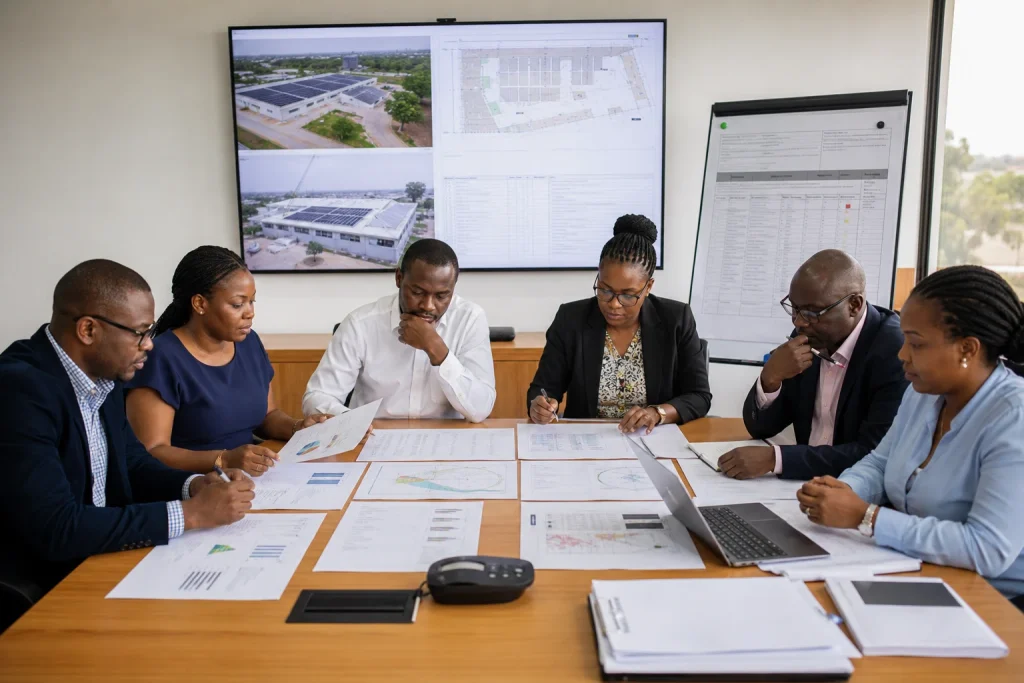
A solar installer for businesses Kenya buyers appoint should be evaluated as a project team, not simply as a seller of panels and batteries. Commercial sites need a documented design basis, clear regulated responsibilities, coordinated installation and evidence that the system was tested against the agreed operating outcome. The right procurement process makes assumptions visible before contract award and keeps price comparisons tied to equivalent scope.
This guide helps directors, CFOs, procurement teams, facilities managers, developers and technical advisers prepare a shortlist. Zama Engineering Systems (ZES) can receive an initial business enquiry, but no public claim should substitute for current project-specific evidence. The written quotation must identify the licensed solar PV contractor, solar worker and electrical arrangements before regulated work begins; it must not imply licences, projects, dealerships, savings or results that have not been verified.
Use the main solar installation services Kenya guide to define the project scope, and use this evaluation guide to compare bidder evidence without turning a supplier shortlist into a general system-design brief.
A solar installer for businesses Kenya buyers should evaluate by evidence
Start by asking every bidder to respond to the same brief. It should describe the site, business activity, operating hours, recent energy use, important loads, outage consequences, available roof or land, existing generator or UPS, planned changes and required decision date. If bidders receive different information, their prices and proposed systems will not be comparable.
A serious response explains which information is confirmed, which assumptions were used and what must be surveyed or measured. It should not jump from one electricity bill to a guaranteed system size, saving or payback. The buyer should be able to trace each major design decision to load evidence, site conditions, approved equipment data and the intended operating mode.
Define the business case before selecting equipment
Separate lower daytime electricity consumption from backup continuity, off-grid operation, sustainability reporting and future expansion. These outcomes can lead to different architectures and commercial models. A factory with stable daytime production may assess generation differently from a hotel with evening demand or a clinic with critical circuits. Batteries should be evaluated against defined loads and runtime, not added because a package looks more complete.
Ask how the proposal treats seasonal demand, weekends, shutdown periods, large motor starts, new machinery and tenant changes. The business case should state exclusions and sensitivity to assumptions. If savings or financial projections are supplied, require the data source, calculation method, tariff assumptions, equipment performance basis and party responsible for the forecast. Do not accept an unqualified percentage as a contractual result.
Verify legal identity, licences and responsible personnel
Confirm the contracting entity’s legal name, address and authorised signatory. EPRA publishes business and licence processes for solar PV contractors and workers and provides renewable-energy information and register routes through its renewable-energy page. Request current project-appropriate licence details and identify the responsible solar worker and electrical contractor arrangements. Check the information independently.
Also identify any professional engineer, structural adviser, roofing contractor, civil contractor, utility liaison or specialist equipment party required for the actual site. A logo, training certificate or manufacturer’s brochure is not automatically a contractor licence or authorisation. If regulated work will be delivered by a partner or subcontractor, the quotation should name that entity, define supervision and make contractual accountability clear.
Assess the survey and design process
Ask what the installer will inspect and measure before final design. A commercial survey may review bills and load data, roof or land area, shading, structure, drainage, access, electrical supply, boards, earthing, protection, cable routes, generator interfaces, equipment locations, environmental conditions and maintenance access. The output should list unresolved matters rather than concealing them as later variations.
The design package should be proportionate to the project and may include a system description, drawings, array layout, single-line information, equipment schedules, protection basis, mounting details, cable routes, supported-load schedule, operating modes, monitoring and test plan. Responsibility for structural review, waterproofing, civil bases and distribution-board modifications must be stated. Ask who approves design changes after work starts.
Compare equipment without relying on brand recognition alone
Require model numbers, ratings, compatibility, environmental limits, standards or approvals applicable to the project, warranty source and documented substitution rules. Modules, inverters, batteries, mounting, protection and monitoring must operate as one designed system.
Ask where equipment will be sourced, how delivery is inspected and who handles a warranty claim. Do not assume the installer has stock, authorised-dealer status or manufacturer backing unless evidence is provided for the actual offer. If an alternative is proposed, the bidder should explain the technical and commercial effect and obtain written approval before supply.
Make every quotation disclose the complete scope
A comparable schedule should cover design, equipment, mounting, cables, containment, protection, monitoring, labels, installation, access equipment, transport, civil or roofing work, distribution changes, shutdowns, testing, commissioning, documentation, training and maintenance. Mark each item included, excluded, provisional or client-supplied.
Programme assumptions matter. Confirm survey access, design-review periods, equipment lead time, working hours, shutdown approvals, lifting, weather limits, security clearance and handover dependencies. Warranty terms, defects obligations and response routes should appear in the contract rather than in a sales conversation. ZES must not promise a particular programme or national mobilisation until scope, location, equipment and responsible parties are confirmed.
Review installation safety and operational disruption
Ask for a site-specific method that addresses work at height, electrical isolation, lifting, fragile roofs, falling objects, weather, public access, hot work where relevant and material storage. An occupied business may need phased zones, tenant or staff notices, alternative routes and daily reopening checks.
The installer should control drawings, equipment schedules and changes. Concealed work and inaccessible routes may require photographic evidence. Materials should be checked against the approved schedule before installation. A substitution made at the gate because the specified component is unavailable can affect compatibility, protection, warranty and performance.
Demand commissioning and handover evidence
Ask bidders to propose acceptance tests before contract award. The exact commissioning procedure depends on the approved design and responsible licensed personnel, but may include mechanical inspection, polarity and insulation checks, earthing and protection verification, inverter and battery configuration, monitoring, shutdown behaviour, generator interaction and functional tests of supported loads.
The handover pack should include approved drawings, equipment schedules, serial records where required, settings, test results, operating and emergency guidance, applicable warranties, maintenance instructions and a closed defect list. Monitoring accounts should be controlled by the customer with named permissions. Staff training should cover normal status, alarm escalation and isolation boundaries without encouraging unqualified intervention.
Evaluate maintenance, monitoring and future expansion
Ask who reviews monitoring alerts, what routine inspections cover, which faults require a site visit and how response terms are agreed. Maintenance needs vary with dust, coastal exposure, vegetation, roof condition, equipment guidance and operating criticality. Panel cleaning alone is not a complete maintenance plan.
Document how future batteries, EV charging, additional panels or changed loads will be assessed. Expansion must be engineered as a controlled modification because existing structure, protection, cable capacity and inverter architecture may not accept it safely.
Treat net metering and approvals as conditional
The Energy (Net-Metering) Regulations, 2024 establish eligibility, capacity and agreement conditions. If a bidder includes net-metering support, ask for the precise documents and coordination included. No installer should guarantee eligibility, approval, export credits or a financial outcome that depends on current rules and decisions by other parties.
Coverage across Kenya’s 47 counties
Baringo, Bomet, Bungoma, Busia, Elgeyo-Marakwet, Embu, Garissa, Homa Bay, Isiolo, Kajiado, Kakamega, Kericho, Kiambu, Kilifi, Kirinyaga, Kisii, Kisumu, Kitui, Kwale, Laikipia, Lamu, Machakos, Makueni, Mandera, Marsabit, Meru, Migori, Mombasa, Murang’a, Nairobi City, Nakuru, Nandi, Narok, Nyamira, Nyandarua, Nyeri, Samburu, Siaya, Taita-Taveta, Tana River, Tharaka-Nithi, Trans Nzoia, Turkana, Uasin Gishu, Vihiga, Wajir and West Pokot.
ZES considers qualifying enquiries across Kenya subject to scope, logistics, safe site access, responsible licensed arrangements, equipment availability and scheduling. This national enquiry route does not imply a ZES office, installer, stock, completed solar project or immediate availability in every county.
Frequently asked questions
Should a business choose the lowest solar quotation?
Only after confirming that all proposals cover the same design basis, equipment, building work, electrical changes, tests, documentation and exclusions. A lower price may simply transfer essential tasks to the client or future variations.
How can a buyer check a solar licence?
Request the current licence details and responsible person’s information, then use the routes provided by the responsible authority to verify status and scope. Do not rely only on a screenshot or website statement.
Are project references enough to prove capability?
References can support due diligence when authorised and verifiable, but they do not replace current licences, a suitable design, responsible personnel or a contract-specific method. Protect client confidentiality while checking relevant evidence.
Should monitoring be included in the quotation?
Monitoring requirements, connectivity, data ownership, account permissions, alert response and subscription costs should be stated. A dashboard is useful only when someone is responsible for reviewing and acting on it.
Can one installer handle roof, electrical and civil work?
Possibly, but the quotation must identify the responsible qualified parties for each discipline and how their work is coordinated. One commercial contract does not remove professional or licensing responsibilities.
Prepare a comparable business solar request
Use the industrial electrical services and backup-power pages to identify relevant interfaces. Then book a site survey, request a written quotation or contact ZES with the site, bills, operating hours, critical loads and desired outcome. The response must confirm licences, responsible parties, scope, exclusions, logistics and availability before regulated work begins.