
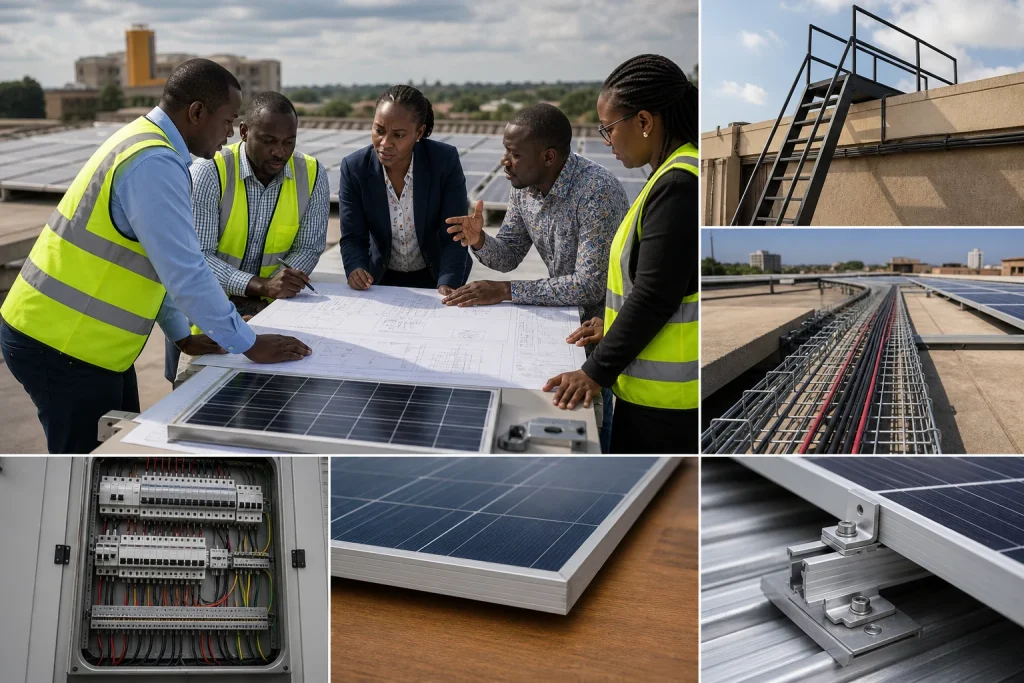
Commercial solar installation cost Kenya buyers compare cannot be reduced responsibly to one national price per panel or kilowatt. Two facilities seeking the same nominal capacity may need different roof work, steel supports, cable routes, protection, access equipment, monitoring, logistics and operating controls. A useful budget separates these components, states the design assumptions and shows what investigation is still required before a firm quotation.
This guide helps businesses, factories, schools, institutions and property managers understand cost drivers without inventing prices, savings or payback periods. It is a procurement framework, not a quotation. Final scope, equipment, current supplier terms, taxes, site conditions, approvals and responsible licensed arrangements must be confirmed for the specific project.
Use the parent solar installation services Kenya guide to define the complete service pathway, and use this budget guide to compare scope boundaries and cost drivers without treating a general web article as a quotation.
What determines commercial solar installation cost Kenya budgets?
The first cost driver is the business objective. A daytime self-consumption system, an outage-resilience solution and a system prepared for possible export are not equivalent. Define the loads, operating hours, critical services, acceptable interruption and future expansion before asking for a system size. Oversizing against an annual bill can create surplus at times when the facility cannot use it, while sizing only to roof area can ignore the electrical and commercial purpose.
Recent electricity bills and available interval data help a designer compare generation timing with demand. The budget should state which meter, tariff, period and load assumptions were used. New production lines, tenant changes, seasonal operations or planned electrification can materially change the model. Missing data should appear as an uncertainty or monitoring recommendation, not as false precision.
Capacity alone does not define value. Ask what functions are included: monitoring, backup for selected loads, batteries, generator coordination, future expansion, export controls, maintenance access and operator training. Each function adds equipment, design, testing or operational obligations that need a visible allowance.
Account for the site, mounting and access
A rooftop budget depends on roof type, condition, height, pitch, access, safe working controls, drainage, penetrations, shading and the route to electrical equipment. A site survey can flag concerns, but structural capacity may require drawings, investigation and review by an appropriately qualified professional. Roof repairs or replacement should be coordinated before solar installation rather than hidden beneath a new array.
Solar carports and ground-mounted systems introduce structural steel, foundations, drainage, underground-service checks, vehicle or perimeter protection and civil reinstatement. They may create useful space or easier module access, but comparing them with a roof requires the complete scope. A low equipment-only figure does not represent a finished parking shelter or secure ground array.
Access influences labour, programme and equipment. Record whether the site needs scaffolding, lifting equipment, controlled parking, temporary walkways, night or weekend work, security escorts or phased closures. County location and the availability of suitable accommodation, transport and delivery routes can affect logistics. The quotation should price or explicitly exclude these needs.
Compare equipment and balance-of-system scope
Modules and inverters are visible cost items, but the balance of system also matters. Mounting, cables, connectors, containment, isolators, protective devices, distribution equipment, earthing, surge protection, labels, monitoring hardware and communications form part of a functioning installation. Ask for quantities, proposed models or technical schedules, ratings, environmental suitability and compatibility with the approved design.
Equipment comparison should include support and replacement considerations without merging separate warranties into one claim. Record the manufacturer, warranting party, applicable product, duration offered in the actual quotation, exclusions and claim route. A longer marketing headline does not automatically mean easier local resolution or full-system coverage.
Substitutions need review. A cheaper model can change dimensions, mounting, communications, protection, control compatibility or warranty terms. Require an approval process and an updated schedule so the final invoice and as-built records match the equipment installed.
Separate electrical integration and resilience options
The connection scope can include distribution-board modification, protection coordination, metering, isolation, cable routes, shutdowns, testing and labels. Existing equipment condition or capacity may only become clear after survey and authorised investigation. A quotation should identify any provisional allowance and the evidence required to convert it into a fixed scope.
Batteries should be priced against a defined usable-energy, power, operating-mode and autonomy requirement, not added as an unexplained “backup” line. Include controls, protection, enclosure or room needs, environmental conditions, monitoring, commissioning and end-of-life considerations. Replacement timing and future prices cannot be guaranteed, so financial models should show their assumption.
Where solar interfaces with a generator or automatic transfer equipment, review the facility’s generator and backup-power arrangement. Compatibility, control logic and testing can affect cost. Do not assume an existing generator will operate correctly with the proposed PV or battery system without project-specific design.
Include design, approvals and licensed delivery
A complete budget should identify survey, detailed design, drawings, calculations, reviews, method statements, project coordination, commissioning and handover. Structural, electrical, fire, planning, environmental, utility or landlord inputs may be required according to the site. State which party provides each item and whether fees are included, provisional or excluded.
EPRA publishes business and licence processes and renewable-energy information and registers. Before regulated work begins, the written quotation should identify the project-specific licensed solar PV contractor, solar worker and electrical arrangements, with current credentials verified through official sources. This article does not claim an unverified ZES licence or approval.
Possible export should remain a conditional scope. Kenya’s Energy (Net-Metering) Regulations, 2024 are the official legal reference, but eligibility, studies, metering, agreements and approvals depend on the actual connection. Do not treat export credits or approval as guaranteed revenue in the base budget.
Budget for installation around live operations
Factories, schools, offices and retail sites may need work phased around production, exams, customers, tenants or security. Define access hours, shutdown windows, delivery routes, work zones, housekeeping and daily reopening requirements. These constraints can influence labour and programme, but leaving them out simply transfers the cost into disruption or later variation.
The programme should show survey, design review, approvals, procurement, delivery, mounting, electrical work, planned isolations, testing, defect closure and handover. Identify long-lead dependencies without promising stock or a completion date that has not been confirmed. Payment milestones should correspond to verifiable deliverables, not only elapsed time.
Include commissioning, records and lifecycle allowances
Testing and commissioning need a defined plan, competent personnel, suitable instruments, results, functional demonstrations and defect closure. Handover should include as-built drawings, asset and serial-number schedules, settings, test records, monitoring ownership, manuals, training, warranties and maintenance requirements. These deliverables have cost but protect the owner’s ability to operate and maintain the asset.
Compare capital cost together with planned inspection, cleaning, monitoring, access equipment, corrective maintenance and likely replacement allowances. Frequencies depend on the environment, equipment and instructions. Coastal exposure, dust, industrial emissions, water quality and roof access can influence lifecycle needs. Do not hide every future cost inside a promised maintenance-free period.
How to compare commercial solar quotations
Issue the same survey information and scope schedule to each bidder. Build a comparison table for capacity and objective, equipment, mounting, civil works, electrical integration, monitoring, storage, generator interface, design, approvals, logistics, commissioning, handover, maintenance, warranties, programme and exclusions. Normalise taxes and provisional sums before comparing totals.
Test every attractive number. Ask whether it depends on unverified roof capacity, free access, an assumed cable distance, daytime load that has not been measured, excluded distribution upgrades or future export. A transparent higher figure can be more useful than a lower offer that leaves essential work undefined.
Require a validity date and change process because equipment, exchange rates, taxes, freight and availability can move. A site-specific quotation should explain how variations are approved. This guide intentionally gives no price range: publishing an unsupported figure would create false certainty across different sites and scopes.
Coverage across Kenya’s 47 counties
Baringo, Bomet, Bungoma, Busia, Elgeyo-Marakwet, Embu, Garissa, Homa Bay, Isiolo, Kajiado, Kakamega, Kericho, Kiambu, Kilifi, Kirinyaga, Kisii, Kisumu, Kitui, Kwale, Laikipia, Lamu, Machakos, Makueni, Mandera, Marsabit, Meru, Migori, Mombasa, Murang’a, Nairobi City, Nakuru, Nandi, Narok, Nyamira, Nyandarua, Nyeri, Samburu, Siaya, Taita-Taveta, Tana River, Tharaka-Nithi, Trans Nzoia, Turkana, Uasin Gishu, Vihiga, Wajir and West Pokot.
ZES considers enquiries across Kenya subject to scope, logistics, site access, responsible licensed arrangements, equipment availability and scheduling. This coverage statement does not mean ZES has an office, installer, stock, completed solar project or immediate availability in every county.
Frequently asked questions
What is the price of a commercial solar system in Kenya?
A responsible price follows load and site assessment. Capacity, mounting, equipment, electrical integration, batteries, access, logistics, approvals and handover can change the total materially. Request a scope-based quotation instead of applying an unsupported national rate.
Is the lowest quotation the best value?
Not necessarily. First align inclusions, technical schedules, warranties, programme, licensed roles and exclusions. A lower price may omit structural work, distribution upgrades, monitoring, commissioning or records that another bidder has included.
Do batteries form part of every commercial solar price?
No. Solar-only self-consumption and hybrid resilience solve different needs. Batteries should be separately defined and compared using critical loads, power, usable energy, operating mode and intended autonomy.
Can a supplier guarantee the payback period?
Financial projections can use disclosed assumptions, but actual payback depends on generation, consumption, tariffs, downtime, maintenance, financing and future changes. Request sensitivities and avoid treating an estimate as a guaranteed outcome.
What should we send before requesting a quote?
Share the site location, recent electricity bills, interval data if available, operating hours, roof or land information, drawings, photographs, backup-power details, critical-load priorities and planned expansion. A site survey is still needed to verify conditions.
Request a transparent, site-specific budget
Review ZES’s industrial electrical services context, then book a site survey, request a written solar quotation or contact ZES. Ask for the design basis, equipment schedule, inclusions, exclusions, provisional sums, programme, handover evidence and project-specific licensed arrangements so the total can be evaluated on more than price alone.