
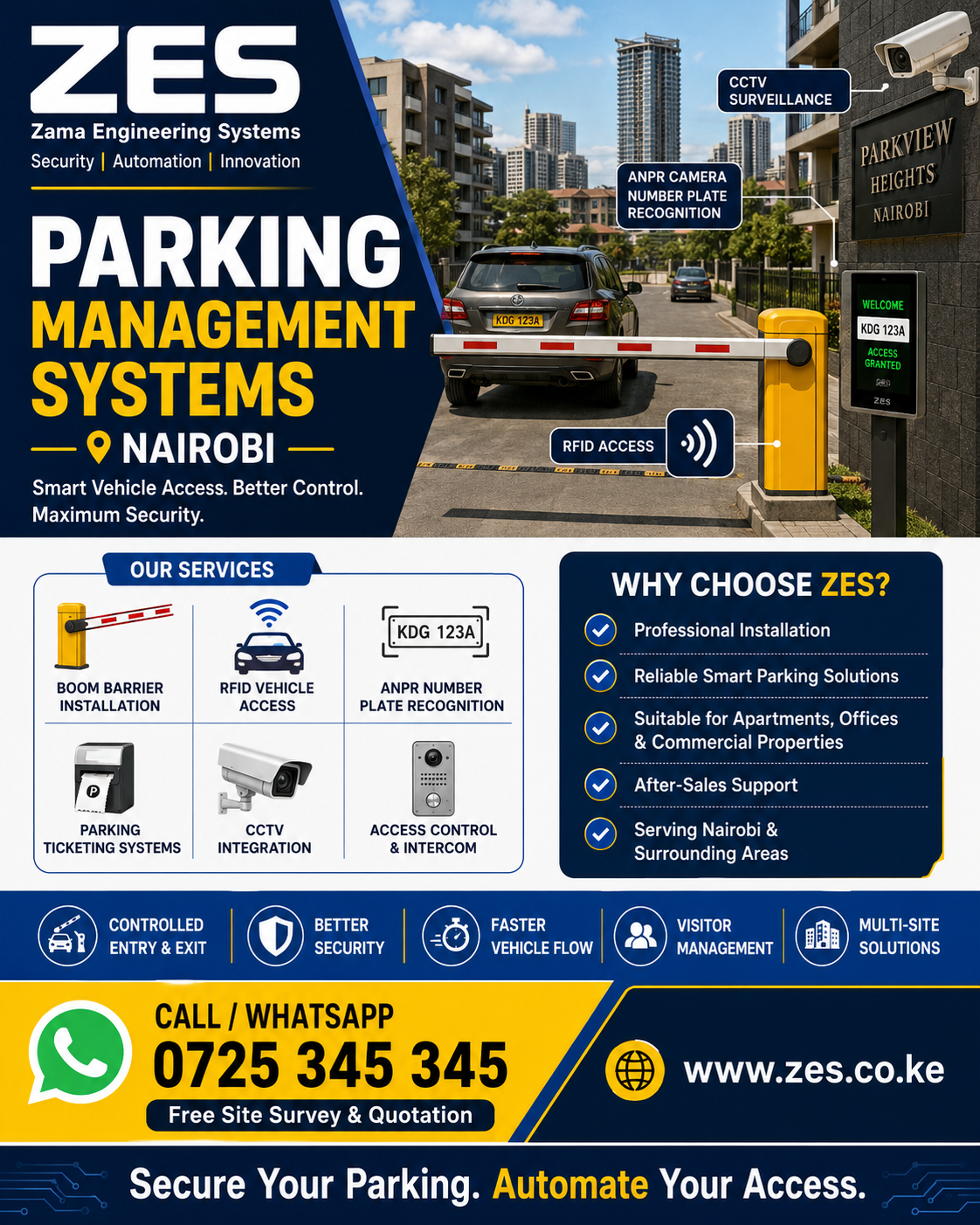
Managing vehicles entering and leaving a property becomes increasingly difficult as the number of residents, employees, customers, visitors, suppliers and vehicles increases. A manual gate and security guard may be enough for a small property, but apartments, office buildings, hotels, hospitals, schools, warehouses, malls and commercial properties often require a more organised approach.
A professional Parking Management System provides a structured way to control vehicle entry, parking access, visitor movement, parking utilisation and security.
At Zama Engineering Systems (ZES), we provide professional Parking Management Systems in Nairobi designed around the needs of residential, commercial, institutional and industrial properties.
A parking management solution may include automatic boom barriers, RFID access, vehicle tags, number plate recognition, CCTV surveillance, intercom communication, automated gates, access-control systems, visitor management and other suitable technologies.
The objective is not simply to automate a barrier.
The objective is to create a parking environment where authorised vehicles can enter conveniently, visitors can be controlled, security teams have better visibility and property administrators can manage access more effectively.
Whether you operate an apartment complex, office building, warehouse, hotel, school, hospital or commercial facility, ZES can assess your entrance, parking arrangement and security requirements before recommending an appropriate solution.
For professional Parking Management Systems Nairobi, call or WhatsApp 0725 345 345 for consultation and a project assessment.
What Is a Parking Management System?
A parking management system is a combination of hardware, software and access-control processes used to manage vehicles entering, using and leaving a parking facility.
The exact system can range from a simple automatic barrier controlled by RFID tags to a larger parking environment incorporating multiple entrances, vehicle identification, CCTV, visitor authorisation and centralised parking administration.
A modern parking system can help answer important questions such as:
- Who is authorised to enter?
- Which vehicle belongs to which user?
- Is the vehicle a resident, employee or visitor?
- Which entrance should the vehicle use?
- When did the vehicle enter?
- When did it leave?
- Should visitors require approval?
- Should unauthorised vehicles be denied access?
- Does the security team need to verify a vehicle before opening the barrier?
- Does management require entry and exit records?
The appropriate system depends on the property.
A ten-unit residential apartment does not necessarily require the same solution as a shopping centre or large commercial building.
This is why ZES approaches parking management from the operational requirement first before selecting equipment.
Why Nairobi Properties Need Better Parking Management
Nairobi continues to have increasingly busy residential and commercial developments.
Apartment buildings may have dozens or hundreds of tenants.
Office complexes may accommodate employees, visitors, suppliers and contractors throughout the day.
Hotels receive guests and service vehicles.
Hospitals receive staff, patients, visitors and emergency vehicles.
Warehouses handle employees, trucks, contractors and suppliers.
Where vehicle movement is not properly managed, several challenges can emerge.
These can include:
- Unauthorised vehicles entering a property
- Congestion at entrances
- Security guards manually checking every vehicle
- Lost or duplicated parking cards
- Difficulty identifying visitors
- Vehicles occupying restricted parking spaces
- Poor records of vehicle entry and exit
- Slow access during busy periods
- Residents sharing access credentials
- Difficulty disabling former users
- Inefficient visitor clearance
- Limited visibility of entrance activity
Installing a suitable parking management system in Nairobi can help property managers create a more structured process.
How Parking Management Systems Work
A parking management system begins when a vehicle approaches an entrance.
The system needs a method of determining whether that vehicle or driver is authorised.
Depending on the installation, this can happen through technologies such as:
- RFID tags
- Access cards
- Number plate recognition
- PIN codes
- Security operator approval
- Intercom approval
- Visitor registration
- Mobile or digital credentials where supported
Once access is authorised, an automatic boom barrier or gate can open.
The vehicle enters the property, and the system can record relevant access information depending on the configuration.
When leaving, the vehicle goes through a similar process at the exit.
More advanced installations can separate entry and exit lanes and use different rules depending on the type of user.
Automatic Boom Barrier Installation Nairobi
Automatic boom barriers are among the most recognisable components of modern parking management systems.
A boom barrier uses a motorised arm to control vehicle movement through an entrance or exit.
The barrier remains closed until an authorised signal is received.
Once access is approved, the barrier arm raises and allows the vehicle to pass.
Boom barriers are commonly suitable for:
- Apartment buildings
- Office complexes
- Parking facilities
- Shopping centres
- Hotels
- Hospitals
- Schools
- Universities
- Warehouses
- Industrial facilities
- Business parks
- Gated communities
- Government facilities
A boom barrier should be selected according to the entrance width, traffic level, required operating frequency and desired control method.
A barrier installed at a small apartment may operate much less frequently than a barrier serving a busy office complex.
The equipment should therefore match actual site requirements.
Boom Barrier Installation with RFID Access
RFID is one of the most practical technologies for parking access control.
An authorised vehicle can be assigned an RFID tag.
When the vehicle approaches the entrance, a compatible reader detects the credential.
If the credential is authorised, the parking system sends a command to open the barrier.
This can reduce the need for drivers to stop and manually present cards, depending on the RFID technology and installation design.
RFID parking systems can be useful for:
- Apartment residents
- Employees
- Registered company vehicles
- Gated community residents
- Hotel staff
- Warehouse vehicles
- Fleet vehicles
A major advantage of controlled credentials is administration.
When a tenant leaves an apartment or an employee leaves a company, their parking access can be removed according to the capabilities of the selected system.
This provides greater control than traditional physical keys or unrestricted remote controls.
RFID Parking Management Systems Nairobi
An RFID Parking Management System Nairobi project should begin by determining how vehicles will be identified and how credentials will be managed.
The administrator may need to store information such as:
- Vehicle registration number
- Vehicle owner
- Apartment number
- Employee name
- Department
- Parking space
- Access status
- RFID identifier
- Allowed entrance
- Access period
This information can help management organise parking access more effectively.
For residential properties, an RFID credential may be associated with a tenant or property owner.
For offices, it can be associated with an employee or company vehicle.
The exact information collected should be appropriate for the organisation’s operational and privacy requirements.
ANPR Parking Management Systems Nairobi
ANPR stands for Automatic Number Plate Recognition.
It uses specialised camera technology and software to identify vehicle registration plates.
Instead of requiring a driver to present an access card, the parking system can compare the detected number plate against authorised vehicle records.
If the vehicle is recognised and authorised, the barrier can be instructed to open according to the system configuration.
ANPR can be particularly useful where organisations want vehicle-based identification.
Potential applications include:
- Office buildings
- Apartments
- Commercial properties
- Hotels
- Private parking facilities
- Corporate headquarters
- Warehouses
- Industrial facilities
- Controlled compounds
However, ANPR systems need to be properly designed.
Camera positioning, lighting, entrance layout, vehicle speed, network connectivity and system configuration can influence performance.
A professional assessment is therefore important before equipment is selected.
ANPR vs RFID Parking Systems
Both ANPR and RFID can provide effective vehicle identification, but they work differently.
RFID
RFID identifies an authorised credential associated with the vehicle or user.
Advantages can include:
- Straightforward user registration
- Convenient resident access
- Good access administration
- Suitable for repeated authorised users
ANPR
ANPR identifies the vehicle using its registration plate.
Advantages can include:
- No physical card needs to be presented
- Vehicle identification can be automated
- Useful for registered vehicle databases
- Can support controlled-entry environments
Some properties may benefit from using both technologies.
For example, permanent users may have RFID access while ANPR and security procedures provide an additional method of vehicle identification.
The ideal solution depends on the customer requirement.
Parking Access Control Systems
Parking access control determines who or what vehicle is allowed through a controlled entrance.
This is one of the most important parts of parking management.
A barrier by itself is simply a physical device.
Access control provides the rules that determine when that barrier should open.
These rules might be based on:
- Registered vehicles
- Approved residents
- Employees
- Visitor authorisation
- Access schedules
- Parking permissions
- Specific entrances
- Security approvals
A commercial building may require employees to use one entrance while delivery vehicles use another.
An apartment may allow registered residents continuous access while visitors require approval.
A warehouse may restrict entry to approved company vehicles and authorised suppliers.
The system should be designed around the actual workflow.
Parking Management Systems for Apartments
Apartment buildings are one of the strongest applications for parking management systems in Nairobi.
Many residential properties now accommodate large numbers of residents and vehicles.
Managing entry manually can become difficult.
A suitable apartment parking management solution can help control:
- Resident vehicles
- Tenant vehicles
- Property owner vehicles
- Visitors
- Delivery vehicles
- Contractors
- Maintenance personnel
- Building management vehicles
Residents can be issued suitable access credentials.
When a tenant moves out, their access can be disabled according to the installed system.
This reduces the risk of former users retaining unrestricted parking access.
Visitor Parking Management for Apartments
Visitors create one of the biggest access-control challenges for apartment buildings.
Residents need visitors to enter conveniently, but management and security also need control.
A visitor-management process can be designed so that visitors are verified before access is granted.
Depending on the system and property procedures, verification may involve:
- Security approval
- Resident confirmation
- Intercom communication
- Visitor registration
- Temporary access permission
The objective is to maintain security without making visitor entry unnecessarily complicated.
Parking Management Systems for Offices
Office buildings typically manage several categories of vehicles.
These can include:
- Employees
- Company vehicles
- Management
- Visitors
- Suppliers
- Contractors
- Delivery vehicles
A structured parking system can help separate permanent users from temporary visitors.
Employees can receive assigned access credentials, while visitors follow an approval process.
Larger organisations may also want parking access linked to broader security infrastructure.
For example, staff vehicle access may operate alongside building access control and CCTV surveillance.
Parking Management for Office Parks
Business parks can be even more complex because multiple companies may share the same parking facilities.
The parking system should accommodate different organisations while providing central administration.
Possible requirements include:
- Company-specific parking permissions
- Employee vehicle registration
- Reserved parking
- Visitor access
- Delivery access
- Contractor access
- Multiple entrance management
- Multiple exit management
A properly designed system can make the shared environment easier to manage.
Parking Management Systems for Shopping Malls
Shopping centres experience constant movement of customer vehicles.
Parking management in this environment is significantly different from residential access control.
A shopping centre may need to consider:
- Customer vehicle entry
- Customer vehicle exit
- Parking duration
- Staff parking
- Tenant parking
- Delivery vehicles
- Supplier access
- VIP parking
- Security monitoring
Depending on requirements, parking systems can include controlled barriers, ticketing technologies, CCTV and parking-payment integrations.
The complete solution should be designed according to traffic patterns and commercial requirements.
Parking Ticketing Systems
Some commercial parking facilities require ticketing.
A driver enters the property and receives an entry record or parking ticket.
When leaving, the system determines the appropriate exit process.
Ticketing systems can be suitable for:
- Commercial parking facilities
- Shopping centres
- Hospitals
- Hotels
- Event venues
- Public parking facilities
Where parking fees are charged, the payment process needs to be integrated into the overall parking workflow according to the selected solution.
A commercial parking system should prioritise reliability and vehicle flow.
A slow payment or exit process can create long queues.
Parking Management Systems for Hotels
Hotels need to manage guests, staff, service providers and visitors.
Unlike apartments where residents are permanent users, hotel guests change constantly.
Parking access should therefore support short-term authorisation.
A hotel solution may need to accommodate:
- Guest vehicles
- Conference attendees
- Restaurant visitors
- Hotel staff
- Suppliers
- Taxi and transport services
- Delivery vehicles
CCTV and controlled entry can provide additional visibility around the entrance.
An intercom can also allow security or reception staff to communicate with arriving visitors where appropriate.
Parking Management Systems for Hospitals
Hospitals require careful parking planning because several vehicle categories use the facility.
These include:
- Doctors
- Nurses
- Employees
- Patients
- Visitors
- Ambulances
- Suppliers
- Service contractors
- Emergency vehicles
Parking management should not interfere with emergency access.
The system should therefore distinguish between normal parking control and critical emergency vehicle movement.
A hospital parking solution may include multiple entrances with different access rules.
Parking Management Systems for Schools
Schools also experience concentrated vehicle traffic.
The busiest periods are normally during arrival and departure.
Vehicles may include:
- Parents
- Teachers
- School buses
- Staff
- Suppliers
- Visitors
A parking system should support safe and organised movement.
Where access controls are installed, emergency and authorised staff procedures should also be considered.
Parking Management for Universities and Colleges
Universities can have hundreds or thousands of students, staff and visitors.
Vehicle management can therefore become challenging.
A campus parking system may support:
- Staff vehicle registration
- Student vehicle permissions
- Visitor access
- Service vehicles
- Security vehicles
- Multiple parking zones
- Controlled campus entrances
Different access permissions can potentially be assigned according to user categories.
Parking Management Systems for Warehouses
Warehouses often have heavy vehicle movement.
Vehicles can include:
- Employee cars
- Delivery vans
- Company vehicles
- Trucks
- Suppliers
- Contractors
- Customer vehicles
Unlike a small apartment entrance, a warehouse barrier may need to accommodate frequent commercial traffic.
The site assessment should consider vehicle size, road layout and loading operations.
Security teams may also need clear records of supplier and delivery vehicles.
Parking Management Systems for Factories
Manufacturing facilities may need structured vehicle access for both security and operational reasons.
The entrance could serve:
- Employees
- Management
- Trucks
- Suppliers
- Contractors
- Customers
- Company vehicles
Parking access may be integrated with wider site security.
For example, CCTV can monitor entrances while access control manages authorised vehicles and controlled personnel areas.
This creates a more coordinated security environment.
Parking Management Systems for Gated Communities
Large estates and gated communities can contain hundreds of homes.
Manual entry procedures can become inconvenient for both residents and guards.
Residents should be able to enter efficiently while visitors remain controlled.
Possible technologies include:
- RFID vehicle tags
- Registered vehicle databases
- Automatic barriers
- Intercoms
- Visitor-management systems
- CCTV
- ANPR
The exact system depends on the estate’s policies, number of residents and entrance layout.
Parking Management Systems for Churches
Churches can experience significant parking traffic during services and events.
A church property may need to handle:
- Members
- Visitors
- Staff
- Weddings
- Conferences
- Funerals
- Special events
A parking-management design can help coordinate entrances and exits while maintaining security.
Large churches may benefit from vehicle direction, controlled areas and CCTV coverage of entrance points.
CCTV Integration with Parking Management Systems
CCTV is an important component of many parking-security environments.
A parking system controls vehicle movement while CCTV provides visual monitoring.
Cameras can be positioned around:
- Vehicle entrances
- Vehicle exits
- Boom barriers
- Parking areas
- Payment areas
- Visitor checkpoints
- High-risk parking zones
Recorded video can help investigate incidents and verify vehicle activity.
For organisations installing CCTV and parking systems together, network and cabling infrastructure should ideally be planned together.
Intercom Integration with Parking Systems
An intercom can support visitor communication.
When a visitor arrives at a controlled entrance, they can contact security, reception or the relevant resident.
The responsible person can then verify the visitor before granting access according to property procedures.
Intercoms can be particularly useful for:
- Apartments
- Offices
- Gated communities
- Hotels
- Warehouses
- Private compounds
Video intercom systems may additionally provide visual identification.
Automatic Gate Integration
Some properties already have sliding or swing gates rather than boom barriers.
A parking-management system can potentially control an automatic gate instead.
For example, authorised vehicles can trigger the gate through RFID or another compatible access system.
Whether a boom barrier or full gate is more appropriate depends on the site.
A gate provides a complete physical closure of the entrance.
A boom barrier primarily controls vehicle movement while usually leaving pedestrian access arrangements separate.
In some high-security environments, both can be used for different purposes.
Parking Management and Biometric Access Control
Vehicle access and pedestrian access often need to work together.
A factory employee might drive through a parking barrier and later use biometric authentication to enter a controlled workplace area.
An office employee might use RFID for parking and an access card for office doors.
These systems do not necessarily need to use identical technology.
The important factor is creating a logical security workflow.
ZES can assess parking, door access, CCTV and related infrastructure as parts of the same security environment.
Multiple Entry and Exit Parking Systems
Large properties often have more than one entrance or exit.
A parking management system can be designed around:
- Multiple entry barriers
- Multiple exit barriers
- Separate resident entrances
- Visitor entrances
- Staff entrances
- Delivery entrances
- VIP entrances
Permissions can potentially differ depending on the access point.
For example, delivery vehicles may be directed through a service entrance rather than the main visitor entrance.
This improves traffic organisation and security.
Parking Management System Reports
Depending on the selected parking software, administrators may have access to useful parking and vehicle information.
Reports can potentially include:
- Vehicle entry history
- Vehicle exit history
- Registered vehicles
- Active access credentials
- Disabled credentials
- Visitor records
- Parking usage information
The exact reporting features depend on the selected platform.
Businesses should define reporting requirements before implementation so the system can be scoped appropriately.
Network Requirements for Smart Parking Systems
Many modern parking systems use network-connected components.
These may include:
- ANPR cameras
- CCTV cameras
- Parking servers
- Access-control controllers
- Intercoms
- Management computers
Reliable network infrastructure can therefore become an important part of the project.
For larger parking systems, network design should consider:
- Cable distances
- Structured cabling
- Network switches
- Fibre where required
- Equipment cabinets
- Internet requirements
- Local network reliability
- Power protection
Poor network infrastructure can affect an otherwise well-designed parking solution.
Backup Power for Parking Management Systems
Parking entrances are operationally important.
A power interruption should therefore be considered during system design.
Possible backup arrangements depend on the equipment installed.
Solutions may include suitable UPS systems, battery-supported equipment or wider building backup power.
Critical questions include:
- What happens when power fails?
- Can the barrier be manually operated?
- Does security know the emergency procedure?
- Does the controller retain configuration?
- How long should backup operation continue?
Backup requirements should be determined before implementation.
Parking Management System Installation Process
ZES approaches parking management projects through a structured process.
Step 1: Requirements Discussion
We first understand:
- Property type
- Location
- Number of entrances
- Number of exits
- Approximate number of vehicles
- User categories
- Visitor requirements
- Security requirements
- Existing infrastructure
Step 2: Site Survey
A technical site assessment can verify:
- Entrance dimensions
- Road layout
- Barrier positions
- Cable routes
- Network availability
- Power availability
- Camera positions
- Security office location
- Equipment installation points
Step 3: System Design
The proposed parking system is selected according to the actual requirement.
Step 4: Quotation
The project scope is documented together with equipment, installation requirements and assumptions.
Step 5: Installation
Equipment can then be installed according to the approved scope.
Step 6: Configuration
Access permissions, authorised vehicles and relevant operating rules are configured.
Step 7: Testing
The system is tested using normal operating scenarios.
Step 8: Training and Handover
Relevant administrators and security personnel receive guidance on operating the system.
Step 9: Support and Maintenance
Ongoing maintenance requirements can be planned according to the system and site.
Parking Management System Cost in Nairobi
One of the most common questions is:
How much does a Parking Management System cost in Nairobi?
There is no single price because parking systems vary significantly.
A simple single-lane apartment entrance with one automatic barrier and RFID access will have a different scope from a commercial parking facility with multiple barriers, ANPR, ticketing, CCTV and parking-management software.
Important pricing factors include:
Number of Entrances and Exits
More lanes generally require additional equipment.
Barrier Type
Different automatic boom barriers have different capabilities.
RFID Requirements
The number of users, tags and readers affects the system.
ANPR Requirements
Number plate recognition requires appropriate cameras, software and supporting infrastructure.
CCTV
Additional cameras and storage requirements affect scope.
Visitor Management
More advanced visitor workflows can require additional technology.
Parking Software
Software requirements vary according to functionality.
Networking
New structured cabling or network infrastructure may be required.
Electrical Installation
Power routes, protection and backup systems can affect project cost.
Civil Works
Some sites require bases, trenching, protective structures or other construction work.
Integration Requirements
Integrating multiple systems can require additional engineering and configuration.
For an accurate quotation, ZES recommends assessing the actual site and requirements.
Call or WhatsApp 0725 345 345 to discuss your parking project.
What Makes a Good Parking Management System?
A good system should not simply have impressive technology.
It should solve the property’s real problems.
A strong parking solution should be:
Reliable
The entrance should function consistently during normal operations.
Easy to Use
Residents, employees, guards and administrators should understand how the system works.
Secure
Unauthorised vehicle access should be appropriately controlled.
Manageable
Administrators should be able to manage access without unnecessary complexity.
Scalable
Where possible, the system should accommodate future growth.
Maintainable
Equipment should be accessible for servicing and maintenance.
Integrated
Where appropriate, parking systems should work alongside CCTV, intercoms, access control and networking.
Common Parking Management Problems
Poorly planned parking systems can create more problems than they solve.
Common issues can include:
- Slow barrier opening
- Long vehicle queues
- RFID credentials not being recognised
- Poorly positioned readers
- Weak network connectivity
- Camera identification problems
- Lost cards remaining active
- Poor visitor-management procedures
- Barriers frequently breaking down
- No backup power
- Insufficient security training
Many of these problems can be reduced through better design, installation and ongoing maintenance.
Parking Management System Maintenance
Like any combination of mechanical, electronic and software systems, parking infrastructure requires maintenance.
Maintenance may include:
- Boom barrier inspection
- Mechanical component checks
- Reader testing
- Access-controller checks
- CCTV inspection
- Network checks
- Software review
- Power-system checks
- Access credential review
- Database housekeeping
- Backup-power inspection
High-traffic properties may require more frequent attention than small residential installations.
Why Choose ZES for Parking Management Systems Nairobi?
A parking management project can involve much more than installing a barrier.
The complete solution may require expertise in:
- Security systems
- Access control
- CCTV
- Automation
- Electrical systems
- Networking
- Gate automation
- Intercoms
- Software integration
- Technical maintenance
Zama Engineering Systems provides solutions across these related areas, allowing the parking entrance to be considered as part of the wider property infrastructure.
For example, an apartment project might require:
- Automatic boom barrier
- RFID vehicle access
- CCTV cameras
- Intercom
- Visitor management
- Automatic pedestrian gate
- Network installation
- Backup power
- Maintenance support
Planning these requirements together can create a cleaner and more manageable implementation.
Parking Management Systems Nairobi Areas We Serve
ZES accepts parking-management enquiries across Nairobi and surrounding areas, including:
- Nairobi CBD
- Westlands
- Parklands
- Kilimani
- Kileleshwa
- Lavington
- Karen
- Lang’ata
- South B
- South C
- Embakasi
- Industrial Area
- Kasarani
- Roysambu
- Ruaraka
- Donholm
- Utawala
- Ruai
- Runda
- Gigiri
- Muthaiga
- Kiambu Road
- Thika Road
- Eastern Bypass
- Ruiru
- Kamakis
- Juja
- Syokimau
- Athi River
- Kitengela
- Kiambu
- Thika
ZES can also assess projects in other parts of Kenya depending on site location and project scope.
Frequently Asked Questions About Parking Management Systems
What is a parking management system?
It is a system used to control and manage vehicle entry, exit, parking access and related security procedures.
Can you install boom barriers in Nairobi?
Yes. Automatic boom barriers can form part of parking access-control solutions for apartments, offices, hotels, schools, warehouses and commercial properties.
Can residents use RFID tags?
Yes. RFID is commonly used to identify authorised vehicles or users depending on the system selected.
What is ANPR?
ANPR means Automatic Number Plate Recognition. It uses camera and software technology to identify vehicle registration plates.
Can number plates automatically open a barrier?
A compatible ANPR and access-control solution can potentially authorise registered vehicles and trigger the barrier according to configured rules.
Can CCTV be integrated with parking management?
Yes. CCTV can monitor entrances, exits and parking areas.
Can visitors be managed separately?
Yes. Visitor access can use different procedures from permanent residents or employees.
Can parking systems work in apartments?
Yes. Apartment buildings are one of the most common applications for controlled parking access.
Can parking systems work for offices?
Yes. Employees, company vehicles, visitors and suppliers can be managed using appropriate access processes.
Can you manage more than one entrance?
Yes. Parking systems can be designed for multiple entrances and exits according to the project.
Can a parking system work during a blackout?
This depends on the power and backup design. Backup requirements should be assessed during system planning.
How much does a parking system cost in Kenya?
Pricing depends on the number of barriers, entrances, users, identification method, software, CCTV, networking, electrical work and integrations required.
Does ZES offer maintenance?
Maintenance and technical-support requirements can be included according to the installed solution and customer requirements.
Do you install outside Nairobi?
Projects elsewhere in Kenya can be assessed according to location, logistics and project scope.
Get Professional Parking Management Systems in Nairobi
Parking is one of the most important access points for apartments, commercial buildings, hotels, hospitals, schools, warehouses and industrial properties.
Leaving vehicle access entirely dependent on manual processes can become inefficient as a property grows.
A properly designed Parking Management System can provide a more structured method of controlling vehicles, visitors and parking access.
ZES can help you design a parking solution incorporating the technologies appropriate for your property.
Depending on your requirements, this may include:
- Automatic boom barriers
- RFID parking access
- ANPR number plate recognition
- Vehicle access control
- Automatic gates
- CCTV surveillance
- Intercom systems
- Visitor management
- Parking software
- Entry and exit controls
- Networking
- Backup power
- Technical support and maintenance
The first step is understanding your site.
Request a Parking Management System Site Assessment
When contacting ZES, provide:
- Property location
- Property type
- Number of vehicle entrances
- Number of vehicle exits
- Approximate number of vehicles
- Whether users are residents, staff, customers or mixed
- Visitor-management requirements
- Whether you want RFID or ANPR
- Whether CCTV is required
- Any existing gate or barrier infrastructure
Call / WhatsApp ZES: 0725 345 345
Website: www.zes.co.ke
Whether you are searching for Parking Management Systems Nairobi, Parking Management System Kenya, Boom Barrier Installation Nairobi, RFID Parking System Kenya, ANPR Parking System Nairobi, Vehicle Access Control Kenya or Automatic Parking Systems Nairobi, ZES can assess your property and develop a solution around your operational and security requirements.
ZES – Security, Access Control, Automation, CCTV & Smart Infrastructure Solutions.