
Updated 4 November 2026 · Zama Engineering Systems buyer guide
Remote CCTV Monitoring Kenya can mean owner viewing from another location, central review across business branches or a separately contracted monitoring arrangement. Those scopes carry different responsibilities. This guide helps ZES customers define the intended service, the authorised users and the response process before accepting a remote-viewing setup. A mobile application alone does not establish a staffed monitoring service or a guaranteed response.
Choose the operational model first
State whether a manager wants occasional playback, a central team needs access to several sites, or a customer is seeking a staffed monitoring proposal. Identify the hours and responsibilities required. Have the quotation describe the offered model clearly, including any work supplied by another party. Do not infer continuous human supervision, alarm verification or physical response from the phrase remote monitoring. Confirm availability and commercial terms for the actual enquiry.
Remote CCTV Monitoring Kenya: allocate account permissions
Nominate the customer owner who approves users and access changes. Separate live viewing, playback, export and system administration according to each role. Explain what happens when a member of staff changes duties or leaves. The handover process should preserve customer control of recovery arrangements and document any agreed support access. Keep credentials and private access details out of general sales emails or publicly available project documentation.
Set expectations for internet and site dependencies
Ask the installer to explain which functions need a working connection and which recording functions remain available locally. Identify responsibility for the site's internet service and power. If several people or branches will connect, include that usage in the technical assessment. A remote-viewing fault does not necessarily mean the cameras stopped recording. An agreed support checklist should help the customer report the affected function accurately without attempting insecure workarounds.
Document the review and response workflow
Define who receives a concern, who is authorised to examine footage and who decides the next action. State the distinction between a technical support enquiry and an operational security incident. Where a separate service provider is involved, establish the relevant service boundaries and written terms. Do not promise response times through a general marketing page. Keep access to recordings and exports limited to the customer's authorised process and people.
Test the customer experience at handover
Use the approved remote arrangement to demonstrate the requested views, playback and a sample export where included. Check the customer's intended device and authorised account, rather than demonstrating only on the technician's phone. Record the system references, support route and recurring dependencies. Axis's security documentation is useful background for an access design that avoids unnecessarily exposing video equipment; the selected products and customer policy determine the final arrangement.
Compare the supplied scope
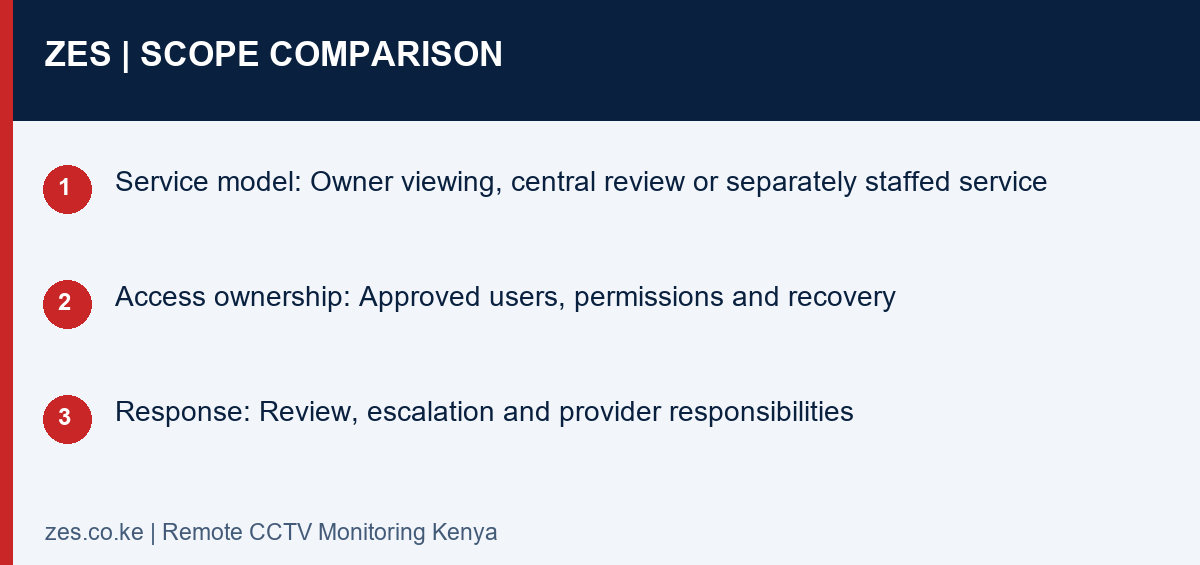
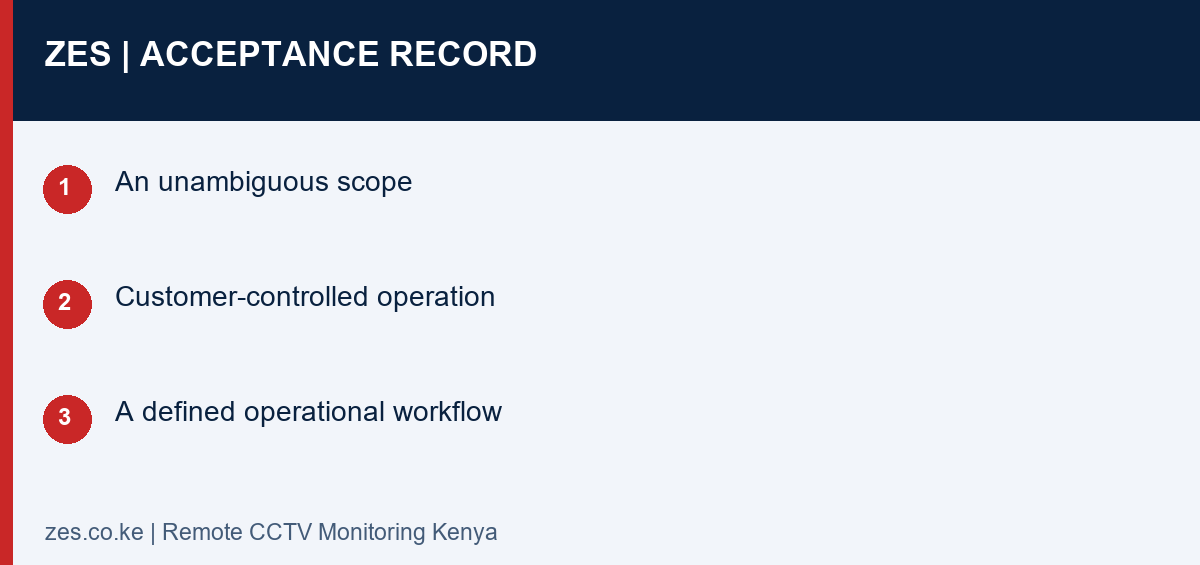
| Decision | Information to confirm | Useful result |
|---|---|---|
| Service model | Owner viewing, central review or separately staffed service | An unambiguous scope |
| Access ownership | Approved users, permissions and recovery | Customer-controlled operation |
| Response | Review, escalation and provider responsibilities | A defined operational workflow |
A practical planning example
A company with two shops may want its manager to review recorded events remotely while local staff handle day-to-day operations. That request is different from paying an operator to watch continuously. The proposal should describe the specific access and training offered, then record any separate monitoring or response arrangement. This scenario does not claim ZES operates a continuously staffed control room.
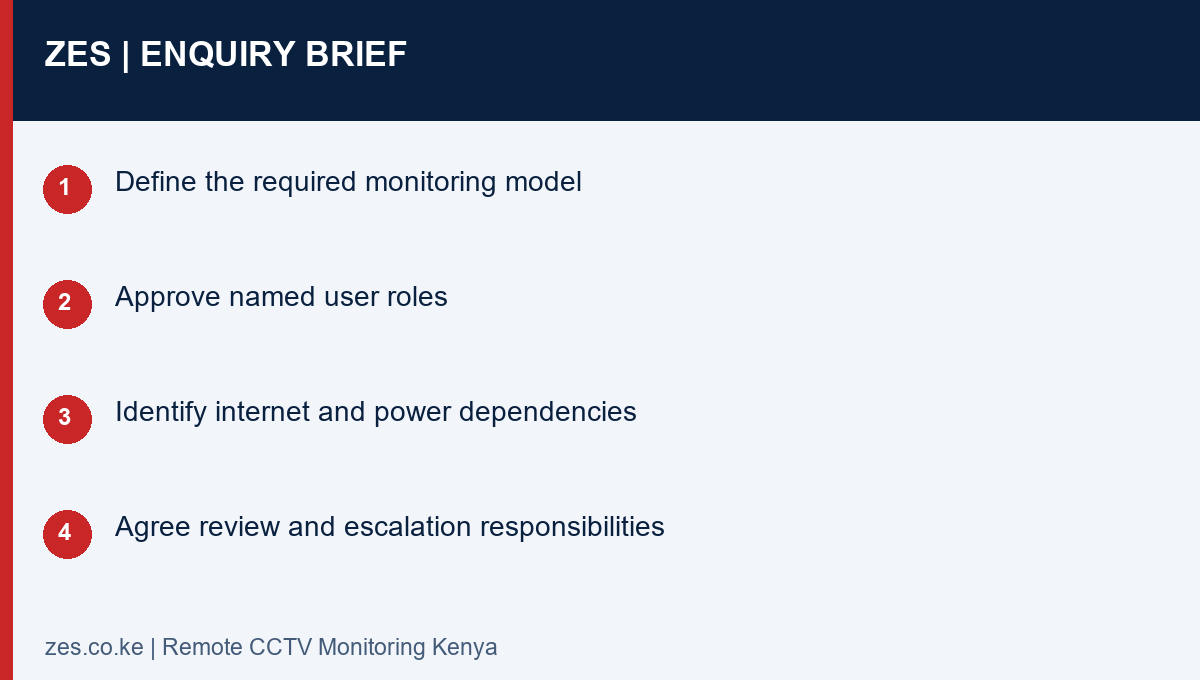
Remote CCTV Monitoring Kenya: enquiry checklist
- Define the required monitoring model
- Approve named user roles
- Identify internet and power dependencies
- Agree review and escalation responsibilities
Questions before commissioning
Does remote access include a human watching the cameras?
Only if a specific staffed service is agreed in writing. Ordinary remote viewing is a technical access function.
Can ZES guarantee a response from a general enquiry?
Response arrangements, availability and any service commitments must be confirmed for the assessed proposal.
Discuss your CCTV requirement with ZES
Read the related ZES CCTV planning guide and explore CCTV surveillance services. Share the location, equipment information and intended outcome. ZES confirms the appropriate assessment, availability, proposed delivery responsibilities and commercial terms for the actual enquiry.
Request a scoped quotation · Request a site assessment · Call +254 725 345 345
Technical background: Axis secure remote-access background. Confirm the actual project requirements with the responsible advisers and relevant product information.
More detailed project planning
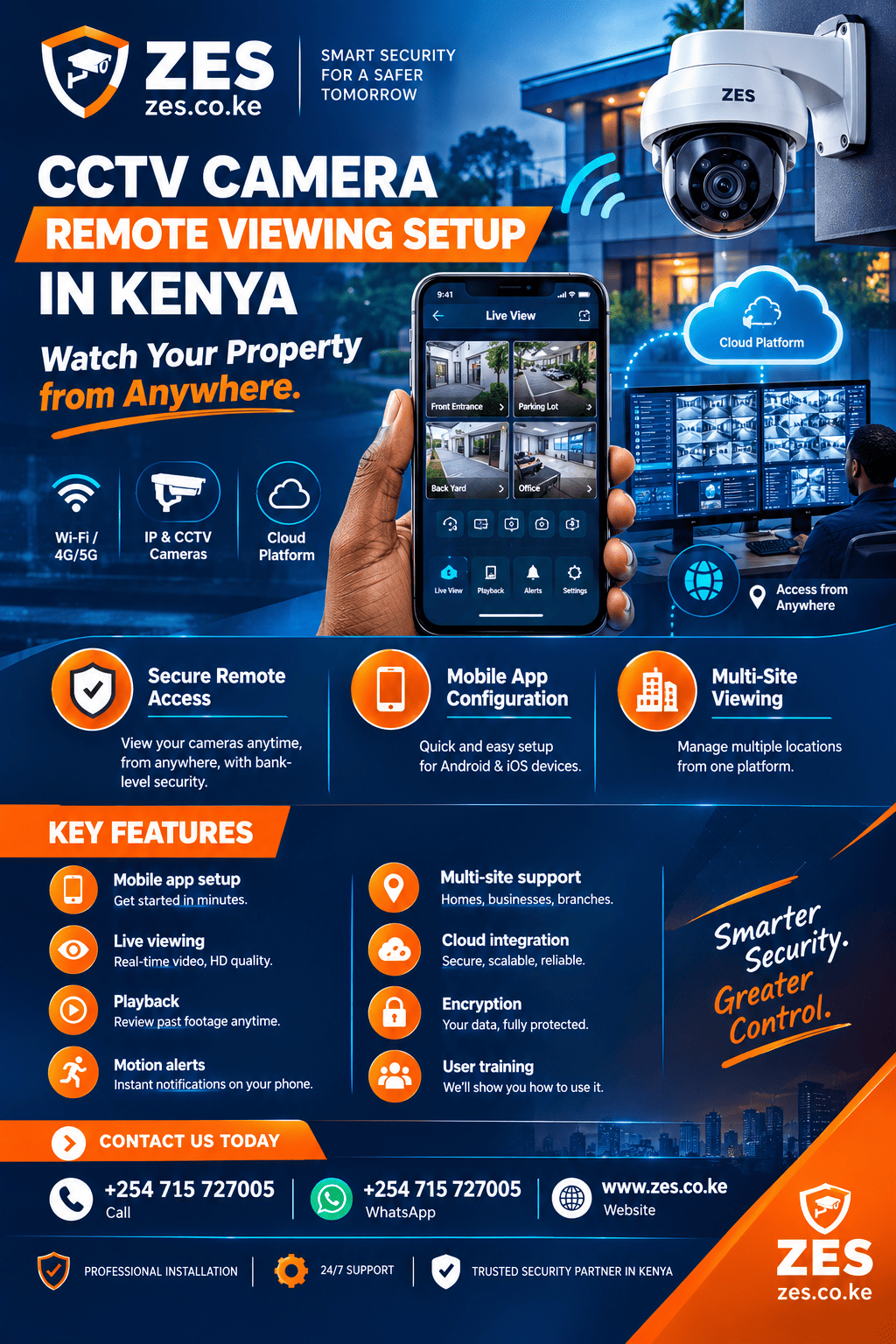
CCTV camera remote viewing setup in Kenya has become one of the most requested services we deliver, because business owners and homeowners increasingly want to see what is happening at their premises without being physically present. At zes.co.ke, we understand that CCTV camera remote viewing setup in Kenya is not simply about installing an app on your phone—it is about building a secure, reliable path between your cameras and your device. Whether you manage a shop in Nairobi, a warehouse in Mombasa, or a home in Kisumu, professional CCTV camera remote viewing setup in Kenya determines whether you can actually see your property when it matters.
The demand for CCTV camera remote viewing setup in Kenya has grown alongside internet penetration and smartphone adoption. Years ago, remote viewing was a premium feature available only on high-end systems. Today, most modern recorders and cameras support some form of remote access. However, the difference between a working remote viewing setup and a frustrating one lies in the details—network configuration, security, bandwidth, and app selection. That is where professional CCTV camera remote viewing setup in Kenya makes a measurable difference.
At zes.co.ke, we have completed CCTV camera remote viewing setup in Kenya for clients across retail, logistics, hospitality, education, and residential sectors. Each project begins with understanding how the client wants to use remote viewing. Some need live viewing during specific hours. Others need playback of recorded events. A few need alerts pushed to their phones when motion is detected. The right CCTV camera remote viewing setup in Kenya reflects these different needs.
Why Remote Viewing Matters for Kenyan Businesses
Business owners cannot be everywhere. A retail chain owner in Nairobi may have branches in Nakuru and Eldoret. A logistics operator may have trucks and yards spread across the country. A homeowner may travel frequently for work. Remote viewing through a properly configured CCTV camera remote viewing setup in Kenya allows these users to monitor their assets from anywhere with an internet connection.
Beyond convenience, remote viewing supports faster response. When an alarm triggers, the ability to view live footage allows owners or security teams to verify whether the alert is genuine before dispatching response. This reduces false alarm costs and improves response effectiveness. A reliable CCTV camera remote viewing setup in Kenya turns a passive recording system into an active monitoring tool.
Remote viewing also supports investigations. When an incident occurs, footage can be reviewed immediately rather than waiting until someone can physically access the recorder. This speed can be critical for identifying suspects, recovering stolen goods, or resolving disputes. Professional CCTV camera remote viewing setup in Kenya ensures that footage is accessible when it is needed.
The Core Components of Remote Viewing
Every remote viewing setup involves several components working together. Understanding these components helps clients appreciate what professional CCTV camera remote viewing setup in Kenya involves. The first component is the camera itself—its resolution, compression, and streaming capability determine the quality of what you see remotely. The second is the recorder or cloud platform that stores and distributes footage. The third is the network that connects the system to the internet. The fourth is the app or platform through which you view footage. The fifth is the security layer that protects the entire chain.
Weakness in any component affects the whole. A high-resolution camera on a poor network will stream poorly. A powerful recorder with weak security exposes your footage to unauthorised viewers. A good app on an unreliable connection frustrates users. Professional CCTV camera remote viewing setup in Kenya addresses all components together.
Network Requirements for Reliable Remote Viewing
Internet connectivity is the foundation of remote viewing. Upload speed matters more than download speed for remote viewing because the cameras must send video to your device. Many Kenyan internet packages advertise high download speeds but modest upload speeds. Before committing to CCTV camera remote viewing setup in Kenya, we assess upload capacity to ensure smooth streaming.
Bandwidth requirements depend on camera count and resolution. A single 1080p camera streaming at moderate quality requires roughly 2-4 Mbps upload. Multiple cameras streaming simultaneously multiply this requirement. Higher resolutions demand more bandwidth. A professional CCTV camera remote viewing setup in Kenya balances quality and bandwidth to match the available connection.
Stability matters as much as speed. Connections that drop frequently interrupt remote viewing. Where primary connections are unreliable, backup options such as 4G failover can maintain connectivity. For sites without fixed internet, 4G cameras with built-in SIM slots can provide remote viewing without any wired connection. Professional CCTV camera remote viewing setup in Kenya considers these options based on site conditions.
Choosing the Right Remote Viewing Method
Several methods exist for achieving remote viewing, each with trade-offs. Port forwarding exposes the recorder directly to the internet, allowing apps to connect. This method works but carries security risks if not configured carefully. Peer-to-peer (P2P) services use cloud brokers to establish connections without exposing the recorder. P2P is simpler to configure but depends on the manufacturer’s servers.
Cloud platforms stream footage to vendor-hosted servers, which users access through web portals or apps. Cloud platforms offer strong security and easy access but may involve subscription costs and depend on upload bandwidth. VPN access requires users to connect to the office network before viewing cameras. VPNs offer strong security but add a step for users.
The best CCTV camera remote viewing setup in Kenya depends on the client’s priorities—simplicity, security, cost, or reliability. At zes.co.ke, we help clients choose the method that fits their situation.
Security Considerations for Remote Viewing
Remote viewing introduces security risks that must be managed. Exposed recorders are scanned constantly by automated tools looking for default passwords and known vulnerabilities. A poorly secured CCTV camera remote viewing setup in Kenya can be accessed by strangers, who may view live feeds or manipulate recordings.
Strong passwords are the first line of defence. Default credentials must be changed. Passwords should be unique and complex. Where supported, two-factor authentication adds another layer. Firmware must be kept updated to address known vulnerabilities.
Encryption protects footage in transit. HTTPS and TLS should be used where available. Some systems support end-to-end encryption, ensuring that even the manufacturer cannot view footage. Where encryption is not supported, the system should not be exposed directly to the internet.
Network segmentation limits the impact of any compromise. Cameras and recorders should reside on separate network segments from business systems, with firewalls controlling traffic between segments. This prevents a compromised camera from becoming a gateway to sensitive data.
At zes.co.ke, security is built into every CCTV camera remote viewing setup in Kenya we deliver. We do not leave clients exposed.
Mobile Apps and User Experience
The app is where remote viewing becomes real for users. A good app is intuitive, responsive, and reliable. It should allow live viewing, playback, and alerts with minimal friction. It should work on the devices users actually carry—Android and iOS smartphones, tablets, and sometimes desktop browsers.
Different manufacturers offer different apps with different strengths. Some excel at live viewing. Others excel at playback and search. Some support multiple sites from a single login, which is valuable for owners with several branches. At zes.co.ke, we help clients select systems with apps that match their needs.
Training is part of the service. We show clients how to log in, view live feeds, review recordings, and manage alerts. We explain how to share access with family members or staff securely. A well-configured CCTV camera remote viewing setup in Kenya is only useful if users know how to operate it.
Remote Viewing for Multi-Site Operations
Organizations with multiple locations face additional complexity. Each site may have its own recorder and cameras. Owners want to view all sites without logging into separate systems. Professional CCTV camera remote viewing setup in Kenya can unify multiple sites under a single platform.
Options include cloud platforms that aggregate multiple recorders, central management software that connects to remote sites, and mobile apps that support multiple systems. Each approach has trade-offs in cost, complexity, and features. At zes.co.ke, we design multi-site CCTV camera remote viewing setup in Kenya that gives owners the visibility they need without overwhelming complexity.
Bandwidth Optimisation Techniques
Not every site has abundant upload bandwidth. Professional CCTV camera remote viewing setup in Kenya includes techniques to work within constraints. Substreams provide lower-resolution streams for remote viewing while the main stream records at full quality. This reduces bandwidth demand without sacrificing recording quality.
Motion-based streaming sends video only when activity is detected, reducing continuous bandwidth usage. Scheduled streaming limits remote access to specific hours. Quality adjustment allows users to reduce resolution when bandwidth is tight.
These techniques make remote viewing feasible even on modest connections. At zes.co.ke, we configure systems to balance quality, bandwidth, and reliability based on each client’s connectivity.
Troubleshooting Common Remote Viewing Issues
Remote viewing problems are common and usually traceable to specific causes. If live view does not load, the issue may be internet connectivity, incorrect app configuration, or firewall blocking. If video is choppy, bandwidth may be insufficient. If playback fails, storage or indexing may be at fault. If alerts do not arrive, notification settings may be misconfigured.
Professional CCTV camera remote viewing setup in Kenya includes documentation and support to resolve these issues quickly. We provide clients with reference guides and access to support when problems arise. Remote troubleshooting can resolve many issues without a site visit.
Integrating Remote Viewing with Alarms and Access Control
Remote viewing becomes more powerful when integrated with other systems. When an alarm triggers, the system can push a notification with a link to live footage. When an access-controlled door opens outside permitted hours, video can be attached to the event. When motion is detected in a restricted area, an alert can include a snapshot.
These integrations make CCTV camera remote viewing setup in Kenya more than passive monitoring—it becomes part of an active security strategy. At zes.co.ke, we design integrations that connect remote viewing with alarms, access control, and intercom systems.
{{VIDEO_EMBED: Insert a 2-minute video here showing a user viewing live CCTV footage on a smartphone, reviewing recorded events, and receiving a motion alert, with commentary on each step.}}
Residential Remote Viewing
Homeowners increasingly request remote viewing to monitor their properties, check on domestic staff, and verify deliveries. Residential CCTV camera remote viewing setup in Kenya often uses Wi-Fi cameras with cloud connectivity, avoiding the need for a recorder. Mobile apps make viewing simple for family members.
Security considerations remain important. Home networks are often less protected than business networks. Default passwords, outdated routers, and unsecured Wi-Fi create risks. Professional CCTV camera remote viewing setup in Kenya for homes includes securing the network, configuring cameras properly, and training homeowners on safe practices.
Business Remote Viewing
Businesses have broader requirements. They may need to view multiple cameras, review extended recordings, and manage user access for staff. They may need to integrate remote viewing with existing security systems. They may need to satisfy compliance requirements around data protection.
Professional CCTV camera remote viewing setup in Kenya for businesses addresses these requirements. We design systems that scale, integrate, and comply. We document configurations for audit purposes. We train staff on proper use.
Remote Viewing for Landlords and Property Managers
Landlords and property managers use remote viewing to monitor common areas, verify maintenance work, and respond to tenant concerns. Remote viewing allows them to check on properties without travelling to each site. Integration with access control allows them to verify who entered and when.
Professional CCTV camera remote viewing setup in Kenya for rental properties balances security with privacy. Cameras should cover common areas, entrances, and perimeters—not private living spaces. Signage informs tenants of camera coverage. Data is handled in accordance with the Data Protection Act.
The Installation and Configuration Process
Professional CCTV camera remote viewing setup in Kenya follows a structured process. We begin with an assessment of the existing system, network, and client requirements. We identify what will be needed—configuration changes, additional hardware, or network upgrades.
Configuration follows. We set up remote access, configure the app, test connectivity, and secure the system. We verify that live view, playback, and alerts work as expected on the client’s devices.
Training ensures that clients can use the system. We demonstrate each function and provide reference materials. We encourage clients to test remote viewing themselves while we are available to assist.
Documentation completes the process. We provide configuration records, login details, and support contact information. Clients know how to reach us if issues arise.
At zes.co.ke, every CCTV camera remote viewing setup in Kenya project is managed from assessment to handover.
Maintenance and Support
Remote viewing setups require occasional maintenance. Firmware updates address security vulnerabilities. App updates add features and fix bugs. Network changes may require reconfiguration. Passwords should be changed periodically.
Support is essential when issues arise. A remote viewing system that fails when the owner is travelling is frustrating and potentially costly. Professional CCTV camera remote viewing setup in Kenya includes support arrangements that ensure problems are resolved quickly.
At zes.co.ke, we offer maintenance and support contracts for remote viewing systems. We monitor system health, apply updates, and respond to issues. Clients know they can rely on their systems.
Cost Considerations
While specific pricing is not provided here, the cost of CCTV camera remote viewing setup in Kenya depends on several factors. If the existing system supports remote viewing, configuration may be straightforward. If not, additional hardware or a new recorder may be required. Network upgrades may be needed to support streaming. Cloud subscriptions may apply for cloud-based solutions.
Total cost of ownership includes ongoing bandwidth, subscriptions, and maintenance. Clients should consider these when evaluating options. At zes.co.ke, we provide transparent advice on costs and help clients choose solutions that fit their budgets.
Common Mistakes in Remote Viewing Setup
Several mistakes recur in CCTV camera remote viewing setup in Kenya. Using default passwords exposes systems to compromise. Exposing recorders directly to the internet without security measures invites attacks. Failing to test remote viewing before handover leaves clients frustrated when they try to use it.
Underestimating bandwidth leads to poor video quality. Ignoring updates leaves known vulnerabilities unpatched. Skipping training means clients cannot use the features they have paid for. At zes.co.ke, we help clients avoid these mistakes through professional configuration and support.
Applications Across Kenyan Sectors
Retail businesses use CCTV camera remote viewing setup in Kenya to monitor stores, verify deliveries, and investigate shrinkage. Owners can view branches across the country from a single app.
Warehouses use CCTV camera remote viewing setup in Kenya to monitor yards, loading bays, and storage areas. Managers can check activity during shifts without being on site.
Homes use CCTV camera remote viewing setup in Kenya to monitor entrances, driveways, and perimeters. Homeowners travelling abroad can check on their properties at any time.
Schools use CCTV camera remote viewing setup in Kenya to monitor campuses and verify incidents. Administrators can review footage without visiting the security office.
Clinics and pharmacies use CCTV camera remote viewing setup in Kenya to protect staff and assets. Remote viewing allows managers to monitor multiple locations.
Corporate offices use CCTV camera remote viewing setup in Kenya for access monitoring and incident investigation. Security teams can view entrances and common areas remotely.
The Future of Remote Viewing
Remote viewing technology continues to evolve. Higher resolutions and better compression improve quality while reducing bandwidth. AI analytics identify events and push smart alerts. Cloud platforms simplify management and enable new features.
Mobile-first design ensures that apps are optimised for smartphones. Integration with smart home and building systems expands what remote viewing can do. Cybersecurity features improve as manufacturers respond to threats.
At zes.co.ke, we stay current with these developments. Our recommendations reflect the best available options for each client’s needs.
Frequently Asked Questions
Q: Can I view my CCTV cameras from my phone?
A: Yes, with proper configuration. Most modern systems support mobile apps for live viewing and playback.
Q: What internet speed do I need for remote viewing?
A: Upload speed matters most. A single camera may need 2-4 Mbps; multiple cameras require more.
Q: Can I view cameras without internet?
A: Local viewing works without internet, but remote viewing requires connectivity. 4G options exist for sites without fixed internet.
Q: Is remote viewing secure?
A: Yes, when configured properly. Strong passwords, encryption, and network segmentation protect access.
Q: How many users can access remote viewing?
A: Most systems support multiple users with different permission levels. Access should be managed carefully.
Q: What happens if the internet goes down?
A: Local recording continues. Remote viewing resumes when connectivity returns.
Q: Can I receive alerts with images?
A: Yes, most systems push alerts with snapshots when motion is detected.
Q: Does remote viewing work internationally?
A: Yes, as long as you have internet access wherever you are.
Investing in professional CCTV camera remote viewing setup in Kenya is a strategic decision that gives you visibility over your property from anywhere. At zes.co.ke, we provide expert configuration, quality equipment, and ongoing support for remote viewing systems. Whether you need basic guidance or a complete setup, our team delivers reliable solutions.
CCTV camera remote viewing setup in Kenya represents a critical capability for modern security. By choosing a professional partner like zes.co.ke, you ensure your system is properly configured, secured, and supported. Our commitment to quality ensures you receive a solution that meets your specific needs.
For more information about CCTV camera remote viewing setup in Kenya and to schedule a free assessment, contact zes.co.ke today. Our team is ready to answer your questions.