
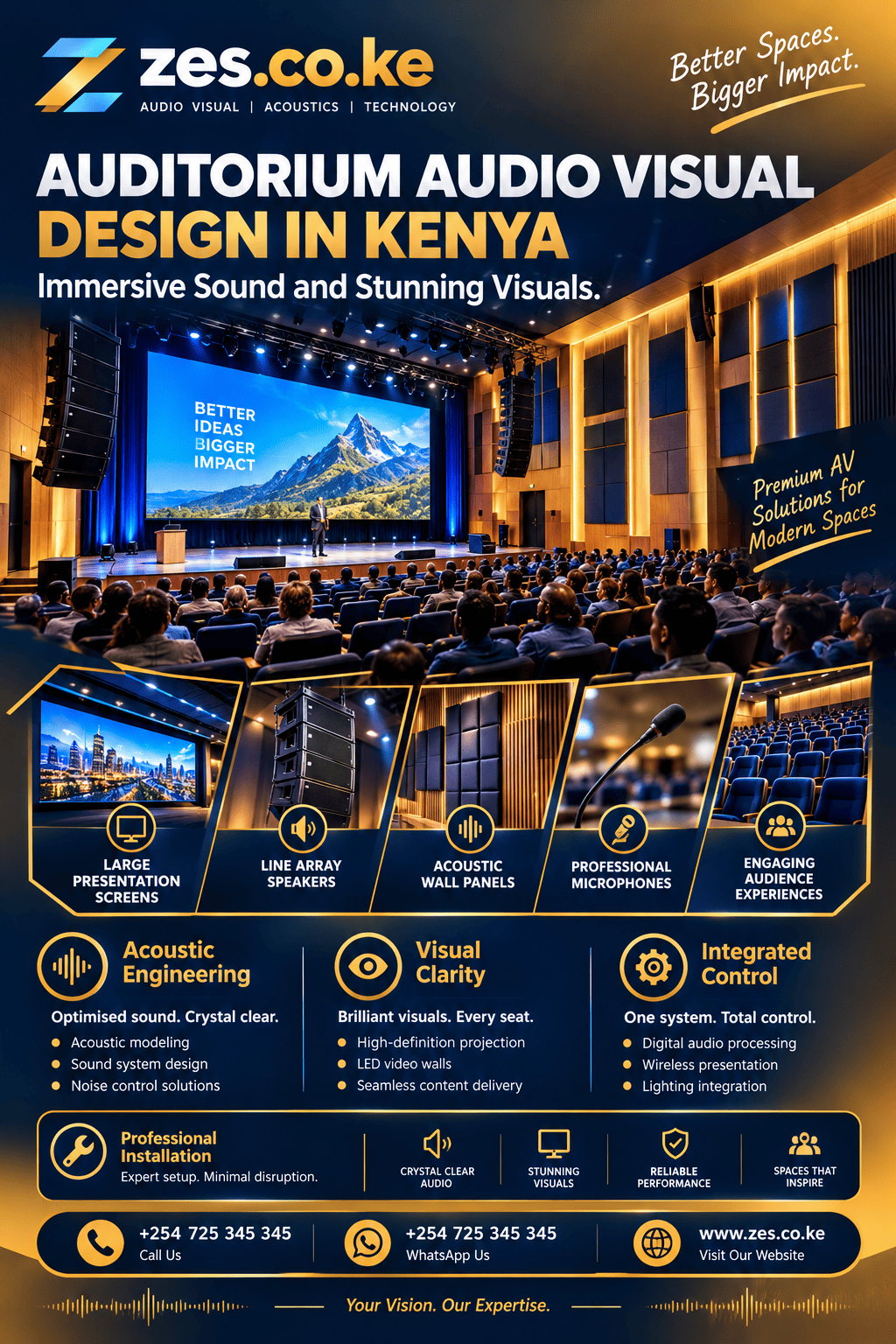
Auditorium audio visual design in Kenya is a highly specialized discipline that combines architectural acoustics, visual engineering, and network integration to create immersive, functional spaces. At zes.co.ke, we understand that this is not simply about hanging a projector and placing a few speakers—it is about engineering an environment where every seat offers an optimal experience. Whether you are designing a corporate amphitheater in Nairobi, a university lecture hall in Kisumu, or a large-scale worship center in Mombasa, professional auditorium audio visual design in Kenya is the foundation for successful communication.
The demand for exceptional auditorium audio visual design in Kenya has grown rapidly as institutions recognize the impact of technology on audience engagement. A poorly designed AV system leads to echoed audio, washed-out visuals, and frustrated presenters. Conversely, a masterfully executed deployment transforms a simple room into a dynamic learning or presentation environment.
At zes.co.ke, we specialize in comprehensive auditorium audio visual design in Kenya that addresses every technical and aesthetic challenge. Our approach begins with a deep understanding of the room’s physical dimensions, the intended use cases, and the audience capacity. From there, we engineer custom solutions that deliver crystal-clear sound and stunning visuals.
Why Invest in Professional AV Design?
Many organizations attempt to retrofit AV equipment into existing spaces without proper planning. This often results in compromised performance. For institutions investing in auditorium audio visual design in Kenya, proper planning from the ground up is essential. The physical layout, ceiling height, and wall materials directly dictate how sound and light behave in the room.
The importance of expert auditorium audio visual design in Kenya cannot be overstated. It ensures that every microphone captures the speaker’s voice perfectly and every screen displays high-resolution content visible from the back row. A well-designed system also simplifies operation, allowing presenters to focus on their message rather than troubleshooting technology.
When evaluating auditorium audio visual design in Kenya, it is crucial to consider both current needs and future scalability. Technology evolves rapidly. A system designed today must be capable of adapting to tomorrow’s standards. Our team ensures that the infrastructure we install provides a robust foundation for future upgrades.
The value of professional auditorium audio visual design in Kenya extends beyond the immediate presentation. It enhances the institutional brand, demonstrates technological competence, and provides a premium experience for attendees. Whether it is a board meeting, a public lecture, or a theatrical performance, the AV system is the bridge between the presenter and the audience.
For organizations requiring comprehensive auditorium audio visual design in Kenya, a holistic approach is necessary. This includes acoustic treatment, advanced display technologies, unified control systems, and robust networking. At zes.co.ke, we integrate all these elements seamlessly to ensure high performance.
User experience is crucial for auditorium audio visual design in Kenya. Presenters must find the systems intuitive to use. If a system is overly complex, it will be underutilized. We prioritize intuitive interfaces and one-touch control systems that simplify complex AV operations.
Modern auditorium audio visual design in Kenya incorporates advanced features like digital signal processing (DSP), high-definition projection, and voice amplification. These technologies ensure that every participant, regardless of their seating position, feels fully immersed in the event.
Flexibility in auditorium audio visual design in Kenya is another critical factor. Auditoriums are multi-purpose spaces. They host everything from single-speaker lectures to multi-presenter panel discussions. The AV system must easily adapt to these varying formats.
Integration capabilities of auditorium audio visual design in Kenya extend to video conferencing and live streaming. As hybrid events become the norm, the ability to seamlessly broadcast high-quality audio and video to remote audiences is vital.
When considering auditorium audio visual design in Kenya, working with experienced integrators is essential. The complexity of acoustic mapping and signal routing requires professional expertise. We bring years of experience to every project.
For specialized needs, auditorium audio visual design in Kenya addresses unique environmental challenges. For example, houses of worship may require specialized sound reinforcement for choirs, while educational facilities might require lecture capture systems.
Looking for cutting-edge auditorium audio visual design in Kenya? We stay at the forefront of AV technology, incorporating the latest advancements in digital audio and visual processing.
{{VIDEO_EMBED: Insert a 2-minute video here showing a walk-through of a newly completed auditorium, highlighting the acoustic panels, the projection screen, and the presenter using a wireless touch panel.}}
Core Components of Auditorium AV Systems
A complete auditorium audio visual design in Kenya comprises several interconnected subsystems. Understanding these components is essential for appreciating the complexity of the design.
Audio Reinforcement Systems: This is the backbone of any presentation. In a large auditorium, relying solely on the presenter’s natural voice is impossible. The audio system must amplify the sound evenly across all seating areas without causing feedback or echo. According to guidelines from AVIXA, proper speaker placement and digital signal processing are critical.
Visual Display Systems: Depending on the room size, this could involve a massive projection screen, a direct-view LED wall, or multiple screens distributed throughout the room. The visual system must provide high contrast and brightness to remain legible under various lighting conditions.
Acoustic Treatment: The physical room dictates the sound quality as much as the speakers do. Hard surfaces reflect sound, creating a muddy listening experience. Incorporating absorptive panels and diffusers is a mandatory step in the overall auditorium audio visual design in Kenya.
Control Systems: A unified control interface allows operators to manage lighting, audio, video, and environmental controls from a single touch panel. This simplifies operations and reduces the chance of user error during live events.
Wireless Presentation: Modern systems allow presenters to walk freely on stage. Wireless microphone systems and wireless presentation gateways ensure the presenter is not tethered to a podium.
Acoustic Design: The Invisible Half of the System
You can buy the most expensive speakers in the world, but if the room’s acoustics are poor, the sound will be bad. Auditorium audio visual design in Kenya must prioritize acoustics.
The goal of acoustic design is to control reverberation—the time it takes for sound to fade after the source stops. In a large hall, sound bounces off the walls and ceiling. If this is not managed, speech becomes unintelligible.
We use advanced acoustic modeling software to simulate how sound will behave in the space before the first panel is even installed. By combining physical treatments (like acoustic clouds, wall panels, and specialized seating) with digital processing (like equalization and delay), we create an environment where every syllable is heard clearly.
Visual Design and Sightlines
In an auditorium, if you can’t see, you can’t engage. The visual aspect of auditorium audio visual design in Kenya involves calculating exact viewing angles and screen sizes.
The furthest viewer should be no more than six times the screen height away to read standard text. We evaluate the room’s slope and seating arrangement to ensure the screen is mounted at the correct height and angle.
For large spaces, a single screen may not suffice. We often design dual-screen setups, where one screen displays presentation slides and the other shows a live camera feed of the presenter. This dual-view approach enhances engagement, especially for those seated far back.
The Role of Lighting in AV Design
Lighting and AV are deeply intertwined. Bright lights can wash out a projection screen, while dim lighting can make it difficult for the audience to take notes.
A holistic approach to auditorium audio visual design in Kenya includes integrating the lighting system with the AV controls. We design pre-set lighting scenes—such as a “Presentation Mode” that dims the lights over the audience but keeps the stage bright, or a “Video Playback Mode” that dims all lights to maximize screen contrast.
Video Conferencing and Hybrid Events
The modern auditorium is no longer an isolated space; it is a broadcasting studio. Effective auditorium audio visual design in Kenya now includes seamless integration with platforms like Zoom, Microsoft Teams, and YouTube Live.
This requires specialized cameras capable of auto-tracking the presenter, along with ceiling-mounted microphone arrays that capture audience questions. We ensure that remote participants have an experience just as engaging as those in the room.
Applications Across Kenyan Sectors
Different sectors have different requirements for their AV systems.
Corporate Headquarters: For corporate spaces, the focus is on high-impact presentations, data visualization, and flawless hybrid meetings. The auditorium audio visual design in Kenya here focuses on corporate branding and seamless usability.
Educational Institutions: Universities and colleges require systems that support lecture capture, distance learning, and multimedia playback. Durability and ease of use are paramount in these environments.
Places of Worship: Churches and mosques require robust audio systems that can handle live music, choirs, and spoken word. The visual systems often include large LED walls for displaying lyrics and sermon notes.
Government Facilities: Government chambers and public halls require secure, highly reliable systems with redundancy built-in. The auditorium audio visual design in Kenya for these spaces must meet strict public sector standards.
The Design and Installation Process at zes.co.ke
Executing a successful project requires a structured methodology. Our process is designed to eliminate risks and ensure client satisfaction.
Phase 1: Needs Analysis and Consultation: We begin by talking to you. What events will be held here? How many people? What is the budget? This discovery phase is crucial for the entire auditorium audio visual design in Kenya process.
Phase 2: Site Survey and Acoustic Measurement: Our engineers visit the site. We measure dimensions, check structural load-bearing capacity, and evaluate existing acoustic properties. We identify potential problems like noisy HVAC systems or problematic wall surfaces.
Phase 3: System Design and Engineering: We create a detailed CAD drawing and system schematic. This outlines speaker placements, screen sizes, cable routing, and equipment rack locations. We select the right hardware from trusted manufacturers to match the design.
Phase 4: Professional Installation: Our certified technicians install the equipment. We manage all cabling, mounting, and rack building. We work closely with other contractors (like electricians and builders) to ensure seamless integration.
Phase 5: Calibration and Testing: We don’t just plug it in and leave. We rigorously test the system. We use specialized software to tune the audio system to the room’s specific acoustics and calibrate the projectors for perfect color and alignment.
Phase 6: Training and Handover: The final step is training your staff. We teach them how to operate the control system, switch between sources, and maintain the equipment. We provide detailed documentation and offer ongoing support.
Maintenance and Longevity
An AV system is an investment that requires care. Dusty environments, frequent use, and power fluctuations can degrade performance over time.
A professional auditorium audio visual design in Kenya incorporates easy access for maintenance. Equipment racks are placed in ventilated, secure rooms.
We offer preventive maintenance contracts. This includes cleaning projector filters, checking cable connections, updating software, and recalibrating audio settings. Regular maintenance extends the lifespan of your equipment and prevents failures during critical events.
Common Mistakes to Avoid
Avoiding pitfalls is easier when you work with professionals. Here are common mistakes we see in the industry:
Underestimating the Environment: Buying great speakers but ignoring the room’s acoustics. This guarantees poor sound.
Ignoring the User: Designing a highly complex system that requires an AV engineer to operate. The system should be intuitive enough for a non-technical presenter to use.
Inadequate Cabling: Running cheap copper cables or failing to plan for future network bandwidth needs. Cabling is the hardest thing to upgrade later.
No Redundancy: For critical spaces, failing to include backup amplifiers, redundant network paths, or backup power (UPS) can be disastrous.
Selecting the Right Partner
Choosing an AV integrator for your auditorium audio visual design in Kenya is a decision that will impact your facility for a decade or more. You need a partner who understands both the technical and practical aspects of AV.
Look for a team with certified engineers, a proven portfolio of similar projects, and strong relationships with reputable hardware vendors. Most importantly, look for a partner who listens to your needs and designs a solution tailored to your specific use case.
At zes.co.ke, we provide independent advice. We are not tied to a single manufacturer, meaning we recommend the technology that best fits your budget and goals. We support you from concept to completion and beyond.
Cost Considerations
While specific pricing is not provided here, the cost of auditorium audio visual design in Kenya depends on several factors:
-
Room Size: Larger rooms require more speakers, larger screens, and more powerful amplifiers.
-
Acoustic Treatments: The extent to which the physical room needs modification.
-
Quality of Equipment: Consumer-grade versus commercial-grade hardware.
-
Complexity: The level of control, integration, and hybrid capabilities required.
It is important to view the AV system as a capital investment. A well-designed system enhances the value of the building and improves the effectiveness of every event held there.
The Future of Auditorium AV
The future of auditorium audio visual design in Kenya is exciting. We are seeing the rise of IP-based audio and video (AV-over-IP). This means sending high-quality audio and video over standard network cables rather than specialized analog cables, allowing for incredible flexibility and scalability.
Artificial Intelligence is also making an impact. We are seeing cameras that automatically track presenters and AI-driven audio processors that automatically eliminate feedback and noise.
As virtual and augmented reality mature, we may soon see auditoriums that feature immersive projected environments, blending the physical stage with digital augmentation.
Frequently Asked Questions
Q: Can we upgrade an older auditorium?
A: Yes. We can often utilize existing infrastructure while replacing outdated displays, speakers, and control systems.
Q: How long does a design and installation take?
A: It depends on the scope. Smaller spaces might take a few weeks, while large auditoriums can take several months from design to commissioning.
Q: Do we need a dedicated AV technician to run it?
A: No. With the right control system design, a non-technical staff member or presenter can operate the system with a single touch.
Q: What about acoustic echo during video calls?
A: Properly designed systems use dedicated processors to cancel acoustic echo, ensuring smooth communication with remote participants.
Q: Is the installation disruptive?
A: We coordinate closely with your schedule to minimize disruption, often working after hours or during off-peak times.
Q: Can the system handle both live presentations and movies?
A: Yes. A well-designed system can be calibrated for both speech intelligibility and the wide dynamic range of cinematic audio.
Q: What happens if a projector bulb blows?
A: We recommend using solid-state (laser) projectors, which have a much longer lifespan. For bulb-based projectors, we provide maintenance contracts to handle replacements.
Investing in professional auditorium audio visual design in Kenya is a strategic move that elevates the quality of communication and engagement in your facility. At zes.co.ke, we provide expert design, premium equipment, and flawless installation. Whether you are designing a new space or upgrading an existing one, our team delivers reliable, world-class AV solutions.
Auditorium audio visual design in Kenya represents the intersection of art and science. By choosing a professional partner like zes.co.ke, you ensure your space is optimized for acoustics, visibility, and ease of use. Our commitment to quality ensures you receive a system that meets your specific needs and exceeds your expectations.
For more information about auditorium audio visual design in Kenya and to schedule a free site survey, contact zes.co.ke today. Our team is ready to answer your questions.