

Biometric Attendance System Westlands: A biometric attendance system in Westlands should answer a clear business question: how will the organisation turn staff clocking into a reviewed attendance report? A terminal alone does not establish that workflow. This guide helps office managers and employers organise a pilot, agree responsibilities and compare complete proposals. ZES accepts Westlands project enquiries and confirms the actual site assessment, installation and support arrangements before a commitment is made.

Biometric Attendance System Westlands: Define your organisation’s boundary
If several businesses share a building or reception, establish which staff and premises belong in your attendance system. A building access record and an employer attendance report have different purposes. Decide whether the terminal serves one company, several authorised departments or a multi-site organisation. Identify the manager who owns the requirement and the administrator who will prepare reports. This prevents a fit-out discussion from becoming an undefined promise to manage everyone entering the building.
Translate the office routine into test cases
List normal schedules, off-site meetings, flexible arrival arrangements where approved and occasional work at another branch. Include the busiest arrival period and an example of a missed event. Ask the supplier to demonstrate these cases with sample identities. Do not assume that default software rules reflect your employment policies. The pilot should show how an authorised administrator explains and corrects an exception before a record is used for a consequential decision.
Map the reporting process before choosing hosting
Specify who needs a daily exception list, a departmental summary or an approved export. Decide whether the organisation has the capacity to administer local software or needs another supported arrangement. Confirm licences, recurring charges, record ownership and backup responsibilities. A cloud description or a network connection alone does not prove that the required report is available. Compare actual outputs with an anonymised sample prepared by the people who will use the information.
Coordinate the pilot with building management
Agree mounting permission, cable routes, working hours and access to shared infrastructure. Name the IT and facilities contacts who approve changes. Identify dependencies that must be ready before installation. In an occupied office, a small pilot can reveal congestion or user difficulty without committing to every terminal position. Record what happens during connection loss and which components have backup power. Each site’s arrangement should be confirmed rather than inferred from another office project.
Define the procurement and acceptance record
Ask the proposal to separate equipment, supporting infrastructure, software, configuration, enrolment arrangements, tests and training. Witness the sample event-to-report workflow and record outstanding limitations. Confirm integration only against accessible interfaces and an agreed test. Keep administrator ownership and support escalation in the handover. ZES can review employee count, office layout and reporting examples, then confirm the appropriate scope and regional attendance arrangements.
A practical attendance acceptance test
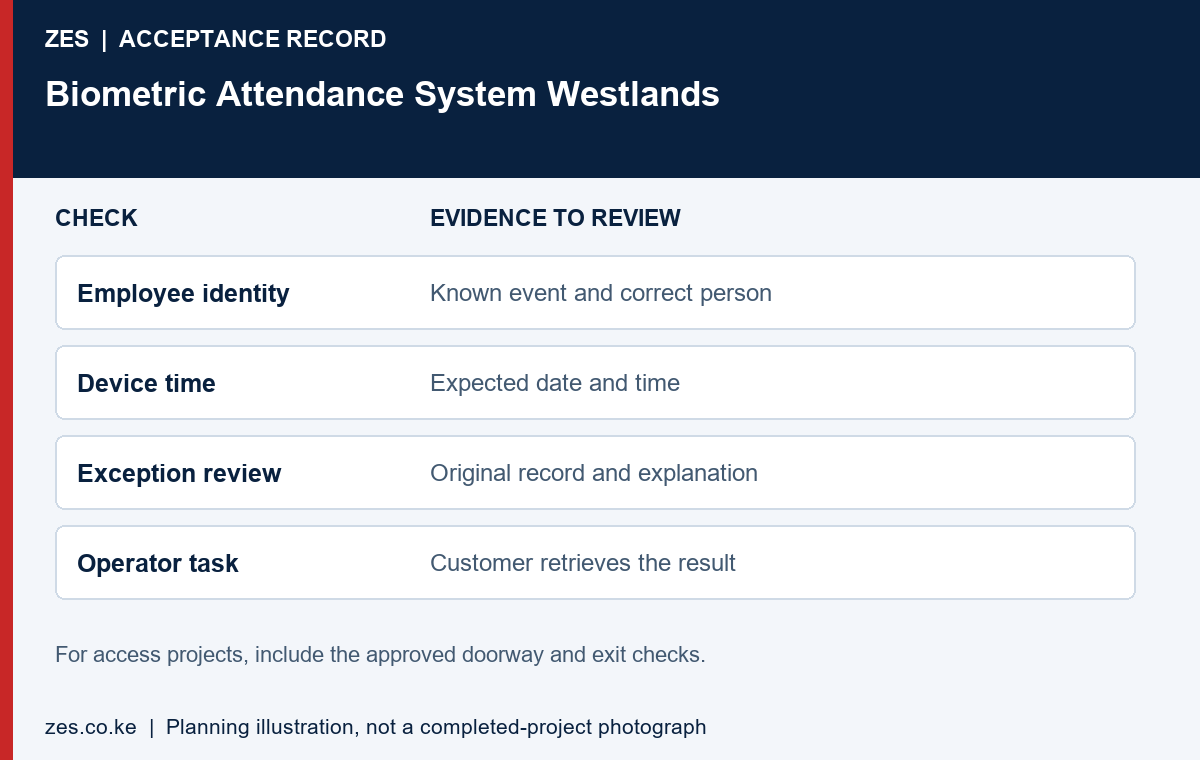
Create a sample staff record and a short, approved schedule before testing. Record an arrival and departure, then retrieve the events in the intended application. Confirm that the employee identifier, date, device time and reporting period agree. Have the designated attendance administrator review a missed event and record an approved correction. Keep the original event and the explanation distinguishable. A clocking event is an input to review, rather than an automatic decision about pay or performance.
Ask the supplier to demonstrate the agreed behaviour when the connection is interrupted. After restoration, compare device events with the application and check for duplication or missing events. Record who will investigate discrepancies, how a backup is retrieved and where the employer keeps its handover documents. The final test should be performed by the person who will operate the system, using sample data wherever practical.
Biometric Attendance System Westlands: supporting guidance
For privacy planning, consult the ODPC guidance notes, including its biometric data guidance. Check equipment and software behaviour against the documentation for the exact proposed version. ZKTeco publishes a ZKBio CVAccess user manual as one product-specific reference; it is not evidence that every device or platform has the same functions. Confirm the model and supported features in your quotation.
A worked example: one employer in a shared office building
Consider an illustrative employer occupying one floor of a building used by other organisations. Its requirement is to review staff attendance, while the building manager separately controls the common reception. The employer should first decide whether its attendance system needs a clocking point at its own office boundary. It should not assume that the reception’s records are available, suitable or authorised for its employment process.
Write two separate statements: the building-entry requirement and the employer’s attendance system requirement. Identify the owner of each record and the person who can approve any proposed connection. If a common entrance is outside the project scope, say so in the quotation. This prevents a supplier being asked to deliver a shared-building integration that no responsible party has actually agreed to provide.
Prepare the staff and location schedule
For this example, prepare an invented staff schedule covering a normal office day, an approved meeting away from the premises and a person temporarily working at another company location. The attendance system should present the available events without inventing reasons for a gap. Ask the administrator to show how the approved explanation is added and reviewed under the employer’s process.
If staff move between locations, ask whether the attendance system needs one reporting view or separate summaries. Establish a stable identifier for each person and check how a sample event from another clocking point is associated. Do not create multiple employee profiles merely because the person sometimes works at a different premises. Record any software or licensing dependency that affects the proposed multi-site arrangement.
Choose a pilot that reveals the actual reporting work
The pilot should be small enough to review carefully and broad enough to expose ordinary exceptions. Select representative working patterns and let the intended attendance system administrator operate the report. Ask that person to retrieve a period summary, identify a missing event and locate an approved correction. Note every manual step required to produce the output the employer requested.
Use the pilot findings to refine the attendance system brief. If the administrator must maintain a separate spreadsheet to explain every routine case, determine whether this is an acceptable operating method or an unresolved design issue. A pilot is useful because it makes that decision visible before the full purchase. It should finish with an agreed list of required functions and acknowledged limitations.
Plan the arrival period and the clocking position
Observe the intended approach to the terminal during the site’s actual assessment. Check that clocking will not unnecessarily obstruct the doorway or another organisation’s working area. Discuss accessibility, mounting permission and practical supervision with the responsible people. Do not select a position solely because a photograph looks attractive or an existing network point happens to be nearby.
Where several people may arrive together, demonstrate the proposed method with a suitable trial group. Record practical observations without turning them into a universal throughput guarantee. The attendance system proposal should identify how the terminal position and number of clocking points relate to the assessed requirement. Any additional devices should solve a documented operational need rather than simply increase the equipment count.
How the attendance system turns an event into a report
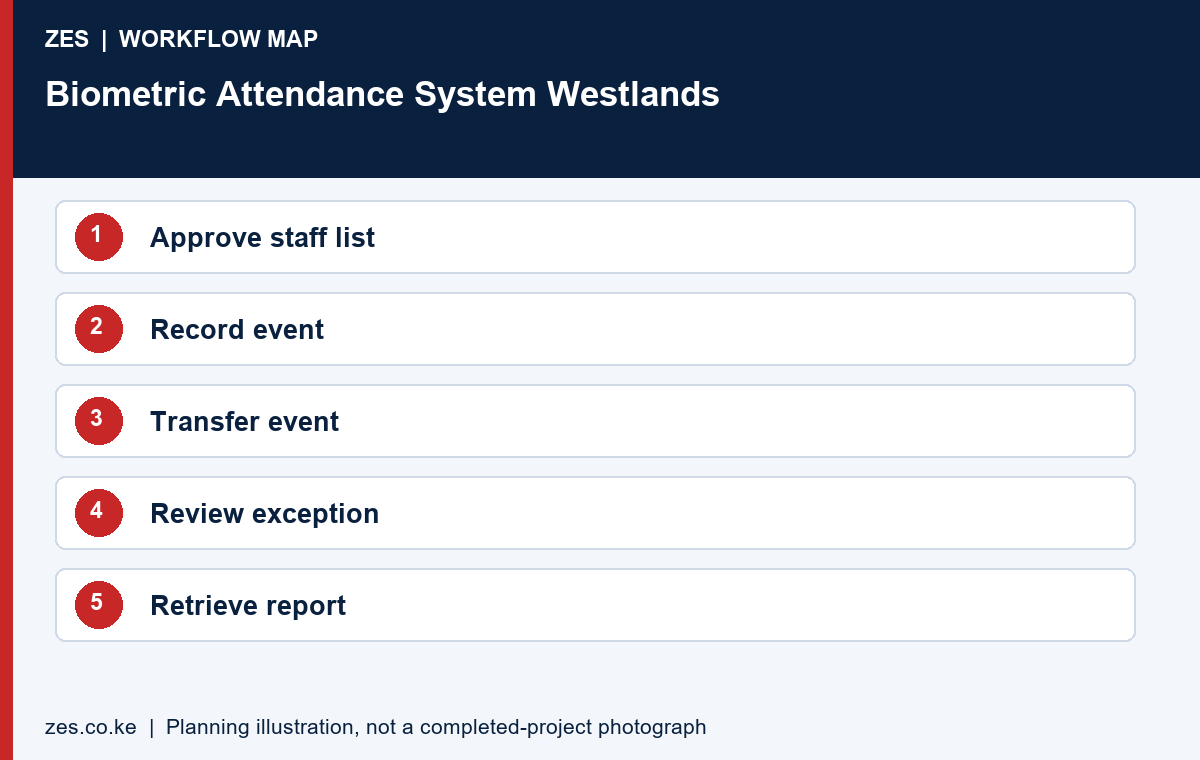
Treat the attendance system as a chain of responsibilities. A recognition event is first associated with an employee identifier and a device time. The application then receives the event and presents it under a reporting period. Approved schedules and exception rules influence the eventual attendance summary. Buying a terminal therefore answers only part of the requirement. Ask the proposer to draw this chain and identify which product performs each step, which connections it needs and who reviews the result.
Test the attendance system with an invented employee record before using operational data. Make a small event sheet containing an expected arrival, departure, authorised absence and missed clocking. Retrieve the corresponding application report and compare it with that sheet. A successful demonstration shows traceable records and understandable exceptions. It should also show what the report cannot establish: a clocking record does not independently explain a person’s duties, whereabouts throughout the day or entitlement to payment.
Attendance system ownership, permissions and exports
Decide which attendance system tasks belong to HR, a supervisor, IT and the supplier. The person maintaining network connectivity may not need permission to review employee records. The person approving a correction may not need permission to change application settings. Ask the proposed software to demonstrate the required separation using test accounts. Record any limitations, including functions that can be restricted only through an operating procedure rather than a software permission.
Request an attendance system export in the format the receiving team actually needs. Check employee identifiers, date boundaries, blank fields, department labels and the treatment of changed records. If a payroll application is involved, obtain its interface requirements before promising automatic integration. Have the receiving team inspect a sample and document the result. A file opening successfully is a useful first check, but it does not demonstrate that every field has the agreed business meaning.
A controlled first reporting period
Introduce the attendance system with a defined review period. Explain the clocking locations, approved hours, contact for a failed attempt and procedure for reporting a missed event. Give the responsible reviewer time to compare sample records with authorised schedules. Keep a list of operational questions and agree who can resolve each one. This is more useful than assuming that a single training session eliminates every exception the organisation will encounter.
At the end of the first reporting period, review the attendance system against the original brief. Can the administrator retrieve the required summary without recreating it manually? Are unexplained gaps investigated? Are authorised corrections distinguishable from original device events? Are reports available to the intended recipients and no wider audience? Record changes that need further testing. The purpose is a manageable attendance process, rather than simply a terminal that accepts a fingerprint.
Continuity checks for the attendance system
Ask how the selected attendance system behaves when a terminal loses its connection to the application. Supported behaviour depends on the actual device, configuration and software version. Demonstrate interruption and recovery under an agreed test rather than relying on a generic promise that every machine works offline. Compare the known test events after recovery and investigate any duplicates or gaps before signing off the arrangement.
Document attendance system recovery responsibilities. Identify who checks the device clock, who restores connectivity and who authorises any temporary recording method. Keep the equipment details and support route with the handover record. Agree how the organisation will retrieve its own reports if a supplier relationship changes. A continuity plan should describe the specific installation and its supported recovery process; it should not assume that a cloud label alone provides backup, retention or disaster recovery.
Agree office IT and facilities interfaces
Ask the organisation’s IT contact what connection method the attendance system is permitted to use. Identify the application location, supported network requirements and responsibility for obtaining access. Keep sensitive network details in the private implementation record. A tender or general enquiry can describe the required interface without publicly exposing the organisation’s internal configuration.
Ask facilities or building management to approve mounting and cable routes before fixing a date for the work. Identify any permit, access or reinstatement conditions that the customer must arrange. Keep these dependencies in the proposal so the parties can check readiness. Installation timing should follow the actual site arrangement, rather than an assumption that every Westlands office has the same access conditions.
Review commercial scope and the first-year operating tasks
An office attendance system comparison should show equipment, software, installation, commissioning and training as identifiable items. Add recurring charges and the customer’s own operating tasks. Ask what the selected licence includes and what changes when users or sites increase. Current terms should come from a written quotation; this guide does not establish a device price or a promised delivery date.
Nominate a primary attendance system administrator and appropriate cover. Agree who reviews exceptions before the reporting deadline and who contacts the supplier about technical issues. Include basic operating instructions in the handover. The employer should be able to distinguish a routine missed event from a device or application fault, so ordinary administration does not automatically become an unresolved technical support request.
Define what a successful office rollout looks like
Set acceptance criteria that the office can witness. The attendance system recognises a sample user, records the correct time, transfers the event and produces the agreed report. The administrator can review a missed entry and retrieve the approved result. Outstanding items are recorded with an owner and a completion arrangement. Each criterion should connect to a requirement in the original brief.
Use the first review meeting to compare these criteria with the actual operating experience. Record whether staff understand the clocking method, whether reports are accessible and whether recurring responsibilities are clear. The result should be a usable office attendance system with a manageable review process. Avoid treating the presence of a branded terminal as the only measure of a completed project.
Send ZES a Westlands attendance brief
For a Westlands enquiry, provide the organisation type, approximate workforce, intended clocking points and the required reporting outputs. State whether the premises are shared, whether staff move between locations and whether existing software must be retained. Include a suitable layout or anonymised sample report when available. Describe the decision you want the attendance system to support before selecting equipment.
ZES can review that brief and confirm the next assessment and proposal steps. The written scope should identify site attendance, installation responsibilities, equipment suitability and support arrangements. Keep procurement requirements and any requested evidence explicit. This page is a planning guide and does not claim a local branch, an existing installation at a named property or an unverified customer reference.
A private and usable project handover
Keep a private implementation file alongside the public buying guide. It should identify the supplied equipment, application arrangement, account owner, support contact and agreed acceptance results. Separate public marketing material from operational configuration and employee records. For an initial enquiry, anonymised examples are usually more useful than a large collection of personal records because they show the required output without exposing information unrelated to the purchase decision.
Ask the responsible organisation to review the purpose, necessity and handling of biometric information with appropriate advisers before live enrolment. The selected product documentation should explain its actual supported functions, but a technical specification does not by itself establish that every proposed use is appropriate. Confirm responsibilities for administration, access to reports, profile withdrawal and the organisation’s approved retention arrangements. Keep those decisions connected to the intended workflow rather than relying on a generic claim that a device is compliant.
Use a short readiness and acceptance record. Before work, confirm the site contact, approved position, enabling tasks and application access. During testing, record the expected result, observed result and unresolved item. At handover, identify who owns the next action and how it will be reviewed. This gives the customer a practical basis for accepting the actual scope, while avoiding a vague completion statement that cannot be compared with the original requirement.
The proposal should also explain how later changes are managed. A new premises, additional users, changed working patterns or another reporting application can create a different requirement. Keep equipment references and the approved scope available for that review. Ask for revised terms and tests where necessary instead of assuming that the original purchase includes every future alteration. Clear documentation is useful to both the customer and the supplier when the people involved in the original project change.
Information to include in your enquiry
Share the site location, organisation type, staff numbers, clocking points or controlled doors, existing devices and software, and the required outcome. Include available layouts and sample reports with personal information removed. Identify the person who approves building access and the person who will administer the system. Ask the quotation to identify assumptions, exclusions, recurring charges, testing and handover responsibilities.
Frequently asked questions
Can building access records replace staff attendance?
Not automatically. The purposes, event meaning, permissions and reporting rules need assessment before using one system to support another workflow.
Should a small office buy the most complex platform?
Select against the actual report and operating requirements. Unneeded complexity can add administration and recurring costs.
Related Westlands biometric guides
- Biometric Installation Westlands: Fit-Out Coordination, Cabling and Commissioning
- Biometric Access Control Westlands: A Permission Plan for Tenants and Managed Premises
Discuss your requirement with ZES
ZES is based in Kamakis, Ruiru and reviews Westlands enquiries before confirming the appropriate assessment and delivery arrangements. Travel, installation timing, equipment availability and support commitments are agreed directly for the actual scope.
Biometric attendance services · Access-control services · Request a quotation · Request a site assessment