

Petrol Station Electrical Inspection Nairobi enquiries should identify the purpose of the inspection and the competent party responsible for it. A visual condition visit, a defined inspection and testing scope and a statutory approval are different deliverables. This guide helps station operators prepare the records and questions needed for a clear proposal. ZES can review the enquiry and confirm appropriate arrangements without claiming an unverified regulatory authorisation or promising that every visit produces a compliance certificate.

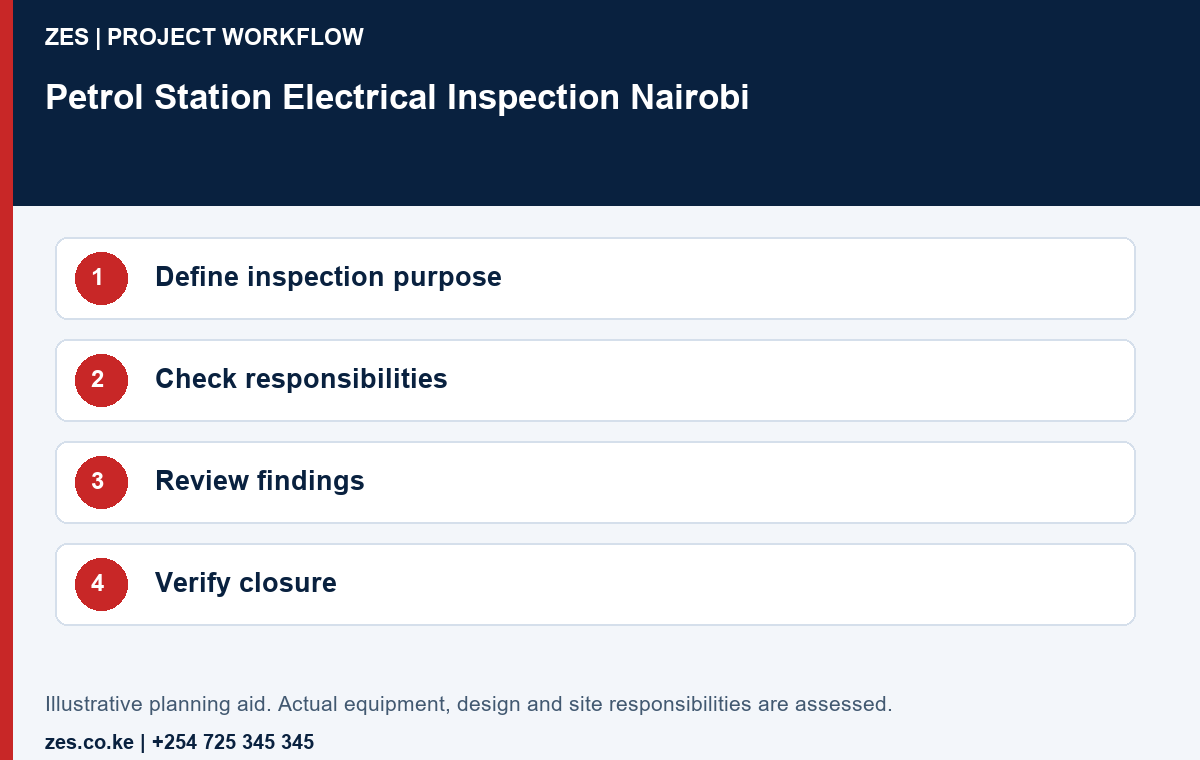
1. State why the inspection is needed
Explain whether the request follows a reported fault, planned alteration, condition concern or a requirement from the responsible authority or professional. Identify the expected deliverable and who will review it. A broad inspection description should not leave the operator and contractor with different expectations about testing, reports or any separate approval process.
2. Verify the responsible credentials and scope
Ask for current evidence of the relevant competence and authorisation for the proposed work. Check the actual scope against official EPRA and NCA information where applicable. Do not infer licensing from a company name, uniform or marketing photograph. The proposal should identify who carries out the inspection and who takes responsibility for the resulting report.
3. Gather existing information
Provide available drawings, equipment schedules, previous reports and a factual description of the concern. Identify known alterations and supporting site information. Keep sensitive operational details within the approved project team. Missing information should be recorded as a limitation or further requirement, rather than silently replaced by an assumption that every existing component matches an earlier installation.
4. Agree access and operating responsibilities
The station operator and competent contractor should establish the site-specific work arrangements and effects on operations. Identify access, authorised coordination and any dependencies before attendance. This guide does not provide instructions for opening equipment, performing electrical measurements or working on live systems. Those activities require the appropriate qualified people and approved method.
5. Make findings understandable
Ask the report to distinguish observed condition, tests within the agreed scope, limitations and recommended next actions. Each finding should identify its location and the responsible follow-up route. Avoid a simple pass label that conceals excluded areas or incomplete information. The operator needs enough context to commission the right remedial work and understand what remains unverified.
6. Separate inspection from remedial work
If corrective work is required, obtain a defined proposal with the responsible design, equipment and verification requirements. Record which recommendations are included and what is excluded. An inspection fee should not be assumed to include every repair, replacement or later approval. Compare remedial quotations against the same findings rather than ask each supplier to infer a different scope.
7. Track findings to verified closure
Keep the report, approved remedial scope, completion evidence and relevant verification together. Identify who accepts closure and how unresolved items are managed. Review the records when the site changes. A useful inspection process finishes with understandable responsibilities and evidence, rather than a filed report whose recommendations nobody has been assigned to address.
Petrol Station Electrical Inspection Nairobi: demonstration and review workbook
A station requests an electrical inspection because existing records are incomplete and management needs a reliable account of the assessed installation. The first decision is the scope and purpose of the inspection, not a promise to issue a universal certificate. The responsible appropriately qualified parties must decide the methods, access and evidence relevant to the actual work. This hypothetical case helps the buyer separate inspection findings from subsequent repairs, restricted access and unassessed systems, keeping the resulting report useful to the people who must act on it.
The following cases help the buyer specify and compare the actual project. Agree which apply to the proposed scope and record any exclusions before acceptance. They are hypothetical review prompts, not evidence of a completed ZES client project. The responsible site team and relevant competent parties approve any physical tests or changes to live operations.
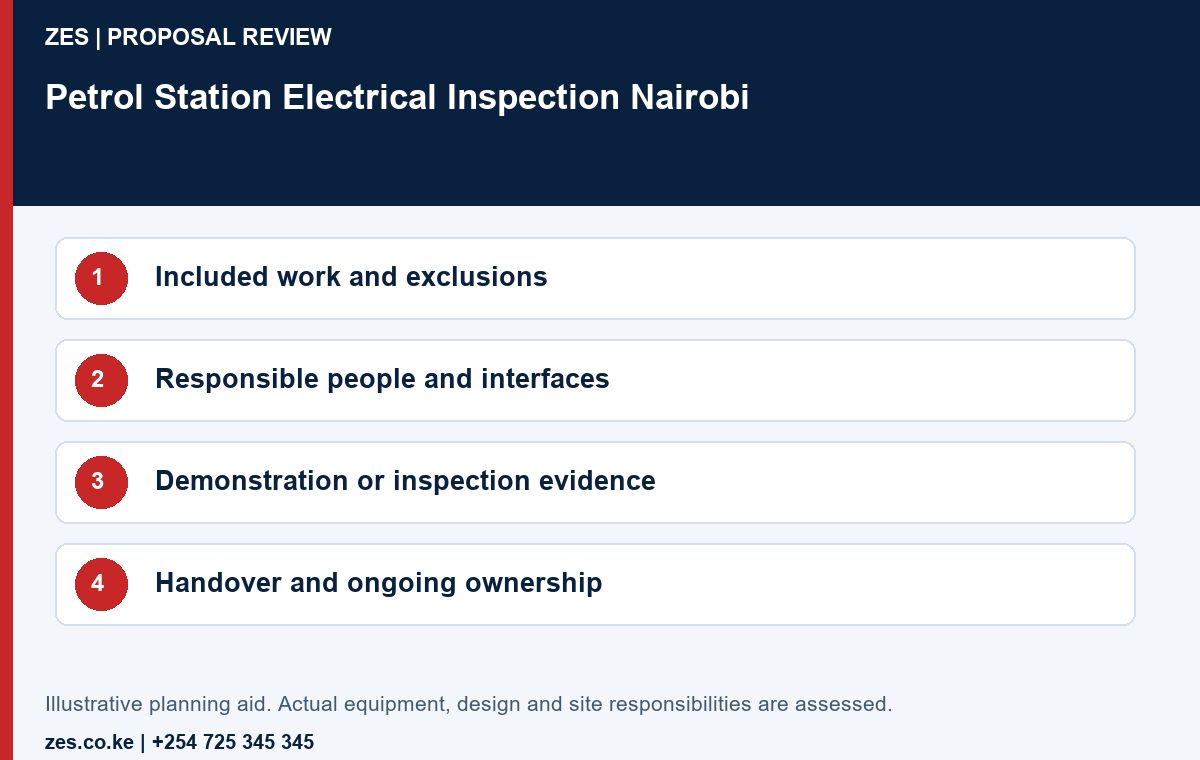
Inspection purpose
State the business reason and intended use of the electrical inspection. The responsible reviewer should confirm the appropriate assessment scope rather than assume every visit serves the same purpose.
Installation boundary
Identify the equipment and areas included, with clear references. Keep third-party, inaccessible or excluded systems distinguishable so the report does not imply wider coverage than was supplied.
Responsible people
Confirm the appropriate credentials and responsibilities for the actual inspection work through current relevant requirements. A general engineering description is not evidence of every required authorisation.
Available records
List drawings, prior reports and relevant asset information. Identify missing or uncertain information and the agreed approach to investigation instead of treating an undocumented assumption as verified fact.
Access arrangement
Agree site access, operating boundaries and relevant dependencies with the responsible team. Inspection availability does not authorise a customer or unqualified person to open or alter equipment.
Method and evidence
Ask the competent reviewer to identify the appropriate inspection and test evidence. The buyer should understand the report’s scope without attempting technical procedures from an internet guide.
Finding references
Link observations to identifiable locations or assets in the controlled report. Keep the distinction between an observed condition, its assessed significance and a proposed corrective action clear.
Action ownership
Assign responsibility for reviewing and responding to findings. The station’s authorised team and competent advisers must decide appropriate priorities and any operating restrictions for the actual condition.
Rectification scope
Obtain a defined proposal for approved corrective work where required. An inspection fee does not automatically include every repair, replacement part, enabling task or further specialist investigation.
Closure evidence
Connect completed corrective work to the relevant findings and subsequent verification. Retain unresolved limitations so a later manager does not assume that a single closed item resolved the entire report.
Detailed buyer questions
Is an inspection the same as a maintenance visit?
No. Define the purpose, extent and evidence of the actual service. General attendance or routine care should not be represented as an electrical inspection that was not performed.
Does the inspection price include repairs?
Only where explicitly included. Separate investigation, reporting, corrective works and subsequent verification in the proposal so that commercial approval does not conceal a technical dependency.
Can a blog confirm that a particular installation is safe?
No. The actual installation needs the appropriate competent assessment and evidence. Use the guide to prepare an enquiry and understand responsibilities, not as a substitute for an inspection.
Define electrical duties and boundaries before equipment selection
Begin with the intended operating result and the systems affected. Lighting, inspection and backup power have different deliverables even when they involve the same premises. Identify who owns the existing installation, the available records and the responsible competent parties. The selected equipment and design must suit the actual location and duty. A familiar product label, enclosure rating or generator capacity does not establish suitability for every fuel-site application.
Ask the responsible reviewer to identify the information needed for assessment. Depending on the scope, this can include existing drawings, asset references, operating requirements and known defects. Keep assumptions visible in the proposal. If an installation cannot be properly assessed from available information, include the investigation as a defined task. Do not translate an incomplete survey into an unconditional compliance, capacity or service-life claim.
Separate assessment, design, installation, inspection and rectification in the commercial scope. The same enquiry may require several responsibilities or stages. Identify the appropriate credentials for the actual work and confirm relevant requirements through current EPRA information and the project’s responsible advisers. A supplier’s general engineering description should not be treated as proof of every licence or approval needed for a specific activity.
Ask for evidence that matches the electrical requirement
A proposal should identify the acceptance documents and demonstrations relevant to its scope. The responsible competent people decide the appropriate inspection and test methods. The station’s representative should understand what the resulting record covers, which limitations remain and who acts on findings. A visual walk-through, a maintenance visit and an electrical inspection are not interchangeable descriptions of the same evidence.
Plan any switching, interruption or testing through the site’s approved arrangements. Identify affected operations, dependencies and the authorised temporary arrangement where needed. This article is a procurement guide, not an instruction to isolate, open or modify equipment. Staff should use the agreed reporting and escalation process for electrical concerns, leaving technical diagnosis and intervention to the responsible competent people.
Compare the complete installation rather than the headline component. A luminaire, power source or inspection instrument is only one element of the proposed work. Supporting systems, integration, enabling work, configuration, documentation and subsequent responsibilities should be identified where applicable. Ask who assesses compatibility and how the actual operating requirement will be demonstrated. Do not infer a complete solution from a product brochure or a single capacity figure.
Keep an asset and document baseline after completion. Record the supplied equipment references, applicable settings or schedules, relevant reports and responsible support contacts in the controlled handover. Review the affected assumptions when operating hours, connected loads, building arrangements or equipment change. If a product is replaced later, the substitute needs assessment for the actual installation; matching appearance or a nominal rating alone is not a sufficient selection process.
Build a proposal that can be compared and accepted
A useful specification separates the result the station wants from the product a supplier proposes. Start with a short statement of the operational problem, the people affected and the evidence that would show improvement. Give each requested deliverable a reference. A supplier can then identify the equipment, labour, configuration, documentation and customer dependencies against that reference. This makes it easier to compare offers without assuming that similar item names describe the same complete service.
Keep a simple comparison register with columns for requirement, included work, excluded work, customer action, acceptance evidence and price basis. An item marked included should have enough detail to distinguish supply alone from installation, configuration or commissioning. An exclusion is not necessarily a poor offer; it becomes a problem when the station discovers it only after work starts. Clarify unanswered questions in writing and attach the clarification to the agreed proposal.
The station should nominate one commercial contact and the operational or technical people who can approve their respective parts. A cashier may explain a daily workflow without having authority to approve a system change. A premises manager may approve access while another party owns an interface or structure. Record these boundaries early. Give the supplier a coordinated response instead of several conflicting instructions from people who assume somebody else has approved the change.
Use a dependency list before agreeing an implementation date. Examples include approved access, available records, enabling works, an authorised test window and attendance by another supplier. For each dependency, identify who provides it and how readiness will be confirmed. Separate the proposed working duration from the full calendar programme. A short installation task can still depend on an assessment, procurement or approval that has not yet been completed.
Use an evidence register rather than a completion claim
Create one acceptance entry for each important requirement. Record the agreed condition, the expected result, the observed result, the person witnessing it and any remaining action. Use the selected product documentation and approved design to decide what is appropriate to test. The examples in this guide are purchasing questions, not permission to carry out hazardous operations or alter live station equipment. Tests must be planned and performed by the responsible people under the site’s arrangements.
An entry should be specific enough for another manager to understand later. An observation such as tested successfully does not explain what was tested. A clearer entry identifies the relevant asset or sample record, the conditions checked and the evidence retained. Do not publish sensitive configuration, employee information or security layouts in a public project gallery. Keep the operational evidence in the customer’s controlled handover file, with access appropriate to its contents.
Distinguish a defect from an agreed exclusion, a customer dependency and a later improvement request. Each needs a different decision. Assign an owner and review date to unresolved matters. If an issue affects the safe or intended use of the delivered work, the responsible parties must decide the appropriate restriction and resolution before treating the affected scope as accepted. A signature should record an informed decision rather than conceal an incomplete requirement.
Customer acceptance and a supplier invoice serve different purposes. An invoice identifies a commercial charge; it does not replace the technical evidence agreed for the project. Similarly, a photograph can show a visible installation without establishing its configuration, structural adequacy or reporting behaviour. Retain the relevant inspection, demonstration or test record alongside the commercial documents so that future reviews do not depend on recollection.
Plan ownership, changes and the next review
Ask for a handover index before completion. Depending on the scope, it may list equipment references, approved drawings, configured functions, maintenance information, licences, acceptance records and support contacts. Mark documents as supplied, not applicable or outstanding. Keep passwords and sensitive access arrangements separate from general manuals. The customer should know who controls each account and how authorised access will be transferred when an employee or contractor changes.
The person expected to use or maintain the result should demonstrate the ordinary task during handover. A presentation to the purchasing team is useful, but it is not the same as the nominated operator retrieving a report, identifying an asset or following the approved support route. Arrange cover for that role. Record the limits of the training and the subjects that still require a competent specialist rather than encouraging staff to improvise repairs.
Compare ongoing obligations as carefully as the initial price. Identify recurring licences, replacement consumables, support arrangements, inspection responsibilities and customer-provided services where relevant. Ask what happens if a renewal is not made, an account changes or an additional site is added. Do not assume that a one-time purchase includes every later configuration change, site visit or third-party service. Request current written commercial terms for the actual scope.
Schedule a review after a representative operating period. Compare the original requirement with actual use, note unresolved findings and decide whether the proposed improvement achieved its purpose. If the station changes layout, staffing, operating hours or another connected system, review the affected assumptions. Keep the approved baseline and later changes together. This gives future suppliers a reliable starting point and reduces the risk of replacing working equipment simply because its documentation has been lost.
Prepare a clear enquiry for ZES
Share the station location, the problem or intended outcome, relevant quantities and the existing equipment or application references. Include available approved plans or anonymised examples where useful. Identify the person who can authorise site access and the contacts responsible for operations and technical interfaces. Keep credentials, employee biometric records and confidential transaction information out of a general enquiry.
Ask the written proposal to identify the supplied work, exclusions, customer dependencies, current commercial terms and the evidence used for acceptance. Confirm specialist responsibilities and relevant credentials for the actual scope. ZES can review the brief and confirm the appropriate assessment and proposal arrangements. Site attendance, timing, product availability and support commitments are agreed directly rather than promised solely because a project names a particular county or town.
Compare the same complete scope
- Equipment or materials: identify the actual model, specification and documentation.
- Supporting tasks: record enabling work, site access and customer-supplied dependencies.
- Configuration or fabrication: state the work and the responsible approving party.
- Acceptance: agree the demonstration, inspection or verification evidence required.
- Ownership: confirm accounts, records, recurring charges and the future support route.
Frequently asked questions
Does every inspection visit provide statutory approval?
No. Identify the actual inspection, report, testing and separate approval responsibilities before commissioning it.
Can the operator carry out the electrical tests from this guide?
No. It is a procurement checklist; the actual work belongs with appropriately qualified and authorised people.
Reference information: EPRA electrical responsibilities · NCA contractor information.
Related ZES service · Petrol-station engineering enquiries · Request a scoped quotation · Request a site assessment · Call +254 725 345 345