
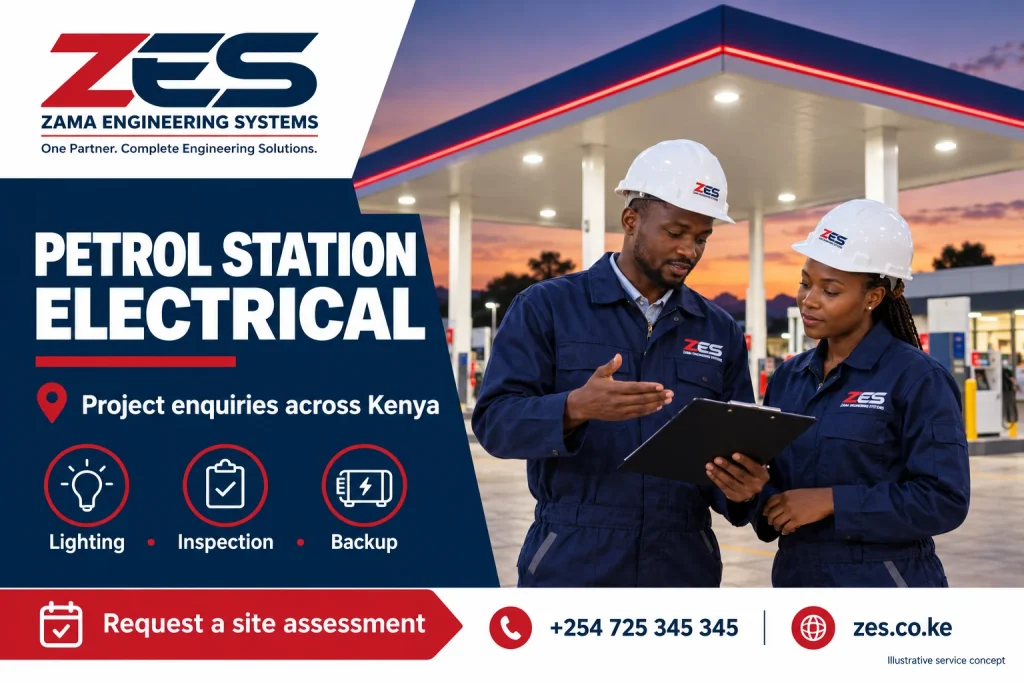
Petrol Station Backup Power System Kenya projects should begin with the loads and operating functions the owner needs to support. A security recorder, office application and dispensing-related installation may have different requirements and responsibilities. This guide focuses on procurement, design interfaces and acceptance. ZES can assess an enquiry and confirm the appropriate supplied scope; electrical design, equipment suitability, changeover and verification need competent project-specific assessment.

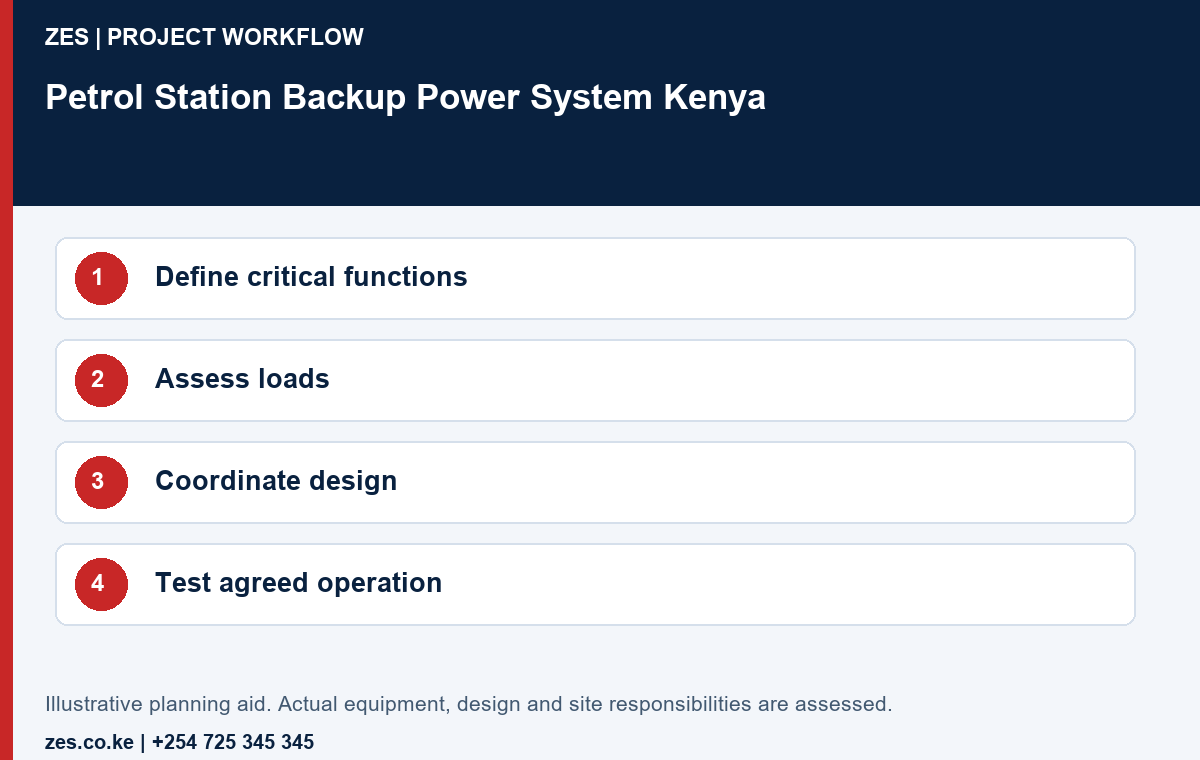
1. Define what must remain available
List the business functions the owner wants to support during an interruption. Distinguish essential reporting or security equipment from loads that may be excluded. Explain the required operating outcome and the approved response when backup is unavailable. Do not assume that a small office backup product can support every function at a fuel station.
2. Obtain an assessed load and duration brief
Ask the responsible designer to assess the actual equipment, operating conditions and intended duration. Identify which information comes from the customer and what must be verified. A generic capacity figure or a neighbouring station’s arrangement is not a design basis. The proposal should explain its assumptions without promising a universal runtime or uninterrupted operation for an unspecified load.
3. Review the technology and location
Compare suitable options through competent assessment of the site and required duty. Identify installation, environmental, fuel-site and maintenance constraints relevant to the proposed equipment. A generator, battery system and other backup arrangements involve different interfaces. The buyer should understand the selected option without treating this guide as instructions for siting or connecting equipment.
4. Coordinate changeover and supporting protection
Assign design and installation responsibilities for the actual electrical interfaces. Identify approved existing information, equipment to be retained and requirements for verification. Changeover and protection arrangements are specialist matters, not features to infer from a product’s marketing label. Confirm which contractor owns each part of the complete supplied system.
5. Include connected applications in the acceptance plan
If security, reporting or other systems are within scope, ask how their intended operation will be checked during an agreed demonstration. Identify what the application does when an interruption occurs and after normal supply returns. A powered device does not automatically establish that its recordings, connections or reports remain usable under the proposed arrangement.
6. Compare complete ownership costs
Request equipment, enabling work, installation, verification, training and recurring responsibilities as identifiable items. Confirm current service, warranty and replacement terms. Ask who maintains the selected system and how a fault is escalated. Avoid comparing only initial equipment totals where one offer excludes important work or operating tasks that the customer must still provide.
7. Keep the approved operating and maintenance record
Retain the equipment schedule, relevant design and verification information, operating responsibilities and support contacts. Have authorised users understand the approved routine and escalation process. Refer changes in load or premises for appropriate reassessment. The installation should be accepted against a defined duty rather than an unsupported promise that the station will never experience an interruption.
Petrol Station Backup Power System Kenya: demonstration and review workbook
A station wants backup power for defined essential functions, but the enquiry currently lists only a desired generator or inverter size. Begin with the loads and intended operating outcome instead. Identify the functions that must continue, their operating pattern and any approved limits during an interruption. The responsible designer must assess capacity, suitability, interfaces and the complete installation. This hypothetical case is a buying checklist, not a sizing calculation, switching instruction or promise that a particular backup source can support every station load.
The following cases help the buyer specify and compare the actual project. Agree which apply to the proposed backup power scope and record any exclusions before acceptance. They are hypothetical review prompts, not evidence of a completed ZES client project. The responsible site team and relevant competent parties approve any physical tests or changes to live operations.
Essential functions
List the functions the backup-power backup power scope must support. Distinguish essential and non-essential loads through the responsible assessment instead of assuming that every existing circuit remains available.
Operating requirement
Describe the desired operation during a supply interruption and the relevant duration assumptions. Identify who approves the requirement and what the station does if those assumptions are exceeded.
Load assessment
Assign the actual capacity and load assessment to competent responsible parties. A nameplate total or a single capacity figure is not a complete design for every operating condition.
Source selection
Compare the proposed power backup source with the approved duty and location requirements. Generator, battery and other arrangements have different dependencies that need assessment in the actual project.
Changeover interface
Identify who designs and supplies the relevant interfaces and approved operating arrangement. This guide does not instruct staff how to connect, switch or back-feed an electrical installation.
Site dependencies
Record the enabling works, access and other requirements relevant to the selected backup arrangement. Distinguish supplied work from customer responsibilities and specialist services outside the offer.
Interruption demonstration
Ask the responsible team to plan an appropriate permitted demonstration. Use the agreed essential functions and record the actual result without casually interrupting live station operations.
Recovery
Include the approved return-to-normal behaviour in the acceptance discussion. Identify any operator task and check the relevant connected-system behaviour rather than treating initial energisation as the entire test.
Maintenance ownership
Obtain the relevant operating and maintenance information for the selected equipment. Confirm who performs technical work and what the station’s authorised staff are trained to observe and report.
Future expansion
Keep the approved load and operating baseline. New equipment or a changed operating requirement needs reassessment instead of being added on the assumption that the original backup has unused capacity.
Detailed buyer questions
Can ZES recommend a backup size from a short message?
An initial enquiry can start the assessment, but final selection needs appropriate information about the actual loads, duty, location and interfaces. Request a defined assessment and proposal.
Does a backup source guarantee uninterrupted operation?
Do not assume that. Define the required behaviour and obtain evidence for the selected complete arrangement, including its limits and dependencies. Different systems may experience different interruption behaviour.
What should be in the final handover?
Include equipment references, the approved operating baseline, relevant verification records, authorised operator information and maintenance responsibilities. Keep technical procedures and sensitive installation information in controlled documents.
Define electrical duties and boundaries before equipment selection
Begin with the intended operating result and the systems affected. Lighting, inspection and backup power have different deliverables even when they involve the same premises. Identify who owns the existing installation, the available records and the responsible competent parties. The selected equipment and design must suit the actual location and duty. A familiar product label, enclosure rating or generator capacity does not establish suitability for every fuel-site application.
Ask the responsible reviewer to identify the information needed for assessment. Depending on the backup power scope, this can include existing drawings, asset references, operating requirements and known defects. Keep assumptions visible in the proposal. If an installation cannot be properly assessed from available information, include the investigation as a defined task. Do not translate an incomplete survey into an unconditional compliance, capacity or service-life claim.
Separate assessment, design, installation, inspection and rectification in the commercial backup power scope. The same enquiry may require several responsibilities or stages. Identify the appropriate credentials for the actual work and confirm relevant requirements through current EPRA information and the project’s responsible advisers. A supplier’s general engineering description should not be treated as proof of every licence or approval needed for a specific activity.
Ask for evidence that matches the electrical requirement
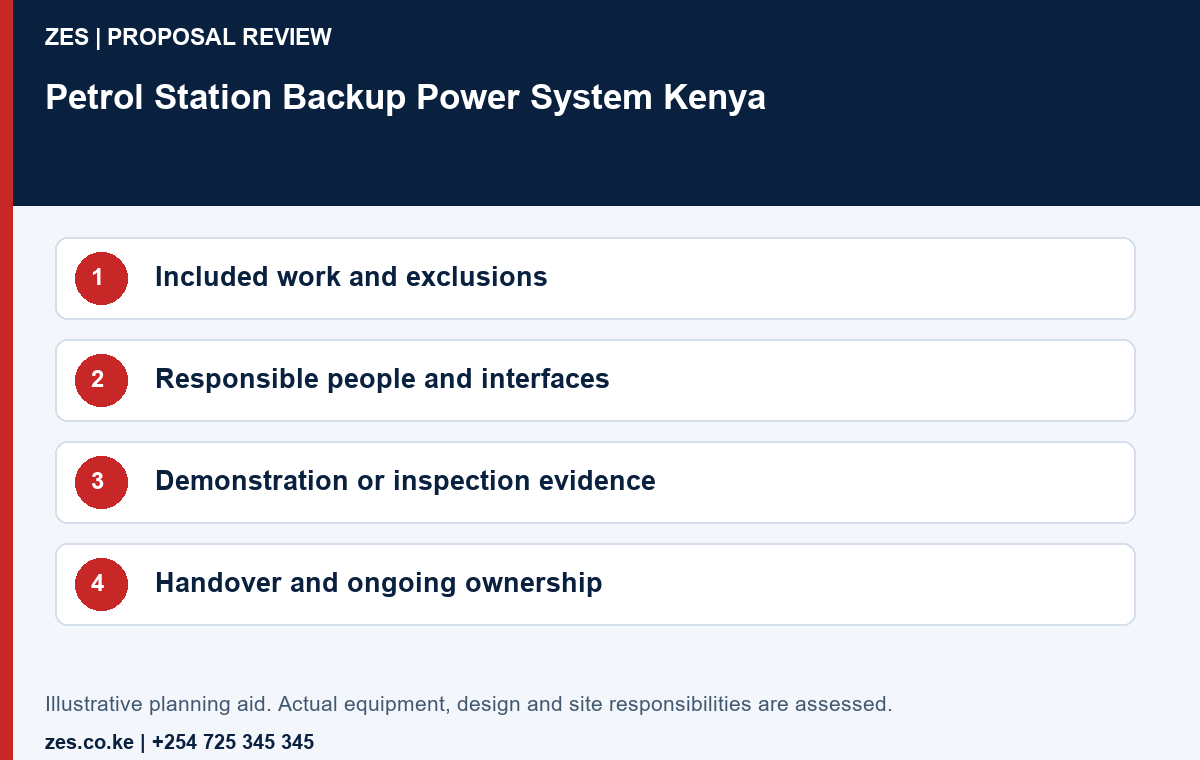
A proposal should identify the acceptance documents and demonstrations relevant to its backup power scope. The responsible competent people decide the appropriate inspection and test methods. The station’s representative should understand what the resulting record covers, which limitations remain and who acts on findings. A visual walk-through, a maintenance visit and an electrical inspection are not interchangeable descriptions of the same evidence.
Plan any switching, interruption or testing through the site’s approved arrangements. Identify affected operations, dependencies and the authorised temporary arrangement where needed. This article is a procurement guide, not an instruction to isolate, open or modify equipment. Staff should use the agreed reporting and escalation process for electrical concerns, leaving technical diagnosis and intervention to the responsible competent people.
Compare the complete installation rather than the headline component. A luminaire, power backup source or inspection instrument is only one element of the proposed work. Supporting systems, integration, enabling work, configuration, documentation and subsequent responsibilities should be identified where applicable. Ask who assesses compatibility and how the actual operating requirement will be demonstrated. Do not infer a complete solution from a product brochure or a single capacity figure.
Keep an asset and document baseline after completion. Record the supplied equipment references, applicable settings or schedules, relevant reports and responsible support contacts in the controlled handover. Review the affected assumptions when operating hours, connected loads, building arrangements or equipment change. If a product is replaced later, the substitute needs assessment for the actual installation; matching appearance or a nominal rating alone is not a sufficient selection process.
Build a proposal that can be compared and accepted
A useful specification separates the result the station wants from the product a supplier proposes. Start with a short statement of the operational problem, the people affected and the evidence that would show improvement. Give each requested deliverable a reference. A supplier can then identify the equipment, labour, configuration, documentation and customer dependencies against that reference. This makes it easier to compare offers without assuming that similar item names describe the same complete service.
Keep a simple comparison register with columns for requirement, included work, excluded work, customer action, acceptance evidence and price basis. An item marked included should have enough detail to distinguish supply alone from installation, configuration or commissioning. An exclusion is not necessarily a poor offer; it becomes a problem when the station discovers it only after work starts. Clarify unanswered questions in writing and attach the clarification to the agreed proposal.
The station should nominate one commercial contact and the operational or technical people who can approve their respective parts. A cashier may explain a daily workflow without having authority to approve a system change. A premises manager may approve access while another party owns an interface or structure. Record these boundaries early. Give the supplier a coordinated response instead of several conflicting instructions from people who assume somebody else has approved the change.
Use a dependency list before agreeing an implementation date. Examples include approved access, available records, enabling works, an authorised test window and attendance by another supplier. For each dependency, identify who provides it and how readiness will be confirmed. Separate the proposed working duration from the full calendar programme. A short installation task can still depend on an assessment, procurement or approval that has not yet been completed.
Use an evidence register rather than a completion claim
Create one acceptance entry for each important requirement. Record the agreed condition, the expected result, the observed result, the person witnessing it and any remaining action. Use the selected product documentation and approved design to decide what is appropriate to test. The examples in this guide are purchasing questions, not permission to carry out hazardous operations or alter live station equipment. Tests must be planned and performed by the responsible people under the site’s arrangements.
An entry should be specific enough for another manager to understand later. An observation such as tested successfully does not explain what was tested. A clearer entry identifies the relevant asset or sample record, the conditions checked and the evidence retained. Do not publish sensitive configuration, employee information or security layouts in a public project gallery. Keep the operational evidence in the customer’s controlled handover file, with access appropriate to its contents.
Distinguish a defect from an agreed exclusion, a customer dependency and a later improvement request. Each needs a different decision. Assign an owner and review date to unresolved matters. If an issue affects the safe or intended use of the delivered work, the responsible parties must decide the appropriate restriction and resolution before treating the affected backup power scope as accepted. A signature should record an informed decision rather than conceal an incomplete requirement.
Customer acceptance and a supplier invoice serve different purposes. An invoice identifies a commercial charge; it does not replace the technical evidence agreed for the project. Similarly, a photograph can show a visible installation without establishing its configuration, structural adequacy or reporting behaviour. Retain the relevant inspection, demonstration or test record alongside the commercial documents so that future reviews do not depend on recollection.
Plan ownership, changes and the next review
Ask for a handover index before completion. Depending on the backup power scope, it may list equipment references, approved drawings, configured functions, maintenance information, licences, acceptance records and support contacts. Mark documents as supplied, not applicable or outstanding. Keep passwords and sensitive access arrangements separate from general manuals. The customer should know who controls each account and how authorised access will be transferred when an employee or contractor changes.
The person expected to use or maintain the result should demonstrate the ordinary task during handover. A presentation to the purchasing team is useful, but it is not the same as the nominated operator retrieving a report, identifying an asset or following the approved support route. Arrange cover for that role. Record the limits of the training and the subjects that still require a competent specialist rather than encouraging staff to improvise repairs.
Compare ongoing obligations as carefully as the initial price. Identify recurring licences, replacement consumables, support arrangements, inspection responsibilities and customer-provided services where relevant. Ask what happens if a renewal is not made, an account changes or an additional site is added. Do not assume that a one-time purchase includes every later configuration change, site visit or third-party service. Request current written commercial terms for the actual backup power scope.
Schedule a review after a representative operating period. Compare the original requirement with actual use, note unresolved findings and decide whether the proposed improvement achieved its purpose. If the station changes layout, staffing, operating hours or another connected system, review the affected assumptions. Keep the approved baseline and later changes together. This gives future suppliers a reliable starting point and reduces the risk of replacing working equipment simply because its documentation has been lost.
A practical enquiry example
A backup enquiry should list essential functions and the intended operating assumptions before asking for a price. Request the backup assessment, proposed equipment, supporting work and the evidence expected for acceptance as identifiable items. Keep backup operating duties and technical maintenance responsibilities distinct. If future expansion is anticipated, describe it as a separate assessed requirement rather than an unlimited promise that the original backup arrangement will support every later load.
Prepare a clear enquiry for ZES
Share the station location, the problem or intended outcome, relevant quantities and the existing equipment or application references. Include available approved plans or anonymised examples where useful. Identify the person who can authorise site access and the contacts responsible for operations and technical interfaces. Keep credentials, employee biometric records and confidential transaction information out of a general enquiry.
Ask the written proposal to identify the supplied work, exclusions, customer dependencies, current commercial terms and the evidence used for acceptance. Confirm specialist responsibilities and relevant credentials for the actual scope. ZES can review the brief and confirm the appropriate assessment and proposal arrangements. Site attendance, timing, product availability and support commitments are agreed directly rather than promised solely because a project names a particular county or town.
Compare the same complete scope
- Equipment or materials: identify the actual model, specification and documentation.
- Supporting tasks: record enabling work, site access and customer-supplied dependencies.
- Configuration or fabrication: state the work and the responsible approving party.
- Acceptance: agree the demonstration, inspection or verification evidence required.
- Ownership: confirm accounts, records, recurring charges and the future support route.
Frequently asked questions
Can a backup product be selected from capacity alone?
No. Assess the actual loads, operating duty, location and electrical interfaces with the responsible designer.
Does backup power guarantee every application remains operational?
No. Include the relevant equipment and application behaviour in an agreed end-to-end acceptance test.
Reference information: EPRA electrical responsibilities · NCA contractor information.
Related ZES service · Petrol-station engineering enquiries · Request a scoped quotation · Request a site assessment · Call +254 725 345 345