
Electric Gate Troubleshooting Nairobi should turn an unclear gate fault into a documented finding and a sensible gate repair decision. ZES assesses faults across the gate, operator, controls and relevant power arrangements. For owners, the most useful preparation is a clear history of the problem, not opening the controller or trying random settings.
Electric Gate Troubleshooting Nairobi: 7 essential enquiry checks
1. Define the gate fault precisely
The gate is not working can mean many things: no response, slow movement, stopping halfway, reversing, failing to close or working with one control but not another. Describe the actual behaviour and its effect on access. Include the gate type and whether the problem affects one leaf or the complete entrance.
A precise description helps the technician plan the visit and distinguish separate complaints. If the remote range is poor and the gate also scrapes the ground, report both. They may require different work even if users experience them as one unreliable entrance.
2. Keep a short gate fault history
Note when the problem began, whether it happens every time and what changed beforehand. Recent building work, a new access-control device, impact or an outage may be relevant. Preserve previous service findings and invoices where available. A history can help identify whether a gate repair addressed the original gate fault or only one part of it.
For an intermittent gate fault, record the date, normal control used and observed behaviour. Do not create a dangerous test to reproduce it. The aim is to give the technician useful observations from ordinary use, with people kept clear of abnormal movement.
3. Identify the equipment and responsibilities
An electric gate may combine a motor, receiver, intercom, access-control system and power backup installed at different times. List the known models and who maintains each part. If another contractor manages an intercom or access system, the assessment may need coordination.
Ask who is responsible for confirming the end-to-end operation. A gate motor can respond correctly to its own control while an external interface has a separate problem. Equally, a working intercom does not prove that the gate mechanism is healthy.
4. Separate observations from conclusions
A clicking sound does not by itself prove that the motor has failed. A gate that stops in one place does not automatically need more force. A remote that works only sometimes does not establish that the receiver must be replaced. Keep these as observations until the relevant assessment is complete.
Ask the technician to explain the finding in terms you can understand: what failed, how it relates to the gate fault and what work is recommended. If several issues exist, request a priority order and identify anything that prevents safe normal operation.
5. Compare gate repair options with clear boundaries
The recommended work may involve configuration, a compatible part, mechanical repairs or equipment replacement. Ask what is included and what is retained. Where the diagnosis requires further investigation, agree that stage before treating an estimate as a fixed completed gate repair price.
| Work type | Decision to clarify |
|---|---|
| Diagnosis | What is being assessed and what report will be provided? |
| Component repair | Which confirmed fault does the work address? |
| Replacement | Why is replacement proposed and what else must change? |
| Interface work | Who confirms operation with the connected system? |
| Follow-up | What happens if the intermittent symptom returns? |
This comparison is especially useful for properties with several contractors. It makes the agreed outcome visible and reduces gaps between each supplier’s responsibilities.
6. Keep unsafe experiments out of owner troubleshooting
Do not bridge safety inputs, open live enclosures or increase settings to force a reluctant gate to move. Do not stand in the movement area to test whether the gate will stop. These actions can introduce hazards and obscure the original gate fault.
Owner preparation should be limited to information gathering from a safe position and using the correct user documentation. If the gate is damaged or unpredictable, keep people clear and seek competent assistance. For a blocked entrance, use the not-opening repair guide to prepare the access information.
7. Close the job with a usable service record
Ask for the finding, work performed, parts supplied and outstanding recommendations. The responsible user should receive a demonstration of the agreed operating arrangement and relevant instructions. Record any change to access devices or normal procedures so other users are not surprised.
For intermittent complaints, agree how recurrence will be reported. The record should distinguish the original symptom from a new problem. A dated account with the control used and observed response is more helpful than simply saying the gate has failed again.
Troubleshooting a shared apartment entrance
Nominate a manager or caretaker to coordinate the enquiry. Gather reports from residents without circulating private access codes. Explain peak traffic times and whether deliveries or pedestrians use the same opening. The gate repair plan should consider how the entrance will be managed during assessment.
If remotes are added or replaced, maintain an authorised device register. A controls problem can overlap with access administration, particularly when old devices remain in circulation. See the remote programming guide for that part of the work.
What determines the troubleshooting cost?
Location, equipment arrangement, access to the installation and the nature of the gate fault affect the assessment scope. Parts and gate repair labour should be confirmed after diagnosis where the cause is unknown. Ask ZES to explain call-out or assessment charges, if applicable, before the visit, and obtain approval terms for additional work.
A cheap guessed component is not a reliable gate repair budget. The useful comparison is the cost of finding and correcting the actual problem, with the completed checks and support terms made clear.
Request an assessment in Nairobi
Send ZES an enquiry with your area, gate type, known model, symptom and recent history. Include the responsible site contact and any existing service record. ZES can then discuss attendance and the next assessment step.
Further guidance for your entrance
Updated 3 November 2026 · Zama Engineering Systems buyer guide
Gate Automation Repair Nairobi enquiries often involve several connected functions: a normal control method, an operator and the entrance’s relevant safety arrangements. A failed interaction does not automatically prove that every connected product needs replacement. This guide focuses on describing the affected functions and comparing an assessed gate repair scope, rather than giving wiring or bypass instructions.
Distinguish the affected functions
Explain whether the problem affects remotes, a keypad, an intercom release or ordinary gate movement. State which functions still work and whether symptoms began after a change. Provide model references and relevant service records. Record only what can be observed safely during normal use. Keep security credentials private and do not attempt terminal bridging or internal tests from an online description.
Gate Automation Repair Nairobi: identify responsibilities
The installed products may involve gate, electrical, intercom or access-control specialists. Ask who assesses each interface and coordinates the overall result. Compatibility depends on the actual products and configuration, not a promise that every device connects. The quotation should state the diagnosis, assumptions and any further checks required. A product’s marketing feature list is not evidence that the existing site has that feature configured.
Define configuration, repair and replacement separately
Some work may involve an authorised configuration review, while other work needs a repaired or replaced component. Ask which option is proposed and why. Include licences, account ownership, parts and any required specialist visits in the supplied-work scope. Do not assume a replacement control product is suitable without reviewing its interfaces. Safety-related faults must be addressed through appropriate competent procedures, not hidden by disabling a function.
Test the agreed end-to-end outcome
Handover should cover the actual user interaction as well as the relevant gate checks. For example, an agreed intercom release should be demonstrated through the installed arrangement, with limitations recorded. Provide user instructions, equipment details and the process for removing obsolete access. Keep support responsibilities clear so a later gate fault does not become a dispute between several suppliers who each checked only their own device.
Compare the supplied scope
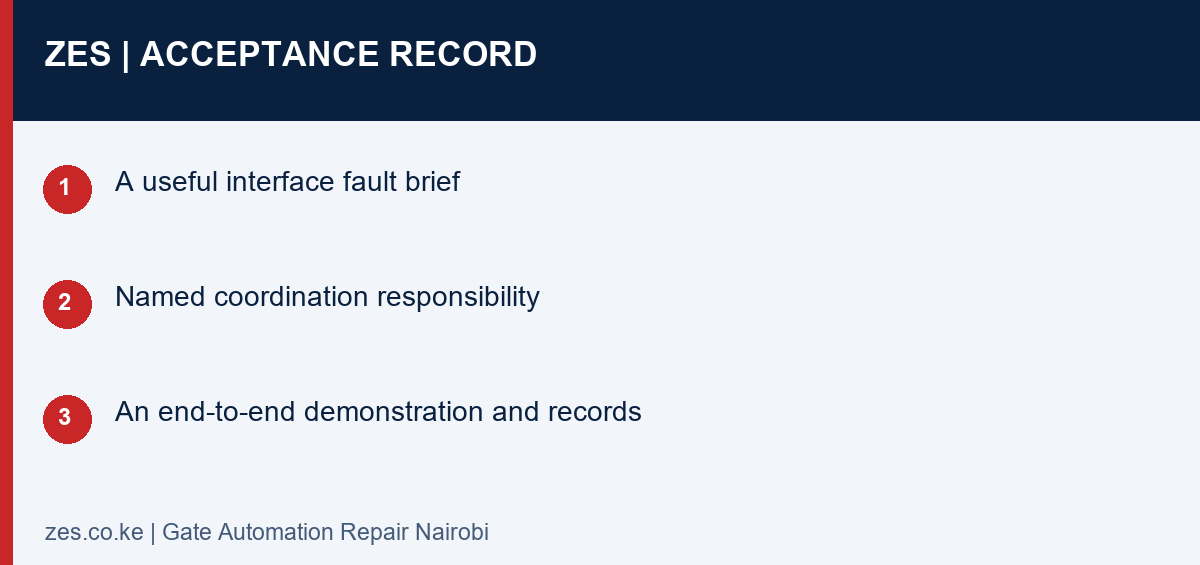
| Decision | Information to confirm | Useful result |
|---|---|---|
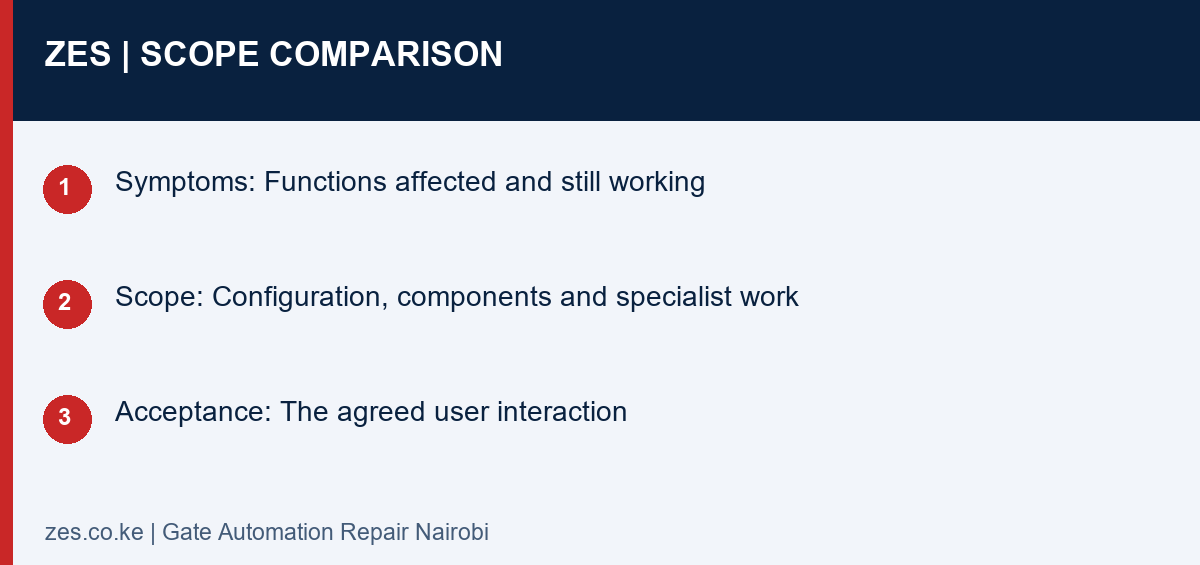
| Symptoms | Functions affected and still working | A useful interface fault brief |
| Scope | Configuration, components and specialist work | Named coordination responsibility |
| Acceptance | The agreed user interaction | An end-to-end demonstration and records |
A practical planning example
An entrance may operate normally from one control method but fail through another installed interface. The useful brief describes that distinction without exposing access codes. This is an illustrative assessment scenario, not a diagnosis.
Gate Automation Repair Nairobi: enquiry checklist
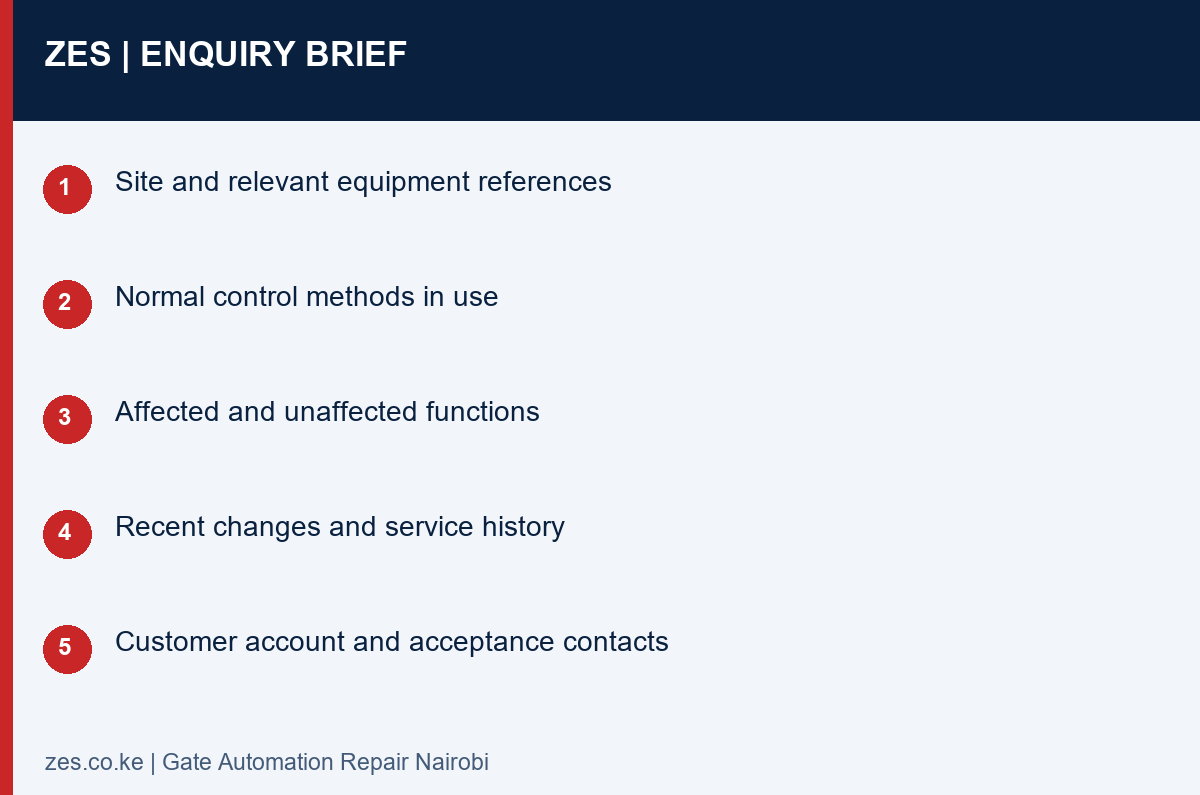
- Site and relevant equipment references
- Normal control methods in use
- Affected and unaffected functions
- Recent changes and service history
- Customer account and acceptance contacts
Questions before arranging work
Can every intercom work with every gate operator?
No general compatibility promise is made. The actual products, interfaces and configuration need confirmation.
Can a safety input be disabled to restore access?
Do not bypass safety functions. Obtain appropriate competent assessment and agree a safe site arrangement while the gate fault is addressed.
Discuss the gate requirement with ZES
Read the related ZES gate project guide and explore the service categories. Share the location, equipment information and intended outcome. ZES confirms the appropriate assessment, availability, proposed delivery responsibilities and commercial terms for the actual enquiry.
Request a scoped quotation · Request a site assessment · Call +254 725 345 345
Technical background: HSE powered-gate technical background (UK). This background does not establish Kenyan legal requirements for a particular project. Use the actual product instructions and appropriate project-specific advice.
For product-specific information, consult the relevant manufacturer documentation, such as FAAC manuals or Centurion technical resources. Use the documentation for the installed model.
A gate fault log for an intermittent electric gate
Keep the log simple enough that the responsible user will maintain it. Record the date, approximate time, normal control used and observed response. Add whether the gate was opening or closing and where it stopped, if that can be observed safely. Do not include private access codes in a general maintenance record.
The log should contain facts rather than assumed causes. Gate stopped after a short movement is an observation. Controller is faulty is a conclusion that needs assessment. Keeping that distinction helps the technician review the pattern without being directed toward an unconfirmed part.
If the problem follows a recent change, record what changed and when. This may include building work, an accessory replacement or a new operating procedure. A sequence can guide investigation, but it does not prove the cause by itself.
Bring previous service findings together with the log. If several people have attended the gate, the record can show what was already checked or replaced. It is more useful than asking the next technician to rely on an incomplete verbal history.
Example: the intercom works but the gate does not respond
An intercom can provide communication while a gate-opening function has a separate problem. Explain which functions work and which do not. Identify the intercom and gate equipment where known, and name the provider responsible for each system.
The gate fault assessment should distinguish the external control interface from the operator and mechanical gate. Ask who will confirm the end-to-end function and whether coordination with another provider is needed. Avoid assuming that one contractor’s equipment is faulty simply because the complaint appears at its user interface.
If a repair is proposed, request the finding and scope in plain language. The quotation should explain whether the work concerns a supported connection, configuration, a failed component or another issue. Any external software or account responsibility should be identified separately.
At completion, demonstrate the actual agreed user action, not only each device in isolation. Record any function that remains outstanding. A working intercom conversation and a gate that opens from a local control do not necessarily establish that the combined requirement has been met.
Example: several faults are reported together
A property manager may report poor remote range, unusual gate noise and intermittent stopping in the same enquiry. These complaints may not share one cause. List them separately and give their history. This helps the technician explain which findings relate to which symptoms.
Ask the repair proposal to identify priorities. A condition affecting safe operation should not be hidden among convenience improvements. The owner should know what must be addressed before normal use and what can be considered separately after the relevant assessment.
If one item is repaired first, record the completed work and the remaining complaints. That prevents an unfinished remote-range issue, for example, from being confused with the outcome of a mechanical repair. Clear scope makes later follow-up more productive.
Do not assume that replacing the complete motor resolves every reported issue. The gate, controls, power and external interfaces still need to be considered as appropriate. Gate troubleshooting should lead to a reasoned proposal for the actual installation.
Example: the gate fault is not present during the visit
Intermittent complaints can be difficult to reproduce during an appointment. Share the gate fault log and previous records, and ask what findings can be established at the visit. A technician should distinguish a confirmed defect from a possible explanation that needs further evidence.
Agree the next step rather than demanding a guessed component replacement. Further observation, a defined investigation stage or coordination with another provider may be appropriate. The proposed process and any charges should be clear before additional work is approved.
Ask what information to record if the symptom returns. Keep observations limited to ordinary use from a safe position; do not create hazardous tests. A useful recurrence report can help the next assessment focus on the conditions associated with the gate fault.
The service record should state what was checked, what was found and what remains uncertain. That is more honest and useful than marking an unexplained intermittent gate fault as permanently solved after one successful operation.
Who should approve gate repair work?
For a home, identify the owner or authorised representative. For a shared or commercial property, nominate a manager who can approve the scope and any changes. The technician should not have to reconcile conflicting instructions from several users while work is under way.
Give that contact the relevant records and explain the operational priorities. If residents or staff need notice of an interruption, arrange the communication through the responsible property team. Confirm access arrangements for the visit and any site rules in advance.
When a variation is proposed, record the reason, work and cost before approval. Keep the updated scope with the final service record. This makes the completed job easier to review and reduces confusion about work that was discussed but not authorised.
Turning the diagnosis into a clear quotation
A repair quotation should connect the finding to the proposed action. Ask which part or condition is being addressed, what remains in service and what checks are included at completion. If a replacement is proposed, ask why that is the recommended option.
Confirm the applicable labour, parts, travel and tax terms. Where the finding requires a staged investigation, make the stage and approval point explicit. A fixed price for an unconfirmed gate fault can be less useful than a clearly defined assessment process.
After work, keep the finding and outcome together. Future gate troubleshooting becomes easier when the record shows why a component was replaced and which gate fault it was intended to address. The next technician can then start from evidence rather than another round of guesses.
Related ZES gate guides
FAAC installation · Gate spare parts · Automatic gate prices · Request a quotation