

Automatic Gate Price in Kenya depends on what you are buying: a new gate and automation, automation for an existing gate, or replacement equipment. These projects should not share a single headline price. ZES prepares quotations around the entrance and agreed work. This guide explains the costs to compare; it does not present unverified market estimates as ZES prices.
Automatic Gate Price in Kenya: 7 essential cost checks
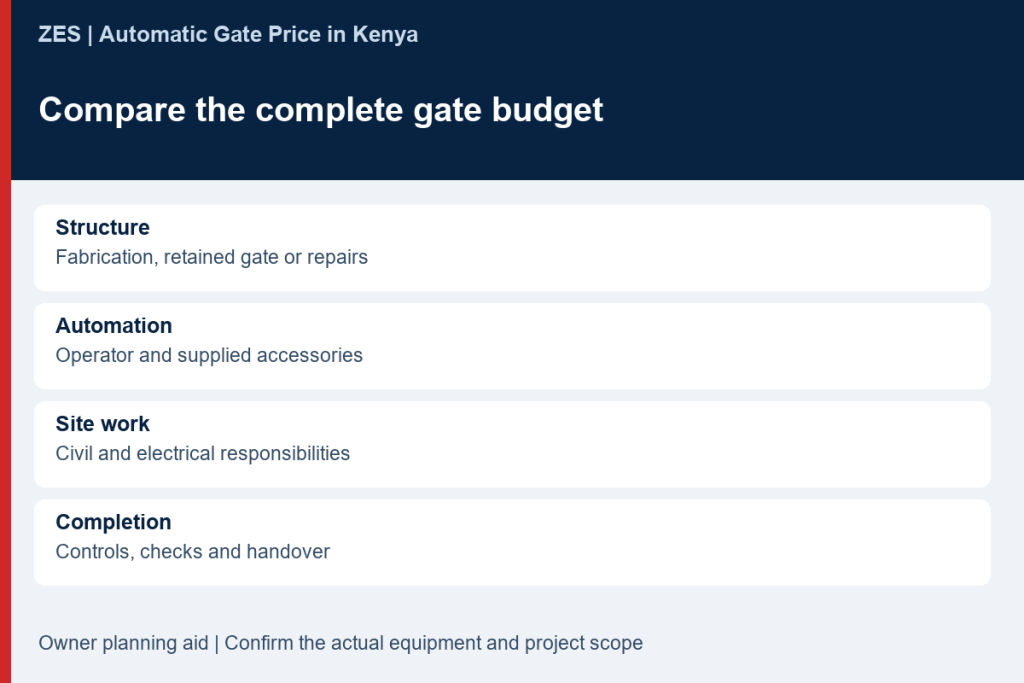
1. Separate the gate from the automation
A fabricated gate, posts and running gear may be priced separately from the motor and controls. If you already have a gate, its condition still needs assessment. Ask whether the gate quotation includes a new structure, repairs to the existing one, or automation only. This is often the largest source of confusion between two apparently different prices.
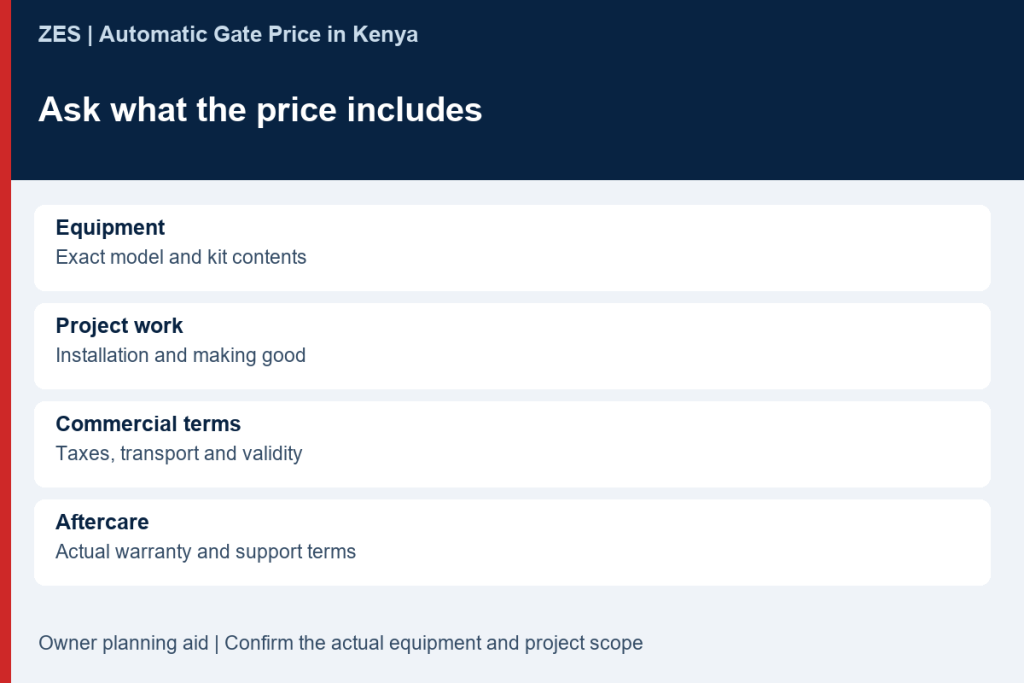
2. Identify the exact equipment
Request the proposed operator model and the reason it suits the gate and usage. A motor-only offer and an installed system are different products. Where a kit is quoted, ask for its contents rather than assuming it contains every item needed on your site.
3. Include the site work
Mounting foundations, track or support repairs, cable routes, power provision, drainage and reinstatement can affect the completed cost. Ask who is responsible for each interface. A gate quotation with a low equipment total may still leave substantial work for another contractor.
4. Count the controls and protective provisions
State how many authorised users need devices and whether an intercom or other access system is involved. Ask which protective arrangements the site assessment requires. These should be defined in the complete proposal rather than treated as optional surprises after the motor is selected.
5. Define backup or solar requirements
If outage operation is important, explain the expected usage and confirm what the proposed arrangement supports. Solar power requires its own assessment. Compare the actual included equipment and assumptions; the words battery ready do not mean a battery or a complete backup installation is supplied.
6. Clarify commercial terms
Ask whether taxes, transport, installation, testing and making good are included. Confirm gate quotation validity, payment stages and approval arrangements for additional work. Read the actual warranty and support terms rather than relying on a general promise of quality.
7. Compare completed outcomes
Put competing quotations into the same categories before comparing totals. A useful proposal defines what will operate at handover and what is excluded. Where one offer omits repairs or controls, request clarification rather than assuming the difference is a saving.
| Budget heading | Confirm before comparing |
|---|---|
| Gate structure | New fabrication, retained gate or repairs |
| Automation | Exact operator and supplied accessories |
| Site work | Civil, mechanical and electrical responsibilities |
| Access | Remotes, visitor controls and supported interfaces |
| Completion | Commissioning, instructions and support terms |
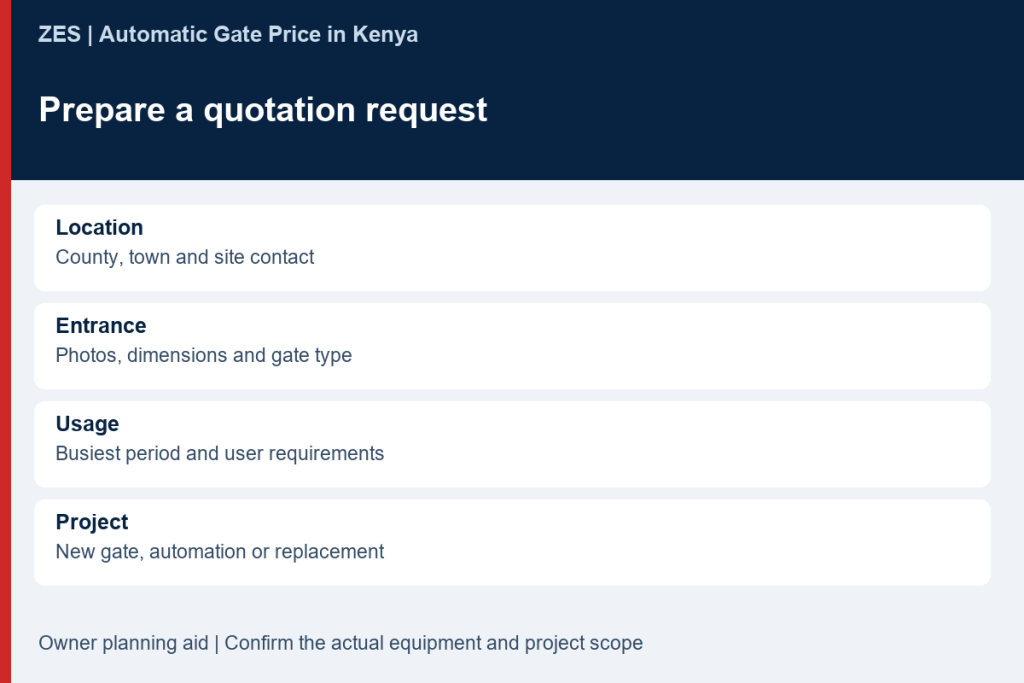
How to obtain a meaningful price from ZES
Send the location, photographs, approximate opening dimensions, gate type and expected usage. Explain whether you need fabrication, a new installation or replacement. ZES can then discuss assessment and an itemised gate quotation. You do not need to guess a motor rating before making an enquiry.
For a sliding entrance, see sliding gate motor prices and installation scope. For installation labour and site-work questions, use the Nairobi installation cost guide. Request your ZES quotation when you have the basic site details.
Why this guide does not show a universal price
No current ZES price schedule has been supplied for these projects. Publishing a made-up range would make budgeting less reliable. An assessed gate quotation is the appropriate place to confirm the current equipment, scope and cost for your entrance.
Three different projects that are often called an automatic gate
A new gate with a complete automation installation
This project starts with the physical entrance. Gate fabrication, posts or supports, running arrangements and finishes may be part of the budget before a motor is selected. The automation installer and fabricator need a shared understanding of the proposed gate and its movement.
Ask who is responsible for confirming the design and installation interfaces. A decorative drawing alone may not establish the structural, mechanical or operating requirements. The completed gate quotation should explain the supplied gate, automation equipment and site work rather than leave the owner to combine unrelated offers.
If a builder is already working at the property, involve the gate installer before foundations, cable routes and paving are finalised. Coordination can prevent the scope from changing after the entrance has been finished. It does not eliminate the need for a site-specific assessment.
Automation for an existing manual gate
An existing gate can reduce the amount of new fabrication, but only if its condition and arrangement are suitable. Ask the assessor to explain necessary repairs and preparation. A gate that drags, has loose supports or lacks an appropriate running arrangement should not be treated as ready merely because it can be moved by hand.
Separate the preparation cost from the operator and controls. This makes it easier to compare proposals and decide whether repairing the current gate is practical. If a supplier excludes all mechanical work, identify who will perform and approve that work before the motor is fitted.
Provide photographs showing the complete entrance and the movement area. Mention previous repairs, impact damage or recurring movement problems. Those details help the initial discussion, while the final suitability decision belongs to the competent site assessment.
Replacement of an existing automatic gate motor
Replacement is a different budget again. Some existing components may be retained, while others may be incompatible or in poor condition. Ask the gate quotation to list what changes and what remains. A new operator does not automatically include new remotes, a battery or repairs to the gate itself.
If the existing installation has a fault, request a diagnosis before assuming replacement is necessary. The repair-versus-replacement decision should consider the finding, equipment condition, parts availability and complete installed scope. Read the replacement decision guide for a more detailed comparison.
Sliding and swing gate budgets are not interchangeable
A sliding gate and a swing gate have different movement and installation requirements. A sliding proposal may involve the running track, rollers, side-travel area and rack. A swing proposal may involve leaf supports, hinges, actuator mounting and the opening area. The appropriate equipment follows the assessed entrance.
For a double-leaf swing gate, ask how the complete arrangement is specified rather than comparing the automatic gate price of one actuator with a complete sliding installation. Confirm the supplied controller, controls, mounting items and protective provisions. The equipment list should make the difference visible.
Neither gate type is universally the cheaper completed option. Existing site conditions can change the amount of preparation required. Compare proposals for the actual property and desired use instead of choosing from a headline price on an unrelated entrance.
What makes an apartment gate quotation different?
Shared entrances often have more users, peak queues and a formal visitor procedure. The project may need a clear device register, a manager responsible for access and coordination with guards or an intercom. Those requirements should be explained before the gate quotation is prepared.
Ask how the proposed equipment suits the busiest periods. Include planned occupancy changes and delivery patterns. A low quoted total based on an individual home’s use may not describe the apartment entrance you need.
Agree who holds the documents and approves future maintenance. The committee or managing agent should be able to see the equipment specification, completed work and actual support terms. A clear record helps compare future service costs and prevents the next manager from starting without installation information.
What makes an industrial gate quotation different?
Industrial entrances may involve larger vehicles, work permits, restricted installation windows and interfaces with other site systems. The gate project should be connected to the site’s movement plan and facilities responsibilities. These are scope questions, not reasons to invent a standard industrial price.
Provide vehicle types, peak activity, approach constraints and the responsible site contact. Where a civil contractor, fabricator or security-system provider is involved, identify their work. Ask the gate quotation to state the interfaces and how the completed arrangement will be accepted.
If the proposal includes a barrier as well as a gate, make sure the functions are explained separately. A traffic-control device and the physical boundary gate may serve different purposes. Procurement should compare the required outcome and complete supplied work rather than combine unrelated product prices.
Avoid comparing an advertised price with an undefined project
An advertisement can be useful for identifying a supplier or product, but it may leave installation assumptions unstated. Ask whether the automatic gate price is for supply only, whether taxes and delivery are included and which accessories are in the offer. Confirm the model and the validity of the price directly with the supplier.
Do not treat a promotional figure as a complete budget for your property until the site work is defined. Equally, do not assume a higher gate quotation is better simply because it is higher. Request the missing details, compare like-for-like scope and ask for the reasoning behind the selected equipment.
Keep the comparison in writing. A short list of included items, excluded work and responsibilities is easier to review than several verbal promises. If an item is provisional, mark it clearly and agree when it will be confirmed.
Planning future ownership costs
Ask what routine servicing the supplied equipment and entrance require, who can provide it and how service findings are recorded. Any battery or other consumable component should be identified so future replacement enquiries use the correct specification. No universal replacement interval is promised here.
Consider the practical availability of compatible parts and user documentation. A low initial price can be difficult to assess if the exact equipment is not named. Keep the model, invoice and supplied terms so a future repair decision can be based on the installation you actually own.
For shared properties, plan how maintenance is authorised and funded. This helps avoid delaying assessment when a fault affects everyone. The maintenance arrangement should reflect the property management structure and actual supplier offer.
Frequently asked price questions
Can ZES give a budget before a site visit?
ZES can discuss the requirement using the information you provide and explain what further assessment is needed. Ask which parts of an initial estimate are provisional. A firm installed scope may need a visit, especially where the existing gate condition or site work is uncertain.
Is a motor kit enough to automate my gate?
Not necessarily. A kit’s contents and the site’s requirements must be compared. Additional mounting, power work, gate preparation, controls or protective provisions may be needed. Ask for the complete installation schedule before buying.
Does a higher-rated motor solve a heavy or sticking gate?
The gate and operator must be assessed together. A motor should not be selected to force an unsuitable or defective mechanism to move. Ask the installer to separate necessary mechanical work from equipment selection.
Where can I get the current ZES price?
Use the quotation form or call/WhatsApp +254 725 345 345. Provide the location, gate photographs and project type. The current price belongs in an itemised offer for your entrance, with the supplied terms and exclusions made clear.
For product-specific information, consult the relevant manufacturer documentation, such as FAAC manuals or Centurion technical resources. Use the documentation for the installed model.
A gate quotation comparison worked through without invented prices
Imagine two proposals for the same existing sliding entrance. Proposal A names an operator and basic fitting. Proposal B names an operator, gate preparation, new controls and commissioning. The owner cannot compare their totals fairly until Proposal A’s exclusions and Proposal B’s included work are understood.
Start with the equipment. Are the models the same, and were they selected for the same usage assumptions? Then compare the gate preparation. If one supplier has identified a track repair, ask whether the other has assessed that condition. Do not silently remove necessary work to make the totals look comparable.
Next, compare the controls and completion scope. Count the remotes, identify any intercom interface and confirm the relevant protective provisions. Ask which checks and instructions are included. The automatic gate price should describe the entrance the owner expects to use at handover.
Finally, compare commercial terms. Taxes, transport, payment stages, gate quotation validity and actual warranty conditions can affect the decision. Keep all clarifications with the offer. The example deliberately contains no figures because its purpose is to show how to compare a real quotation, not manufacture a market price.
How to discuss a limited budget with ZES
Explain the essential requirement and any preferred features separately. The essential brief may be an assessed automated entrance with suitable controls and protective arrangements. Preferences might include a particular appearance or an additional supported convenience function. The installer can then explain the available scope rather than guess what matters most.
Do not ask for necessary repairs or protective provisions to be omitted merely to reach a target total. Ask instead whether there is a suitable alternative equipment arrangement or a clearly defined project phase. Any phased work needs an understood completed condition and responsibilities.
If some work will be supplied by another contractor, identify it explicitly. A lower ZES gate quotation that excludes civil preparation is not the same as a lower total project budget. Combine the actual agreed scopes when deciding what the entrance will cost.
Keep the final decision in writing. A clear budget discussion should leave you knowing what is included, what is deferred and what conditions must be satisfied before normal use. It should not leave the owner relying on an unrecorded promise that extra work will somehow be absorbed later.
Why photographs help but do not establish every cost
Wide photographs can show the gate type, approach, side-travel or opening area and visible condition. They help ZES prepare an initial discussion and identify the next questions. Existing drawings and equipment records can add useful detail.
Photos may not establish hidden foundations, electrical suitability, every mechanical defect or the condition of retained components. Ask which parts of an initial proposal remain provisional and what assessment is required. A clearly stated limitation is more useful than treating an incomplete view as a full survey.
If you send dimensions, explain how they were measured and whether they are approximate. The installer should confirm relevant dimensions before ordering equipment or finalising installation work. Do not mistake an owner-supplied estimate for a completed technical assessment.
Keeping price information useful over time
Save the gate quotation date and validity with the project record. If you return to the project later, ask for the automatic gate price, equipment availability and supplied terms to be reconfirmed. A current automatic gate price should relate to the scope being ordered now, not an earlier proposal with different assumptions.
If the property or gate changes, explain that before relying on the old offer. A new leaf design, altered paving or increased usage may affect the proposed work. The supplier can then review the scope rather than discover the change on the installation day.
After completion, retain the final gate quotation, approved variations and invoice together. This gives future maintenance decisions a clear record of the installed equipment and work. It also makes it easier to distinguish a later upgrade from an item that was already included in the original project.
The most useful next step
Prepare a short brief and request an itemised offer. Include the location, gate type, photographs, approximate dimensions, intended use and whether you need a new gate, automation or replacement. State the controls and outage requirements you want assessed.
ZES can then discuss the appropriate next step and the proposed scope. A current gate quotation gives you a meaningful basis for deciding, while an unsupported universal price would hide the differences between entrances.
Related ZES gate guides
FAAC installation · Gate spare parts · Automatic gate prices · Request a quotation