
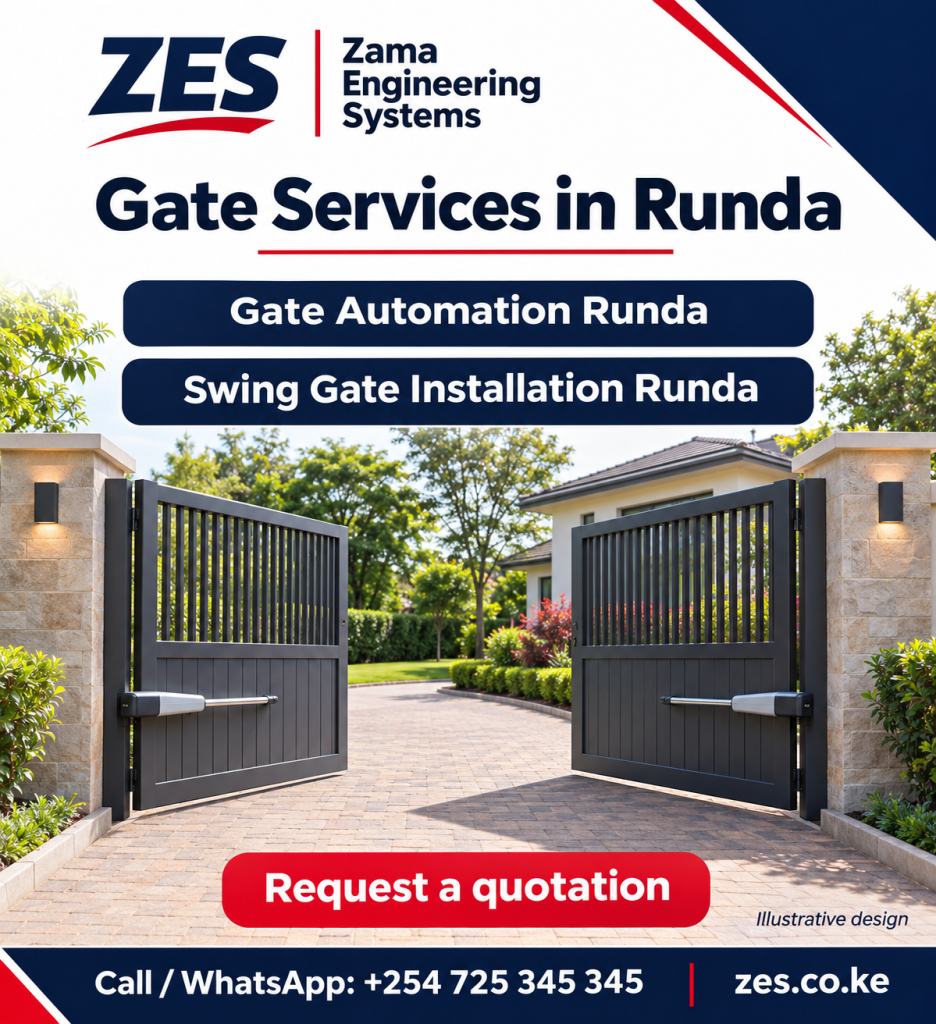
Sliding Gate Automation Runda — planning, quotation and owner guidance
A sliding gate should make your entrance easier to use, not add another problem to the daily routine. If you are considering sliding gate automation in Runda, the most important starting point is the gate’s movement: where it travels, what supports it and whether it can open fully without interfering with the rest of the property.
Zama Engineering Systems (ZES) helps you turn those practical requirements into an installation scope. A new gate, a manual gate being upgraded and an existing automated entrance needing improvement are different projects. Understanding which one you have prevents unnecessary equipment purchases and incomplete quotations.
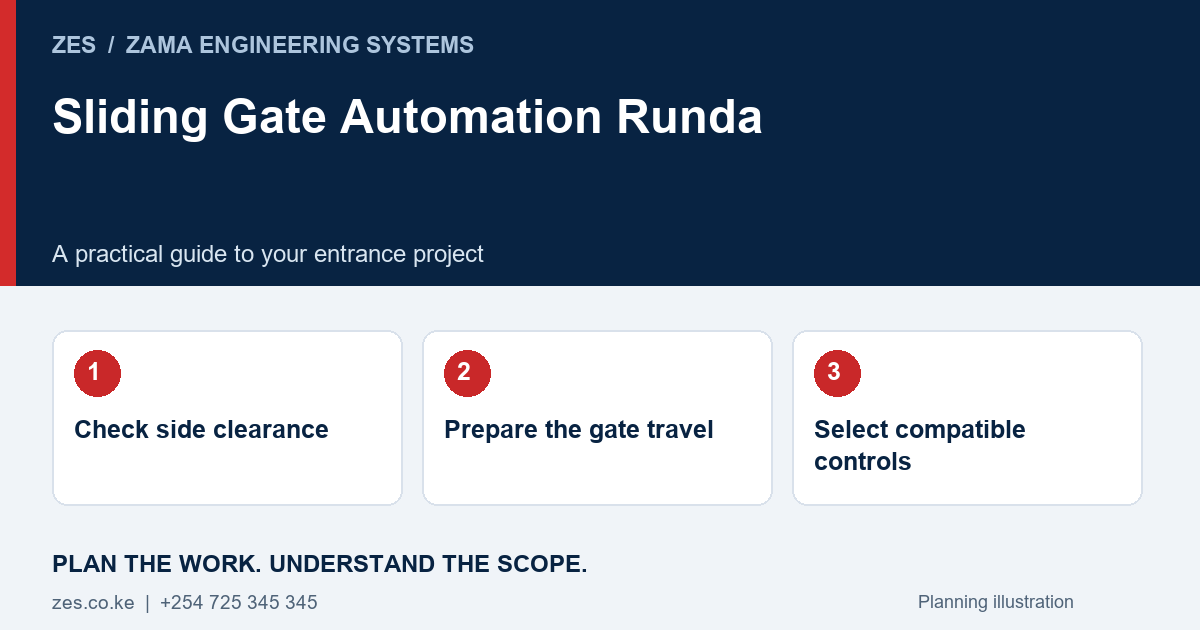
Why choose a sliding automatic gate?
Sliding gates travel sideways rather than swinging into the driveway. This can be useful where vehicle parking or the driveway arrangement makes a swinging leaf inconvenient. However, the gate needs sufficient space beside the opening to retract.
That side space should be considered part of the operating entrance. It should not become an improvised storage area for bins, materials or parked motorcycles. Discuss the whole travel route during the survey, including nearby walls, planting and pedestrian access.
If you are still deciding between gate types, compare the proposed layout with swing gate automation before fabrication begins.
Sliding gate automation Runda: assess the gate before the motor
An operator works as part of a mechanical system. Wheels, guides, supports, track condition and alignment can all affect the installation. Existing movement problems should be identified before automation is added.
A gate that catches in one position may need mechanical correction. Buying a larger motor without addressing the cause can leave the entrance with the same underlying problem. Tell the assessor about difficult movement, unusual noise or earlier repairs, and let the inspection establish the work required.
Where a new gate is being fabricated, the fabricator and automation installer should agree the relevant dimensions and mounting provisions. This is easier before the structure and finishes are complete.
Tracked or cantilever: understand the difference
A tracked sliding gate travels on a ground-level track. A cantilever gate uses a different supporting arrangement and does not rely on a track across the driveway opening. These designs have different space and structural requirements.
Neither is automatically the best answer for every Runda property. Ask the designer to explain why the proposed arrangement suits your entrance and which civil works it needs. The answer should account for the available travel space, supports and site conditions.
If paving or drainage work is planned, coordinate it early. Changes to finished levels can affect work that has already been completed. Agree who handles the equipment base, routes and reinstatement.
Choose a motor for the way the entrance is used
Gate dimensions and weight matter, but the expected operating pattern also belongs in the equipment discussion. A private entrance with occasional vehicle movements is different from a shared entrance with repeated arrivals at busy times.
Give the installer a realistic description of peak use. Mention delivery access, guard operation and any changes you expect in future. Ask for the exact proposed model and the reason it is suitable, rather than choosing from a brand name alone.
Existing remotes, receivers and other accessories should be assessed for compatibility before they are included as retained equipment. Reuse can be worthwhile when the components are appropriate.
Features worth discussing
| Requirement | Option to discuss with ZES |
|---|---|
| Convenient entry | Remotes for the authorised household or property users |
| Visitor communication | A compatible intercom arrangement |
| Managed access | Suitable controls and user permissions |
| Power interruptions | Compatible backup and authorised release arrangements |
| Future changes | Provision for later accessories where practical |
The final selection should remain easy to operate. Adding features is useful only when someone knows how to administer them and understands any ongoing connectivity requirements.
What should a complete quotation cover?
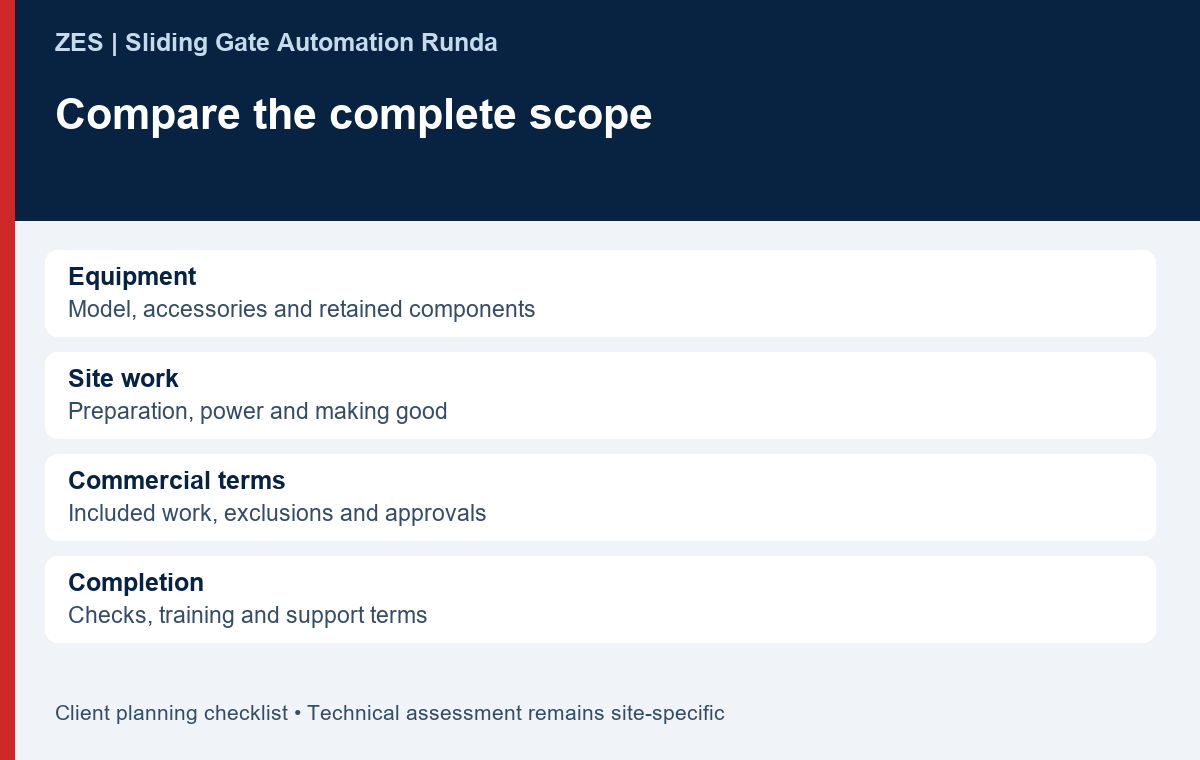
A sliding gate automation quotation should explain gate preparation, the operator, electrical work, controls, protective measures and commissioning. It should also identify site work supplied by another contractor.
Ask whether the figure includes the agreed remote quantity, excavation and making good. Clarify taxes, exclusions and any item that remains subject to inspection. This gives you a fair basis for comparing offers.
For more on operator selection, see the ZES sliding gate motor guide. Your final equipment choice should follow the assessed installation.
Frequently asked questions
Can my existing manual sliding gate be automated?
It may be suitable following assessment. The survey should identify which components can remain and what preparation is needed.
Should I finish the driveway first?
Discuss automation before final paving where possible. The contractors can then coordinate equipment positions, routes and finished levels.
Is a faster gate always better?
Speed is only one part of the design. The installer must consider the actual gate, usage and protective requirements together.
Seven easy checks for a sliding gate project in Runda
Use these checks to understand the proposal before choosing equipment. They focus on layout, responsibilities and ownership. Measurements, structural decisions and technical commissioning still belong with the appropriate installer or designer.
1. Measure the project beyond the driveway opening
The clear driveway opening is only part of a sliding gate layout. The gate also occupies space while retracting and when fully open. Ask the assessor to show that complete movement on the site plan.
Include walls, planting, utility features and objects that are normally kept beside the entrance. A photograph taken on a tidy survey day can miss where bins or materials are usually stored. Describe normal use, not just the temporary arrangement.
If you expect a future boundary extension, mention it. Gate automation should be coordinated with known changes rather than designed around a clearance that will disappear after construction.
Ask what parts of the travel area must remain accessible for maintenance and which areas require protection. The outcome should be a clear boundary between the gate’s operating space and the rest of the property. That is more useful than simply being told that a sliding gate “will fit.”
2. Understand how the selected gate is supported
Ask whether the design is tracked or cantilever and what that means for the supporting works. A tracked gate and a cantilever gate are not interchangeable packages with the same preparation.
The designer should explain the relevant foundations, supports and space requirements for the proposed arrangement. If these items are outside the automation installer’s quotation, identify the contractor responsible and the information they need before starting.
For an existing sliding gate, record known repairs and any difficulty with movement. The assessment should establish whether the supporting components are suitable for continued use. Do not use an operator upgrade to avoid addressing a mechanical problem.
Request a clear list of preparation tasks and a point at which they will be checked. This helps coordinate fabrication, building and gate automation work. It also prevents a new motor being delivered to a site that is not ready for installation.
3. Coordinate the travel path with paving and drainage
Describe what happens around the entrance during rain and routine cleaning. Note where water passes, where loose material gathers and whether vehicles bring gravel or soil onto the driveway. These observations help the site discussion without assuming a diagnosis.
If paving is planned, share the intended levels and the contractor’s programme. The position of the sliding gate components should be coordinated with the finished entrance. Later changes may require review of work already completed.
Agree who handles any necessary drainage or reinstatement work. An automation quote should not silently assume that another contractor will solve a site condition that no one has assigned.
Keep the final arrangement accessible for the maintenance described in the product instructions. The useful result is an entrance whose civil work and gate automation have been planned together. A clean-looking equipment installation is only one part of that result.
4. Describe the busiest operating period
A daily vehicle total can hide the most demanding period. Tell the supplier whether several users arrive or leave close together and whether visitors add to that activity. Shared entrances deserve an especially clear description.
Ask how the proposed operator suits the sliding gate and expected demand under its product requirements. The explanation should identify the actual model and any relevant installation assumptions. A headline maximum-weight claim alone is not a complete specification.
Describe expected changes, such as more occupants or a different visitor arrangement. The supplier can explain whether the current design accommodates them or which later work would be needed.
Where several operating modes are proposed, establish how users select them and who may change the settings. The system should be understandable to the person managing the property. Gate automation is more useful when its operating assumptions match real use rather than a sales estimate.
5. Review accessories as part of one system
List the remotes, intercom, keypad or other controls included in the quotation. State the quantities and identify any existing equipment that you hope to retain. Compatibility should be confirmed before the retained items become a pricing assumption.
If connected access is proposed, ask about the required network, account owner and recurring charges. Establish how access is managed when a phone is replaced, a user leaves or a device is lost.
An intercom should have an agreed destination for visitor calls. Discuss who answers and what happens when that person is unavailable. The installation should follow the property’s visitor process rather than require users to improvise one later.
For a sliding gate, access controls and movement are parts of the same project, but they serve different purposes. Keep convenience features distinguishable from protective measures. Ask the installer to explain both and document the complete agreed arrangement.
6. Inspect the quotation for gaps between trades
Look for references such as “power by others,” “base excluded” or “civil work to be provided.” These may be reasonable exclusions, but each needs a responsible person, a defined task and an agreed completion point.
Ask who checks the gate before the automation work begins. If mechanical preparation is required, establish how readiness is confirmed. This is particularly useful when a fabricator and an automation installer work under separate contracts.
Compare like-for-like quantities. Two offers can name a similar operator while including different controls, electrical work, finishing and commissioning. A simple comparison table makes those differences visible.
Also discuss access while work is underway. Residents, deliveries and other contractors need a practical arrangement. Include the site contact who can make decisions when work exposes an unforeseen condition. Clear coordination can prevent an otherwise straightforward sliding gate project from stalling over an unassigned task.
7. Leave with a usable owner record
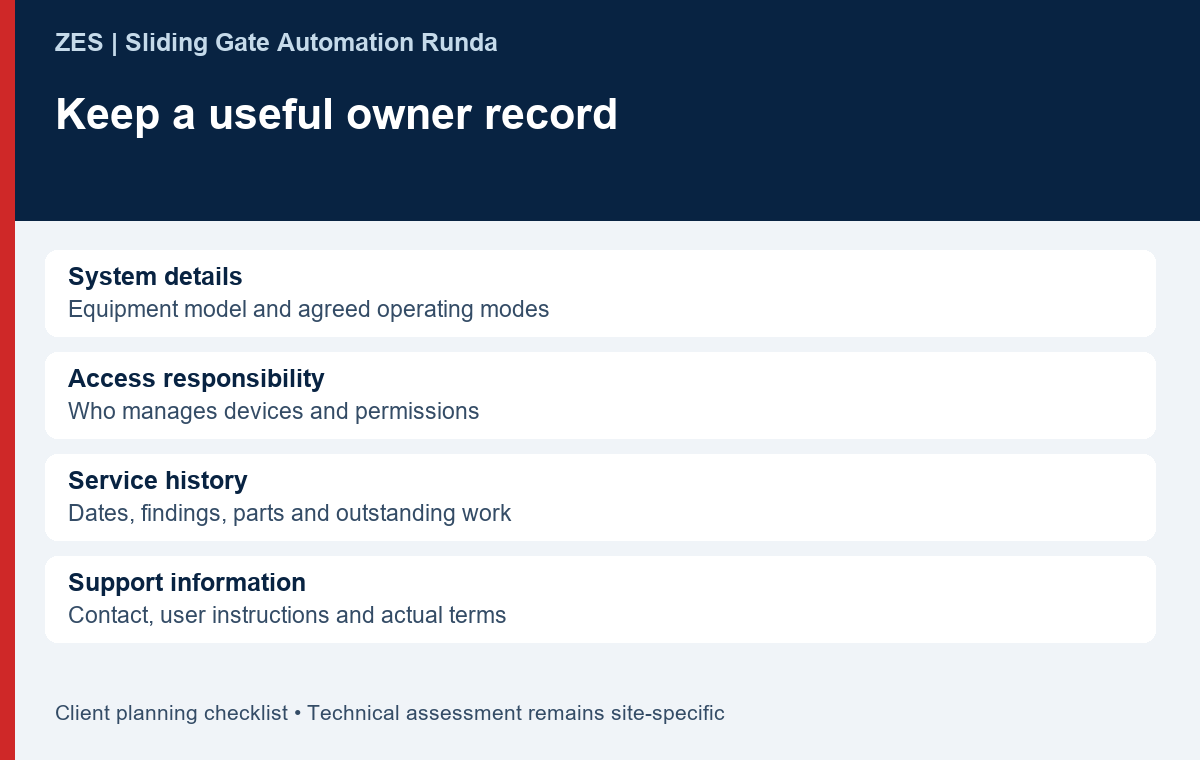
At handover, collect the equipment model, relevant instructions, supplied-device list and service contact. Ask for the agreed controls to be demonstrated and for the applicable technical checks to be documented by the responsible installer.
Keep release keys with an authorised person who understands the documented procedure. The location should be known to the people responsible for the property without making security-sensitive information public.
Record any outstanding work and the agreed next step. If the installation changes later, update the owner record. A future technician should be able to understand the gate automation without relying on someone’s memory of the original purchase.
Discuss routine observations and professional maintenance. Report changes in movement or noise rather than trying to compensate through settings. A sliding gate’s operating space should remain managed as part of the entrance, including after landscaping, storage or parking arrangements change.
An illustrative retrofit decision
Consider a property with a manual sliding gate and a driveway scheduled for resurfacing. The owner wants automation immediately but has not confirmed the final paving levels. This is a planning example, not an account of a ZES installation.
The useful first step is to coordinate the gate and paving assessments. The team can identify the required supporting work and agree which tasks must precede installation. Buying a motor first would not resolve those dependencies.
The quotation should then distinguish the gate preparation, selected operator, electrical work and reinstatement. If the owner chooses additional controls later, the initial project can identify any sensible provision without pretending that an unspecified future device is already included.
This sequence gives the owner a clearer budget and reduces avoidable rework. It also lets the sliding gate be assessed as part of the completed entrance.
Information that helps ZES prepare the right response
Photograph the gate from a safe stationary position, showing the opening and the area into which it travels. Include an overall view so the surrounding structures can be understood. Do not enter a hazardous movement area to obtain a closer picture.
State whether the gate is manual, automated or not yet built. Describe known defects, available equipment records and any planned site work. Give an approximate use pattern and your preferred access method.
ZES can then discuss the assessment and the information needed for a scoped quotation. The first enquiry is a way to establish the project, not a reason to guess equipment capacity from a photograph.
Keep the operating area useful over time
Once installed, the sliding gate travel area can be easy to overlook because it is beside the driveway. Treat changes there as entrance changes. New fencing, planting, storage or parking should be reviewed for their effect on operation and maintenance access.
Tell anyone managing the property which space must remain clear under the installer’s instructions. Keep a simple record of impacts or unusual behaviour and share it during service enquiries.
This practical ownership approach supports the original gate automation design. It helps the entrance continue to serve the way the property is actually used.
Questions to settle before landscaping beside the gate
Before planting or installing a feature beside the entrance, locate the sliding gate travel area on the agreed plan. Ask whether the change affects movement, maintenance access or any protective arrangement. A visually minor feature may still occupy space used by the installation.
Discuss who will maintain the area and how normal storage will be managed. Bins, tools and other temporary objects can gradually become permanent if nobody knows the space has an operating purpose.
Keep the gate automation contractor informed when substantial work changes the surroundings. Do not assume that a plan approved for the original entrance automatically covers later changes.
Record the equipment positions and relevant access requirements in the property maintenance information. This is especially useful when a gardener, facilities team or new owner takes over.
The aim is not to prevent improvements to the property. It is to coordinate them with the sliding gate that is already there. The same approach applies to changes in parking, fencing or driveway levels. A brief review before work starts can identify questions while they are still straightforward to resolve.
Arrange your Runda gate assessment
Send ZES photographs of the opening and the area beside it, your location and the number of regular users. Tell us whether you need a new installation or an upgrade. Request a site survey and receive a quotation based on the entrance you actually have.
Further reading: HSE powered-gate safety guidance explains why the complete installation needs assessment. This is UK technical background, not a statement of Kenyan legal requirements.
Gate Automation Runda: comparing swing and sliding layouts
Gate Automation Runda enquiries should start with the entrance layout, gate condition and expected movement of people and vehicles. A sliding design needs suitable side travel and supporting mechanics; a swing design needs an assessed opening area, hinges and supports. Neither arrangement should be selected solely because a motor package is advertised.
Explain where vehicles wait, how pedestrians enter and whether other equipment must operate with the gate. The assessor can review the actual site and identify preparation required before automation. Keep gate fabrication, site work and equipment selection coordinated.
Swing Gate Installation Runda: define the complete scope
For Swing Gate Installation Runda, clarify whether the quotation includes new leaves and supports or automation of an existing hinged gate. Ask for the proposed operator, the basis for selection and any required work on the gate structure. The installed geometry and condition need assessment rather than assumptions from a photograph.
Describe the required controls and operating arrangement. Ask how the completed installation will be checked, what user demonstration is included and which model-specific instructions will be supplied. Relevant protective provisions must be considered for the whole entrance.
If you are comparing swing and sliding options, request complete scopes for both. A motor-only figure cannot represent the cost of changing gate construction, preparation and controls. See the swing gate automation guide and request a site-specific quotation from ZES.