
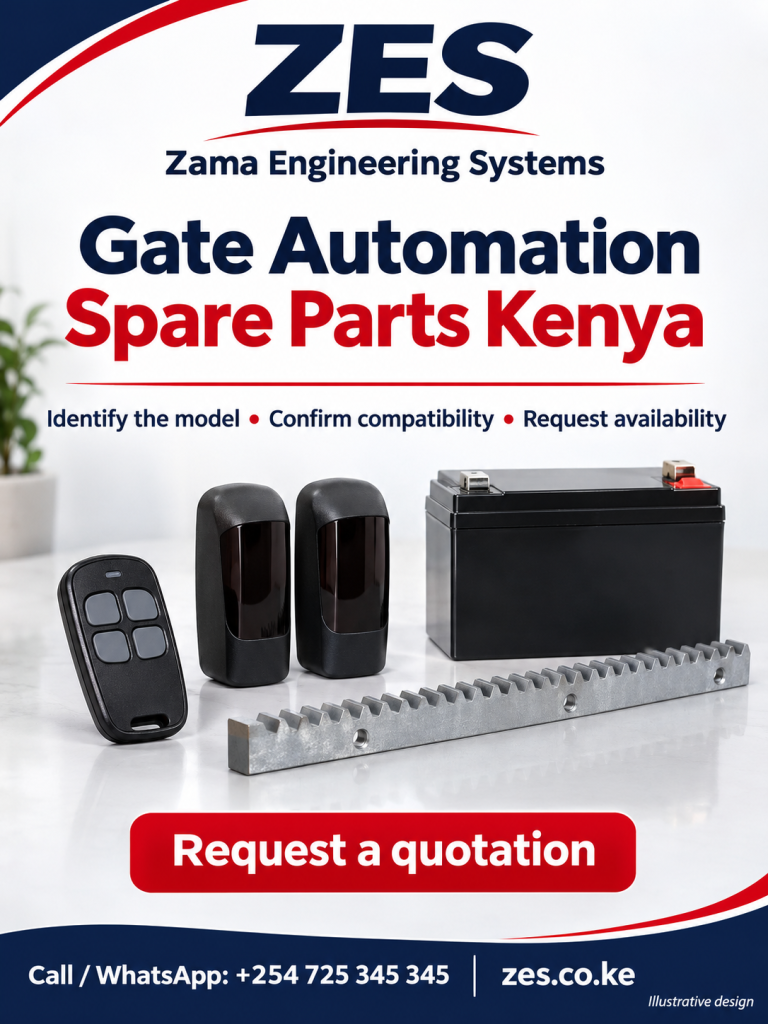
Gate Automation Spare Parts Kenya enquiries are most useful when they identify the installed equipment and the spare part actually needed. ZES supplies gate automation spare parts and can help assess compatibility before supply. Availability, lead time and the supplied terms must be confirmed for the specific item; this guide is not a live stock list.
Buying a spare part because it resembles the old one can lead to the wrong purchase. A matching brand name may still cover several models or revisions. Start with the equipment details and a confirmed diagnosis where the part is intended to repair a fault.
Gate Automation Spare Parts Kenya: 7 essential ordering checks
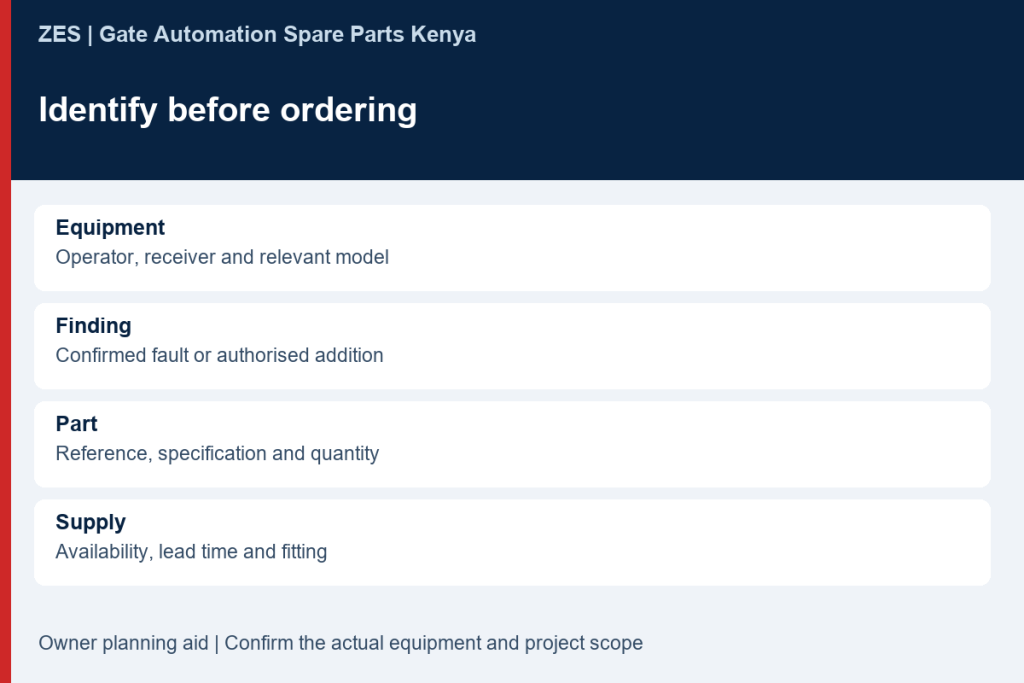
1. Identify the operator and relevant component
Use the original manual, invoice or a safely visible label to identify the gate motor. Include the model and serial details if available. If the required spare part belongs to a separate receiver or accessory, identify that device too. The operator brand alone may not describe every component connected to the gate.
Photographs can help clarify labels and the existing arrangement, but do not open live enclosures simply to obtain them. If the necessary information is inaccessible, arrange competent assessment. A technician can record the details as part of the inspection.
If equipment has been replaced before, include that history. An installation can contain an older motor with a newer controller or an external receiver from another supplier. The current configuration matters more than what was originally fitted years ago.
2. Confirm why the spare part is needed
Explain whether you are adding an authorised device, replacing physical damage, carrying out planned maintenance or repairing a diagnosed fault. These are different enquiries. A gate that does not open does not automatically need a new motor, controller or battery.
Where diagnosis has been completed, share the relevant finding and proposed spare part description. Ask what fault the replacement is intended to correct. If the cause remains unknown, request fault assessment before buying components by guesswork.
This is especially important for repeated failures. Replacing the same item again without considering the underlying installation may leave another issue unresolved. Ask whether the gate condition, power arrangement or connected equipment also needs attention.
3. Match the spare part number and supported specification
Ask for confirmation that the proposed spare part suits the identified model or revision. Physical similarity is not sufficient for electronic components, charging equipment or controls. A supplier should be clear about what is being supplied and the basis for compatibility.
Keep any spare part number from the existing documentation, but allow for the possibility that a supported replacement has a different reference. Ask for that relationship to be explained. Do not assume a different number is either automatically wrong or automatically an upgrade.
Manufacturer documentation is useful for model identification and supported arrangements. For relevant equipment, consult Centurion’s technical support resources or FAAC’s manuals resources. The exact installed model still needs to be established.
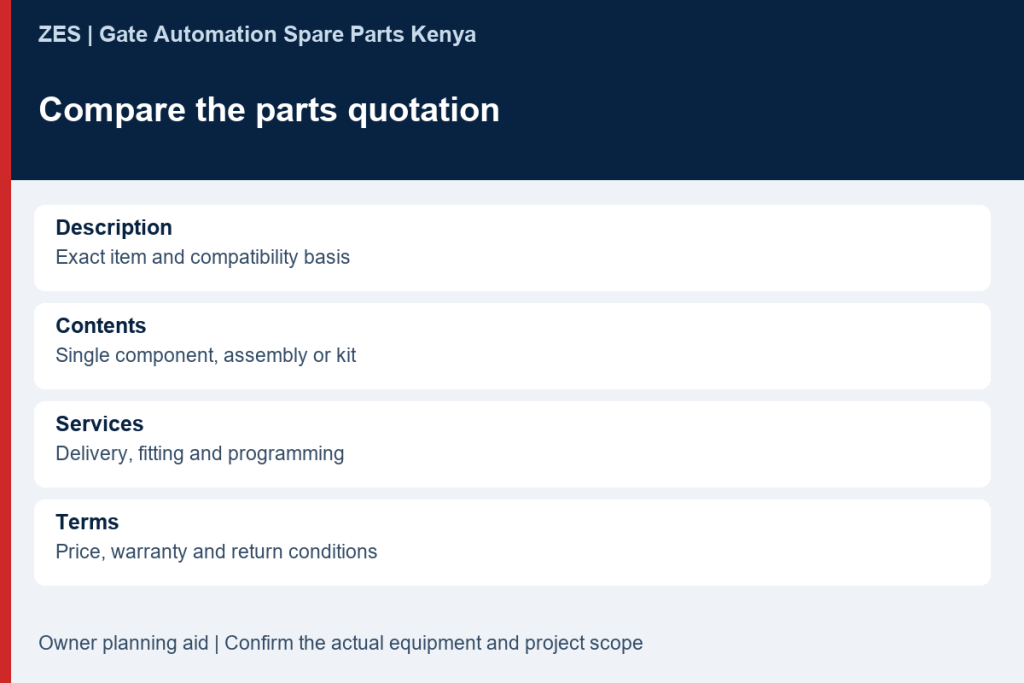
4. Clarify what is included in the supplied item
A spare may be a single component, an assembly or a kit. Ask whether brackets, connectors, mounting pieces or other required items are included. If installation or programming is needed, establish whether that is part of the quotation or a separate service.
For a remote, confirm the supported receiver arrangement and the process for authorised programming. For a protective device, confirm the complete installation requirement rather than treating the item as a decorative accessory. For mechanical components, assess the condition of the parts they work with.
Do not assume that replacing a component completes the repair. The installation may require configuration and checks before it returns to normal use. Agree who is responsible for that work and the handover.
5. Confirm availability and delivery arrangements
Ask whether the specific item is available, must be ordered or needs further identification. Confirm the expected lead time and delivery or collection arrangements before committing. A product category advertised on a website does not mean every variant is held in stock.
For sites outside Nairobi, provide the town and delivery location. Ask about transport charges and the arrangements if installation is also needed. Do not make a project schedule depend on an assumed delivery date that has not been confirmed.
If an alternative spare part is proposed, request the compatibility explanation and supplied terms. Do not accept a vague assurance that all gate parts are universal. Any substitution should be clear before the order is approved.
6. Review price, warranty and return terms
The quotation should identify the item, quantity, price and applicable taxes or delivery charges. Confirm whether labour, programming or testing is included. A supply-only price and a completed repair price should be compared separately.
Ask for the actual warranty and return conditions before ordering, particularly when a spare part is specially sourced or depends on the model information provided. Do not assume that all electrical parts can be returned after fitting. The supplier’s stated terms should guide the decision.
Keep the quotation and confirmation of the supplied item with the maintenance record. This helps later enquiries start from the actual spare part reference instead of another visual guess.
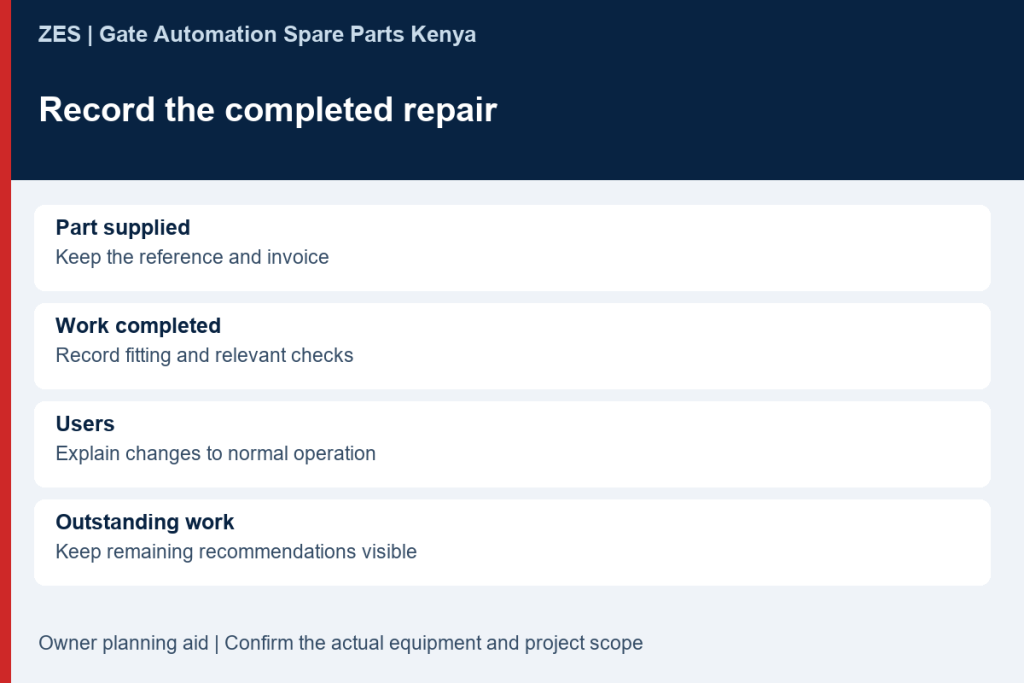
7. Arrange fitting and record the outcome
Gate equipment should be fitted and checked by a competent person using the relevant documentation. Do not bypass protective arrangements or improvise wiring to make an incompatible spare part work. If the installation does not behave as expected, stop and seek assessment.
Record the spare part supplied, date, reason for replacement and completed work. Ask the responsible user to receive any changed operating instructions. For shared properties, update the access administrator if remotes or receiver settings have changed.
A useful record distinguishes a repaired fault from an outstanding recommendation. If other work remains necessary, have it stated clearly so the owner does not mistake a partial repair for a complete resolution.
Types of spare-parts enquiries ZES can review
The categories below describe common enquiries, not guaranteed stock or universal compatibility. ZES will confirm the actual item and supply arrangement after the equipment details are checked.
| Category | Information to provide |
|---|---|
| Remote controls | Existing handset and receiver details; authorised quantity needed |
| Receivers and control accessories | Equipment models and intended function |
| Batteries and charging components | Supported specification from the identified equipment |
| Controllers and electronic components | Exact model or revision and diagnostic finding |
| Photocells and protective devices | Existing system and assessed replacement requirement |
| Rack and mechanical components | Gate arrangement, dimensions and condition assessment |
If you do not know the spare part name, describe the problem and send safe, clear photographs of the entrance and accessible labels. ZES can discuss whether a site assessment is needed before a supply quotation can be prepared.
Ordering a replacement gate remote
Identify the receiver as well as the motor. Some installations use a separate receiver, and similar handsets may use different systems. Confirm compatibility before purchase and arrange programming through the authorised owner or manager.
If a remote is lost, discuss how its access can be removed where the system supports that function. Issuing a new handset does not by itself cancel the missing one. Our gate remote programming guide explains the information to prepare.
For apartments, keep a device register and a named person who approves new access. This makes later replacements easier to manage and helps distinguish a supply request from an unauthorised attempt to add a user.
Ordering a battery or charging component
The correct selection depends on the installed equipment and supported specification. Do not choose from appearance alone or assume a larger battery is a suitable upgrade. Ask the competent installer to confirm the arrangement and whether the complaint actually points to that component.
If the gate fails during an outage, explain the operating pattern and recent history. Battery condition, charging performance and the wider installation may need assessment. A new battery should not be used to conceal an unresolved charging or mechanical problem.
Keep replacement details with the service record. For a solar gate, also retain the charging and system documentation so future decisions consider the complete power arrangement.
Ordering controller or motor components
Electronic and internal mechanical parts require accurate identification. Provide the diagnostic finding, exact equipment details and any previous modifications. Do not open or dismantle equipment to identify a component unless you are competent and authorised to perform that work safely.
Ask whether the proposed repair is practical compared with complete operator replacement. Parts availability, retained equipment condition and the full installed scope affect that decision. Our motor replacement guide gives a comparison framework.
Where replacement is chosen, confirm which remotes, receivers and protective devices remain compatible. A new operator can change the parts required elsewhere in the installation, so the quotation should describe the complete arrangement.
Questions before ordering gate spare parts
Are all parts available immediately?
No live stock promise is made here. Contact ZES with the specific item and model to confirm availability and lead time. Some enquiries may require further identification or sourcing before a firm supply date can be given.
Are supplied parts original or compatible alternatives?
Ask for the exact description in the quotation. Do not infer origin, manufacturer approval or warranty from a brand mentioned in an article. ZES can explain the proposed supply and its stated terms for the particular item.
Can I buy a controller because my gate is not opening?
Only after the fault and compatibility have been assessed. A gate not opening is a symptom with several possible causes. Buying a guessed controller can add cost without correcting the problem.
Does supply include installation?
Confirm that explicitly. The quotation should distinguish supply, delivery, fitting, programming and completed checks. If another installer will fit the item, agree how compatibility information and responsibilities will be handled.
Can ZES help when the model label is missing?
Send existing documents and photographs taken from a safe position. ZES can discuss the next identification step. Some installations require a site assessment before the correct spare part can be confirmed.
Request a gate spare-parts quotation
Send your enquiry to ZES with the location, operator model, spare part reference if known, quantity and reason for the request. Include a diagnostic report where available and state whether installation is required. You can also call or WhatsApp +254 725 345 345.
ZES will review the information, confirm what further identification is needed and discuss the actual supply or repair scope. That approach gives you a clearer decision than buying an unfamiliar spare part from a photograph alone.
A useful spare-parts enquiry versus a guessed order
A message saying that you need a gate board leaves important questions unanswered. A useful enquiry identifies the operator, the relevant controller if known, the observed fault and any diagnostic finding. It also states the quantity, location and whether fitting is required. This gives ZES a basis for checking the actual gate spare parts requirement.
If you have a technician’s report, include the proposed spare part reference and the reason for replacement. If no diagnosis has been completed, say so. There is no benefit in presenting a guess as a confirmed finding; it can direct the supply enquiry toward the wrong component.
Photographs should support identification without creating a hazard. Use existing records or accessible labels. Do not remove covers from electrical equipment to obtain an image for an online order. ZES can discuss an assessment where the necessary details are not safely available.
Keep the supplier’s confirmation with the order. The record should identify what was supplied and which equipment it was intended for. That is more useful at the next service visit than a payment record that says only gate parts.
Example: replacing a damaged remote handset
Suppose an authorised resident has a broken handset and wants a replacement. The first question is whether the receiver and handset system have been identified. The motor brand may help, but it does not prove which receiver is currently installed. A separate receiver could have been added during an earlier repair.
Ask ZES to confirm a compatible remote and whether programming is included. If the old device is physically damaged but still accounted for, explain that. If it is missing, discuss how its access can be removed where the equipment supports that action. Those are different access-management situations.
For a shared gate, obtain the manager’s approval and update the device register. The replacement should become part of the property’s authorised access arrangement. A spare handset is not simply a consumer accessory when it opens a shared entrance.
After programming, the responsible user should see the agreed function demonstrated. If the gate still fails with other controls, record that as a separate fault rather than assuming another remote will solve it. The wider installation may need assessment.
Example: a battery is proposed after an outage complaint
An owner reports that the gate failed during a power interruption and asks for a battery. A compatible battery may be part of the eventual repair, but the complaint alone does not establish that replacement is the only work needed. The supported battery specification, charging arrangement and equipment condition should be checked.
Explain the usage during the outage and whether the symptom is new. Provide the model and any previous battery-service record. This helps the competent assessor review the complaint against the actual installation rather than assume every outage problem has the same cause.
If replacement is recommended, ask for the supplied specification and fitting scope. Do not select a different battery merely because it has a larger advertised capacity. The proposed arrangement must be suitable for the installed equipment and enclosure.
Keep the replacement date and item details in the maintenance file. If the problem returns, that history helps the next assessment consider the charging system, usage and other possible causes. It also prevents repeated purchases without a record of what was changed.
Example: a controller is no longer available
For older equipment, the originally fitted component may be unavailable or require sourcing. Ask whether a supported replacement exists and what other changes it requires. A proposed alternative should be described clearly, including compatibility, supplied terms and any configuration work.
Compare the complete repair with the complete replacement option. A controller price alone may omit the labour or accessories needed to use it. Equally, a new motor proposal may retain parts of the old installation that still require assessment. Ask both options to explain the completed arrangement.
Do not assume that an alternative controller will preserve every existing function. Confirm the required controls, protective provisions and operating modes. Any limitation should be understood before the owner approves the supply or repair.
This example does not imply that a particular model is obsolete or unavailable. Availability must be checked for the actual gate spare parts enquiry. The purpose is to show the questions that help an owner make a clear decision when sourcing becomes more complicated.
Organising spare parts for a managed property
An apartment or commercial site can keep a simple equipment register without buying a stock of unconfirmed components. Record each gate’s operator, receiver, relevant accessories and service history. Identify the person authorised to request parts and approve fitting.
Where the property has several entrances, label the records by location. Similar-looking gates may use different equipment. A spare part reference from one entrance should not be assumed suitable for another until compatibility is checked.
If the maintenance team proposes holding spares, ask which items are appropriate, how they will be stored and who will review their suitability after equipment changes. Avoid buying costly electronics simply because a generic list calls them essential. The actual installation and maintenance plan should drive the decision.
Keep private access information separate from the general asset register. The register needs equipment identification and service facts; it should not become a publicly circulated list of codes or credentials.
Confirm the final order in writing
Before payment or collection, confirm the spare part description, quantity, compatibility basis, availability and delivery arrangement. Record whether the order includes fitting, programming and completed checks. Ask for the actual warranty and return terms rather than assuming them from a brand name.
When the item arrives, retain its documentation and invoice with the project record. If anything differs from the agreed description, resolve that before installation. A clear order and handover make the gate spare parts purchase easier to review and future maintenance easier to plan.
Related ZES gate guides
FAAC installation · Gate spare parts · Automatic gate prices · Request a quotation