
Gate Automation Westlands projects can involve more than one supplier: the gate installer, an intercom provider, an electrician and a property-management team. When responsibilities are unclear, each device may appear to work on its own while the entrance still fails to behave as expected. ZES can assess the gate automation requirement and define the work and interfaces for your Westlands property.
This guide is for owners and facilities teams comparing Gate Motor Technicians Westlands services. It focuses on coordinating connected equipment and approving a measurable outcome. It does not assume a particular building type, existing system or guaranteed integration at your site.
Gate Automation Westlands: 7 easy coordination checks
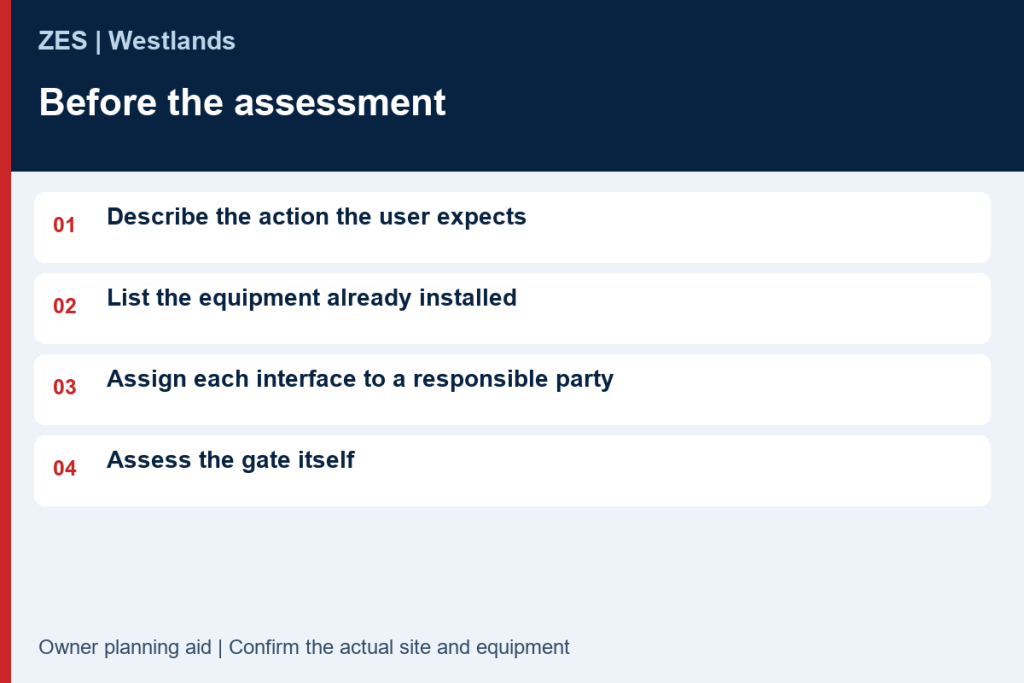
1. Describe the action the user expects
Start with a plain-language requirement. A visitor calls the reception desk; an authorised person approves entry; the gate responds through a supported control arrangement. This describes an outcome more clearly than asking for a smart gate without explaining what smart should mean.
Distinguish vehicle access, pedestrian access and visitor communication. If several entrances are involved, identify each one. The installer can then review the gate and relevant interfaces against a defined brief rather than guess which functions the owner expects.
2. List the equipment already installed
Record the known motor, receiver, intercom and access-control models. Use invoices, manuals or safely accessible labels. If another provider manages software or accounts, identify that responsibility without sharing private credentials in a general enquiry.
A gate motor brand alone does not establish compatibility with every connected device. Ask what information remains to be checked on site. The proposed arrangement should be supported by the relevant equipment documentation.
3. Assign each interface to a responsible party
Identify who supplies power, who prepares the physical entrance and who configures any external system. If an existing intercom provider must attend, agree that before the gate visit. A task should not be left between two contractors who each assume the other will complete it.
A small responsibility schedule is often sufficient. It should name the work, the party responsible and how completion will be confirmed. The schedule need not expose technical details to everyday users, but the project team should understand it.
4. Assess the gate itself
Connected controls do not remove the need to assess the mechanical entrance. Report scraping, damaged supports, unusual noise or unreliable movement. The gate, operator and appropriate protective arrangements must be considered together.
Explain where people wait and walk around the entrance. Reception staff, visitors and delivery personnel may approach it differently. The competent site assessment should address the actual movement and use, not just the convenience of a remote command.
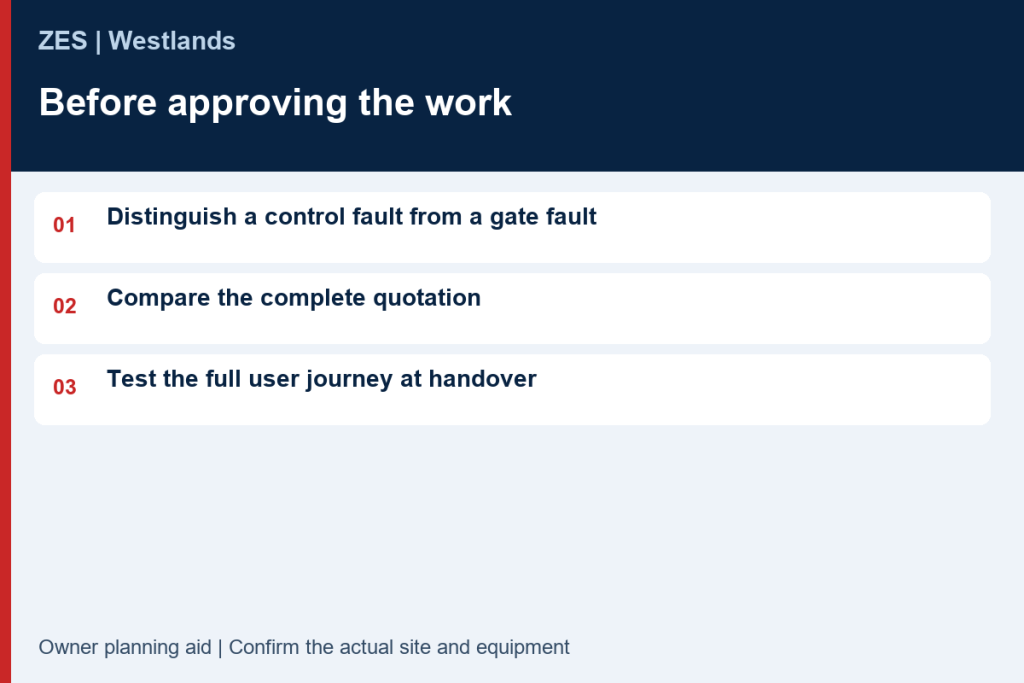
5. Distinguish a control fault from a gate fault
Report which normal functions are affected. For example, communication through an intercom might work while the opening request does not. That observation is useful, but it does not identify which component has failed. Diagnosis should establish the relevant cause before parts are ordered.
Do not bridge terminals or bypass protective inputs to test a theory. Keep owner preparation to safe information gathering and the correct user procedures. For wider fault reporting, see electric gate troubleshooting.
6. Compare the complete quotation
Ask whether the offer includes the gate equipment, controls, supported interfaces, site work, commissioning and user instructions. Confirm work assigned to other providers. An apparently lower figure can leave an important interface unpriced rather than represent the same completed project at a saving.
State the approval process for additional work. If the site assessment identifies another defect, the owner should understand the finding and proposed change before authorising it. Keep the final scope with the quotation.
7. Test the full user journey at handover
The agreed function should be demonstrated from the user’s normal control through to the gate response. Testing the motor locally and the intercom separately may not establish that the connected requirement is complete.
Record what was demonstrated, which equipment was supplied and any outstanding work. Give the nominated user the relevant instructions and service contact. For a managed property, identify who can approve access-device changes after handover.
Choosing Gate Motor Technicians Westlands services
Ask a prospective technician to explain the proposed assessment and the evidence behind a repair recommendation. A useful answer distinguishes the complaint, finding and work required. Avoid treating a confident diagnosis from a short phone description as a substitute for inspecting the actual installation.
Request a clear equipment and scope description when replacement is proposed. Ask which accessories will be retained and whether their compatibility has been checked. Relevant manufacturer documentation should support the selected arrangement; for example, FAAC publishes model manuals.
Confirm attendance arrangements, applicable charges and who is authorised to approve the work. This guide does not claim a local branch, an attendance guarantee or manufacturer-authorised status. The specific offer should establish the terms for your property.
Example: reception can speak to visitors but cannot open the gate
In this illustrative situation, the communication function works, but the opening request does not produce the expected result. The manager records the models, identifies the intercom provider and explains the normal user procedure. The complaint is not immediately labelled a failed gate motor.
The relevant providers agree who will assess the external interface and who will assess the gate equipment. If a repair is proposed, its purpose is documented. The final demonstration follows the same reception-to-gate sequence that users need, so the manager can see whether the agreed requirement has been delivered.
If another issue remains, such as poor handset operation, it is listed separately. This avoids closing a job with a vague statement that the gate works while a reported function remains unresolved. The example describes a useful process, not a claimed completed project.
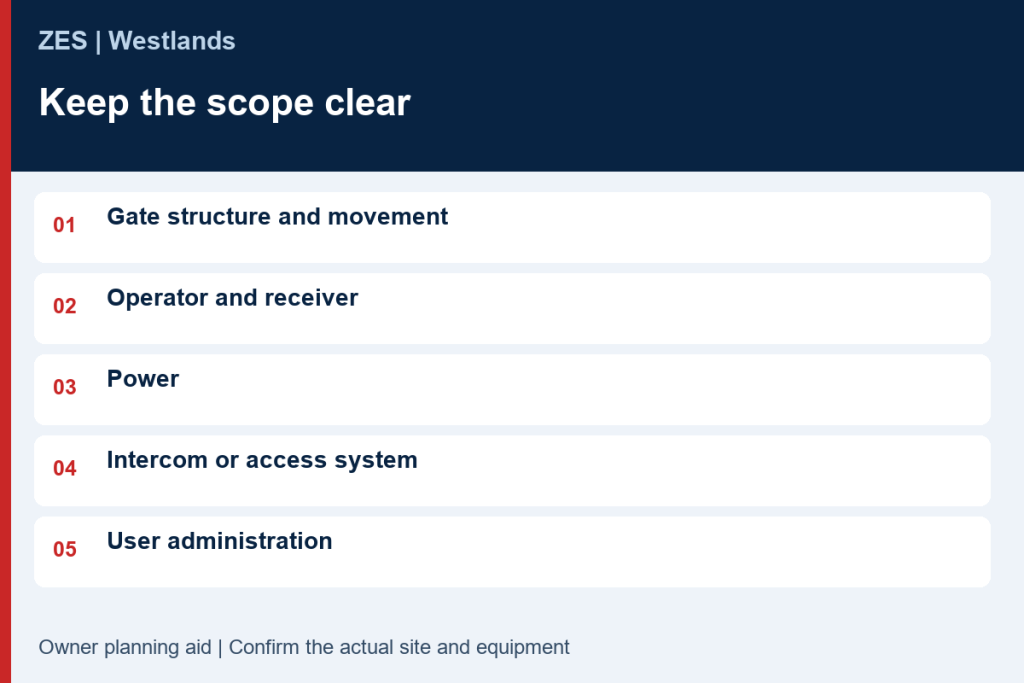
A scope table for connected entrances
| Interface | Confirm before work |
|---|---|
| Gate structure and movement | Condition, repairs and responsible contractor |
| Operator and receiver | Models, suitability and retained equipment |
| Power | Assessed requirements and responsible provider |
| Intercom or access system | Supported function and configuration responsibility |
| User administration | Who approves devices and access changes |
| Completion | End-to-end demonstration and documentation |
Keep the table with the project brief. When the scope changes, update the responsibilities rather than rely on a separate verbal agreement. A clear record is particularly useful when facilities personnel change later.
Planning the service visit
Provide the Westlands location, responsible site contact and any access or work restrictions. Explain whether the gate blocks normal operations and whether an approved alternative route exists. Confirm the appointment rather than assuming attendance from a submitted form.
Gather previous findings and parts records if several technicians have worked on the installation. A repeated symptom may need a broader assessment, and an accurate history helps avoid repeating an unproven repair. Keep observations factual and avoid unsafe attempts to reproduce the fault.
For an occupied property, explain how users will be informed of interruption or changed controls. If another provider is needed, coordinate their availability. This is part of delivering the agreed function, not merely an administrative detail after equipment is fitted.
Frequently asked coordination questions
Can an existing intercom be retained?
Potentially, subject to the supported interface and equipment condition. Give ZES its model and the required function. The proposal should explain any additional configuration, equipment or involvement from the current provider.
Does a new motor include new access controls?
Not automatically. Ask for the supplied items and quantities to be listed. Existing controls should not be assumed compatible without review, and programming or account responsibilities should be explicit.
Who should accept the completed work?
Nominate someone who understands the agreed user requirement and can receive the instructions. Where several systems interact, the relevant providers should confirm their part of the demonstration and record any outstanding interface.
Can ZES quote before all models are known?
ZES can discuss the enquiry and identify what further assessment is required. Ask which items remain provisional. A complete final scope should not rely on guessed equipment compatibility.
Coordinating gate automation with an intercom provider
A gate automation project can involve several providers: one for the gate mechanics, another for the operator and another for the intercom or access system. The owner should describe the intended result in ordinary language before the providers decide how to achieve it. For example, state who should admit a visitor and what the gate should do after the authorised command.
Ask each provider to identify the equipment and work within its scope. An intercom that makes a call is not necessarily evidence that its gate interface is complete. A gate motor responding to its own remote does not establish that every other agreed control works. The handover should cover the full agreed arrangement.
Use a shared responsibility record
List the interface, the responsible provider and the acceptance requirement. Include power preparation, cable routes, retained accessories and any work by the building contractor. If a proposed change affects another provider’s equipment, obtain the relevant compatibility confirmation before the change is made.
For an established automatic gate, a fault report should explain which normal control worked and which did not, based on observations already made. Do not conclude that the gate motor is defective simply because one interface fails. The assessment should determine where the issue lies.
Test the agreed user journey at completion
Arrange for the appropriate users and providers to attend the demonstration where needed. Confirm normal gate operation and the authorised visitor process, then record any outstanding interface work. Avoid declaring the project complete while an essential part of the agreed access arrangement remains untested.
Keep the records for gate repair and interface changes together. If the intercom or controller is replaced later, the next provider should know which gate automation equipment is being retained. This does not require publishing access credentials in a general report; sensitive information should remain with authorised people.
Discuss your Westlands gate requirement with ZES
Request a quotation with the entrance photographs, known models, current complaint or proposed user function. You can also book a site survey or call/WhatsApp +254 725 345 345. ZES can discuss the assessment and the responsibilities needed for a clear completed installation or repair.