

Gate Automation Komarock starts with an entrance that moves correctly and equipment selected for its actual use. A motor should not be treated as a cure for a damaged track or an unstable gate. ZES can assess a proposed installation or a Sliding Gate Repair Komarock enquiry, explain the findings and quote the agreed work.
This guide focuses on movement problems and decisions about retaining equipment. It helps an owner prepare a useful enquiry without attempting powered tests, adjustments or repairs.
Gate Automation Komarock: 7 easy assessment checks
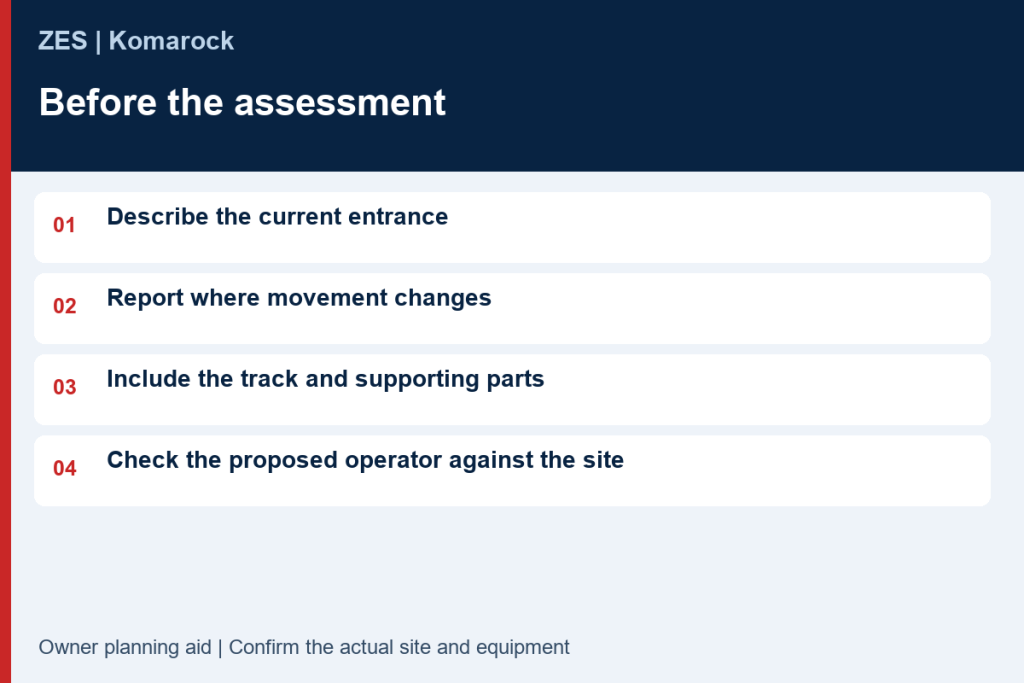
1. Describe the current entrance
Say whether the project involves a new gate, automation of an existing gate or repair of an installed system. Include the location, gate type and safely taken photographs. A wide view often explains more than a close photograph of the motor cover alone.
Record any recent construction, impact or repair. These events may help the assessor decide which parts of the installation require attention. They do not prove the cause of the fault.
2. Report where movement changes
If you have already observed the sliding gate stopping at a particular point, note the location and direction. Explain whether the behaviour is consistent or intermittent. Do not keep cycling a struggling gate to obtain a video.
Grinding, scraping, derailment or visibly loose components warrant keeping people clear and arranging assessment. A damaged gate can present a mechanical hazard independently of its electrical equipment.
3. Include the track and supporting parts
The assessment should consider the track, wheels, guides, stops and supporting structure as applicable to the gate design. Repairs may involve more than the gate motor. The technician should identify the relevant findings rather than quote a motor solely from the symptoms.
Ask which mechanical work is included and who will perform it. If fabrication or masonry work belongs to another contractor, record that boundary and the order in which work must happen.
4. Check the proposed operator against the site
For a new installation, the proposal should identify the actual operator and the basis for its selection. Gate dimensions, weight, operating demand and site arrangement matter. A motor label or advertised maximum capacity is not a complete specification.
Where equipment is retained, ask whether it remains suitable after the mechanical work. An assessment may support repair, adjustment or replacement; the decision should follow findings rather than a predetermined package.
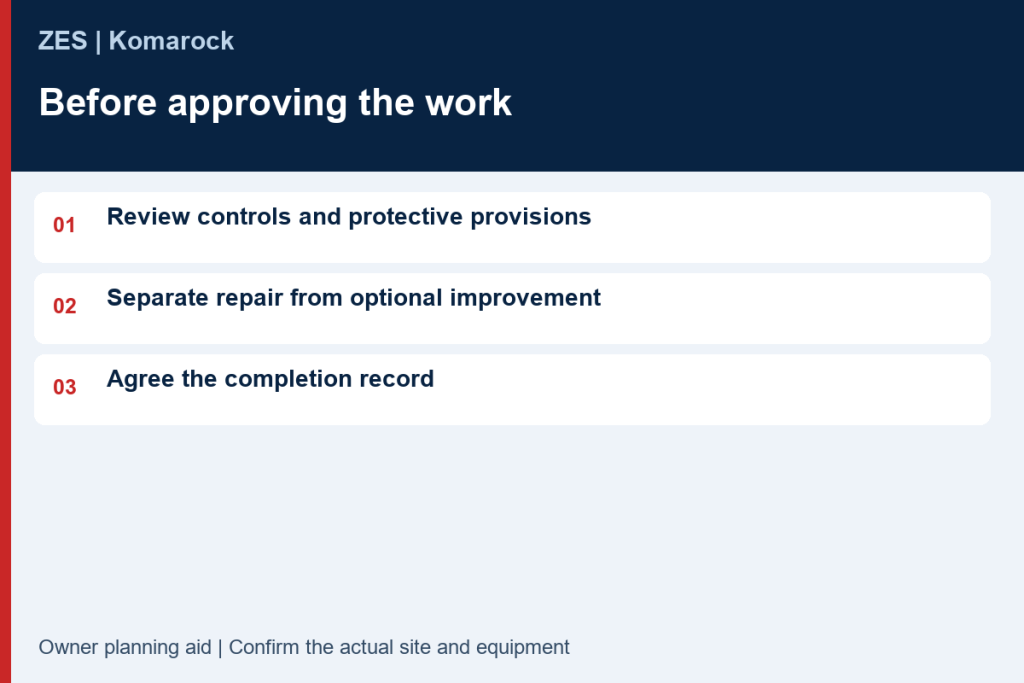
5. Review controls and protective provisions
List the controls currently in use and the functions the owner expects. The assessment should consider how people and vehicles approach the entrance, relevant protective devices and the overall operating arrangement.
Do not bypass a device to stop an unwanted interruption. A repeated reversal or stop requires investigation. Ask for an explanation of what was found and how the completed installation will be checked.
6. Separate repair from optional improvement
A quotation should identify work needed to address the complaint, dependent work and optional upgrades. This makes it possible to compare proposals without assuming that every suggested addition is part of the same repair.
Ask what equipment will remain and whether any limitation remains afterward. Retaining a component does not mean it has been renewed, and a repair to one fault is not a guarantee that every older component will never fail.
7. Agree the completion record
Request a record of the finding, completed work, supplied parts and checks. The responsible user should receive instructions relevant to the actual installation, including the agreed outage and release arrangement.
Keep outstanding recommendations visible. If another trade must complete work, record who is responsible and whether the sliding gate can be used in the meantime under the technician’s instructions.
Sliding Gate Repair Komarock: what to report
Describe the symptom before naming a replacement part. Useful observations include a gate that stops at one position, moves differently in each direction, responds inconsistently to a control or has become noisy. State when the issue began and whether anything changed shortly beforehand.
Share existing manuals, invoices and model information where available. Only photograph labels that can be reached safely without opening live equipment or entering the sliding gate’s travel area. A technician can obtain inaccessible information during the visit.
If the sliding gate is stuck, explain its position and the effect on access. Avoid forcing it or assuming that a generic release procedure applies. Follow the installed model’s instructions and seek assistance where the arrangement is unclear.
An illustrative repair decision
Consider a gate that repeatedly stops near the end of its travel. One proposal lists a replacement motor; another proposes investigation of the gate movement and operator before specifying repairs. The owner needs the basis for the recommendation, not simply a comparison of motor prices.
If a mechanical defect is confirmed, the quotation should explain its correction and whether any operator work is also required. If the gate motor is defective, the proposal should identify what evidence supports replacement and which accessories can remain. This example is illustrative, not a ZES project report.
Compare the complete scope
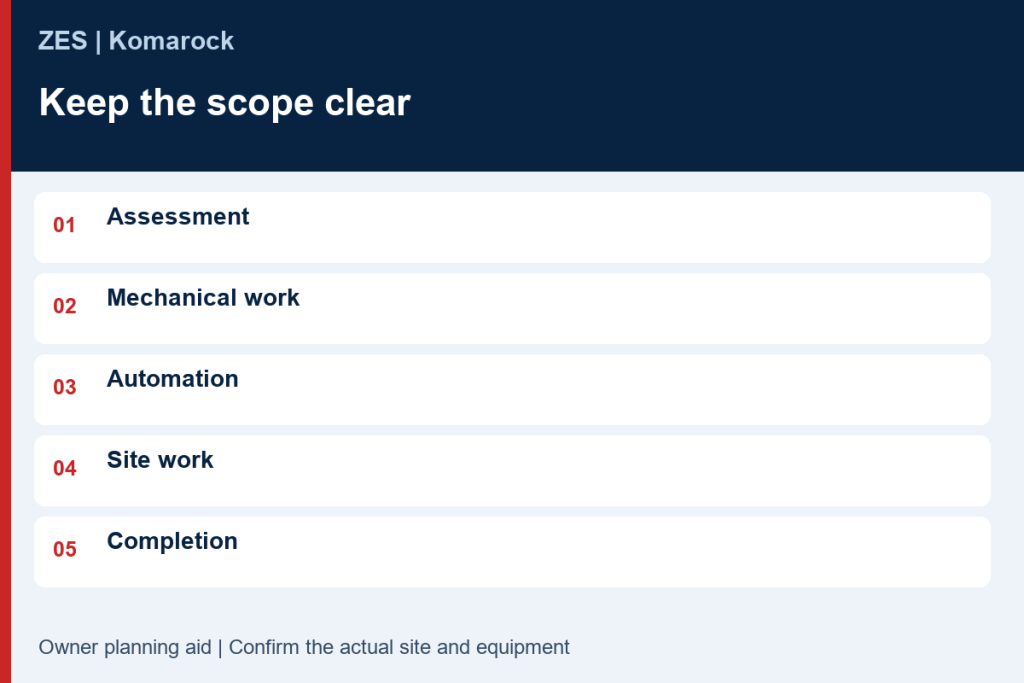
| Item | What to establish |
|---|---|
| Assessment | The complaint, equipment identification and relevant findings |
| Mechanical work | Track, wheels, guides or other confirmed work |
| Automation | Operator work, retained items and compatible parts |
| Site work | Electrical, fabrication or civil responsibilities |
| Completion | Checks, instructions, documents and outstanding items |
Ask whether the quoted amount includes attendance, parts, fitting, transport and applicable taxes. Confirm any work that needs a separate approval. ZES can prepare a quotation from the actual site requirement; this guide does not invent a standard repair price.
For broader selection guidance, read sliding gate automation in Kenya. For an established installation, the gate motor replacement guide explains the repair-versus-replacement discussion.
Questions owners ask
Can a more powerful motor solve difficult movement?
Do not assume so. The gate mechanics and installation need assessment. Selecting a different operator does not remove a damaged track, poor support or another physical defect.
Must every old component be replaced?
Not necessarily. The proposal should identify serviceable, compatible items that can remain and explain any replacement recommendation. Condition and suitability need checking on the actual installation.
Can I obtain a quote from photographs?
Photographs can support initial discussion. They may not establish concealed faults, movement resistance, electrical condition or complete compatibility. A site assessment may be needed before a final scope is agreed.
Will my existing remotes remain usable?
That depends on the receiver and proposed changes. Include retained controls in the enquiry and ask for confirmation of the supported arrangement before approving equipment.
What documentation should I keep?
Keep the equipment details, repair findings, invoice, supplied-part references, user instructions and actual warranty terms. For model-specific information, consult the relevant Centurion technical resources where applicable.
A repair proposal should explain what caused the concern
When a sliding gate begins to struggle, the owner needs a finding before a shopping list. Ask the assessor to explain the relationship between the reported behaviour and the proposed work. The explanation should identify whether the concern lies in the gate mechanics, automation or another relevant part of the installation.
A gate motor replacement may be appropriate in some cases, but it should not be assumed from a stopping symptom alone. Likewise, a visible mechanical problem does not establish the condition of every electrical component. The complete relevant assessment should guide the scope.
Distinguish correction from adjustment
Ask what the proposed sliding gate repair will change and how completion will be checked. If a structural or mechanical item needs correction, record the responsible provider. The owner should not be expected to compensate for an unresolved defect by repeatedly changing operating habits or settings.
Do not alter force settings or bypass a protective device to make a difficult gate continue moving. Follow the installed instructions and arrange assistance where operation is abnormal. The technician should address the relevant finding rather than conceal the symptom.
Retain usable equipment deliberately
Keeping an existing gate motor or accessory can be part of a sensible repair scope when its condition and suitability support that decision. Ask which items are retained and whether limitations remain. Retained equipment should be identified so a later owner does not mistake a partial repair for a complete replacement.
If a new operator is proposed, confirm compatibility with the sliding gate and controls. Include any preparation and fitting work in the comparison. A motor-only price is not the total cost of returning the entrance to the agreed operation.
Review the record after completion
Keep the finding, work description, supplied-part references and actual support terms. Note any further recommendation and the agreed next step. If the symptom returns, share that record with the service provider and explain the new observation.
A gate automation history does not guarantee that future faults will have the same cause. It gives the next assessment a better starting point and helps the owner compare proposals using the actual work already completed.
Request a Komarock assessment
Send ZES the site location, gate type, reported fault or installation requirement, safely taken photographs and a contact person’s details. Request a quotation, book a site survey or call +254 725 345 345. Availability, scope and any proposed parts should be confirmed for the enquiry.