

Automatic Gate Repair Kilimani — planning, quotation and owner guidance
A gate that refuses to open can disrupt the entire property. Residents cannot leave, visitors wait outside and the person responsible for the entrance has to make decisions quickly. When you need automatic gate repair in Kilimani, the priority is to establish what has failed and organise a repair that addresses the cause.
Zama Engineering Systems (ZES) supports gate and access-system enquiries, including assessment of existing equipment and proposed repair work. Describe the fault and current access situation when you contact us. Attendance arrangements and the required work can then be discussed for your property.
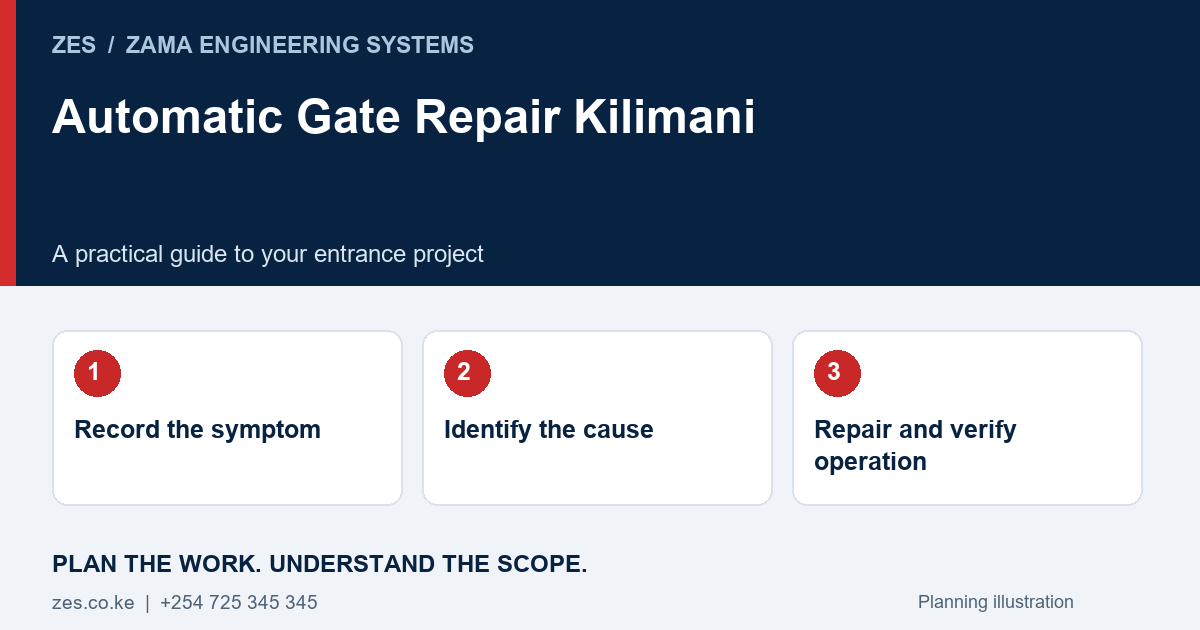
Automatic gate repair Kilimani: which problem are you seeing?
A stopped gate does not always mean a failed motor. The complete system includes mechanical components, power, user controls and protective devices. Different faults can produce similar symptoms.
| What you notice | What to tell the technician |
|---|---|
| Nothing happens | Which normal control was used and whether others work |
| Gate moves partway | Where it stops and whether the behaviour repeats |
| Gate reverses unexpectedly | When it happens and what was observed nearby |
| Some remotes fail | Whether the issue affects one user or everyone |
| Operation is intermittent | Time, frequency and any recent changes |
| Movement or noise changes | What is different from normal operation |
This information helps organise the assessment. It does not replace testing or establish which component must be changed.
If the gate is unstable, damaged or moving unpredictably, stop using it and keep people clear. Do not repeatedly run it to obtain a video.
What you can do before the repair visit
Prepare a short fault history. Record when the issue began, whether it is constant and whether anything changed beforehand. A recent impact, power interruption, service visit or driveway work may be relevant context.
Find previous invoices or equipment records if available. A safely visible model label can help identify the system, but do not open an enclosure or reach into the mechanism.
For a shared property, appoint one contact to collect reports. “The gate did not work” is less useful than knowing that the guard’s control worked while one resident’s remote did not. Accurate observations help avoid approving replacement parts on an assumption.
Keeping the property accessible during a fault
An entrance problem is also an access-management problem. Decide who will speak with residents, direct visitors and authorise the work. Inform the technician if there is an alternative entrance or a specific procedure for reaching the site.
Do not bypass sensors or improvise electrical connections to keep the gate moving. Authorised manual release should follow the actual equipment instructions and take account of the gate’s condition. A damaged or unstable gate needs professional attention before it is handled.
If immediate attendance is important, call and confirm availability directly. An enquiry submission is not an agreed arrival time.
What a proper repair assessment should establish
The technician should investigate the reported behaviour and explain the findings before major replacement work is approved. The recommendation should distinguish the identified fault from unrelated improvements.
Ask what needs repair, what can remain and whether further tests are required. If a component is only suspected, that uncertainty should be clear. You should also know the assessment charge and how additional work is authorised.
The ZES automatic gate repair guide gives broader context for assessing the whole entrance rather than assuming every fault requires a new operator.
Repair or replace: how to compare the options
A repair proposal may restore the agreed function while retaining serviceable components. A replacement proposal may be appropriate when the assessed equipment condition, compatibility or parts support makes it the better option.
Compare complete scopes. A quote for a single part is not directly comparable with one that includes mechanical correction, replacement controls and commissioning. Ask each supplier to identify the problem addressed and any limitations remaining after the work.
For recurring faults, share the service history. Repeated symptoms deserve an explanation that considers the previous work and the installation as a whole.
What affects gate repair costs in Kilimani?
Repair cost depends on the diagnosed fault, equipment, parts, labour and site requirements. Ask whether the quotation includes assessment, transport, testing and any return visit.
A useful written offer also states taxes, exclusions and the support terms for the supplied work. Avoid authorising a vague “complete repair” without knowing what is included.
Questions property owners ask
Can a gate be repaired without replacing the motor?
Yes, where assessment identifies a repairable fault elsewhere or within a serviceable system. The correct remedy depends on the findings.
What if the fault disappears before the technician arrives?
Keep the history and describe the conditions in which it occurred. Intermittent faults can still need attention, particularly when operation has been unpredictable.
Should the gate be tested after repair?
The agreed operation and relevant protective functions should be verified professionally before normal use resumes. Ask for a record of the work and any outstanding recommendations.
Seven easy checks before authorising a gate repair
These checks help the property contact organise information, compare the proposed work and manage access. They do not require anyone to open an enclosure, operate a damaged gate or carry out electrical troubleshooting.
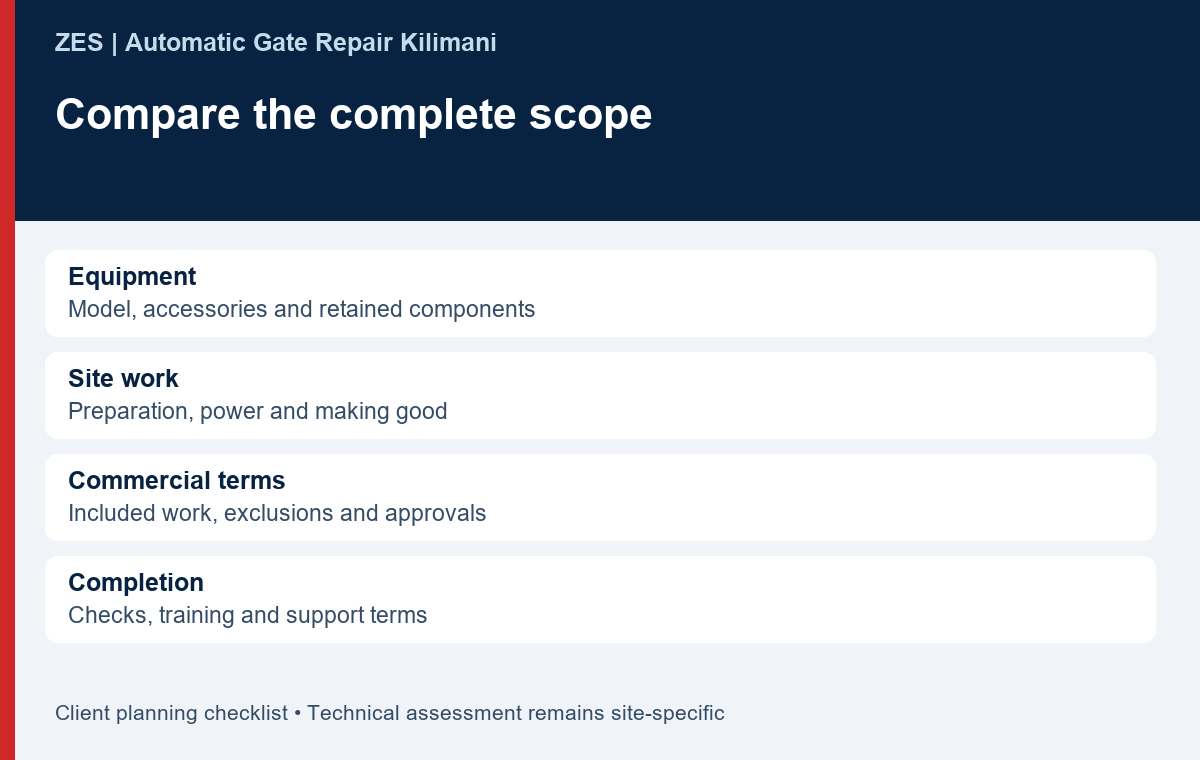
1. Separate the symptom from the explanation
Record what happened before deciding why it happened. “The gate stopped halfway through opening” is an observation. “The motor is burnt out” is a diagnosis that needs evidence.
Ask each person reporting a problem which normal control they used and what the automatic gate did. If reports differ, keep the differences rather than combining them into a single vague complaint. One failed remote and a system-wide failure may need different investigation.
Note when the symptom first occurred and whether it repeats. Do not keep activating a gate that has become unpredictable to create a more complete report. Existing observations are enough to begin the discussion.
This distinction makes a gate repair enquiry more useful. It helps the technician plan the assessment and reduces the chance that the owner approves a component replacement simply because someone used a familiar fault label.
2. Build a short timeline of changes
Write down the sequence of events around the problem. Include recent service, impacts, building work, power interruptions or changes to access controls. These are possible context, not proof of a cause.
If the automatic gate worked normally after an event and failed later, record that too. An accurate timeline is more useful than selecting one event and assuming it explains everything.
Attach previous work records where available. A technician should know which components were replaced, which were retained and whether the current symptom resembles an earlier complaint.
For a shared property, appoint one person to maintain the timeline. Residents and guards can send observations to that contact. This avoids losing important details across several separate calls and gives the gate repair team one consistent account of the reported problem.
3. Decide who manages access while the fault is assessed
A gate fault can affect residents, visitors, deliveries and staff. Name the person responsible for the temporary access arrangement and for communicating updates.
Tell the repair provider whether there is another entrance and what is required to reach the site. If a guard or facilities representative must attend, coordinate their availability. Confirm attendance directly rather than treating a website enquiry as an agreed appointment.
Do not improvise by bypassing protective devices or making electrical connections. If an authorised release procedure is appropriate, it must follow the equipment instructions and account for the gate’s condition.
The access plan and the gate repair plan should support each other. A technician needs room to assess and work, while the property needs a controlled way to manage people arriving. Agree those practical arrangements before the visit where possible.
4. Understand the assessment and approval process
Ask what the initial assessment covers and whether there is a charge. Clarify whether diagnosis and repair are separate stages or included in one defined scope.
The technician should explain the findings and recommended work. If further tests are needed, ask what remains uncertain and how the next stage will be approved. An unexplained parts list is not the same as a diagnosis.
For a managed property, identify who may authorise expenditure. If that person will not be on site, agree how the assessment information reaches them. Delays often arise when the technician has findings but no one is available to make a decision.
Keep the automatic gate repair scope in writing. It should distinguish the reported fault from optional upgrades or unrelated maintenance recommendations. This makes the decision clearer and helps the property understand exactly what the approved work is intended to achieve.
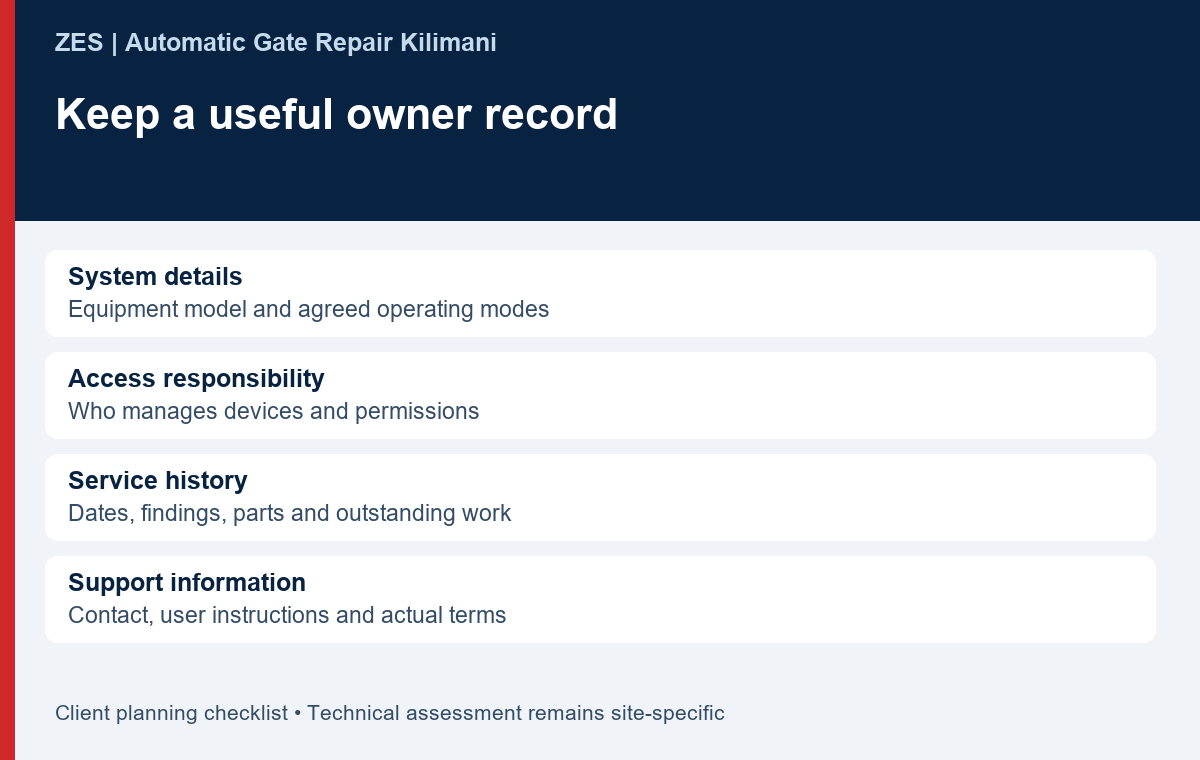
5. Compare repair and replacement on the same basis
A repair may retain most of the existing system, while a replacement proposal may include new controls or supporting work. Compare the whole result rather than one equipment line.
Ask each proposal to identify the problem it addresses, the components retained and the limitations remaining afterwards. A repair of one fault does not renew every part of an older automatic gate.
If replacement is recommended, ask why. Equipment condition, parts support or compatibility may affect the decision, but the recommendation should connect those factors to the actual installation.
Request confirmation of parts availability and the proposed work sequence. Do not assume an advertised component is immediately available for your model. A sound gate repair decision balances the explained scope, practical availability and actual support terms rather than relying on a generic claim that one option is always better.
6. Define the return-to-service checks
Before normal use resumes, the responsible technician should verify the agreed operation and relevant protective functions through appropriate procedures. Ask how the completion of the work will be recorded.
Normal control demonstrations help the property contact understand what has changed. If remotes, permissions or operating instructions are different, make sure the relevant users receive the updated information.
Do not test uncertain behaviour by putting a person or vehicle in the automatic gate’s path. Technical safety checks and an owner’s demonstration have different purposes.
Record any unresolved issue and the agreed next action. A gate repair is easier to manage when the final record distinguishes completed work, observed operation and outstanding recommendations. That record becomes useful evidence if the same symptom returns.
7. Keep a service history that can be used later
Store the diagnosis, work description, replaced-part information and service date together. Include the provider’s contact and the actual support terms for the work supplied.
When a later fault occurs, add the new symptoms to the history rather than starting a separate, unconnected record. A recurring problem may require the technician to review more than the latest component.
Keep access administration information secure. General service records can identify equipment and work without publicly sharing remote credentials, codes or sensitive entry instructions.
Assign responsibility for reporting abnormal movement, impacts or new noises. The automatic gate may be used by many people, but one contact should coordinate maintenance decisions. This gives future gate repair assessments a clearer starting point and avoids repeated work based on incomplete information.
An illustrative shared-entrance fault report
Imagine a property where several residents report that the gate “sometimes fails.” The guard says the normal control worked during one of those incidents. Those reports should not be dismissed as contradictory.
A useful record asks when each event happened, which control was used and what the gate did. It may reveal that the complaints involve different behaviours. The technician can then assess the reports without assuming a single failed part.
This is a hypothetical example, not a diagnosis or a ZES project account. Its purpose is to show why precise observations matter. An automatic gate is a system, and the person using it usually sees the outcome rather than the underlying cause.
The property contact can collect that information safely without opening equipment or recreating a hazardous fault. The gate repair visit then begins with a clearer brief.
What a written repair approval should contain
Before work proceeds, confirm the identified problem, proposed corrective work and quoted amount. Include the supplied parts, labour, testing and any necessary return visit.
Ask whether taxes, transport or assessment charges are included. If some items remain provisional, specify the approval required before additional expenditure. The property should understand the boundary of the instruction it is giving.
Identify retained equipment and known limitations. If a recommendation is deferred, record what that means for the installation and follow the technician’s advice about whether it can be used.
Keep the approved scope with the final service record. This provides a reference for any later discussion about the work and helps distinguish a recurring fault from an unrelated new problem.
Communicating with residents and staff
A short operational update is usually more useful than an unconfirmed technical explanation. Tell users which entrance arrangement applies, whom to contact and whether normal use has resumed.
Avoid promising a completion time before the repair provider has confirmed the scope and parts. If the programme changes after assessment, update the people affected. Clear communication can reduce repeated calls to the site contact.
After handover, share relevant user instructions through the property’s normal channel. Keep sensitive access information limited to authorised recipients. If the repair changed remotes or other controls, make sure the affected users know what to do.
These administrative steps do not replace the technical repair. They help the completed work translate into a usable entrance for the people who depend on it.
When the same symptom returns
Stop treating a recurring complaint as a new isolated incident. Refer to the previous diagnosis and work record when arranging another assessment. Explain whether the automatic gate behaved normally after the repair and how long that lasted.
Ask what further investigation is needed and whether the support terms for the earlier work apply. The answer depends on the cause and scope; do not assume every later fault is covered or unrelated.
If operation is unsafe or unpredictable, keep users clear and arrange professional attention. Do not compensate by defeating protection or repeatedly resetting equipment. A clear history and controlled access arrangement are the useful contributions the owner can make.
A useful first call about a repair
Have the site location, responsible contact and current access situation ready when you call. Explain whether the entrance can be left unused while assessment is arranged and whether a representative must meet the technician.
Describe the symptom in one sentence, then add the relevant timing. Avoid a long list of unconfirmed causes. If there is a previous gate repair record, mention it and offer the relevant details through the agreed channel.
Ask what information is needed to confirm attendance and assessment charges. A phone discussion can organise the next step, but it cannot establish every fault remotely.
Before ending the call, confirm who is responsible for updating the property’s users. Keep any agreed appointment or next action in writing where practical.
A good gate repair enquiry is concise and specific. It helps the provider understand the requirement while giving the owner a clear next step. If circumstances change before the visit, tell the provider so the assessment can be planned around the current situation.
Arrange a Kilimani gate repair assessment
Contact ZES with your location, fault description and the person responsible for site access. Include equipment details and previous repair information where available. Request a repair assessment or call +254 725 345 345 to discuss availability and the next step.
Further reading: HSE powered-gate safety guidance explains why the complete installation needs assessment. This is UK technical background, not a statement of Kenyan legal requirements.
Automatic Gate Installers Kilimani: assess the whole entrance
When comparing Automatic Gate Installers Kilimani, ask how the gate, site preparation, operating demand and controls will be assessed. A proposal should explain the equipment selection and identify work that must happen before fitting. The owner’s requirement should cover pedestrians and visitors as well as vehicle access.
For a replacement installation, provide the existing equipment records and explain which accessories must remain. The installer should confirm compatibility rather than assume that every old remote or intercom connection will work unchanged.
Sliding Gate Motor Kilimani: choose from the actual requirement
A Sliding Gate Motor Kilimani enquiry should include the gate type, available dimensions, movement condition and expected use. The operator must suit the assessed gate and demand. A larger advertised capacity does not correct track damage, poor support or an unsuitable layout.
Ask whether the quotation covers the operator alone, a kit, or the complete installation. Identify mechanical repairs, electrical preparation, controls and completion checks separately. For an existing fault, establish whether motor replacement is necessary before purchasing equipment.
The handover should record the supplied model, relevant instructions and actual support terms. Any outstanding work should have a named responsible party. See sliding gate automation in Kenya for selection questions, or send ZES a quotation request with the site details.