
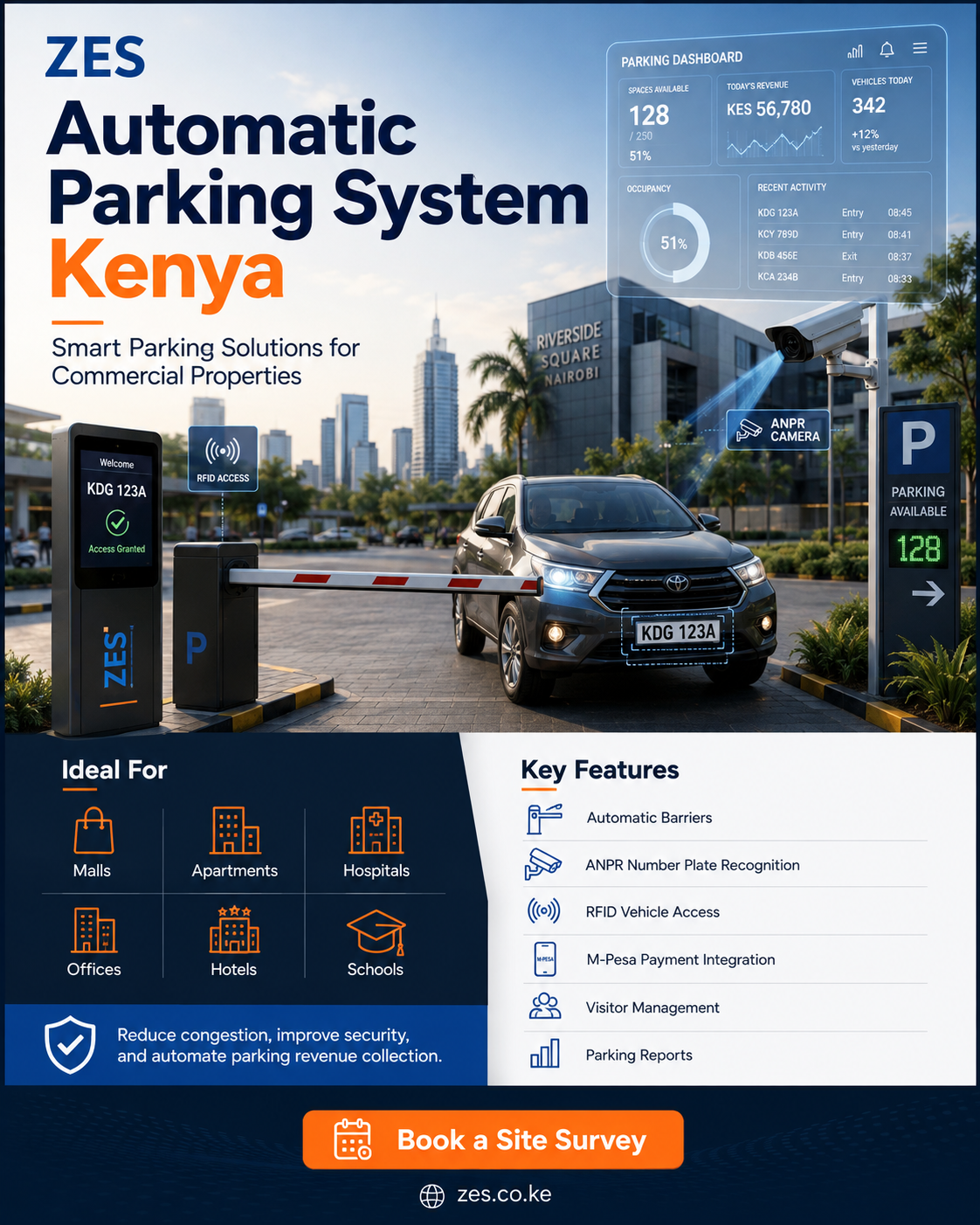
Parking management is becoming an important part of modern property management, security, access control, and revenue collection. Businesses, hospitals, shopping centres, apartment developments, office buildings, hotels, schools, universities, government institutions, and industrial facilities increasingly need a reliable way to control vehicles entering and leaving their premises.
An Automatic Parking System Kenya solution gives property owners a smarter way to manage parking spaces, control vehicle access, collect parking fees, reduce congestion, improve security, and generate accurate parking reports.
At ZES, we provide parking automation solutions designed for commercial properties and organizations that want to move away from manual parking operations.
A complete parking management system can combine automatic barriers, RFID access, number plate recognition, parking tickets, QR codes, payment integration, visitor management, CCTV cameras, access control, parking guidance, cloud reporting, and centralized monitoring.
Whether you manage a commercial building in Nairobi, a hospital in Kiambu, an apartment development in Westlands, a shopping mall in Karen, an industrial facility in Athi River, or several branches across Kenya, an automated parking solution can significantly improve how vehicles are managed.
What Is an Automatic Parking System?
An automatic parking system is a technology-based solution that controls vehicle entry, parking, payment, and exit from a parking facility.
Instead of depending entirely on security guards, handwritten books, manual receipts, or physical parking attendants, the system automates most parking operations.
A typical system records information such as:
- Vehicle registration number
- Entry time
- Exit time
- Parking duration
- Parking charges
- Payment status
- Driver category
- Visitor details
- Employee details
- Parking zone
- Barrier activity
- Vehicle image
- Access credentials
- Transaction history
The system can then determine whether a vehicle should be allowed to enter or leave.
For example, when a registered employee approaches a parking gate, an RFID tag or number plate recognition camera can identify the vehicle automatically.
The barrier opens without requiring the driver to stop and speak to a guard.
For a visitor, the system can issue a ticket, scan a QR code, capture the vehicle registration number, or create a temporary visitor parking record.
When the visitor leaves, the parking system calculates the amount payable according to the configured parking rates.
This makes parking management faster, more secure, and easier to audit.
Why Automatic Parking Systems Are Growing in Kenya
Commercial developments in Kenya are becoming larger and more technologically advanced.
Many organizations are operating buildings that receive hundreds or even thousands of vehicles every day.
Manual parking management becomes difficult as vehicle traffic increases.
Organizations may experience problems such as:
- Long queues at entrance gates
- Long queues during exit
- Lost parking tickets
- Revenue leakage
- Unrecorded vehicles
- Unauthorized access
- Employee parking abuse
- Fake parking receipts
- Cash handling problems
- Difficulty identifying vehicles
- Poor visitor tracking
- Lack of accurate parking reports
- Limited parking spaces
- Security incidents
- Difficulty monitoring multiple entrances
Installing an Automatic Parking System Kenya helps solve many of these challenges.
Automation allows the organization to establish clear parking rules while technology handles vehicle identification, charging, access permissions, and reporting.
Automatic Parking System Kenya for Commercial Properties
Commercial properties require reliable parking infrastructure because parking is usually the first and last interaction visitors have with a building.
A poorly managed parking facility can create traffic congestion outside the property and frustrate customers before they even enter the building.
Automatic parking systems can be implemented in:
Shopping malls
Shopping centres receive vehicles throughout the day.
A parking management system can automatically record entry times, calculate charges, accept payments, and open barriers after payment.
Office buildings
Corporate buildings may require separate access rules for employees, directors, tenants, contractors, and visitors.
An automated system can assign different permissions to each vehicle category.
Hospitals
Hospitals often operate 24 hours.
Parking systems can manage staff vehicles, ambulances, visitors, suppliers, doctors, and emergency vehicles differently.
Apartments
Residential developments can use RFID tags, number plate recognition, or mobile access credentials to allow registered residents into the parking area.
Hotels
Hotels can provide temporary parking access to guests while keeping employee and supplier parking separate.
Universities and colleges
Institutions can manage vehicles belonging to students, lecturers, staff members, contractors, and visitors.
Industrial facilities
Factories and warehouses can combine parking management with vehicle access control and logistics management.
Government buildings
Government institutions can improve visitor accountability and control restricted vehicle access.
Components of an Automatic Parking System
A complete parking automation project may include several hardware and software components.
The exact equipment depends on the size of the property, traffic volume, payment model, security requirements, and number of entrances.
1. Automatic Barrier Gates
Automatic barriers are among the most visible components of a parking management system.
The barrier controls when vehicles can enter or leave the facility.
The barrier can be activated through:
- RFID cards
- RFID vehicle tags
- Parking tickets
- QR codes
- Number plate recognition
- Remote controls
- Mobile applications
- Security control rooms
- Intercom systems
- Access control systems
Modern barrier systems are designed for frequent opening and closing.
Commercial sites with high traffic should use industrial-grade barriers designed for intensive operation.
Automatic Barrier Installation Kenya
Automatic barriers can be installed at:
- Shopping centre entrances
- Office buildings
- Apartment gates
- Hospitals
- Schools
- Warehouses
- Hotels
- Factories
- Airports
- Government facilities
- Private parking facilities
- Industrial parks
The barrier is normally connected to the parking management controller.
When the parking system confirms that the vehicle is authorized, the barrier automatically opens.
Safety sensors can also be installed to prevent the barrier arm from lowering while a vehicle is still passing underneath.
2. Automatic Number Plate Recognition
One of the most advanced technologies used in an Automatic Parking System Kenya is Automatic Number Plate Recognition.
It is commonly referred to as:
ANPR – Automatic Number Plate Recognition
or
LPR – License Plate Recognition.
ANPR cameras capture vehicle registration plates as vehicles approach an entrance or exit.
The software analyzes the image and extracts the vehicle registration number.
For example:
KDA 123A
The system can then compare the vehicle against a database.
The database may classify the vehicle as:
- Resident
- Employee
- Tenant
- VIP
- Visitor
- Supplier
- Contractor
- Blacklisted vehicle
- Authorized vehicle
Once the vehicle is identified, the system determines the correct action.
An authorized employee vehicle can enter automatically.
A blacklisted vehicle can trigger an alert.
A visitor vehicle can be registered and its parking session started.
Benefits of ANPR Parking Systems
Number plate recognition eliminates the need for physical parking cards in many environments.
Benefits include:
- Faster vehicle entry
- Reduced queues
- Contactless access
- Vehicle tracking
- Improved security
- Automatic parking records
- Reduced card sharing
- Detailed audit trails
- Better visitor management
ANPR is particularly useful for corporate offices, residential estates, hospitals, hotels, airports, and premium commercial properties.
3. RFID Parking Access Control
RFID remains one of the most reliable methods of controlling registered vehicles.
An RFID tag can be attached to a vehicle.
When the vehicle approaches the parking entrance, the RFID reader detects the tag.
The parking software checks whether the tag is active.
If the vehicle is authorized, the barrier opens.
RFID access is commonly used for:
- Employees
- Residents
- Tenants
- Directors
- Permanent contractors
- Monthly parking customers
Different parking permissions can be created.
For example:
Management vehicles may be allowed access at any time.
Employees may be allowed between specific hours.
Contractors may only enter during scheduled periods.
Residents may have 24-hour access.
4. Ticket-Based Parking System
Ticket parking systems remain useful for commercial parking facilities receiving large numbers of visitors.
When a vehicle arrives, the driver receives a parking ticket.
The ticket records the entry time.
When leaving, the ticket is scanned and the system calculates the parking fee.
The amount payable can depend on the configured tariff.
For example:
First 15 minutes – Free
First hour – KSh 100
Every additional hour – KSh 50
Daily maximum – KSh 500
Different parking rates can be configured according to the property owner’s requirements.
5. Ticketless Parking System Kenya
Many modern facilities are moving toward ticketless parking.
Instead of printing a physical ticket, the parking system records the vehicle digitally.
The system may use:
- Number plate recognition
- Mobile phone number
- QR code
- RFID
- Mobile application
- Digital parking account
Ticketless parking reduces the cost associated with paper tickets and ticket printers.
It also eliminates problems such as:
- Lost tickets
- Damaged tickets
- Ticket swapping
- Printer failures
- Paper replacement
6. QR Code Parking Access
QR code parking systems can be useful for visitors.
For example, an office receptionist can create a visitor appointment.
The visitor receives a QR code.
When the visitor arrives, the QR code is scanned at the entrance.
The system confirms the appointment and opens the barrier.
QR codes can also be configured to expire after a specific period.
This prevents visitors from reusing old access credentials.
7. Parking Payment System
Commercial parking facilities require a reliable payment system.
A modern parking system can support several payment methods depending on the implementation.
These may include:
- M-Pesa
- Cash
- Bank card
- Mobile payments
- Corporate parking accounts
- Monthly parking subscriptions
- Prepaid parking
- Postpaid parking
M-Pesa integration is particularly important for parking facilities in Kenya.
Customers can pay parking charges using their mobile phones.
The payment can be automatically confirmed by the parking software before the exit barrier opens.
Businesses requiring integrated digital payment solutions can also explore platforms such as Pawa for payment and billing technology.
M-Pesa Parking System Kenya
Integrating M-Pesa with an automatic parking system can significantly improve parking revenue collection.
A typical process may work as follows.
A vehicle enters the parking facility.
The system records the entry time.
When the vehicle owner wants to leave, the parking fee is calculated.
The customer pays using M-Pesa.
The payment is automatically matched with the parking transaction.
The system marks the parking session as paid.
The vehicle approaches the exit.
The barrier opens.
This reduces the need for cash handling.
8. Parking Management Software
Hardware alone cannot provide complete parking management.
The parking management software controls the entire system.
Administrators should be able to view important information from a centralized dashboard.
The system can display:
- Vehicles currently inside
- Vehicles that have exited
- Available parking spaces
- Parking revenue
- Employee vehicles
- Visitor vehicles
- Outstanding parking payments
- Gate activity
- Parking duration
- Blacklisted vehicles
- Monthly parking customers
A well-designed parking management system also provides reports for management.
Companies requiring customized software integrations for larger enterprise environments can work with technology providers such as Zama Systems or explore enterprise software solutions through ZamaCore.
Parking Management Dashboard
The administrator dashboard provides a real-time overview of the parking operation.
For example, management may see:
Vehicles currently parked: 287
Available spaces: 113
Vehicles entered today: 1,426
Vehicles exited today: 1,319
Parking revenue today: KSh 178,400
Active monthly parking customers: 245
Unauthorized access attempts: 4
This gives property managers immediate visibility into parking operations.
9. Parking Guidance System
Large parking facilities can be difficult to navigate.
A driver may enter a shopping mall parking area and spend several minutes searching for an available parking space.
Parking guidance systems help solve this problem.
Sensors can detect whether individual parking bays are occupied.
Digital displays then show drivers where parking spaces are available.
For example:
LEVEL B1
Zone A – 24 spaces
Zone B – 11 spaces
Zone C – FULL
LEVEL B2
Zone A – 38 spaces
Zone B – 17 spaces
The driver can immediately choose the correct direction.
Smart Parking Sensors
Parking bay sensors can be installed above or beside parking spaces.
The sensor determines whether the parking space is occupied.
This information is transmitted to the parking management software.
The system can then provide accurate information about:
- Occupied spaces
- Free spaces
- Reserved spaces
- Disabled parking
- VIP parking
- Loading zones
- Visitor parking
This technology is useful for large malls, airports, office complexes, universities, hospitals, and multi-storey parking facilities.
10. CCTV Integration
Parking facilities should also be monitored using CCTV cameras.
CCTV provides visual evidence of activities taking place within the parking facility.
Cameras can monitor:
- Entry gates
- Exit gates
- Payment stations
- Parking bays
- Pedestrian areas
- Ramps
- Loading zones
- Restricted areas
ANPR cameras can work alongside normal surveillance cameras.
The ANPR camera identifies the registration number while the CCTV camera captures the broader scene.
This combination significantly improves parking security.
11. Access Control Integration
Parking management can also be integrated with building access control.
For example, the same employee profile may be associated with:
- Vehicle access
- Office door access
- Biometric attendance
- Staff identification
- Building permissions
This allows the company to manage physical access centrally.
At ZES, parking systems can form part of a larger commercial security and building access environment that includes biometric access control, time attendance, CCTV surveillance, automatic gates, and other security technologies.
Automatic Parking System for Shopping Malls
Shopping malls are among the biggest users of automated parking technology.
A mall parking system must handle large numbers of vehicles efficiently.
Customers should enter quickly without creating traffic congestion outside the property.
The system can record vehicles entering the mall and automatically calculate parking charges.
Mall management can view parking revenue and vehicle traffic reports.
The system can also support:
- Free parking periods
- Tenant parking
- Employee parking
- VIP parking
- Monthly parking
- Lost ticket management
- Special events
- Holiday rates
- Discount vouchers
Tenants can sometimes provide parking discounts to customers.
For example, a supermarket may validate a customer’s parking after the customer spends a certain amount.
Automatic Parking System for Hospitals
Hospitals have unique parking requirements.
Vehicles entering a hospital may include:
- Doctors
- Nurses
- Employees
- Patients
- Visitors
- Ambulances
- Suppliers
- Contractors
- Emergency vehicles
Emergency vehicles must never be delayed by normal parking procedures.
Doctors and employees may require permanent access credentials.
Visitors and patients may require temporary parking.
The parking management software can assign different rules to each vehicle category.
Hospital management can also reserve specific parking areas for doctors, ambulances, patients, visitors, and staff.
Automatic Parking System for Apartments
Modern residential developments require better vehicle access control.
A large apartment development may contain hundreds of residents.
Security guards may not know every resident vehicle.
Automatic parking technology provides better control.
Each resident can register one or more vehicles.
Access can then be granted using:
- RFID tag
- Vehicle number plate
- Mobile application
- Access card
Visitor vehicles can be registered temporarily.
Security administrators can see which visitor entered, the apartment being visited, and the time of entry.
Property managers using software such as RentalDesk can also maintain more organized property management processes while parking technology handles physical vehicle access.
Automatic Parking System for Office Buildings
Office buildings may have limited parking spaces.
Parking therefore needs to be allocated carefully.
Spaces may be assigned to:
- Company directors
- Employees
- Tenants
- Visitors
- Customers
- Contractors
The parking system can maintain a database showing which vehicles belong to each company.
Visitors can receive temporary access.
For multi-tenant commercial buildings, parking allocations can be assigned according to the tenant’s lease agreement.
For example:
Company A – 25 parking spaces
Company B – 10 spaces
Company C – 18 spaces
Company D – 7 spaces
Parking usage can then be monitored.
Automatic Parking System for Hotels
Hotels need parking systems capable of handling both short-term and long-term guests.
A hotel guest may receive parking access linked to the hotel booking.
When the guest checks out, the parking access can automatically expire.
Hotels can maintain separate parking categories for:
- Guests
- Staff
- Suppliers
- Events
- Conference visitors
- VIP guests
This provides better parking security while maintaining a professional guest experience.
Automatic Parking System for Schools and Universities
Educational institutions increasingly need controlled vehicle access.
Universities may receive vehicles belonging to:
- Students
- Lecturers
- Employees
- Visitors
- Parents
- Suppliers
- Contractors
Parking automation can prevent unauthorized vehicles from entering restricted campus areas.
Vehicle access can also be limited according to time.
For example, contractor vehicles may only enter between 7:00 AM and 6:00 PM.
Automatic Parking System for Industrial Facilities
Factories, warehouses, logistics centres, and manufacturing companies may need more than normal parking.
The system may need to differentiate between:
- Employee cars
- Delivery trucks
- Supplier vehicles
- Company vehicles
- Visitors
- Contractors
Vehicle records can be integrated with security operations.
For example, the system can record:
Vehicle registration
Driver
Company
Reason for visit
Arrival time
Departure time
Loading bay
Security approval
This creates a strong vehicle audit trail.
Automatic Parking System Nairobi
Nairobi has some of the busiest commercial developments in Kenya.
Parking automation is especially useful in areas such as:
- Westlands
- Upper Hill
- Kilimani
- Karen
- Runda
- Gigiri
- Industrial Area
- Parklands
- CBD
- Ngong Road
- Mombasa Road
- Thika Road
- Kiambu Road
- Eastern Bypass
Traffic congestion around a building entrance can quickly become a major problem.
A properly configured Automatic Parking System Nairobi allows vehicles to pass through entrances much faster.
Parking Management System Kenya
Although automatic barriers are important, a complete Parking Management System Kenya goes much further.
It combines several technologies into one centralized solution.
The system may include:
- Entrance barrier
- Exit barrier
- ANPR cameras
- RFID readers
- Ticket dispenser
- QR code scanner
- Payment terminal
- M-Pesa integration
- CCTV cameras
- Parking server
- Management software
- Parking sensors
- Digital signage
- Intercom
- Network infrastructure
These components work together.
Multi-Entrance Parking Management
Large properties may have several parking entrances.
For example:
Gate A
Gate B
Gate C
Basement Entrance
VIP Entrance
Service Entrance
The parking system can manage all these entrances from one platform.
Security managers can see activity across all gates.
Multi-Branch Parking Management
Organizations with several locations can also centralize parking management.
For example, a company may have buildings in:
- Nairobi
- Mombasa
- Kisumu
- Nakuru
- Eldoret
Each location can operate its own parking system while management receives centralized reports.
This is particularly useful for:
- Banks
- Hospitals
- Universities
- Shopping centres
- Government institutions
- Corporate organizations
Parking Revenue Management
Parking can be an important source of revenue.
Unfortunately, manual parking systems can create opportunities for revenue leakage.
Examples include:
- Unrecorded cash payments
- Fake receipts
- Unauthorized discounts
- Manipulated tickets
- Vehicles leaving without paying
- Employees cancelling transactions
- Incorrect parking charges
An automated system creates a digital transaction trail.
Every parking transaction can be recorded.
Management can compare:
Vehicles entered
Vehicles exited
Payments received
Outstanding transactions
Cancelled transactions
Discounted transactions
This makes parking revenue much easier to audit.
Parking Reports
Good parking software should provide detailed reports.
Examples include:
Daily parking report
Shows vehicle activity for a specific day.
Revenue report
Shows parking income.
Vehicle report
Shows the history of a specific registration number.
Entry and exit report
Shows vehicles entering and leaving.
Parking duration report
Shows how long vehicles remained inside.
Employee parking report
Shows employee vehicle activity.
Visitor report
Shows temporary visitor vehicles.
Monthly parking report
Shows customers with monthly subscriptions.
Gate activity report
Shows transactions processed by each entrance.
Operator report
Shows actions performed by parking attendants or administrators.
Audit Trail
An audit trail is extremely important.
Administrators should be able to see who changed parking records.
For example:
Transaction created by: System
Parking charge changed by: Supervisor
Original charge: KSh 500
New charge: KSh 300
Reason: Customer parking validation
Date: 03 September
Time: 14:20
This protects the organization from unauthorized adjustments.
Employee Parking Management
Companies can register employee vehicles.
Each employee profile may contain:
Employee name
Employee number
Department
Vehicle registration
RFID number
Allowed gate
Parking zone
Access schedule
Employees can then enter automatically.
The system can also deactivate access immediately when an employee leaves the organization.
Visitor Parking Management
Visitor management is another important feature.
A visitor may be registered by:
- Receptionist
- Security officer
- Employee
- Tenant
- Online visitor portal
The system records:
Visitor name
Phone number
Vehicle registration
Person being visited
Company
Expected arrival
Expected departure
Parking permission
The visitor receives temporary access.
Once the visit ends, access expires automatically.
Reserved Parking Spaces
Organizations may reserve parking spaces for certain people.
These might include:
Directors
VIP customers
Doctors
Disabled drivers
Tenants
Emergency vehicles
Security personnel
Parking sensors can also detect if an unauthorized vehicle occupies a reserved parking space.
Automatic Parking and Building Management Systems
Large commercial buildings increasingly use centralized technology platforms.
Parking systems can form part of a broader Building Management System environment.
The building may contain:
- Access control
- CCTV
- Fire alarm
- Parking management
- Visitor management
- Elevator access
- Biometric attendance
- Energy monitoring
- HVAC systems
- Security alarms
Integrating these technologies allows the building to operate more efficiently.
Businesses requiring broader business management platforms can also explore solutions from Vega for business and ERP-related requirements.
Network Infrastructure for Parking Systems
Modern parking systems depend heavily on reliable networking.
Equipment such as:
- ANPR cameras
- Parking controllers
- Barrier gates
- Servers
- Payment terminals
- CCTV cameras
- Parking sensors
may communicate over an IP network.
The network therefore needs to be designed correctly.
Large parking facilities may require:
- Structured cabling
- Network switches
- Fiber connections
- Wireless links
- Routers
- Backup internet
- Network cabinets
- UPS backup
For organizations that require reliable internet connectivity, SpaceKits provides connectivity-related solutions including Starlink deployment and network coverage solutions.
Cloud-Based Parking Management
Parking management software can be hosted locally or in the cloud.
Cloud systems provide several advantages.
Management can monitor parking remotely.
Reports can be accessed from different locations.
Multiple parking facilities can be managed centrally.
Data backups can also be managed more effectively.
Cloud-based systems are particularly useful for organizations with multiple branches.
Parking System User Permissions
Not every employee should have full access to the parking system.
The software should support role-based permissions.
Example roles include:
Administrator
Full system access.
Parking Manager
Manages parking operations and reports.
Security Supervisor
Monitors security activity.
Parking Attendant
Processes parking transactions.
Receptionist
Registers visitors.
Finance Officer
Views payments and financial reports.
Auditor
Views reports and audit trails without modifying transactions.
This improves security.
Parking System Security
Parking systems manage sensitive access information.
Security should therefore be part of the system design.
Recommended controls include:
- Strong passwords
- User permissions
- Audit logs
- Data backups
- Secure network configuration
- CCTV monitoring
- Server protection
- Restricted administrative access
- System updates
Physical equipment should also be installed in secure locations.
What Happens When Internet Goes Down?
A professionally designed parking system should consider internet failures.
Depending on the system architecture, local parking operations may continue even when the internet connection is temporarily unavailable.
For example, local controllers may continue recognizing employee RFID tags.
Once internet connectivity is restored, transactions can synchronize with the central server.
Organizations requiring continuous operations may also install backup internet connections.
Power Backup for Parking Systems
Power interruptions can disrupt parking operations.
Important equipment should therefore be connected to backup power.
This may include:
- Barrier controllers
- Servers
- Network switches
- ANPR cameras
- Access controllers
- Payment terminals
UPS systems, generators, or inverter solutions can be incorporated according to the facility requirements.
Automatic Parking System Installation Process
Every successful parking project should begin with proper planning.
At ZES, a typical parking automation project can follow several stages.
Stage 1: Site Survey
A technical team visits the property.
The survey examines:
- Entrance locations
- Exit locations
- Traffic flow
- Parking capacity
- Existing barriers
- Network infrastructure
- Power availability
- Security requirements
- Payment requirements
- Number of vehicles
- Number of users
The site survey helps determine the correct equipment.
Stage 2: Solution Design
After the survey, the parking solution is designed.
The design identifies:
- Number of barriers
- Number of cameras
- RFID readers
- Ticket machines
- Payment terminals
- Server requirements
- Network requirements
- Software modules
Stage 3: Quotation
A detailed quotation can then be prepared.
The quotation may include:
Equipment
Software
Installation
Cabling
Configuration
Training
Integration
Support
Warranty
Stage 4: Installation
Equipment is installed at the parking facility.
This may include civil works for barrier mounting.
Network and power cables are installed.
ANPR cameras are positioned correctly.
Controllers and servers are configured.
Stage 5: Software Configuration
Parking rules are configured.
These may include:
Parking tariffs
User categories
Vehicle categories
Access schedules
Monthly parking
Reserved parking
Employee parking
Visitor parking
Stage 6: Integration
Where required, integrations can be configured.
Possible integrations include:
M-Pesa
Access control
Visitor management
CCTV
Accounting systems
Corporate ERP
Employee databases
Stage 7: Testing
All parking scenarios should be tested.
Examples include:
Employee entering
Visitor entering
Visitor paying
Visitor leaving
Lost ticket
Blacklisted vehicle
Unauthorized vehicle
Network failure
Power interruption
Manual barrier opening
Stage 8: Training
Administrators, parking attendants, security officers, receptionists, and finance teams may require training.
Stage 9: Go-Live
After testing and approval, the parking facility begins using the system.
How Much Does an Automatic Parking System Cost in Kenya?
The cost of an automatic parking system varies considerably.
There is no single price because each property has different requirements.
The project cost depends on factors such as:
Number of entrances
A property with one entrance costs less than a property with six entrances.
Number of exits
Every exit may require additional equipment.
Barrier type
Commercial barrier gates vary depending on speed, durability, and duty cycle.
ANPR cameras
Number plate recognition increases the level of automation but also affects project cost.
Ticket system
Ticket dispensers and validators increase hardware requirements.
Payment integration
M-Pesa or other payment integrations may require software development and configuration.
Parking sensors
Parking guidance systems can require hundreds or thousands of individual sensors.
Software
The parking management software may be licensed according to the size of the installation.
Network infrastructure
Large parking facilities may require significant structured cabling and network equipment.
Civil works
Barrier installation may require concrete foundations, trenching, and protective infrastructure.
For this reason, organizations should request a site survey and detailed quotation.
Cheap Parking Systems vs Professional Parking Systems
Organizations should be careful when selecting parking equipment based entirely on price.
Parking gates can process thousands of vehicles.
Failure during peak traffic can create serious congestion.
A professional system should prioritize:
Reliability
Availability of spare parts
System support
Software stability
Integration capability
Security
Reporting
Expansion capability
Warranty
The cheapest system may become expensive if it constantly fails.
Scalable Automatic Parking Systems
Parking infrastructure should be designed for future expansion.
A company may begin with:
1 entrance
1 exit
500 registered vehicles.
Later, the organization may expand to:
3 entrances
3 exits
2,500 vehicles.
The parking platform should allow additional barriers, cameras, users, and branches to be added.
Smart Parking System Kenya
Smart parking goes beyond controlling barriers.
The goal is to make parking efficient using connected technologies.
A Smart Parking System Kenya may combine:
- IoT parking sensors
- ANPR cameras
- Cloud software
- Mobile applications
- Digital payments
- Parking reservations
- Real-time occupancy
- Analytics
- Automatic barriers
- Visitor management
Drivers can potentially check parking availability before arriving.
Parking Reservation System
Some facilities may allow customers to reserve parking.
This can be useful for:
Hotels
Airports
Events
Corporate offices
Hospitals
Premium parking facilities
The customer reserves a space online.
The system creates a digital parking credential.
When the vehicle arrives, the system verifies the reservation.
Monthly Parking Management
Commercial buildings may rent parking spaces monthly.
Monthly parking customers can register their vehicles.
The system can track:
Subscription start date
Subscription expiry
Payment status
Vehicle registration
Assigned parking zone
Expired accounts can automatically lose parking access until payment is renewed.
Parking System for Events
Large events can create temporary parking challenges.
Event parking systems can use:
QR codes
Prepaid parking
Temporary RFID
Number plate registration
Digital tickets
The organizers can know how many vehicles are expected.
This improves traffic planning.
Reducing Parking Congestion
One of the biggest benefits of automatic parking is faster vehicle processing.
Manual parking may require a security guard to:
Stop the vehicle.
Ask the driver questions.
Write the registration number.
Record the driver’s details.
Open the barrier.
This process can take significant time.
Automation can reduce this process to a few seconds.
The system identifies the vehicle and opens the gate automatically.
Improving Customer Experience
Parking affects customer experience.
Imagine visiting a shopping mall and spending fifteen minutes waiting at the parking entrance.
Then another twenty minutes trying to exit.
Even if the shopping experience was good, parking frustration affects the overall impression.
Automated parking helps create:
Faster entry
Faster payment
Faster exit
Clear directions
Better parking availability
Improving Security
Automatic parking systems create better security records.
Security teams can search historical vehicle activity.
For example:
Search registration:
KDA 123A
The system can show:
First visit: 12 May
Entry: 09:14
Exit: 11:45
Second visit: 18 May
Entry: 14:22
Exit: 16:17
This can assist security investigations.
Blacklisted Vehicles
Certain vehicles may be prohibited from entering a facility.
The vehicle registration can be added to a blacklist.
If ANPR detects the vehicle, the system can:
Keep the barrier closed.
Notify security.
Record the attempted entry.
Capture images.
This provides additional security.
Parking Analytics
Parking data can provide valuable business information.
Management may analyze:
Peak parking hours
Average parking duration
Most active days
Monthly vehicle traffic
Parking revenue trends
Parking occupancy
Customer parking behaviour
This information helps management make better decisions.
Integration with Accounting Systems
Parking revenue can also be integrated with accounting systems.
Instead of manually transferring parking revenue figures, transactions can be synchronized with financial systems.
Companies requiring sophisticated accounting, ERP, inventory, or business management environments may also evaluate platforms such as Zivo for broader operational management.
Automatic Parking System Maintenance
Parking systems contain moving mechanical parts and electronic devices.
Regular preventive maintenance is important.
Maintenance may include:
Barrier inspection
Barrier arm inspection
Motor testing
Sensor testing
Camera cleaning
ANPR alignment
Network testing
Software updates
Database maintenance
Payment terminal inspection
Regular maintenance reduces unexpected failures.
Common Parking System Problems
Parking systems can experience problems if installation or maintenance is poor.
Common issues include:
Barrier not opening
Barrier opening slowly
ANPR not reading plates
Damaged RFID tags
Network disconnection
Payment not reflecting
Ticket printer problems
Damaged sensors
Power failures
Server storage problems
Most of these issues can be reduced through proper design and preventive maintenance.
Choosing an Automatic Parking System Installer in Kenya
When choosing a parking system company, consider more than equipment price.
Ask the provider whether they can handle:
Site survey
System design
Hardware supply
Software configuration
Installation
Networking
Access control integration
CCTV integration
Payment integration
Training
Maintenance
Technical support
A parking system combines hardware, software, networking, security, and electrical installation.
The installer should understand the entire environment.
Why Work With ZES for Parking Automation?
ZES focuses on technology-driven security, access control, automation, networking, and commercial systems.
Our approach is to design parking infrastructure around the client’s actual operational requirements.
A typical project can combine:
Automatic barriers
ANPR
RFID
Parking management software
M-Pesa integration
CCTV
Vehicle access control
Visitor management
Networking
Reporting
Our goal is not simply to install a barrier.
The objective is to provide an integrated vehicle management environment that improves security, parking efficiency, accountability, and customer experience.
Areas We Can Serve
Automatic parking systems can be implemented across Nairobi and other parts of Kenya.
Potential project locations include:
Nairobi
Kiambu
Thika
Ruiru
Juja
Limuru
Machakos
Athi River
Kitengela
Kajiado
Nakuru
Naivasha
Mombasa
Kisumu
Eldoret
Nyeri
Meru
And other counties depending on project requirements.
Automatic Parking System Kenya for Enterprise Projects
Large organizations often require custom parking solutions.
For example, a hospital may require:
4 entry lanes
4 exit lanes
12 ANPR cameras
RFID staff parking
Visitor ticket parking
M-Pesa payments
Ambulance priority access
CCTV integration
Central reporting
Another project, such as an apartment development, may only require:
1 automatic gate
ANPR camera
Resident database
Visitor management
Each project should therefore be designed individually.
Future of Parking Automation in Kenya
Parking management will increasingly become digital.
More facilities will move away from:
Manual notebooks
Cash-only parking
Physical parking cards
Standalone barriers
Toward:
Number plate recognition
Digital payments
Cloud management
Mobile access
Smart parking sensors
Centralized security
Parking analytics
Automatic vehicle identification
The result will be faster and more secure parking facilities.
Organizations installing parking infrastructure today should therefore select systems capable of expanding as technology changes.
Frequently Asked Questions About Automatic Parking Systems in Kenya
What is the best Automatic Parking System Kenya?
The best parking system depends on the property.
A shopping mall may require ticketing, M-Pesa payment, ANPR, and parking guidance.
An apartment may only require ANPR and RFID resident access.
A site survey helps determine the best configuration.
Can parking systems accept M-Pesa?
Yes.
Parking management software can be integrated with M-Pesa so customers can pay parking charges digitally.
Can the barrier open automatically?
Yes.
Automatic barriers can open after the system confirms authorization.
The authorization may come from RFID, ANPR, QR code, parking ticket, or payment confirmation.
Can a parking system recognize number plates?
Yes.
ANPR cameras can automatically identify vehicle registration plates.
Can employees enter without stopping?
Yes.
RFID or ANPR can allow registered employee vehicles to enter automatically.
Can the system manage visitors?
Yes.
Visitors can receive temporary parking access through QR codes, number plate registration, RFID, or tickets.
Can parking access expire automatically?
Yes.
Temporary parking permissions and subscriptions can have expiry dates.
Can I manage several parking locations?
Yes.
Cloud-based systems can allow centralized management of multiple parking facilities.
Can the system show parking revenue?
Yes.
Parking software can provide daily, weekly, monthly, and customized revenue reports.
Can the system show which vehicles are inside?
Yes.
The dashboard can show vehicles that have entered but not yet exited.
Can I blacklist vehicles?
Yes.
ANPR systems can identify blacklisted registration numbers and notify security.
Can you install parking systems in Nairobi?
Yes.
ZES can design parking automation solutions for commercial and residential properties in Nairobi and surrounding locations depending on project scope.
Do you install automatic barriers?
Yes.
Automatic barriers can be supplied and configured as part of a complete vehicle access or parking management solution.
Can CCTV be connected to the parking system?
Yes.
CCTV and ANPR cameras can be incorporated into the parking security design.
Can parking be integrated with access control?
Yes.
Parking access can form part of a larger physical access control environment.
Get an Automatic Parking System in Kenya
If your organization is still managing vehicles using handwritten books, manual barriers, paper receipts, or basic security checks, it may be time to automate your parking operations.
A properly designed Automatic Parking System Kenya can help your organization:
Reduce parking queues
Control unauthorized vehicles
Improve revenue collection
Track vehicle movement
Improve visitor management
Automate employee parking
Accept digital payments
Generate parking reports
Improve customer experience
Strengthen security
ZES can evaluate your parking facility and recommend a solution based on the number of entrances, parking spaces, users, vehicles, and required integrations.
Whether you require a small automatic barrier system for an apartment or a complete enterprise parking management platform for a shopping mall, hospital, office building, hotel, university, factory, or multi-branch organization, the system can be designed around your operational requirements.
Visit ZES Kenya to learn more about our commercial automation, access control, security, biometric, networking, and parking management solutions.
For organizations undertaking broader digital transformation projects, our wider technology ecosystem also includes:
- Zama Systems – custom software development and enterprise technology.
- ZamaCore – business and enterprise software solutions.
- Zivo – business management and operational systems.
- Vega – ERP and business management solutions.
- RentalDesk – rental and property management software.
- SpaceKits – connectivity, networking and Starlink solutions.
- Pawa – payment and billing technologies.
Automatic Parking System Kenya – Build a Smarter Parking Facility With ZES
Parking should not become a bottleneck for your organization.
With automatic barriers, number plate recognition, RFID access, M-Pesa payment integration, visitor management, parking software, CCTV, smart parking sensors, and centralized reporting, your organization can transform parking into a secure and efficiently managed operation.
For an Automatic Parking System Kenya, parking management system, ANPR parking system, automatic barrier installation, smart parking system, RFID vehicle access system, or commercial parking automation project, contact ZES for assessment, system design, supply, installation, integration, and support.