
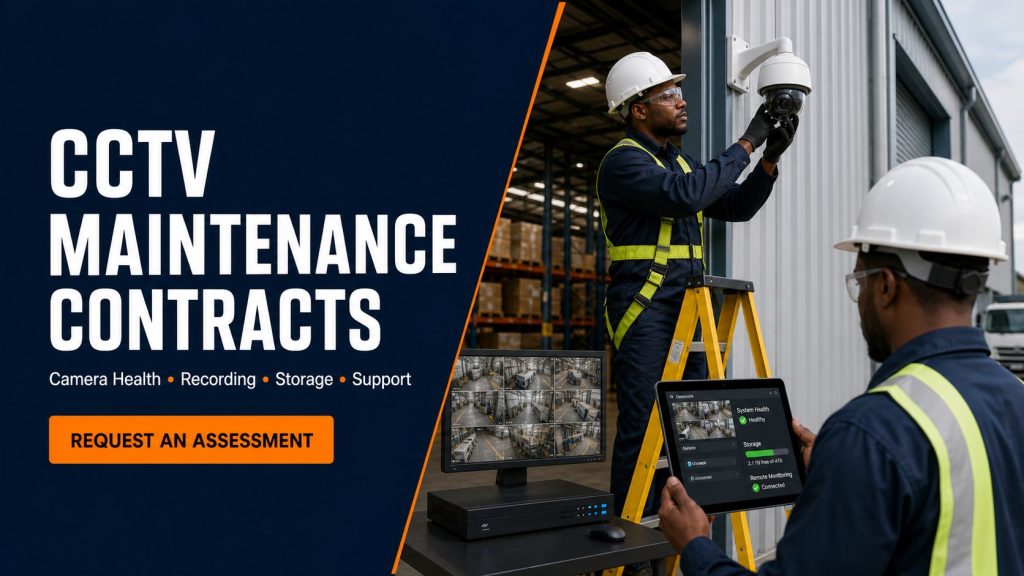
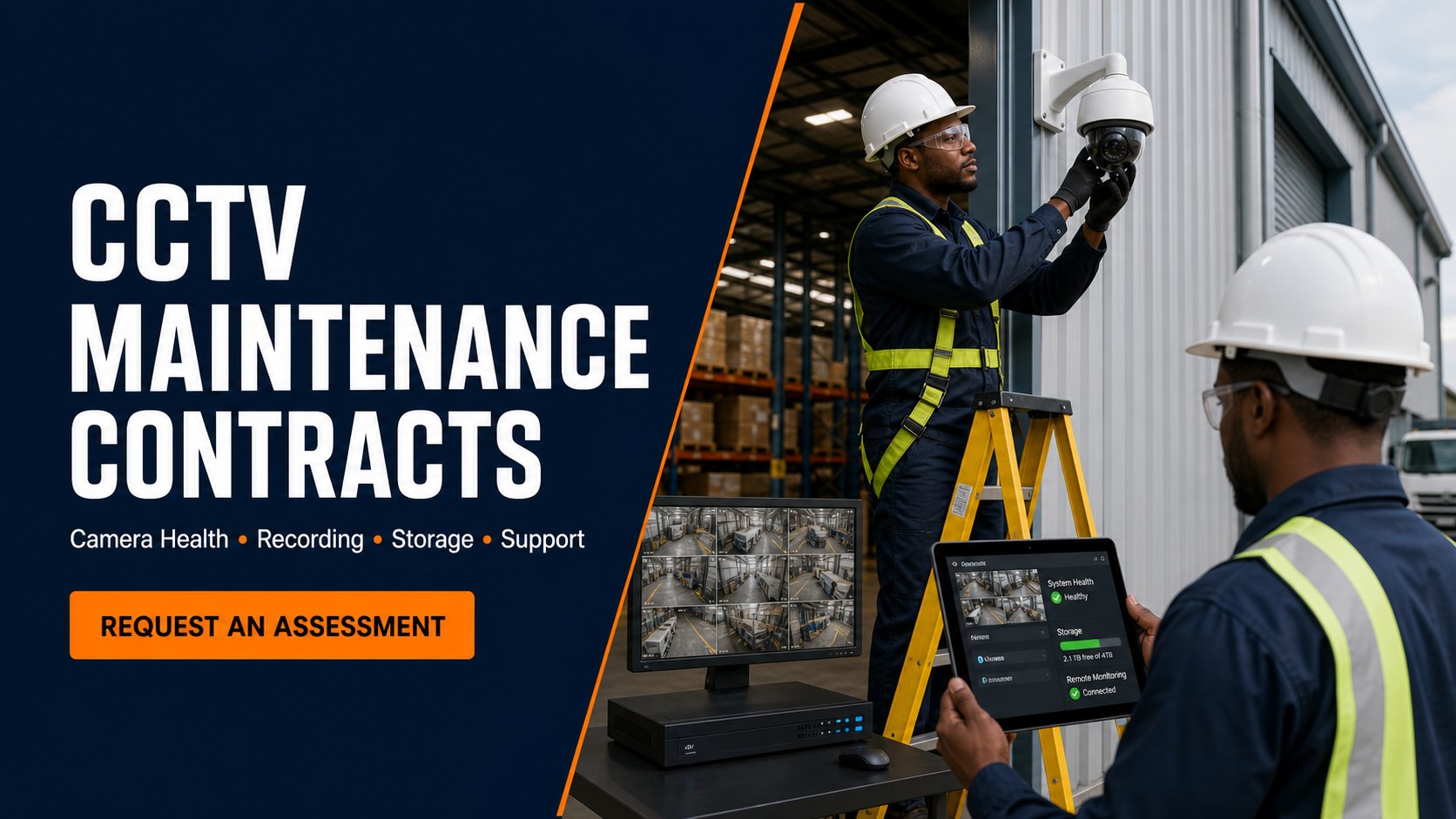
CCTV maintenance contracts help businesses discover camera, recording, storage and connectivity faults before an incident exposes the gap. A camera can appear powered while producing a blurred, obstructed or incorrectly timed recording; a recorder can show live images while failing to retain the required history.
This article is for security managers, facilities teams, schools, warehouses, factories, hospitals, hotels, offices, residential developments and multi-branch organisations that depend on CCTV evidence and remote visibility.
When this service is the right fit
A maintenance agreement is particularly valuable where cameras protect critical assets, the system has many devices, sites are geographically distributed, recording must be retained for an agreed period or internal staff do not perform documented health checks.
- Warehouses, factories and logistics yards
- Schools, universities, hospitals and hotels
- Office buildings, shops and shopping centres
- Petrol stations, farms and construction sites
- Residential developments and multi-branch businesses
A useful proposal starts with the required business outcome. Screen size, camera coverage, viewing distance, wall construction, available power, network capacity, room acoustics, content sources, operating hours and future expansion can all change the correct design. Zama Engineering Systems (ZES) confirms these conditions during assessment rather than treating the installation as a one-product purchase.
What a professional scope should include
The maintenance scope should define assets, visit frequency, checks, response times and exclusions. It may include:
- Camera image, focus, angle, cleanliness and night-view checks
- Recorder health, channel status, date, time and event review
- Storage-capacity and actual retention-period verification
- Power supplies, UPS condition and surge-protection observations
- Network links, switches, remote access and authorised user review
- Cable, connector, enclosure and mounting inspection
- Firmware or configuration review where approved and compatible
- Service report, fault priorities and corrective quotation
The quotation should identify which equipment is supplied, which customer-owned devices will be retained, what cabling and builders work are included, what testing will be completed, and which subscriptions or third-party services remain the customer’s responsibility. This prevents a low headline price from becoming an incomplete installation.
Engineering and design decisions
A contract must be built around the system’s risk and architecture rather than a fixed generic checklist:
- Critical cameras and the minimum acceptable evidence view
- Required recording retention and image-quality trade-offs
- Preventive visit frequency versus remote health monitoring
- Spare cameras, disks, power supplies or switches for critical sites
- Customer approval process for firmware and configuration changes
- Response targets, access hours and escalation contacts
Where displays, cameras, audio, control equipment and network devices share infrastructure, the design should document signal routes, cable categories, connection lengths, equipment ventilation, rack space, surge protection and access for future maintenance. Compatibility should be checked using exact device models rather than assumptions based only on connector appearance.
How ZES plans and delivers the project
1. Baseline assessment
ZES inventories the visible CCTV assets, records system condition and identifies immediate gaps. Unknown passwords, unsupported equipment and undocumented cabling are highlighted.
2. Maintenance plan
Cameras and supporting equipment are classified by criticality. Visit frequency, remote checks, reporting, response and exclusions are agreed.
3. Preventive inspection
The technician checks image quality, recording, storage, power, network, enclosures, cables and selected playback events using the approved checklist.
4. Fault prioritisation
Critical recording failures are separated from image-quality improvements and lifecycle recommendations. Corrective work outside the contract is quoted transparently.
5. Reporting and review
Each visit produces a record of checks, faults, actions and recommended next steps. Recurring issues can then be reviewed at management level.
The handover should leave the customer able to operate the system without depending on undocumented settings. ZES records the agreed configuration, demonstrates normal operation, identifies routine checks and explains how faults should be reported. Passwords and administrative access should be transferred to authorised customer representatives using an agreed secure process.
Common problems this approach prevents
Without structured maintenance, surveillance failures remain hidden. Common examples include:
- Dirty, shifted or overgrown camera views
- Failed night illumination or severe glare after lighting changes
- Incorrect recorder time that weakens incident timelines
- Hard disks reporting errors or retaining fewer days than expected
- Remote access failing after router, password or internet changes
- Former staff retaining accounts or shared credentials remaining active
Some faults do not appear on installation day. Loose fixings, heat buildup, marginal signal paths, insufficient storage, weak wireless connectivity and inaccessible cable joints may emerge later. A practical design includes appropriate load margins, physical support, labelled cables, ventilation and maintenance access so the installation remains serviceable.
Integration with networking, security and power
CCTV reliability depends on networking, power and access control. ZES can review PoE switches, fibre links, wireless bridges, UPS units, remote connectivity and selected integrations with access-control events. Changes are coordinated with the customer’s IT and security policies to avoid disrupting other systems.
Business systems also need predictable power. Where the service is operationally important, the survey should consider surge protection, voltage quality, backup power and controlled shutdown. Remote access should use authorised accounts and appropriate network security; exposing equipment directly to the internet without a reviewed security method creates unnecessary risk.
What affects project cost?
A responsible quotation is based on the site and required outcome. The following factors normally have the greatest effect:
- Number of sites, cameras, recorders and supporting network devices
- Preventive visit frequency and remote-monitoring capability
- Travel, working heights and special access equipment
- Required response time and support hours
- Age, brand mix, documentation and condition of the installed system
- Included consumables, spares and whether corrective labour is bundled
Customers receive a more useful quotation when they provide the site location, room or area photographs, device models, quantities, approximate mounting heights, available drawings, preferred completion date and the operational problem being solved. A site survey is recommended where wall structure, long cable routes, working-at-height access or system integrations cannot be confirmed remotely.
Service coverage across Kenya
ZES can assess projects in Kenya’s 47 counties, subject to project scope, scheduling, travel and site logistics. For county and subcounty work, the quotation identifies mobilisation, accommodation where applicable, access hours and any local coordination required. We do not publish hundreds of identical location pages; national and county content should provide genuine local service information, project evidence and useful subcounty coverage.
Questions to ask before appointing an installer
- Does the contract verify recording and playback, not only live images?
- How is actual retention period measured?
- Which faults qualify as critical and what response applies?
- Are replacement parts included or quoted separately?
- How are passwords and remote access handled securely?
- Will every visit produce a clear service report and action list?
Compare proposals on complete outcomes, not the cheapest equipment line. Confirm specifications, load ratings, cable management, configuration, testing, training, warranty, travel, taxes, exclusions and response arrangements. If an existing system is being expanded, ask how compatibility and current condition will be verified.
Related ZES services
- CCTV surveillance solutions
- CCTV installation company
- Business security systems
- Preventive maintenance contracts
Frequently asked questions
How often should CCTV be serviced?
Frequency depends on site conditions, system criticality, camera exposure and the organisation’s risk. ZES recommends a schedule after baseline assessment.
Can ZES maintain a system installed by another contractor?
Yes, subject to assessment, safe access, equipment condition, available credentials and compatibility. Existing defects are documented before the contract begins.
Does maintenance guarantee that no camera will fail?
No. Preventive work reduces hidden faults and improves response, but electronic and mechanical equipment can still fail. Critical sites should consider spares and monitoring.
Can storage retention be increased?
Possibly. Retention depends on disk capacity, camera count, resolution, frame rate, compression and recording schedule. The existing system must be assessed.
Do you cover all 47 counties?
ZES can quote national and multi-site maintenance. County routes, mobilisation and response expectations are agreed in the contract.
Request a CCTV maintenance assessment
Share the site locations, camera and recorder counts, current faults, required retention and preferred service frequency for a tailored proposal.