

Centurion Gate Motor Repair Kenya starts with the exact equipment and the fault it is showing. ZES repairs Centurion gate motors and can assess the Centurion operator alongside the gate, controls and power arrangement. Share the location and model where available so the visit and any parts enquiry can be planned around your installation.
Centurion Gate Motor Repair Kenya: 7 essential enquiry checks
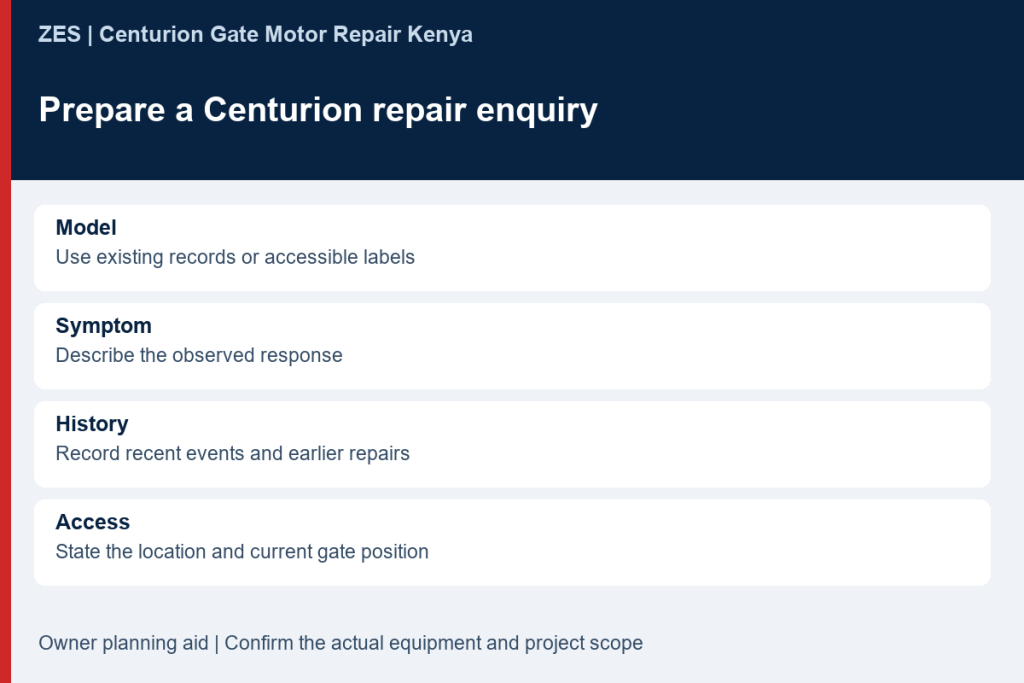
1. Record the model without opening live equipment
Use an existing invoice, manual or safely visible label. Different Centurion models and controller versions can require different parts and procedures. If the label is inaccessible, say that it needs to be checked during assessment. A guessed model can delay the correct repair.
2. Describe the response to the normal control
Explain whether the gate does nothing, starts then stops, reverses, or works intermittently. Note any visible message or audible pattern from a safe position. Avoid repeated triggering when movement is abnormal. The same broad symptom can arise from different causes, so this information supports diagnosis rather than replacing it.
3. Explain what changed before the fault
A power interruption, impact, heavy rain, new remote or recent service may be relevant. Give the sequence of events rather than assuming the cause. Mention whether the fault affects every normal control or only one handset. That distinction can help the technician focus the assessment.
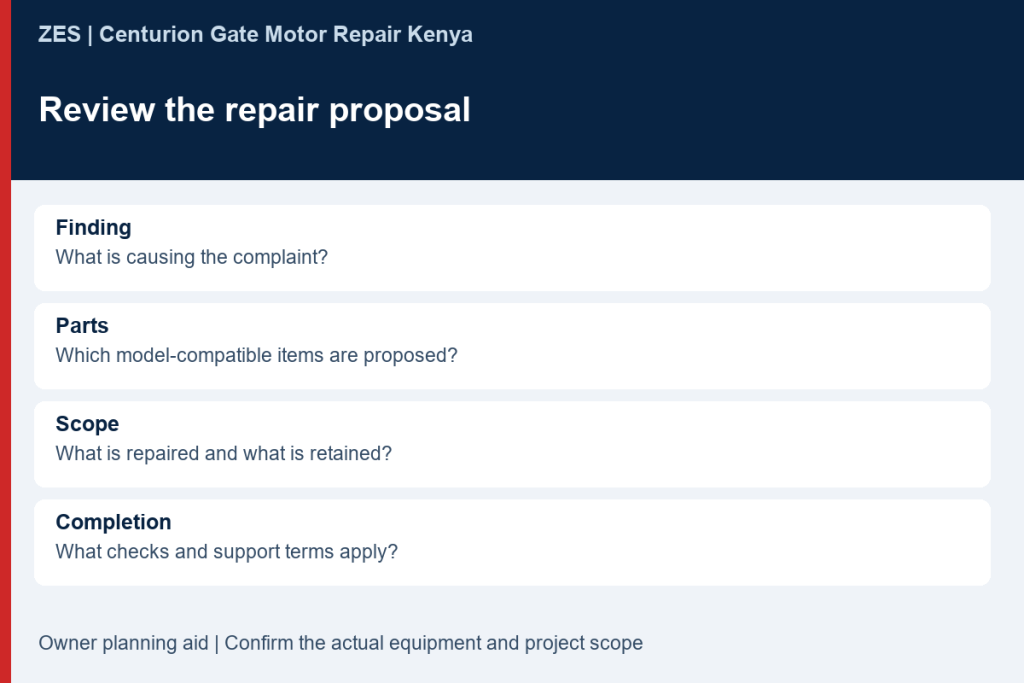
4. Separate mechanical and electrical findings
A gate motor repair should consider the load the Centurion motor is moving and the connected equipment. Ask the technician to explain whether the recommended work concerns the gate, Centurion operator, power system or control interface. Replacing a board without addressing another identified defect may leave the underlying problem unresolved.
5. Confirm compatible spares before ordering
Ask for the part description and its compatibility with the identified model or revision. Availability and delivery time should be confirmed for the actual part. ZES supplies gate spare parts, but this does not mean every Centurion component is held in stock. Confirm the supplied item and terms before committing.
6. Compare repair and replacement clearly
Ask what the repair will restore and which older components remain. If replacement is proposed, request the reason and the additional installation work involved. Our motor replacement guide explains how to compare those options.
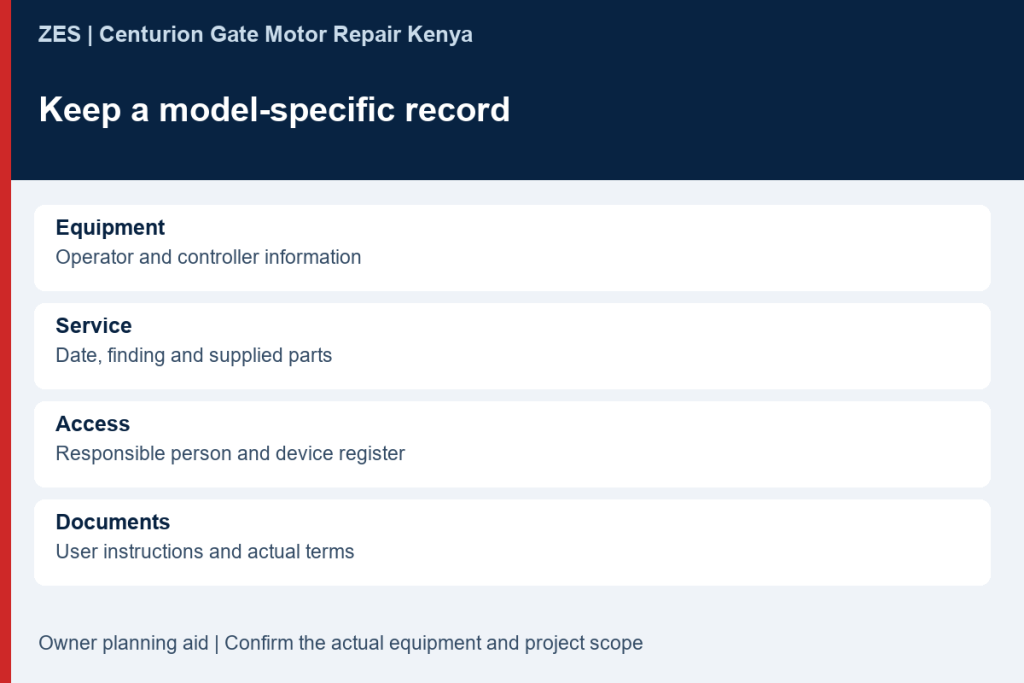
7. Keep the findings and handover record
Retain the diagnosis, parts supplied, completed checks and actual support terms. Ensure the responsible user receives the instructions relevant to the repaired arrangement. For a shared gate, identify who manages remotes and who reports any recurrence.
Manufacturer information and ZES service
The Centurion technical support resources are a useful starting point for model documentation. Follow the correct documentation for the installed equipment; model-specific procedures are not interchangeable. ZES’s repair service described here does not imply manufacturer-authorised dealer status.
Arrange a Centurion repair assessment
Request assistance from ZES with the location, model, symptoms and access situation. For Nairobi properties, include the area and a site contact. For other locations in Kenya, confirm the assessment arrangements and any travel or delivery costs before booking.
Further guidance for your entrance
Centurion operators are common on Kenyan gates because they are designed for frequent use and have a broad support history. That does not make every fault identical. A Centurion sliding Centurion motor that beeps, a swing Centurion operator that reverses, and a gate that ignores its remote can share a brand name while needing completely different repairs. The purpose of this guide is to show owners, estate managers and maintenance teams what a careful Centurion Gate Motor Repair Nairobi process looks like, why the exact model matters, and how to judge whether a repair, a part replacement or a full upgrade is the sensible path.
It is not a repair manual and it does not replace a competent technician. It is a buyer’s guide to the questions, evidence and safety checks that should surround the work.
Why Centurion Gate Motor Repair Nairobi Needs Model-Level Detail
Centurion has produced several generations of sliding and swing operators, and the differences affect everything from battery type to controller settings, remote technology and spare-part compatibility. Two motors may look similar from the outside but use different boards, different limit arrangements or different gear sets. A repairer who works from memory rather than from the label can fit the wrong part, use an incompatible remote, or apply settings that are unsuitable for the gate. The first step in any serious repair is therefore identification, not assumption.
Model-level detail also matters when a system has been modified. A gate may have started with one Centurion operator and later received a replacement controller, a different receiver or a new battery arrangement. The label on the Centurion motor may not tell the whole story. The technician should inspect the controller enclosure, the power supply, the limits and the accessories, and record what is actually installed. If the installation has been repaired by several people over the years, the wiring may not match the original diagram. Documentation and photographs help everyone avoid repeating the same mistakes.
Keep original manuals and previous repair records. Share safely accessible labels; inaccessible controller information should be recorded by the technician. ZES does not claim manufacturer-authorised status.
Reading the Model, Serial and Controller Labels
The Centurion motor label usually carries the model name, serial number, voltage and other ratings. On some installations the label is faded, painted over or hidden behind a cover, so the technician may need to remove a protective housing to read it. The controller board may have its own label or printed version number. These details should be recorded before parts are ordered. A serial number can also help a supplier identify the production batch and the correct replacement components.
It is important to distinguish between the Centurion operator model and the gate type. A sliding gate operator may be mounted on a concrete plinth beside the gate, while a swing operator may be an arm model or an underground unit. The same brand can supply both, and the repair procedure differs. The technician should also check whether the gate has one leaf or two, whether it is cantilevered or tracked, and how heavy it is. A Centurion motor that was correctly sized when installed may be overloaded if the gate has been modified, strengthened or fitted with additional cladding.
Labels should be photographed rather than copied by hand, because a single character can change the part number. The owner should keep the photograph with the maintenance records. If a controller has been replaced with a non-original board, that should be documented too, because the remote-learning procedure and fault indications may differ. A transparent record of the installed equipment makes future repairs faster and reduces the risk of buying a part that does not fit.
Symptom Patterns: What the Gate Is Telling You
Gate symptoms are clues, not diagnoses. A gate that beeps may be indicating a low battery, a fault input, a collision or a controller condition, depending on the model. A gate that opens but will not close may be held open by a safety input, a limit setting or a command from an access control system. A gate that moves a short distance and stops may be hitting an obstacle, losing position or detecting a Centurion motor overload. The technician should observe the sequence, the indicator lights and the sound of the motor before touching the settings.
The owner’s description is valuable if it is specific. “It does not work” is less useful than “it opens normally in the morning, but after the fourth or fifth car it stops halfway and the controller beeps.” The time of day, weather, number of cycles, remote used and any recent power interruption can all point to the cause. If the gate has a display or indicator code, the owner should note it. If the gate is connected to an intercom or access control system, the owner should say whether the command comes from the remote, the keypad or the phone.
Some symptoms are safety-related and should not be ignored. A gate that closes on a vehicle, fails to reverse when blocked, or moves without warning is a hazard. The gate should be taken out of automatic service until it has been inspected. A technician should not simply increase force or disconnect a safety device to keep the gate moving. The correct repair restores safe operation, even if that means replacing a sensor or refusing to restore automatic use until a part arrives.
Centurion motor battery, charger and backup behaviour
Many Centurion sliding operators use a battery-backed system so that the gate can continue to operate during a mains failure. The battery, charger and controller work as a team. A battery that is nearing the end of its life may hold enough charge for a few cycles, then fail under load. A charger that is not delivering the correct voltage may leave the battery partially charged, producing intermittent faults that look like controller problems. The technician should test the battery under load and check the charging circuit, not just measure the battery voltage at rest.
Battery replacement should use the correct type and capacity for the Centurion operator. A larger battery may seem like an upgrade, but if the charger is not designed for it, the battery may never reach a full charge. A smaller or automotive battery may fit in the housing but may not tolerate the charging profile or the duty cycle. The technician should also inspect the battery terminals and wiring for corrosion, loose connections and heat damage. A poor connection can cause voltage drops that reset the controller or cause erratic movement.
Charger faults can be intermittent. A charger may work when cool and fail after running for a while, or may be affected by a loose plug or a damaged cable. The technician should check the supply to the charger, the charger output, the fuse and the connections. If the charger is replaced, the battery should be re-tested and the system run through several cycles. The owner should be told how to recognise a low-battery condition in future, so that a repeat failure can be reported before the gate becomes unusable.
Centurion motor limits, origin and travel settings
Limits define the safe open and closed positions. If they drift, the gate may stop short, overshoot, reverse or fail to latch. The cause may be a loose limit magnet, a bent bracket, a worn mechanical stop or a controller setting that has changed. The technician should inspect the physical limit components and confirm that the controller receives a consistent signal at each end of travel. The gate should then be run through several complete cycles to confirm that the positions repeat consistently.
Some systems use an origin or reference position that the controller learns after installation or a battery change. If the controller loses its reference, the gate may behave unpredictably until it is re-initialised. The correct procedure depends on the model and should be performed according to the manufacturer’s instructions. Randomly pressing buttons or moving the gate by hand while the controller is powered can make the problem worse. The technician should explain what was done and whether the gate needs a full travel re-learn after future battery replacements.
Limit problems are sometimes caused by the gate rather than the electronics. A gate that has dropped on its rollers, a track that has shifted, or a rack that has come loose can change the physical end position. Adjusting the limit without correcting the mechanical alignment may provide temporary relief, but the gate will drift again. The technician should check the gate’s movement by hand where safe, look for binding or excessive play, and verify that the gate runs smoothly before setting the limits.
Centurion motor gears, rack and mechanical load
The gearbox and drive system carry the gate’s weight and resistance. A worn gear can produce a rhythmic grinding noise, a jerking movement or a complete loss of drive. A dry or misaligned rack can accelerate wear. A gate that is heavier than the Centurion operator’s rating, or one that runs on a damaged track, will place extra load on the gears and Centurion motor. The technician should inspect the drive components, listen to the gate in motion and check for signs of overheating, metal filings or lubricant loss.
Replacing a gear or drive component is only part of the repair. The cause of the wear should be identified. If the gate is binding, the new gear may fail quickly. If the rack is loose, it should be secured and aligned. If the gate is sagging, the rollers or hinges may need attention. The technician should also confirm that the replacement part is suitable for the specific model. A part that looks similar may have a different tooth profile, material or bore, and may not last.
Lubrication should follow the manufacturer’s guidance. Some components require specific grease, while others should be kept clean and dry. Excess lubricant can attract dust and grit, forming an abrasive paste that increases wear. The owner should ask what maintenance is recommended and how often the drive should be inspected. A simple routine of cleaning and checking for loose parts can extend the life of the mechanism, but it cannot compensate for an overloaded or misaligned gate.
Remotes, Receivers and Accessories
Remote-control problems are common and often misunderstood. A remote may stop working because its battery is flat, because it has lost its code, because the receiver has failed, or because the aerial is poorly positioned. In a shared estate, interference or a nearby transmitter can also affect range. The technician should test the remote at different distances and angles, check the receiver and aerial, and confirm whether the system uses fixed or rolling codes. The correct remedy depends on the technology, not on repeated button pressing.
Adding or removing remotes should be done through the proper learning procedure. If a remote is lost, the owner should ask whether it can be deleted from the receiver’s memory. Some systems allow individual remotes to be removed, while others require a full reset. A full reset may affect other users, so it should be planned. The owner should keep a record of how many remotes are in use and who holds them. In rental properties and estates, this record helps prevent unauthorised access.
Accessories such as keypads, intercoms, photocells and loop detectors can also cause apparent Centurion motor faults. A stuck keypad button, a failed intercom relay or a misaligned photocell can hold the gate open or prevent it from closing. The technician should test the accessories as part of the diagnosis and should not assume the motor is at fault. If an accessory is incompatible with the controller, it may work intermittently or cause resets. The owner should ask whether the accessory is supported by the installed controller and whether it has its own power supply.
Spares Availability and Compatible Parts
Spare availability is a practical concern that should be discussed before repair work begins. Some Centurion models have long production histories and widely available parts, while others may be older or less common. The supplier may have the part in stock, may need to order it, or may offer a compatible alternative. The owner should ask what is being fitted, whether it is original or aftermarket, and what warranty applies. A cheap substitute may restore operation but may not provide the same life or safety performance.
Compatibility is not only about physical fit. A controller board must support the installed receiver, limits, safety devices and accessories. A battery must match the charger. A gear must match the drive. The technician should confirm compatibility before installation, especially when a system has been modified. If an original part is unavailable, the options may include a manufacturer-approved alternative, a refurbished part or a controller upgrade. Each option has trade-offs in cost, lead time and future support.
Owners should be cautious of anyone who claims to have every part for every model at all times. That is rarely true. A reliable repairer will check availability and give an honest lead time. They will also explain whether the gate can be used safely in the meantime, or whether it should remain out of service. Keeping a small stock of commonly needed items, such as fuses, batteries and remote batteries, can reduce downtime, but the main spares decision should be based on the actual equipment installed.
Centurion motor assessment when a controller is suspect
Controller boards can fail because of power surges, water ingress, insect nests, corrosion or incorrect wiring. The symptoms may include a dead display, repeated resets, random movement, failure to learn remotes or inability to drive the Centurion motor. Before condemning the board, the technician should check the supply voltage, fuses, wiring connections, limit inputs and safety inputs. A board that appears dead may simply have no power or a blown fuse. A board that resets may have a failing power supply or a short circuit in an accessory.
Board repair is sometimes possible, but it requires the right skills and equipment. Replacing components on a board without understanding the circuit can create a safety risk. In many cases, replacement with a compatible board is the more practical option, especially if the original is obsolete. The technician should transfer the settings, re-learn the remotes and limits, and test all inputs and outputs. The owner should receive a record of the new board’s model and version.
A controller replacement should not be used to hide a mechanical problem. If the gate is binding or the Centurion motor is drawing excessive current, a new board may fail in the same way. The technician should measure the motor current where possible and inspect the mechanical system. A board replacement is justified when the board itself is faulty or incompatible, not simply because it is the easiest part to change.
How Gate Structure and Foundation Affect the Operator
A Centurion operator can only perform as well as the gate it drives. A sliding gate that has settled, a track that is no longer level, or a foundation that has cracked can introduce resistance that the Centurion motor was never designed to overcome. The Centurion operator may then show symptoms that look electrical: overheating, repeated reversal, slow movement or failure to complete a cycle. Before replacing a controller or increasing force, the technician should check the gate’s alignment, the condition of the rollers and the stability of the mounting plinth.
Swing gates have their own structural issues. Worn hinges, a sagging leaf or a post that has moved can cause the Centurion operator to strain. A gate that drags on the ground or binds against a stop will draw more current and may trigger an overload. The technician should inspect the hinges, the gate frame and the mounting points, and should confirm that the operator is appropriate for the leaf weight and width. A gate that has been modified with heavy cladding or additional bars may now exceed the original design.
The foundation and housing also affect reliability. An Centurion operator mounted on a weak base may vibrate, shift or allow water to enter. A housing that is not sealed can admit rain, dust and insects, leading to controller corrosion. Cable entries should be protected, and the housing should be positioned so that it does not sit in standing water. If the installation is in a low-lying area, drainage may need attention. These are not cosmetic issues; they directly affect the life of the electronics and the safety of the gate.
Correcting the structure may add cost to a repair, but it can prevent repeat failures. The owner should ask whether the gate runs freely by hand, whether the track or hinges are worn, and whether the Centurion operator is correctly rated. A technician who ignores these questions may solve the immediate symptom while leaving the underlying cause in place. ## Documentation for Shared Properties and Managing Agents
Centurion gates are often installed at apartment blocks, office parks, schools and gated communities where responsibility is shared. In those settings, record keeping is especially important. The managing agent, caretaker and committee need to know which Centurion operator is installed, when it was last serviced, what parts have been replaced and who authorised the work. Without that history, each new technician starts from scratch, and repeated faults may be misdiagnosed as new problems.
A simple asset file can include photographs of the Centurion motor label, controller board and gate, the original installation date, the service history and the remote-control register. The register should record how many remotes exist, who holds them and whether any have been lost or replaced. When a tenant moves out, the remote should be recovered or disabled. When a contractor needs access, a temporary remote or keypad code should be issued and removed afterwards. These practices reduce the risk of unauthorised entry and make the system easier to manage.
The file should also record the safety configuration. If the gate uses photocells, safety edges or loops, the committee should know what each device does and when it was last tested. If a device has been removed or disabled, that should be documented and corrected, not quietly accepted. Any change to the controller settings should be recorded, because a setting that suits one gate may be unsafe for another. Clear records help a new committee or agent understand the system without relying on memory.
Good documentation also supports budgeting. A planned replacement or a major repair can be discussed before an emergency occurs. The committee can compare quotations using the same equipment details and maintenance history. That makes it harder to substitute an unsuitable part or charge for work that was not done, and it helps the technician bring the right spares on the first visit.
Repair or Replace a Centurion Operator
The repair-versus-replace decision should be based on the Centurion operator’s condition, the gate’s condition, the availability of spares and the cost of repeated repairs. A well-built operator that needs a battery, a remote receiver or a limit switch is usually worth repairing. An operator with a corroded board, a worn gearbox and a damaged housing may be a candidate for replacement, especially if parts are difficult to obtain. The gate itself also matters: a sound gate with a failed Centurion motor may only need a new operator, while a distorted gate may need mechanical work before any motor can perform reliably.
The owner should ask for a comparison of outcomes, not just prices. How long will the repaired unit last? Are the parts likely to remain available? Will the existing remotes and accessories work with a replacement? Does the replacement require a new controller, battery or power supply? What warranty applies? A replacement may be more expensive initially but cheaper over several years if it is better supported and more efficient. A repair may be the right choice if the unit is otherwise sound and the fault is isolated.
What to Expect From a Centurion Gate Motor Repair Nairobi Visit
A proper Centurion Gate Motor Repair Nairobi visit should begin with identification and a conversation about symptoms, followed by safe isolation and a structured inspection. The technician should check the power supply, battery and charger, the controller and receiver, the limits and travel, the drive mechanism, the manual release and the safety devices. The gate should be tested through several cycles, and the results should be recorded. If a part is needed, the technician should confirm availability and explain the options.
The owner should receive a clear report covering the model and serial number, the fault found, the tests performed, the parts replaced and any remaining issues. If the gate cannot be restored safely on the first visit, the technician should explain what should be done and whether the gate can be used manually. The owner should not be left with a gate that is unsafe or with a controller setting that has been changed without explanation. A short demonstration of the repair and the safety tests helps build confidence.
Follow-up matters. If the same symptom returns, the owner should be able to contact the provider and describe what happened. A good provider will keep records and use them to narrow the diagnosis. The owner should also keep their own maintenance log, including dates, symptoms and parts. This is especially important in estates where committee members change and records can be lost. Good documentation protects both the owner and the technician.
Centurion motor maintenance and record keeping
Centurion operators benefit from regular inspection. The gate should be checked for smooth movement, unusual noise, loose fittings and damage. The battery and charger should be tested periodically, and the safety devices should be checked for correct operation. The remote batteries should be replaced when performance drops. The controller enclosure should be kept clean, dry and insect-free. Vegetation should be cleared away from the gate’s path and from any sensors.
A maintenance log should record the date, the technician, the work done, the parts used and any recommendations. Photographs of the installation, labels and wiring are useful. If the gate is part of a shared property, the log should be kept with the estate records so that all committee members can see the history. A planned maintenance visit is usually cheaper and less disruptive than an emergency repair, and it provides an opportunity to identify worn parts before they fail.
Maintenance is not a guarantee against breakdown, and no responsible provider should claim otherwise. It is a way to manage risk. The owner should ask what is included, whether parts are extra and how the technician will report findings. A simple checklist and a written report are more valuable than a vague assurance that the gate has been “serviced”. For related guidance, see our Centurion gate motor installation page and the broader automatic gate repair guide.
Frequently Asked Questions
How do I identify my Centurion gate motor model?
Look for the label on the Centurion operator housing and any label on the controller board. Record the model, serial number and voltage. If the label is unreadable, photograph the installation and ask a technician to identify it. Exact model and firmware should be confirmed before ordering parts.
Why does my Centurion gate beep?
Beeping can indicate a low battery, a fault condition, a safety input or a controller warning, depending on the model. The pattern and any indicator lights matter. Do not ignore repeated beeping; have the system tested before the gate stops completely.
Can I replace the battery myself?
Battery replacement involves electrical and safety risks, and the correct type must match the charger and controller. A professional should test the charging circuit as well as the battery. If you do replace it, follow the manufacturer’s instructions and dispose of the old battery responsibly.
Why does the gate work with the remote but not the intercom?
The fault may be in the intercom, its wiring or the controller input rather than the Centurion motor. Accessories should be tested separately. A stuck relay or an incompatible device can prevent the gate from receiving a command.
Are Centurion spare parts easy to find in Nairobi?
Availability varies by model and generation. Some parts are common, while others may need to be ordered. Always confirm the exact part number and compatibility with the supplier. Do not assume that a similar-looking part will work.
Is it worth repairing an older Centurion motor?
It can be, if the unit is otherwise sound and the required parts are available. Compare the repair cost, expected life, spares outlook and the cost of a replacement. A technician should give you evidence, not just an opinion.
Centurion Gate Motor Repair Nairobi: A Measured, Evidence-Led Approach
The most reliable way to handle a faulty Centurion gate is to treat it as a specific system, not a generic brand. Identify the model, record the symptoms, test the battery and charger, check the limits and drive, and verify the safety devices before deciding on a repair or replacement. That approach costs a little more time at the start, but it reduces repeat visits and avoids unsafe shortcuts. If you need help with a Centurion Gate Motor Repair Nairobi project, Request a quotation with the model label, a description of the fault and any recent repair history. You can also compare options in our gate automation installation and automatic gate repair Nairobi guides before making a decision.
Related ZES gate guides
FAAC installation · Gate spare parts · Automatic gate prices · Request a quotation