
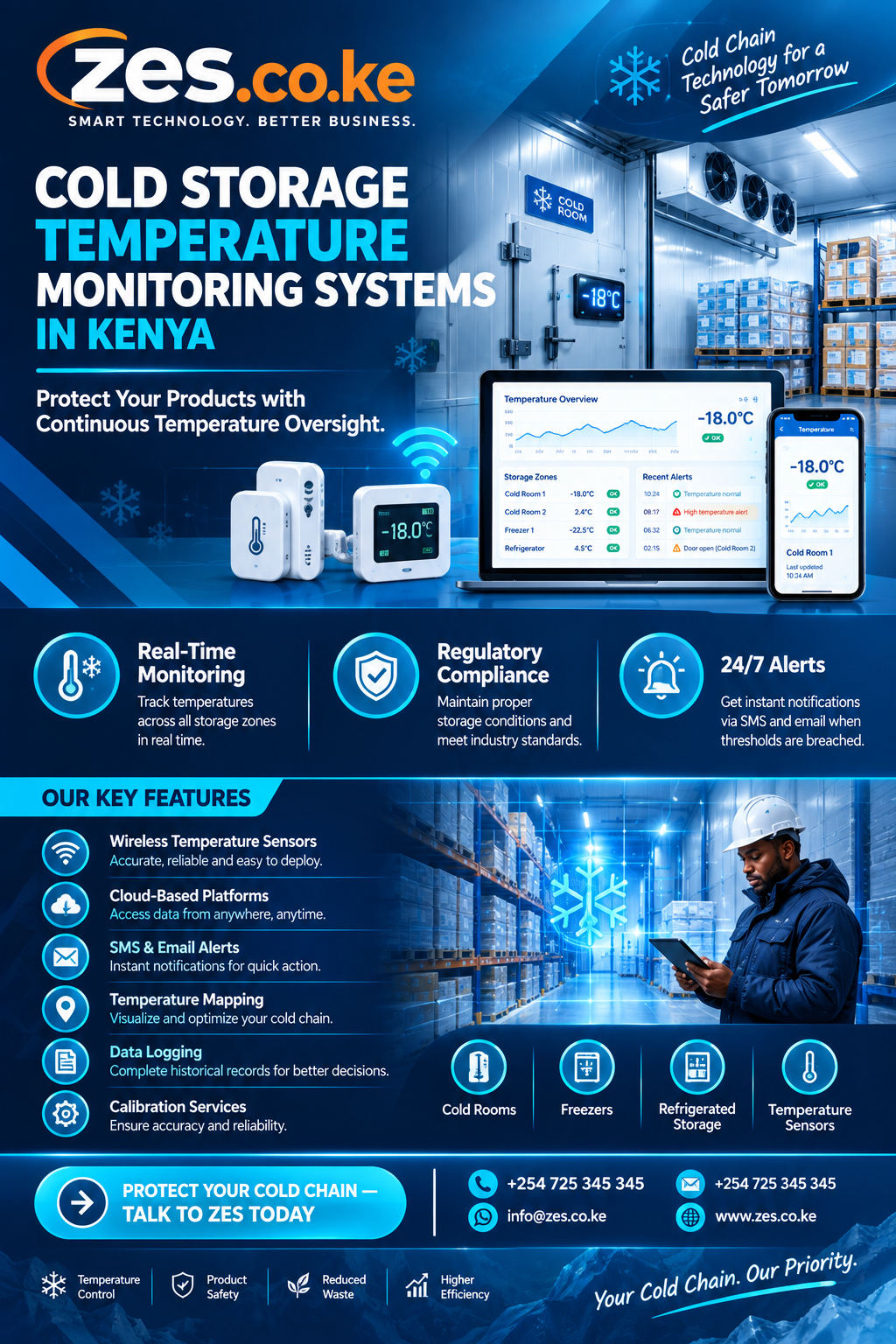
Cold storage temperature monitoring systems in Kenya have become essential for pharmaceutical distributors, food processors, agricultural exporters, and healthcare facilities seeking to protect temperature-sensitive products and comply with stringent regulatory requirements, and at zes.co.ke, we understand the critical importance of continuous temperature oversight.
Whether you operate a pharmaceutical cold room in Nairobi’s Industrial Area, manage a horticultural export facility in Naivasha, or run a vaccine storage facility in Turkana, implementing professional cold storage temperature monitoring systems in Kenya is the foundation for product integrity, regulatory compliance, and business reputation. With Kenya’s Pharmacy and Poisons Board requiring cold chain conditions between 2°C and 8°C from manufacture to administration, and with food safety regulations demanding verifiable temperature records, more organizations are recognizing that manual temperature logs and periodic checks are no longer sufficient, and zes.co.ke is at the forefront of providing comprehensive monitoring solutions.
The cold chain monitoring landscape in Kenya has evolved dramatically, with businesses seeking automated solutions that provide real-time visibility, instant alerts, and comprehensive audit trails. When researching cold storage temperature monitoring systems in Kenya, you will discover that these systems provide numerous advantages including continuous monitoring, automated data logging, remote access, and integration with existing cold storage infrastructure. IoT-enabled monitoring systems now allow real-time tracking of temperature, location, and door openings, transforming how organizations manage their cold chain operations. At zes.co.ke, we offer comprehensive solutions.
At zes.co.ke, we specialize in providing cold storage temperature monitoring systems in Kenya that address the unique requirements of different industries and facility types. Our solutions are designed to handle everything from small pharmacy refrigerators to large pharmaceutical warehouses and multi-site cold chain networks, all while maintaining the highest standards of accuracy, reliability, and regulatory compliance. We understand that every facility has different requirements, which is why we offer customizable solutions that fit your specific temperature ranges, monitoring needs, and reporting obligations.
For pharmaceutical distributors and healthcare facilities, cold storage temperature monitoring systems in Kenya represent a strategic investment in patient safety and regulatory compliance. The Pharmacy and Poisons Board requires that all thermolabile products be stored in a refrigerator or cold room in a temperature-regulated environment between 2°C and 8°C, with continuous temperature monitoring and documented procedures for handling deviations. A properly implemented monitoring system ensures that vaccines, medicines, and biological products remain within their required temperature ranges throughout their storage life. zes.co.ke offers systems that integrate seamlessly with existing cold storage infrastructure.
The importance of professional installation and validation cannot be overstated when considering cold storage temperature monitoring systems in Kenya. Proper installation ensures that sensors are placed to capture representative temperatures, that systems are calibrated correctly, and that monitoring covers all critical areas including hot and cold spots. At zes.co.ke, our certified technicians understand the nuances of Kenyan regulatory environments—from PPB requirements for pharmaceuticals to KEBS standards for food products—and can recommend the most appropriate solutions for your specific compliance needs. From initial temperature mapping to final training, we manage every aspect of the implementation process.
When evaluating cold storage temperature monitoring systems in Kenya, it’s essential to consider factors such as temperature range, accuracy requirements, sensor placement, alarm thresholds, and reporting capabilities. Professional temperature mapping studies identify hot and cold spots within cold rooms and freezers, ensuring that sensors are placed where they will capture the most critical temperatures. Systems must provide accurate measurements within the required tolerance, typically ±0.5°C for pharmaceutical applications. Alarm systems must alert responsible personnel immediately when temperatures deviate from specified ranges. At zes.co.ke, we provide expert guidance on all these technical requirements.
The value of cold storage temperature monitoring systems in Kenya extends to specialized applications including vaccine storage, pharmaceutical warehousing, food processing, and agricultural cold chains. For vaccines, systems must monitor not just temperature but also door openings and power status, providing complete visibility into storage conditions. For food products, monitoring systems must comply with HACCP requirements and provide verifiable records for audits. For agricultural exports, monitoring ensures that produce arrives at destination markets in optimal condition. At zes.co.ke, we offer advanced solutions tailored to each application.
For organizations requiring comprehensive cold chain visibility, cold storage temperature monitoring systems in Kenya provide the foundation for integrated logistics management. Systems can integrate with transportation monitoring, warehouse management, and ERP platforms, creating a seamless flow of temperature data from production to delivery. This integration supports end-to-end traceability and regulatory compliance. At zes.co.ke, we prioritize practical, integrated solutions.
The user experience is crucial when selecting cold storage temperature monitoring systems in Kenya. Professional systems ensure that staff can easily view temperature status, that alerts are delivered promptly to the right people, and that reports are generated without manual effort. Mobile apps and web dashboards provide access from anywhere, enabling managers to monitor conditions even when off-site. At zes.co.ke, we prioritize ease of use and comprehensive training.
When exploring cold storage temperature monitoring systems in Kenya, modern solutions offer advanced features including wireless sensors that eliminate complex cabling, cloud-based data storage for permanent records, SMS and email alerts for immediate notification, and integration with building management systems. Wireless sensors are particularly valuable in cold rooms where cabling is difficult and in facilities with multiple monitoring points. At zes.co.ke, we stay at the forefront of monitoring technology.
The flexibility provided by cold storage temperature monitoring systems in Kenya extends to various monitoring scales. Single-room systems monitor one cold room or refrigerator with one or more sensors. Multi-room systems monitor multiple storage areas from a central platform. Enterprise systems monitor multiple sites across a region, providing centralized visibility and management. At zes.co.ke, we help you select the right scale for your operations.
The integration capabilities of cold storage temperature monitoring systems in Kenya extend to comprehensive cold chain management platforms. Integration with transportation monitoring ensures continuous temperature visibility from origin to destination. Integration with quality management systems ensures that deviation reports and corrective actions are captured and tracked. At zes.co.ke, we provide comprehensive integration solutions.
When considering cold storage temperature monitoring systems in Kenya, it’s important to work with providers who understand both the technology and the regulatory requirements. Professional providers conduct temperature mapping studies, install and validate monitoring systems, and provide documentation for regulatory inspections. They also train staff on alarm response procedures and reporting requirements. At zes.co.ke, we ensure complete project management.
For organizations requiring specialized monitoring solutions, cold storage temperature monitoring systems in Kenya offers expertise in ultra-low temperature freezers, pharmaceutical cold rooms, and food processing facilities. Whether you need to monitor a single vaccine refrigerator or a network of cold storage facilities across multiple counties, professional providers can deliver the right solution for your requirements. At zes.co.ke, we offer comprehensive solutions.
Looking for cutting-edge technology in cold storage temperature monitoring systems in Kenya? The latest systems include IoT-enabled sensors with GSM and Wi-Fi connectivity, cloud-based platforms with analytics and predictive alerts, and integration with solar power systems for off-grid facilities. VacciBox, for example, incorporates IoT monitoring that tracks temperature, battery status, and performance in real time, with solar power support for rural facilities. At zes.co.ke, we offer these innovative solutions for organizations seeking the highest level of cold chain visibility.
For additional insights into temperature monitoring standards and best practices, resources such as the World Health Organization provide guidance on vaccine cold chain management. The Pharmacy and Poisons Board of Kenya offers regulatory requirements for pharmaceutical cold chain. The Kenya Bureau of Standards provides standards for food safety and temperature control. TechNet-21 offers resources on cold chain equipment and monitoring. GS1 provides standards for traceability in cold chain logistics. Wikipedia’s article on cold chain offers technical background on temperature-controlled supply chains.
Understanding Cold Storage Temperature Monitoring Technology
What Is a Cold Storage Temperature Monitoring System?
A cold storage temperature monitoring system is an integrated solution that continuously measures, records, and reports the temperature conditions within refrigerators, freezers, cold rooms, and cold storage warehouses. Unlike manual temperature checks that capture conditions at a single point in time, automated monitoring systems provide continuous oversight, detecting deviations immediately and creating comprehensive records for regulatory compliance and quality assurance. At zes.co.ke, we help clients understand and deploy this technology.
How Monitoring Systems Operate in Kenyan Cold Storage Facilities
In a typical deployment, temperature sensors are placed at strategic locations within the cold storage environment—often determined by temperature mapping studies that identify hot and cold spots. These sensors transmit data wirelessly or via wired connections to a central monitoring unit or cloud platform. The system continuously records temperature readings, compares them against configured thresholds, and triggers alarms if deviations occur. Authorized personnel receive alerts via SMS, email, or mobile app, enabling immediate corrective action. All data is stored for audit purposes, providing verifiable records for regulatory inspections. At zes.co.ke, we design monitoring systems optimised for Kenyan facility conditions.
Key Regulatory Requirements for Cold Storage in Kenya
Pharmacy and Poisons Board Requirements
The Pharmacy and Poisons Board requires that all products requiring cold chain conditions be maintained within the temperature range of 2°C to 8°C from the time of manufacture until administration to individuals. Facilities must have continuous temperature monitoring devices, written procedures for responding to temperature deviations, and contingency plans for power failures or equipment breakdowns. Temperature logs for refrigerators should be maintained on a daily basis, and equipment should be calibrated at defined intervals. At zes.co.ke, we ensure all monitoring systems meet these requirements.
WHO Prequalified Devices
The Pharmacy and Poisons Board requires that manufacturers, marketing authorization holders, and importers use WHO Prequalified Temperature Monitoring Devices for temperature monitoring. Cold chain monitor cards, vaccine vial monitors, and freeze indicators are no longer recommended for international shipments alone. Appropriate temperature monitoring devices must be attached together for shipments. At zes.co.ke, we supply WHO-compliant monitoring solutions.
Food Safety and HACCP Requirements
For food processing and storage facilities, temperature monitoring is a critical control point under HACCP principles. Facilities must maintain verifiable records of temperature conditions and demonstrate that corrective actions were taken when deviations occurred. At zes.co.ke, we help food facilities implement compliant monitoring systems.
National Cooling Action Plan
Kenya’s National Cooling Action Plan (NCAP 2023-2027) emphasizes the importance of temperature control and monitoring for export-quality products. This plan supports the adoption of energy-efficient cooling technologies and improved cold chain infrastructure. At zes.co.ke, we align our solutions with national priorities.
Types of Temperature Monitoring Systems
Wireless Sensor Systems
Wireless sensor systems use battery-powered sensors that transmit data to a central receiver or gateway without the need for cabling. These systems are ideal for retrofitting existing cold rooms, for facilities with multiple monitoring points, and for applications where drilling or cabling is impractical. Wireless sensors typically operate in the 2.4 GHz or sub-GHz bands and offer battery life of several years. At zes.co.ke, we supply wireless monitoring systems.
Wired Sensor Systems
Wired sensor systems use sensors connected by cables to a central monitoring unit. These systems offer reliable, continuous data transmission and are ideal for new installations where cabling can be planned. Wired systems are less susceptible to wireless interference and do not require battery replacement. At zes.co.ke, we install wired monitoring systems.
Data Logger Systems
Data logger systems record temperature data at defined intervals and store it locally for later download. While these systems do not provide real-time alerts, they are useful for applications where continuous monitoring is not required or where real-time alerts are provided by a separate system. At zes.co.ke, we supply data loggers for supplementary monitoring.
Cloud-Based Monitoring Systems
Cloud-based systems transmit data to secure cloud platforms, enabling access from anywhere with an internet connection. These systems provide real-time alerts, comprehensive reporting, and long-term data storage without the need for on-site servers. Cloud platforms also enable integration with other business systems and support multi-site monitoring. At zes.co.ke, we deploy cloud-based monitoring solutions.
IoT-Enabled Monitoring Systems
IoT-enabled systems combine sensors, connectivity, and analytics to provide intelligent monitoring with features like predictive alerts, performance analytics, and integration with operational systems. VacciBox, for example, uses IoT technology to track temperature, battery status, and performance in real time, with GSM and Wi-Fi connectivity for remote monitoring. At zes.co.ke, we offer IoT monitoring solutions.
Key Features of Modern Monitoring Systems
Accuracy and Calibration
Monitoring systems must provide accurate measurements within the required tolerance. For pharmaceutical applications, accuracy of ±0.5°C is typically required. Systems should be calibrated at defined intervals, with calibration certificates available for regulatory inspections. At zes.co.ke, we ensure accuracy and calibration compliance.
Real-Time Alerts
Alerts must be delivered promptly when temperatures deviate from specified ranges. Modern systems support SMS, email, phone call, and mobile app notifications, ensuring that responsible personnel are reached even when off-site. Escalation procedures ensure that alerts reach the right people at the right time. At zes.co.ke, we configure comprehensive alert systems.
Data Logging and Reporting
Continuous data logging creates permanent records for regulatory compliance and quality assurance. Reports should be configurable to meet the specific requirements of regulatory bodies and internal quality systems. Data should be exportable in standard formats for analysis. At zes.co.ke, we provide comprehensive reporting solutions.
Remote Access
Web dashboards and mobile apps enable remote access to temperature data, allowing managers to monitor conditions from anywhere. This is particularly valuable for multi-site operations and for managers who need visibility outside working hours. At zes.co.ke, we prioritize remote accessibility.
Integration Capabilities
Integration with building management systems, ERP platforms, and quality management systems ensures that temperature data is available where it is needed. Integration with power monitoring systems can alert staff to power failures that could affect cold storage. At zes.co.ke, we provide comprehensive integration solutions.
Battery Backup and Power Monitoring
Systems should include battery backup to maintain monitoring during power outages. Power monitoring can alert staff to failures that could compromise cold storage, enabling rapid response. At zes.co.ke, we prioritize power resilience.
Audit Trails
Audit trails record all system activities, including temperature readings, alarms, acknowledgements, and corrective actions. These records are essential for regulatory inspections and quality investigations. At zes.co.ke, we ensure comprehensive audit trails.
Benefits of Professional Temperature Monitoring Systems
Product Integrity Protection
Continuous monitoring ensures that temperature-sensitive products remain within their required ranges, protecting their efficacy, safety, and quality. At zes.co.ke, we protect your products.
Regulatory Compliance
Automated monitoring provides the verifiable records required by the Pharmacy and Poisons Board, KEBS, and other regulatory bodies. At zes.co.ke, we ensure compliance.
Reduced Product Loss
Early detection of temperature deviations enables corrective action before products are compromised, reducing waste and financial loss. At zes.co.ke, we minimize losses.
Improved Operational Efficiency
Automated monitoring eliminates manual temperature checks, freeing staff for higher-value tasks. Reports are generated automatically, reducing administrative burden. At zes.co.ke, we improve efficiency.
Enhanced Customer Confidence
Demonstrating robust temperature monitoring builds confidence among customers, partners, and regulators. At zes.co.ke, we enhance your reputation.
Data-Driven Decision Making
Historical temperature data supports analysis of trends, identification of recurring issues, and optimization of cold storage operations. At zes.co.ke, we provide actionable insights.
Scalability
Monitoring systems can be scaled from a single refrigerator to a multi-site network, accommodating business growth. At zes.co.ke, we design scalable solutions.
Peace of Mind
Knowing that your cold storage is continuously monitored and that you will be alerted to any deviation provides peace of mind for managers and business owners. At zes.co.ke, we deliver peace of mind.
Applications of Temperature Monitoring Systems in Kenya
Pharmaceutical Distribution
Pharmaceutical distributors use monitoring systems to protect vaccines, medicines, and biological products throughout storage and distribution. Compliance with PPB requirements is essential. At zes.co.ke, we deliver pharmaceutical monitoring solutions.
Healthcare Facilities
Hospitals, clinics, and health centres use monitoring systems to ensure that vaccines and temperature-sensitive medicines remain viable. IoT-enabled systems like VacciBox have helped triple vaccination rates in some facilities by reducing spoilage. At zes.co.ke, we provide healthcare monitoring solutions.
Food Processing and Storage
Food processors and cold storage facilities use monitoring systems to ensure food safety and quality, complying with HACCP requirements and protecting against spoilage. At zes.co.ke, we deliver food industry monitoring solutions.
Agricultural Cold Chains
Horticultural exporters and agricultural cooperatives use monitoring systems to maintain the cold chain from farm to port, protecting produce quality and meeting export market requirements. At zes.co.ke, we provide agricultural monitoring solutions.
Dairy and Fisheries
Dairy processors and fisheries use monitoring systems to maintain product quality and safety, from collection through processing and storage. At zes.co.ke, we deliver dairy and fisheries monitoring solutions.
Research Laboratories
Research institutions and laboratories use monitoring systems to protect sensitive reagents, samples, and biological materials. At zes.co.ke, we provide laboratory monitoring solutions.
The Installation and Validation Process at zes.co.ke
Initial Consultation and Requirements Assessment
The first step in cold storage temperature monitoring systems in Kenya is a comprehensive consultation. At zes.co.ke, we discuss your temperature requirements, regulatory obligations, and facility layout.
Temperature Mapping Study
We conduct a temperature mapping study to identify hot and cold spots within your cold storage environment, ensuring that sensors are placed where they will capture the most critical temperatures.
System Design and Equipment Selection
Based on the mapping study and your requirements, we design a tailored monitoring solution, selecting appropriate sensors, connectivity, and software platforms.
Professional Installation
Our certified technicians install sensors, gateways, and monitoring units, ensuring proper placement, secure mounting, and reliable connectivity.
System Configuration and Alarm Setup
We configure the system, including temperature thresholds, alarm escalation procedures, and reporting templates, to meet your regulatory and operational requirements.
Validation and Documentation
We validate the system, documenting sensor placement, calibration certificates, and configuration details for regulatory inspections.
Training and Handover
We provide comprehensive training for staff on system operation, alarm response, and reporting, and deliver documentation including user guides and standard operating procedures.
Ongoing Support
At zes.co.ke, we provide ongoing support including calibration, maintenance, and technical assistance, ensuring your monitoring system continues to perform optimally.
Maintenance and Long-Term Performance
Regular Calibration
Sensors require periodic calibration to maintain accuracy. We provide scheduled calibration services with certificates for regulatory compliance.
Battery Replacement
Wireless sensors require periodic battery replacement. We provide battery replacement services to ensure continuous monitoring.
System Health Monitoring
We monitor system health, including sensor connectivity, battery status, and data transmission, to identify issues before they affect monitoring.
Software Updates
Monitoring platforms require periodic updates for security and functionality. We provide update services.
Report Review and Optimization
We review monitoring reports and alarm logs to identify trends and optimization opportunities, helping you improve cold storage performance over time.
Common Challenges in Cold Storage Monitoring
Sensor Placement
Poor sensor placement can miss temperature deviations. Temperature mapping studies ensure optimal placement. At zes.co.ke, we prioritise proper sensor placement.
Wireless Connectivity
Cold room walls and metal shelving can block wireless signals. We design connectivity solutions that ensure reliable data transmission. At zes.co.ke, we solve connectivity challenges.
Power Reliability
Power failures can disrupt monitoring. Battery backup and power monitoring ensure continuous oversight. At zes.co.ke, we prioritise power resilience.
Alarm Fatigue
Excessive false alarms can desensitise staff. Proper threshold configuration and sensor placement minimise false alarms. At zes.co.ke, we optimise alarm settings.
Regulatory Compliance
Meeting PPB, KEBS, and other regulatory requirements requires careful documentation. We provide compliant solutions and documentation. At zes.co.ke, we ensure regulatory compliance.
Staff Training
Effective monitoring requires trained staff who know how to respond to alarms. We provide comprehensive training. At zes.co.ke, we prioritise training.
Choosing the Right Temperature Monitoring Provider
Verify Technical Expertise
Look for providers with experience in cold chain monitoring and regulatory compliance. At zes.co.ke, we bring expert knowledge.
Assess Product Quality
Quality sensors and platforms ensure reliability and accuracy. At zes.co.ke, we source quality equipment.
Evaluate Compliance Capabilities
Ensure your provider can deliver systems that meet PPB, KEBS, and WHO requirements. At zes.co.ke, we ensure compliance.
Check Support Capabilities
Ongoing support is essential for long-term performance. At zes.co.ke, we provide comprehensive support.
Review References
Speak with clients who have deployed similar systems to learn about their experience. At zes.co.ke, we can connect you with satisfied clients.
Investing in professional cold storage temperature monitoring systems in Kenya is a strategic decision that protects product integrity, ensures regulatory compliance, and provides peace of mind. At zes.co.ke, we are committed to providing expert design, quality equipment, and professional installation for all your cold chain monitoring needs. Whether you require a single sensor for a pharmacy refrigerator or a comprehensive multi-site monitoring network, our experienced team delivers reliable solutions.
Cold storage temperature monitoring systems in Kenya represent a valuable investment in your products, your compliance, and your reputation. By choosing a professional provider like zes.co.ke, you ensure your monitoring system is properly designed, installed, validated, and supported for optimal performance. Our commitment to quality and customer satisfaction ensures you receive a solution that meets your specific needs.
For more information about cold storage temperature monitoring systems in Kenya and to schedule a free site assessment, contact zes.co.ke today. Our friendly team is ready to answer your questions and provide expert guidance for your cold chain monitoring project.
- Cold storage temperature monitoring systems in Kenya
- Cold storage temperature monitoring systems in Kenya
- Cold storage temperature monitoring systems in Kenya
- Cold storage temperature monitoring systems in Kenya
- Cold storage temperature monitoring systems in Kenya
- Cold storage temperature monitoring systems in Kenya
- Cold storage temperature monitoring systems in Kenya
- Cold storage temperature monitoring systems in Kenya
- Cold storage temperature monitoring systems in Kenya
- Cold storage temperature monitoring systems in Kenya
- Cold storage temperature monitoring systems in Kenya
- Cold storage temperature monitoring systems in Kenya
- Cold storage temperature monitoring systems in Kenya
- Cold storage temperature monitoring systems in Kenya
- Cold storage temperature monitoring systems in Kenya
- Cold storage temperature monitoring systems in Kenya