
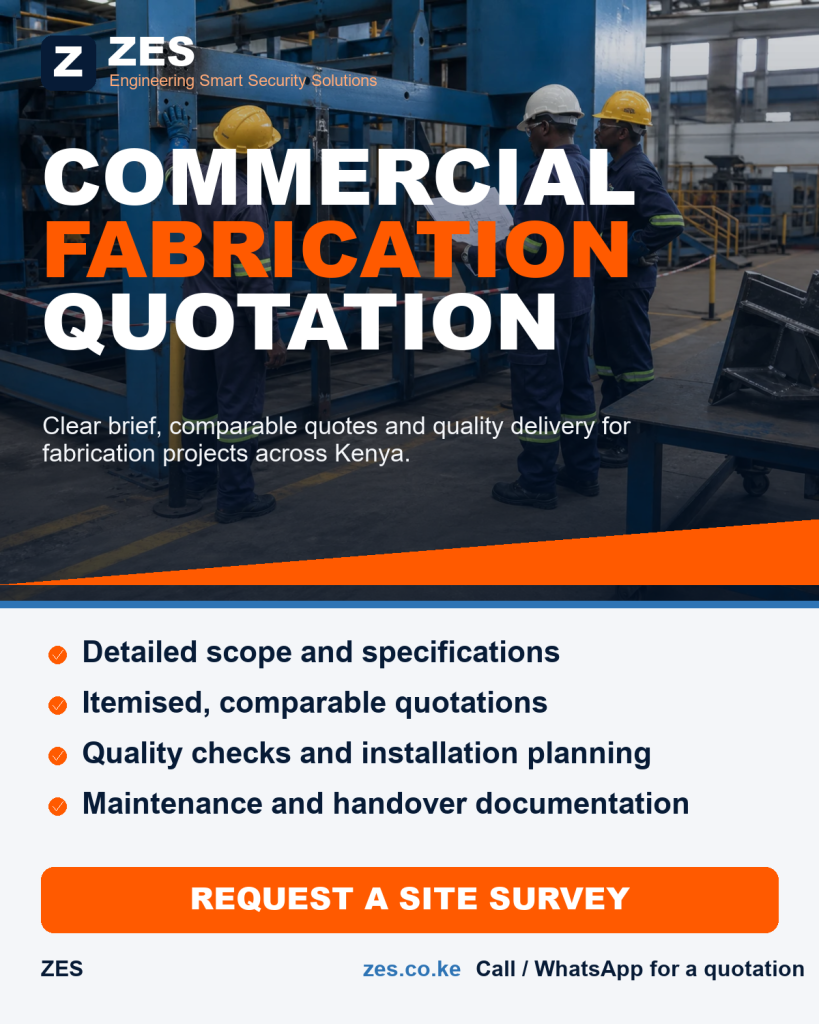
A fabrication project can succeed or fail long before any steel is cut. The difference is usually the quality of the brief and the quotation. When the brief is vague, suppliers quote different things, comparisons become meaningless and the cheapest price often hides the biggest risk. When the brief is clear, quotations become comparable, quality can be checked and surprises are reduced.
This guide explains how to request a commercial fabrication quotation properly. It covers what to include in the brief, how to compare quotations, the quality checks that should happen during fabrication, how to plan installation, how to plan maintenance, and the documentation you should expect at handover.
It is written for procurement officers, project managers, business owners, facility managers and anyone responsible for buying fabrication work in Kenya.
Why a Good Brief Matters
A fabrication quotation is only as good as the information it is based on.
Comparable quotations. When suppliers quote the same scope and specification, you can compare properly.
Fewer variations. Clear drawings and specifications reduce changes after work starts.
Better quality. Suppliers understand the standard expected.
Realistic timelines. A clear brief allows a realistic programme.
Fewer disputes. Written expectations reduce disagreements.
Better value. You pay for what you need, not for guesses.
Safer projects. Clear requirements reduce shortcuts.
A little time spent on the brief saves far more time and money later.
What to Include in a Fabrication Brief
A strong fabrication brief covers several elements.
Scope of Works
Describe what is required: items, quantities, sizes and purpose. Be specific. "Stainless tables" is not a scope; "six stainless steel work tables, 1800 × 700 × 900 mm, with undershelf and adjustable feet" is.
Drawings
Provide dimensional drawings where available. If you do not have drawings, ask the fabricator to produce them for approval. Include any architectural, structural or services drawings that affect the work.
Materials and Finishes
Specify grade, thickness and finish. For stainless, state 304 or 316. For structural steel, state sections and coatings. For food areas, state hygiene requirements.
Performance Requirements
State load capacities, hygiene requirements, durability expectations and any standards that apply.
Site Conditions
Describe access, floor condition, available power and water, and any restrictions. Site conditions affect cost and programme.
Installation Requirements
State whether installation is required, who is responsible for services, and any phasing or access constraints.
Timeline
State required delivery and installation dates, and any milestones.
Quality and Documentation
State inspection requirements, documentation expectations and warranties.
Budget
If you have a budget range, say so. It helps suppliers propose suitable solutions rather than over- or under-specifying.
Evaluation Criteria
If this is a tender, state how quotations will be evaluated.
A complete brief makes the quotation process much more effective.
How to Compare Fabrication Quotations
Quotations can look similar but differ enormously in what they include.
Itemisation. Does the quotation break down materials, fabrication, finishing, delivery and installation?
Specifications. Does it state grade, thickness, finish and hardware?
Assumptions. What has the supplier assumed about the site and services?
Exclusions. What is not included? This is where surprises hide.
Quantities. Are the quantities correct?
Load ratings. For structural or storage work, are load capacities stated?
Programme. Is the timeline realistic and clearly stated?
Warranty. What is covered and for how long?
Payment terms. Are milestones reasonable?
Documentation. What drawings, certificates and manuals will be provided?
Support. What maintenance or after-sales support is offered?
A low total with vague specifications is rarely the best value. A slightly higher quote with clear scope and quality is usually safer.
Common Quotation Traps
Buyers should watch for common problems.
Vague specifications. "Stainless steel" without grade or thickness.
Missing items. Excluding installation, delivery or protective finishes.
Understated quantities. Assuming fewer items than required.
No load ratings. Especially for structural or storage work.
Optimistic timelines. Promising delivery before design is complete.
Hidden extras. Charging for drawings, commissioning or protection separately.
No warranty. Or a warranty that excludes the most likely failures.
No documentation. Leaving you without drawings or certificates.
Pressure tactics. Urging a quick decision to avoid proper review.
No references. A supplier who cannot show comparable work is a risk.
Asking questions about these points quickly separates serious suppliers from casual ones.
Quality Checks During Fabrication
Quality should be checked during the work, not only at the end.
Material verification. Confirm grade and thickness against the specification.
Dimensional checks. Verify sizes and fit against drawings.
Weld inspection. Check continuity, profile and finish.
Heat control. Confirm distortion is controlled, especially on stainless.
Finishing. Check grinding, polishing and passivation where required.
Hygiene details. Check for crevices, seams and sharp edges in food areas.
Load and stability. Confirm structural items are adequately supported.
Trial assembly. Verify fit before delivery where practical.
Documentation. Record inspections and corrections.
Hold points. Agree in advance when you will inspect before work continues.
Hold points are especially useful for structural, food and safety-critical work.
Installation Planning
Installation is where fabrication meets the building.
Sequencing. Coordinate equipment with civil, electrical, plumbing and ventilation work.
Access. Confirm delivery routes, door widths, lifts and storage.
Services. Confirm power, water, drainage, gas and ventilation are ready.
Phasing. Plan work around operations, school terms or production schedules.
Safety. Plan hot work, working at height and lifting.
Protection. Protect finished surfaces and surrounding areas.
Commissioning. Agree how equipment and services will be tested.
Handover. Confirm documentation, training and sign-off.
Poor installation planning causes rework, damage and delays.
Maintenance Planning
Fabrication should be planned with maintenance in mind.
Access for cleaning. Equipment should be cleanable and inspectable.
Access for repair. Components should be reachable.
Replaceable parts. Legs, feet, shelves, guards and castors should be replaceable.
Standard components. Simplify spares and repairs.
Protective finishes. Choose finishes suited to the environment to reduce maintenance.
Maintenance schedule. Agree inspection intervals.
Documentation. Provide drawings and asset information.
Support. Agree who will carry out maintenance.
Budget. Include maintenance in the whole-life cost.
Buying with maintenance in mind reduces long-term cost.
Tender and Procurement Process
For larger projects, a structured procurement process is advisable.
Prepare documents. Scope, drawings, specifications and bill of quantities.
Set evaluation criteria. Price, quality, experience and references.
Invite quotations. Give suppliers enough time to prepare properly.
Answer questions. Share clarifications with all bidders.
Evaluate. Compare on specification and total cost, not headline price.
Clarify. Ask suppliers to explain assumptions and exclusions.
Award. Confirm scope, programme and payment terms in writing.
Monitor. Check quality and progress against the contract.
Accept. Inspect and sign off before final payment.
A structured process protects both buyer and supplier.
Documentation and Handover
Documentation is part of the deliverable.
Drawings. Approved layout and shop drawings.
Material certificates. Evidence of grade and thickness.
Inspection records. Weld, dimensional and hygiene checks.
Test results. For load, drainage, ventilation or other performance requirements.
Operation and maintenance information. Cleaning, use and maintenance guidance.
Asset register. List of items with locations and specifications.
Warranty documents. Coverage and terms.
Training records. Who was trained and when.
Handover sign-off. Confirmation that the work is accepted.
Good documentation supports audits, maintenance and future projects.
Writing a Detailed Scope of Works
The scope of works is the heart of the brief. A good scope is specific, measurable and complete.
List every item. Tables, sinks, racks, frames, guards, structures — each with quantity.
State dimensions. Length, width, height, thickness and spacing.
Describe configuration. Shelves, drawers, castors, backsplash, sink bowls.
Specify materials. Grade, thickness and finish.
State performance. Load ratings, hygiene requirements, durability.
Describe installation. What is included and what is excluded.
State the site. Location, access and conditions.
State the timeline. Delivery, installation and completion dates.
State documentation. Drawings, certificates and manuals.
State acceptance. How the work will be inspected and accepted.
A scope that leaves room for interpretation will produce quotations that cannot be compared.
Specifying Materials and Finishes
Material and finish specifications prevent cost-cutting.
Stainless steel. State grade (304 or 316) and thickness. State whether surfaces are brushed, polished or passivated.
Mild steel. State sections, thickness and protective coating.
Galvanising. State whether hot-dip galvanising is required and to what standard.
Powder coating. State colour, finish and surface preparation.
Paint systems. State primer and topcoats.
Fixings. State material and corrosion resistance.
Hardware. State brand or performance requirements for hinges, locks, castors and drawers.
Hygiene. State cleanability, weld finish and food-contact requirements.
Vague material specifications are the most common source of disappointment.
Understanding Pricing Structures
Fabrication quotations can be priced in different ways.
Lump sum. A single price for the whole scope. Simple, but requires a clear scope.
Itemised pricing. A price per item, which supports comparison and variations.
Rate-based pricing. A rate per kilogram, per metre or per hour. Common for structural work, but can be opaque.
Cost-plus. Materials plus labour plus margin. Uncommon for standard fabrication.
Milestone payments. Payments linked to design, fabrication, delivery and installation.
Retention. A portion withheld until defects are corrected.
Escalation clauses. Adjustments for material price changes.
Taxes and delivery. Confirm whether prices include VAT, transport and installation.
Understanding the pricing structure helps you compare fairly and manage variations.
Managing Variations
Changes during fabrication are expensive. Manage them carefully.
Written instructions. All changes should be documented.
Impact assessment. Assess cost and time impact before proceeding.
Approval. Obtain approval before work proceeds.
Records. Keep a variation register.
Drawings. Update drawings to reflect changes.
Quality. Ensure variations do not compromise quality or safety.
Communication. Keep all parties informed.
Final account. Reconcile variations at completion.
Good variation management prevents disputes and cost overruns.
Contract Terms and Warranties
A clear contract protects both parties.
Scope and specifications. Attached to the contract.
Programme. Start and completion dates, and any milestones.
Payment terms. Amounts, timing and conditions.
Variations. How changes are handled.
Quality and inspection. Standards and acceptance criteria.
Defects liability. Period and process for correcting defects.
Warranty. Coverage, duration and exclusions.
Insurance. Liability and site insurance.
Safety. Responsibilities and compliance.
Termination. Conditions and consequences.
Dispute resolution. Process for resolving disagreements.
Read the terms before signing, and ask for clarification where needed.
Site Inspection Before Quotation
A site inspection improves accuracy and reduces risk.
Measurements. Confirm actual dimensions and obstructions.
Access. Check delivery routes, door widths and lifting.
Services. Confirm power, water, drainage and ventilation.
Floor condition. Check levelness, strength and drainage.
Existing structures. Check what the new work must connect to.
Restrictions. Note working hours, noise limits and access controls.
Photos. Record conditions for reference.
Report. Ask the supplier to document what they observed.
A quotation based on a site inspection is far more reliable than one based on assumptions.
Evaluating Supplier Capability
Price is only one factor. Capability matters.
Experience. Similar projects and sectors.
Workshop capacity. Can they deliver on time?
Engineering. Can they design and calculate?
Quality systems. Inspection and documentation.
Safety record. Practices and training.
References. Ask for contacts and examples.
Financial stability. Can they complete the work?
Support. Maintenance and after-sales.
Communication. Responsiveness and clarity.
Insurance. Adequate cover.
A capable supplier may not be the cheapest, but is usually the better value.
Preparing a Bill of Quantities
A bill of quantities makes pricing and comparison easier.
Item description. Clear description of each item.
Unit. Number, metre, kilogram or set.
Quantity. Accurate quantities.
Specification reference. Link to the specification.
Unit rate. Price per unit.
Total. Quantity multiplied by unit rate.
Notes. Assumptions or exclusions.
Summary. Total project cost.
A bill of quantities also helps manage variations and final accounts.
Clarifying Questions to Ask Suppliers
Ask these questions before awarding work.
What is included and excluded? Confirm the full scope.
What grade and thickness will you use? Confirm the specification.
How will you inspect quality? Confirm the quality process.
Who will install? Confirm responsibility.
What is the programme? Confirm dates and milestones.
What happens if there are variations? Confirm the process.
What warranty do you provide? Confirm terms.
What documentation will you provide? Confirm drawings and certificates.
Can you provide references? Confirm comparable work.
What are your payment terms? Confirm the schedule.
Clear answers indicate a professional supplier.
Quality Assurance Plan for Fabrication
A quality assurance plan sets out how quality will be controlled.
Responsibilities. Who is responsible for each check.
Hold points. When work pauses for inspection.
Inspection criteria. What is acceptable.
Testing. What tests are required.
Records. What evidence will be kept.
Non-conformance. How problems are handled.
Corrective action. How issues are resolved.
Final inspection. Acceptance before handover.
Review. Lessons learned for future projects.
A quality plan is particularly valuable for structural, food and safety-critical work.
Handover, Training and After-Sales
Handover is the transition from project to operation.
Inspection. Walk through the work and confirm acceptance.
Snagging. List and correct defects.
Training. Show staff how to use, clean and maintain the work.
Documentation. Provide drawings, certificates and manuals.
Asset register. Record the new assets.
Warranty. Explain coverage and how to make a claim.
Support. Provide contact details for maintenance.
Review. Check performance after a period of use.
Good handover reduces operational problems and builds trust.
Sustainability and Whole-Life Cost
The cheapest quotation is rarely the lowest whole-life cost.
Durability. Longer-lasting work reduces replacement costs.
Maintenance. Designs that are easy to maintain cost less over time.
Energy. Efficient equipment and processes reduce operating costs.
Materials. Recyclable and responsibly sourced materials matter.
Repairability. Designs that can be repaired extend life.
Waste. Good design reduces waste during fabrication and use.
Whole-life cost. Consider purchase, installation, maintenance and replacement.
Value. Balance cost with performance and lifespan.
Buying for whole-life value protects the organisation's budget over time.
Frequently Asked Questions
What should a fabrication quotation include?
It should include itemised materials, fabrication, finishing, delivery, installation, commissioning, documentation and warranty, with clear specifications and exclusions.
Should I provide drawings or let the fabricator design?
Either can work. If you provide drawings, confirm they are accurate. If the fabricator designs, review and approve the drawings before fabrication.
How do I compare quotations fairly?
Compare the same scope and specification, check exclusions and assumptions, and evaluate total cost and quality rather than headline price.
What quality checks should I expect?
Material verification, dimensional checks, weld inspection, finishing checks, hygiene details where relevant, and documentation.
Who should inspect the work?
Someone competent to assess the work, or an independent inspector for critical projects.
How do I plan installation?
Coordinate services, access, phasing and safety, and agree commissioning and handover requirements.
What maintenance information should I receive?
Drawings, cleaning guidance, spare parts information, inspection intervals and warranty details.
Can you provide a quotation after a site visit?
Yes. A site visit allows accurate measurement and a more reliable quotation.
Do you work outside Nairobi?
Yes. Fabrication and installation can be arranged across Kenya.
How long does a quotation take?
It depends on the scope and drawings. Simple items can be quoted quickly; complex projects need design and assessment.
A Final Pre-Purchase Checklist
Before requesting a commercial fabrication quotation, confirm the following. Prepare a clear scope with quantities and sizes. Provide or request drawings. Specify materials, finishes and performance requirements. Describe site conditions and installation needs. State the timeline and any phasing. Ask for itemised pricing and exclusions. Confirm quality checks and documentation. Ask about maintenance and warranty. Compare quotations against the same specification. Finally, confirm the programme and payment terms in writing.
A supplier who answers these points clearly is usually the one worth trusting.
Conclusion
A good fabrication quotation is the result of a good brief. The difference between a smooth project and a difficult one is the clarity of the scope, the specification, the drawings, the quality checks, the installation planning and the maintenance plan.
If you are buying fabrication work, start with a clear brief. Then insist on comparable quotations, documented quality, proper installation and maintenance information.
ZES provides fabrication, welding, installation and maintenance for commercial and institutional clients across Kenya. If you would like a practical assessment and a clear, itemised quotation, start with a site survey.