
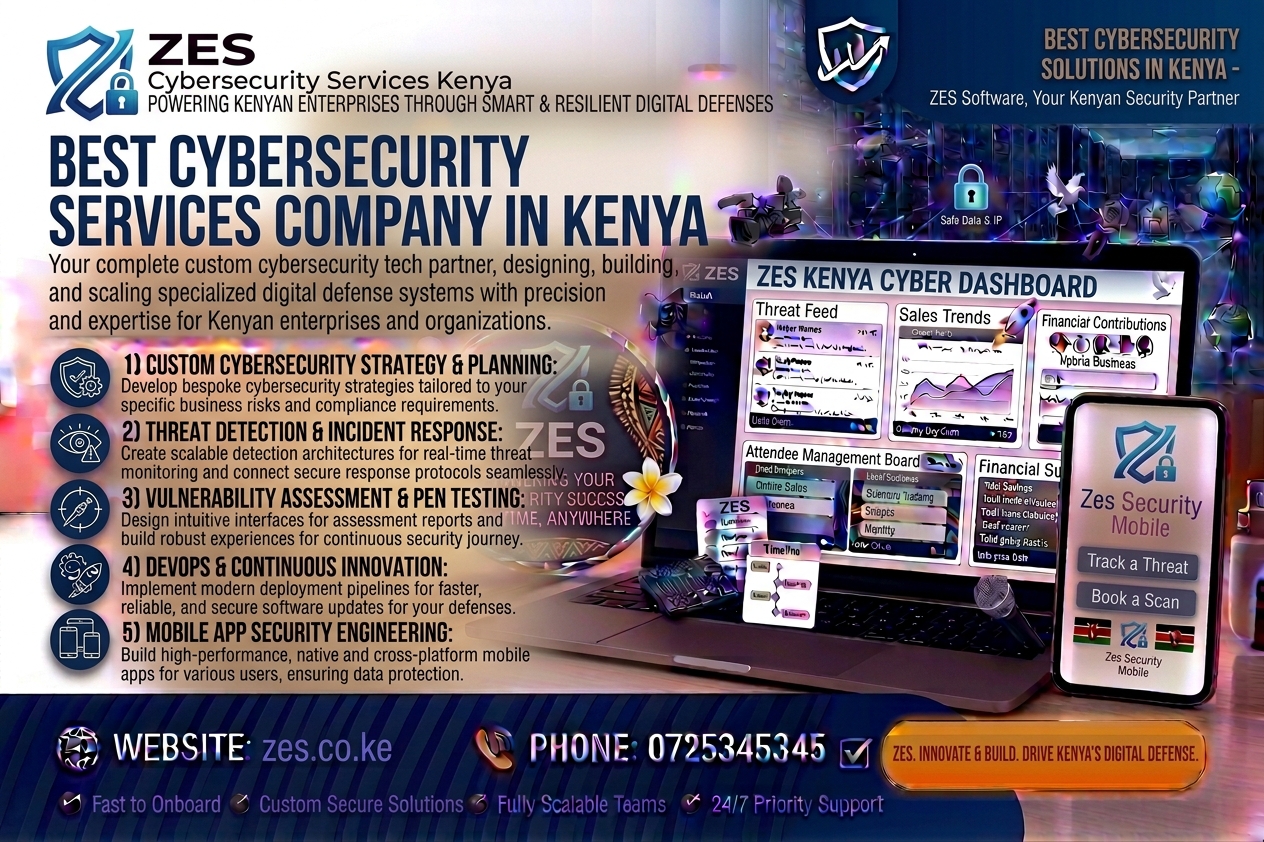
 Cybersecurity services Kenya are becoming increasingly important as businesses depend more heavily on computers, internet connectivity, cloud applications, digital payments, business software, websites, CCTV systems, access-control systems and connected devices.
A modern business can no longer treat cybersecurity as an optional IT expense. A single compromised account, unsecured network, stolen password or poorly protected device can create operational disruption, financial losses and reputational damage.
For Kenyan businesses, institutions, property managers, retailers, schools, offices, factories and other organizations, effective protection requires more than installing antivirus software. Businesses need a structured approach that combines secure networks, controlled access, monitoring, reliable infrastructure, user awareness, backups, system maintenance and appropriate security technologies.
ZES provides technology and security solutions in Kenya, including access control, CCTV surveillance, IT and network infrastructure, server and IT infrastructure, intercom and visitor systems, alarms, and support and maintenance. Businesses can explore the broader ZES security and technology solutions when planning a security infrastructure project.
This guide explains what cybersecurity services Kenya businesses need, why cybersecurity matters, how organizations can strengthen their technology environments, and how professional security and IT infrastructure can contribute to a safer business operation.
Table of Contents
- What Are Cybersecurity Services Kenya?
- Why Cybersecurity Services Kenya Matter
- Common Cybersecurity Threats Facing Kenyan Businesses
- Network Security and Cybersecurity Services Kenya
- Access Control and Cybersecurity
- CCTV and Physical Security
- Server and IT Infrastructure Security
- Employee Security Awareness
- Data Protection and Backup
- Cybersecurity Risk Assessment
- Cybersecurity Services Kenya for Small Businesses
- Cybersecurity Services Kenya for Large Organizations
- Cybersecurity Services Kenya for Schools
- Cybersecurity Services Kenya for Retail Businesses
- Cybersecurity Services Kenya for Property Managers
- Cybersecurity Services Kenya for Logistics Companies
- Cybersecurity Services Kenya for Farms and Agribusiness
- Choosing a Cybersecurity Provider in Kenya
- Benefits of Professional Cybersecurity Services Kenya
- Cybersecurity Best Practices
- Frequently Asked Questions
- Conclusion
What Are Cybersecurity Services Kenya?
Cybersecurity services Kenya refers to professional services, technologies and processes designed to protect an organization’s computers, networks, applications, devices, information and digital operations from unauthorized access, disruption, manipulation and other cyber risks.
Cybersecurity is broader than antivirus software.
A complete security strategy can involve:
- Network protection
- Firewall configuration
- Secure Wi-Fi
- Password management
- User access controls
- Multi-factor authentication
- Endpoint protection
- Server security
- Data backups
- Security monitoring
- CCTV surveillance
- Physical access control
- Visitor management
- System maintenance
- Security assessments
- Employee awareness
- Incident response planning
Organizations looking for cybersecurity services Kenya should therefore consider both digital and physical security.
A business may have a strong password policy but still face significant risk if unauthorized people can enter the server room.
Similarly, an organization may have CCTV cameras but still have vulnerable computers connected to an unsecured network.
Good security connects these different layers.
ZES focuses on integrated technology and security infrastructure, including biometric systems, access control, CCTV, IT and network infrastructure and related support services. Explore ZES solutions for a broader view of available technology and security systems.
Why Cybersecurity Services Kenya Matter
The growth of digital business has created new opportunities for organizations across Kenya.
Businesses use digital systems to:
- Receive payments
- Manage customers
- Store documents
- Communicate with employees
- Process orders
- Manage inventory
- Run websites
- Access cloud applications
- Manage accounting
- Track deliveries
- Monitor buildings
- Control employee access
This dependence also creates risks.
Effective cybersecurity services Kenya help businesses identify vulnerabilities and introduce controls before security problems become major incidents.
Cybersecurity can protect:
Business Information
Companies may store customer details, employee information, financial records, contracts and internal documents.
Unauthorized access to such information can create serious business problems.
Business Continuity
If computers or networks become unavailable, employees may not be able to perform their normal responsibilities.
Security planning can reduce avoidable interruptions.
Customer Trust
Customers expect businesses to handle their information responsibly.
Strong security practices can support confidence in a company.
Physical Infrastructure
Servers, networking equipment, offices and restricted areas also require protection.
This is why modern security increasingly combines digital controls with physical security systems.
Common Cybersecurity Threats Facing Kenyan Businesses
Organizations searching for cybersecurity services Kenya should first understand the threats they are trying to prevent.
Phishing
Phishing messages attempt to trick users into revealing passwords, payment information or other sensitive details.
A message may appear to come from a colleague, supplier, bank or service provider.
Employees should be trained to recognize suspicious links and unexpected requests.
Weak Passwords
Simple passwords can expose accounts to unauthorized access.
Organizations should encourage strong, unique passwords and additional authentication controls where appropriate.
Malware
Malware can affect computers and systems in different ways.
Businesses should maintain appropriate endpoint protection and keep software updated.
Ransomware
Ransomware can prevent users from accessing files and systems.
Reliable backups and recovery procedures are therefore important components of business resilience.
Unauthorized Access
Unauthorized people may attempt to access offices, server rooms, equipment areas or restricted systems.
This is where physical access control becomes part of a broader security strategy.
Unsecured Networks
Poorly configured networks can create unnecessary security risks.
Network design should consider user access, devices, segmentation, Wi-Fi security and administrative controls.
Insider Risks
Security problems can also arise from mistakes or misuse by people who already have legitimate access.
Role-based permissions can help reduce unnecessary access to sensitive resources.
Network Security and Cybersecurity Services Kenya
Network security is one of the most important areas of cybersecurity services Kenya.
Every organization with computers, Wi-Fi, servers, printers, cameras or other connected devices should consider how its network is designed and protected.
A professional network security approach can include:
- Secure routers
- Firewall controls
- Network segmentation
- Secure Wi-Fi
- Access permissions
- Device management
- Monitoring
- Software updates
- Secure administration
- Network documentation
Businesses should also know which devices are connected to their networks.
For example, an organization might have:
- Office computers
- Staff smartphones
- Printers
- CCTV cameras
- Biometric attendance devices
- Access-control systems
- Servers
- POS systems
- Wi-Fi access points
- IoT devices
Every connected device should be considered when designing a secure environment.
ZES provides IT and network infrastructure solutions alongside security technologies, making infrastructure planning an important part of an organization’s wider security strategy.
Access Control and Cybersecurity
Access control is an important component of cybersecurity services Kenya because physical access can affect digital security.
Consider a server room containing critical networking equipment.
If unauthorized people can enter the room, they may be able to interfere with equipment even if the organization’s digital systems are well protected.
Modern access-control systems can help businesses manage who is allowed into specific areas.
Possible technologies include:
- Biometric access
- Card access
- PIN-based access
- Door controllers
- Visitor management
- Restricted-area controls
- Access records
ZES provides access control systems in Kenya designed around doors, offices, server rooms, warehouses, apartments and other controlled areas.
A well-designed access-control system can help organizations establish clearer physical security policies.
CCTV and Physical Security
CCTV surveillance can complement cybersecurity services Kenya by protecting the physical environment where technology and people operate.
Cameras can provide visibility around:
- Offices
- Warehouses
- Server rooms
- Entrances
- Parking areas
- Retail premises
- Industrial facilities
- Apartment buildings
- Reception areas
CCTV should not be treated as a replacement for cybersecurity.
Instead, it can form part of a layered security strategy.
For example, an organization may use:
Firewall + network controls + user authentication + access control + CCTV + monitoring + backups
This layered approach is stronger than relying on one technology.
ZES offers CCTV surveillance and security solutions as part of its broader technology and security capability.
Server and IT Infrastructure Security
Organizations investing in cybersecurity services Kenya should pay attention to server infrastructure.
Servers may host:
- Databases
- Business applications
- Websites
- File storage
- Internal applications
- Authentication services
- Reporting systems
- Communication platforms
A server environment should be protected through appropriate administrative access, physical security, software updates, backups and monitoring.
Server rooms should also be controlled.
Businesses can combine:
- Access control
- CCTV
- Environmental monitoring
- Secure network design
- Backup systems
- Controlled administrative permissions
The objective is to reduce opportunities for unauthorized access while improving visibility and resilience.
Employee Security Awareness
Technology alone cannot eliminate every security risk.
Employees are an important part of cybersecurity services Kenya because users interact with email, websites, applications, files and devices every day.
Security awareness training can cover:
- Identifying phishing emails
- Creating strong passwords
- Avoiding suspicious downloads
- Protecting company devices
- Reporting unusual activity
- Using public Wi-Fi carefully
- Protecting business information
- Following access-control procedures
- Recognizing social engineering attempts
Training should be practical.
Instead of simply telling employees to “be secure,” organizations should explain what suspicious activity looks like and what employees should do when they encounter it.
Data Protection and Backup
Data is one of the most valuable assets in many organizations.
Businesses should consider how information is:
- Created
- Stored
- Accessed
- Shared
- Backed up
- Retained
- Deleted
Reliable backups are particularly important.
A backup should not simply exist. Organizations should also understand how quickly they can restore important systems and information after an incident.
Businesses should periodically test their recovery procedures.
For companies operating business applications, platforms such as Zivo demonstrate how Kenyan businesses are increasingly moving financial and operational workflows into digital systems.
As digital records increase, protecting the infrastructure around those systems becomes increasingly important.
Cybersecurity Risk Assessment
A risk assessment is a useful starting point for cybersecurity services Kenya.
The organization should identify:
- What systems are being used?
- What information is sensitive?
- Who has access?
- Which devices connect to the network?
- Which areas require physical access restrictions?
- Where are backups stored?
- What happens if a server fails?
- What happens if an employee account is compromised?
- What security systems are already installed?
- Which weaknesses require immediate attention?
A risk assessment helps organizations prioritize investment.
Not every company needs exactly the same security setup.
A small office may require a different approach from a bank, factory, school, warehouse or large property complex.
Cybersecurity Services Kenya for Small Businesses
Small businesses sometimes assume that cybercriminals only target large organizations.
That assumption can be dangerous.
Small companies may still have:
- Customer databases
- M-Pesa information
- Email accounts
- Websites
- Accounting systems
- POS systems
- Employee records
- Business documents
Professional cybersecurity services Kenya can help small businesses establish a strong security foundation without implementing unnecessarily complicated systems.
A small business can begin with:
- Secure Wi-Fi
- Strong passwords
- MFA
- Regular updates
- Antivirus protection
- Backups
- Access controls
- Employee training
- Firewall configuration
- Basic security policies
As the organization grows, its security infrastructure can grow with it.
For example, a retail business using Vega POS may have computers, payment workflows, customer information and network-connected equipment that should be included in its broader technology security planning.
Cybersecurity Services Kenya for Large Organizations
Large organizations have more users, devices, departments and locations.
This makes security management more complex.
Large organizations may require:
- Multi-site networking
- Centralized access management
- Role-based permissions
- Advanced monitoring
- Server security
- CCTV integration
- Biometric systems
- Visitor management
- Network segmentation
- Security policies
- Incident response procedures
Professional cybersecurity services Kenya can help large organizations create security processes that are easier to manage across multiple departments and locations.
Documentation is especially important.
Organizations should maintain records of important systems, equipment, access privileges and security procedures.
Cybersecurity Services Kenya for Schools
Schools increasingly depend on technology.
They may use:
- Computers
- Student information systems
- Wi-Fi
- Digital learning platforms
- Staff email
- CCTV
- Biometric attendance
- Access-control systems
Schools therefore need appropriate cybersecurity services Kenya to protect systems while allowing legitimate users to access the resources they need.
Access control can be particularly useful for schools.
Different areas may require different permissions for:
- Students
- Teachers
- Administrators
- Visitors
- Contractors
Organizations using education-management platforms should also consider account security and role-based access.
For example, Wito provides event, ticketing, RSVP, check-in and contribution workflows that demonstrate how organizations are increasingly using online systems for operational activities.
Cybersecurity Services Kenya for Retail Businesses
Retail businesses handle payments, inventory, staff accounts and customer information.
A retail environment may contain:
- POS terminals
- Computers
- Routers
- Wi-Fi
- CCTV cameras
- Staff devices
- Printers
- Payment systems
This makes cybersecurity services Kenya relevant to both digital and physical retail security.
Businesses should control access to POS systems and administrative accounts.
CCTV can also help monitor entrances, checkout areas and stock rooms.
Retailers can explore Vega POS for retail sales and stock management while ensuring that the underlying computers, network and physical premises are appropriately secured.
Cybersecurity Services Kenya for Property Managers
Property management companies increasingly depend on digital systems to manage tenants, rent, maintenance, records and communication.
A property may also use:
- CCTV
- Access control
- Intercom systems
- Visitor management
- Wi-Fi
- Servers
- Security gates
This creates an environment where physical and digital security overlap.
Cybersecurity services Kenya can help property managers think about the security of both their technology and physical infrastructure.
Platforms such as KayaPro360 provide digital property-management workflows, including property, tenant, maintenance and reporting functions.
Property managers should therefore consider account permissions, secure access, backups and physical protection for technology equipment.
Cybersecurity Services Kenya for Logistics Companies
Logistics companies rely on digital systems for dispatch, customer information, payments, tracking and communication.
A courier company may operate:
- Driver accounts
- Customer accounts
- Dispatch systems
- Smartphones
- Tracking systems
- Payment systems
- Office networks
- Computers
This makes cybersecurity services Kenya important for maintaining operational continuity.
A courier platform such as Dexa is designed around courier and driver operations, including customer orders, riders, tracking, payments, receipts and proof of delivery.
The security of the surrounding infrastructure should also be considered.
Companies should protect employee accounts, office networks, mobile devices and administrative systems.
Cybersecurity Services Kenya for Farms and Agribusiness
Agribusinesses are becoming increasingly digital.
Modern farms may use software for:
- Crop records
- Livestock records
- Stock
- Machinery
- Staff
- Sales
- Accounting
- Reporting
FAMA provides a farm management platform for operational and financial farm records.
As organizations digitize farm operations, they should also consider account security, access permissions, backups and device security.
This illustrates a broader principle: cybersecurity is relevant anywhere digital information is being used.
Choosing a Cybersecurity Provider in Kenya
When evaluating cybersecurity services Kenya, businesses should avoid choosing a provider based solely on price.
Consider the following factors.
Technical Experience
Does the provider understand networks, servers, security systems and business infrastructure?
Site Assessment
Can the provider inspect the organization’s actual environment before recommending a solution?
Security Integration
Can digital and physical security systems work together where appropriate?
Scalability
Can the solution expand as the organization grows?
Support
Is technical support available after installation?
Documentation
Will the organization understand what was installed and how it should be managed?
Maintenance
Security systems require ongoing attention.
A provider should explain maintenance and support requirements clearly.
ZES provides security and technology solutions with consultation, site assessment, design, installation, configuration, testing, training and support capabilities. See the ZES security and life-safety service.
Benefits of Professional Cybersecurity Services Kenya
Investing in cybersecurity services Kenya can provide several business benefits.
1. Better Risk Awareness
Organizations understand their vulnerabilities more clearly.
2. Improved Access Control
Businesses can better control who enters restricted physical and digital environments.
3. Stronger Network Protection
Secure network infrastructure reduces avoidable weaknesses.
4. Better Business Continuity
Backups, maintenance and recovery planning can reduce disruption.
5. Improved Accountability
Access records and monitoring can make it easier to investigate incidents.
6. Greater Customer Confidence
Businesses can demonstrate that security is taken seriously.
7. Better Operational Control
Integrated security infrastructure can provide management with greater visibility.
8. Scalable Security
Organizations can build security systems that expand alongside the business.
Cybersecurity Best Practices for Kenyan Businesses
Regardless of company size, businesses can follow several practical cybersecurity services Kenya principles.
Use Strong Passwords
Every employee should have unique credentials for important systems.
Enable Multi-Factor Authentication
MFA can add another layer of protection to supported accounts.
Update Software
Security updates should be installed promptly where appropriate.
Secure Wi-Fi
Business Wi-Fi should use strong authentication and appropriate administrative controls.
Limit Access
Employees should receive the permissions required for their responsibilities.
Protect Servers
Servers should have appropriate physical and technical security controls.
Maintain Backups
Critical business data should have reliable backup arrangements.
Train Employees
Staff should understand common security risks.
Monitor Systems
Organizations should know when unusual activity occurs.
Secure Physical Areas
Server rooms, network cabinets and restricted areas should not be freely accessible.
Review Security Regularly
Security should be treated as an ongoing process rather than a one-time installation.
Integrating Physical and Digital Security
One of the most important developments in modern business security is the convergence of physical and digital systems.
For example, an organization may combine:
Biometric attendance + access control + CCTV + secure networking + server infrastructure + user permissions
This creates multiple security layers.
ZES provides solutions covering biometric attendance, access control, CCTV surveillance, IT and network infrastructure, server and IT infrastructure, intercom, visitor and alarm systems, and maintenance support. View the complete ZES solutions range.
This integrated approach is useful because cybersecurity does not exist separately from the physical environment.
A compromised server room, unsecured network cabinet or uncontrolled visitor area can create security risks even when software protections are strong.
How Businesses Can Start Improving Cybersecurity
Organizations considering cybersecurity services Kenya do not need to transform their entire technology environment overnight.
A practical starting process is:
Step 1: Identify Important Systems
List computers, servers, applications, network equipment, cameras, access systems and other connected devices.
Step 2: Identify Sensitive Information
Determine which data requires stronger protection.
Step 3: Review User Access
Check who can access important systems and information.
Step 4: Inspect Physical Security
Review server rooms, network cabinets, offices, entrances and restricted areas.
Step 5: Review Network Security
Identify weaknesses in Wi-Fi, routers, switches, firewalls and connected devices.
Step 6: Check Backups
Confirm that important information can be recovered.
Step 7: Train Staff
Explain common security risks.
Step 8: Create an Improvement Plan
Prioritize the most important weaknesses.
Step 9: Implement Security Solutions
Work with qualified technical professionals where specialist installation or configuration is required.
Step 10: Maintain the Environment
Cybersecurity requires continuous review.
Cybersecurity and the Wider Kenyan Technology Ecosystem
Modern businesses rarely operate using a single software platform.
A company may use different systems for:
- Sales
- Property management
- Finance
- Events
- Agriculture
- Delivery
- Connectivity
- Websites
- Employee management
For example, RentalDesk focuses on property rental operations, while Pawa WiFi provides Wi-Fi and MikroTik billing functionality.
Businesses using multiple digital systems should consider how accounts, devices, networks and data interact.
Other technology businesses serving Kenyan organizations include Zama, ZamaCore, Dereva, SpaceKits, Wito, FAMA, Zivo and Kenya Website Experts.
Each platform addresses different operational requirements, but the common lesson is clear: as businesses digitize more processes, technology security becomes increasingly important.
Why Businesses Should Combine Security With IT Infrastructure
A strong cybersecurity strategy should not be isolated from IT infrastructure planning.
Network equipment, servers, access points, CCTV cameras, biometric devices and access-control systems all depend on reliable infrastructure.
Cybersecurity services Kenya therefore work best when organizations consider:
- Power
- Networking
- Physical security
- Connectivity
- Hardware
- Software
- Access permissions
- Maintenance
- Backups
- User training
This approach helps businesses avoid implementing disconnected systems that are difficult to maintain.
A professional assessment can help determine which technologies are actually appropriate for a specific site.
The Future of Cybersecurity Services Kenya
The Kenyan business environment is becoming increasingly digital.
More businesses are using:
- Cloud software
- Mobile applications
- Digital payments
- Online stores
- SaaS platforms
- Remote collaboration
- Connected devices
- Smart security systems
- Digital customer services
As adoption grows, the importance of cybersecurity services Kenya will continue to increase.
Businesses will need to think beyond traditional antivirus software.
Future security strategies are likely to place greater emphasis on identity, access management, network visibility, device security, automation, monitoring, physical security and resilience.
The organizations that prepare early can establish stronger foundations for sustainable digital growth.
Frequently Asked Questions About Cybersecurity Services Kenya
What are cybersecurity services Kenya?
Cybersecurity services Kenya are professional technology and security services designed to help organizations protect computers, networks, systems, accounts, data and connected infrastructure against unauthorized access, disruption and other security risks.
Why do Kenyan businesses need cybersecurity?
Businesses increasingly depend on digital systems, internet connectivity, software and connected devices. Security controls help reduce risks and improve operational resilience.
Does cybersecurity only involve computers?
No. Cybersecurity can involve computers, networks, servers, mobile devices, applications, accounts and information. Physical security can also support cybersecurity by controlling access to technology infrastructure.
Are cybersecurity services useful for small businesses?
Yes. Small businesses can also have valuable customer information, payment systems, websites, email accounts and business records that require protection.
What is network security?
Network security involves protecting an organization’s network infrastructure and connected devices through appropriate controls such as secure Wi-Fi, firewalls, permissions, segmentation and monitoring.
Is CCTV part of cybersecurity?
CCTV is primarily a physical security technology, but it can complement cybersecurity by protecting the physical environment in which servers, networking equipment and other technology operate.
What is access control?
Access control determines who can enter particular physical areas or access specific systems. Technologies can include biometrics, cards, PINs and visitor-management systems.
Why are backups important?
Backups provide a way to recover important information after accidental deletion, hardware failure, security incidents or other disruptions.
How often should cybersecurity be reviewed?
Cybersecurity should be reviewed regularly, especially after major changes to systems, networks, employees, applications or business operations.
Can ZES help with security infrastructure?
ZES provides technology and security solutions including biometric attendance, access control, CCTV surveillance, IT and network infrastructure, server and IT infrastructure, intercom, visitor and alarm systems, and support and maintenance. Businesses can contact ZES to discuss their requirements.
Building Stronger Cybersecurity for Kenyan Businesses
Cybersecurity services Kenya are becoming an essential part of modern business infrastructure.
Organizations now depend on networks, computers, cloud applications, websites, digital payments, mobile devices, servers and connected security systems to operate efficiently.
Protecting these systems requires a layered approach.
Businesses should consider:
- Secure networks
- Strong authentication
- Access control
- CCTV
- Server protection
- Data backups
- Employee awareness
- Physical security
- Monitoring
- Regular maintenance
- Security assessments
The most effective strategy is not necessarily the one with the most technology. It is the one that matches the organization’s actual risks, operating environment, budget and growth plans.
For organizations looking for cybersecurity services Kenya, ZES offers a wider technology and security infrastructure capability covering access control, CCTV, biometrics, IT and network infrastructure, server infrastructure, visitor systems and security-related support.
A secure business starts with understanding the risks.
The next step is assessing the current environment, identifying vulnerabilities and implementing practical controls that protect people, information, systems and physical infrastructure.
If your organization is reviewing cybersecurity services Kenya, visit ZES to explore its technology and security solutions and request a site assessment or quotation.
Recommended Internal and External Resources
- ZES – Technology & Security Solutions
- ZES – Security and Life-Safety Systems
- ZES – IT and Network Infrastructure
- Dexa – Driver and Courier Operations
- Vega POS – Retail Management
- Zivo – Business Finance Platform
- FAMA – Farm Management System
- RentalDesk – Property Management
- KayaPro360 – Property Management
- Pawa WiFi – Wi-Fi Billing
- Dereva – Driver Marketplace
- SpaceKits – Connectivity and Installation
- Wito – Events and Ticketing
- ZamaCore – Software Development
- Kenya Website Experts
SEO Publishing Checklist