
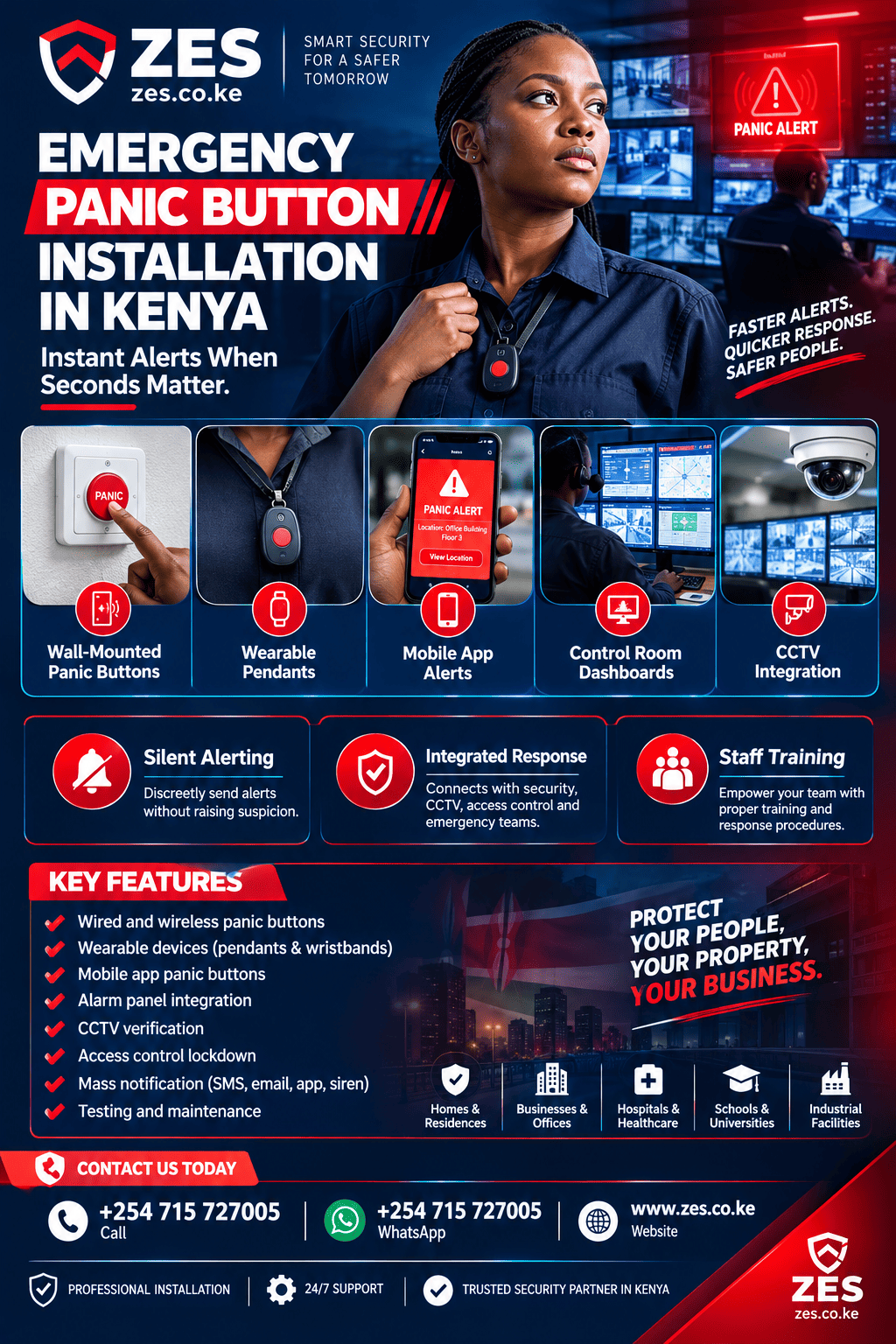
Emergency panic button installation in Kenya has become a core requirement for banks, retail chains, pharmacies, schools, and corporate offices that need a silent, instant way to summon help. At zes.co.ke, we understand that emergency panic button installation in Kenya is not simply about mounting a red button on a wall—it is about designing a duress system that reliably alerts the right people within seconds. Whether you manage a bank branch in Nairobi, a jewellery shop in Mombasa, or a school in Kisumu, emergency panic button installation in Kenya determines how quickly your team can respond when every second counts.
The demand for emergency panic button installation in Kenya has grown sharply as businesses recognise that guards and CCTV alone cannot prevent incidents. Cameras record what happened; panic buttons change what happens next. Proper emergency panic button installation in Kenya ensures that a teller under threat, a pharmacist facing armed robbery, or a receptionist dealing with an aggressive visitor can trigger an alert without alerting the attacker.
At zes.co.ke, we specialise in emergency panic button installation in Kenya across commercial, institutional, and residential settings. Our approach begins with a security assessment that identifies risk points—cash handling areas, reception desks, dispensaries, and isolated offices. From there, emergency panic button installation in Kenya is designed around how your team actually works, not around a generic template.
Why Emergency Panic Button Installation in Kenya Matters
Violent crime and armed robbery remain real risks for many Kenyan businesses. Incidents often unfold in seconds, leaving staff with no time to call for help. A well-designed emergency panic button installation in Kenya provides a covert way to raise an alarm without provoking an attacker. Silent alerts can be sent to a control room, a response team, or the police while the situation is still developing.
Beyond robbery, emergency panic button installation in Kenya supports medical emergencies, fire incidents, and lone-worker safety. Staff working alone in warehouses, clinics, or remote offices need a way to summon assistance. emergency panic button installation in Kenya gives them a lifeline that does not depend on a phone being in reach.
Insurance and compliance considerations also drive demand. Many insurers now ask about duress systems when underwriting commercial policies. Regulators in banking and healthcare expect documented emergency procedures. Professional emergency panic button installation in Kenya provides the documented, tested system that satisfies these requirements.
Types of Panic Buttons Used in Kenya
Several types of devices fall under emergency panic button installation in Kenya. Fixed wall-mounted buttons suit teller counters, reception desks, and cash offices. They are typically wired to an alarm panel and can be labelled or unlabelled depending on the requirement. Fixed buttons are simple, reliable, and easy to use under stress.
Wireless panic buttons offer flexibility where cabling is impractical. They communicate via radio frequency, Wi-Fi, or proprietary protocols to a receiver that triggers the alarm. emergency panic button installation in Kenya using wireless devices suits heritage buildings, temporary sites, and locations where drilling is restricted.
Wearable panic buttons—pendants, lanyards, or wrist straps—suit staff who move around, such as security guards, nurses, and lone workers. When integrated with location technology, emergency panic button installation in Kenya can pinpoint where the alert originated, allowing responders to reach the right location quickly.
Mobile app panic buttons extend emergency panic button installation in Kenya to smartphones, allowing staff to trigger alerts from anywhere within a defined area. These are increasingly popular for field teams, delivery drivers, and staff working across large campuses.
Foot-operated buttons, under-desk buttons, and covert buttons disguised as everyday objects are also available. Each variant serves specific scenarios, and emergency panic button installation in Kenya should match the device to the risk and the environment.
Where Emergency Panic Buttons Should Be Installed
Effective emergency panic button installation in Kenya begins with identifying where incidents are most likely to occur. Cash handling points are a priority—tills, cash offices, and vaults. Reception areas where visitors may become aggressive are another priority. Pharmacies, clinics, and dispensaries face robbery risks and need discreet alerting.
Warehouses and loading bays need panic buttons for staff working alone or in isolated areas. Server rooms, plant rooms, and other restricted spaces benefit from emergency alerting. Parking areas and gatehouses may need outdoor-rated devices. Boardrooms and executive offices sometimes require discreet duress buttons.
In schools, emergency panic button installation in Kenya supports staff facing intruders, medical emergencies, or student incidents. In hotels, front desk and back-of-house areas benefit from duress systems. In places of worship, offering boxes and offices may require protection.
At zes.co.ke, we map risk points during the assessment and recommend device types and locations that address each scenario. The goal is comprehensive coverage without over-installation.
How Panic Buttons Integrate with Security Systems
A panic button in isolation is of limited value. The real value of emergency panic button installation in Kenya comes from integration with alarm panels, CCTV, access control, and response platforms. When a button is pressed, the alarm panel can trigger sirens, send alerts to monitoring centres, and activate CCTV recording at the relevant location.
Integration with CCTV allows operators to view live footage from the area where the alert originated, verifying the situation before dispatching response. Integration with access control can lock down doors, preventing escape or restricting movement. Integration with mass notification systems can alert all staff via SMS, email, or public address.
emergency panic button installation in Kenya can also integrate with mobile response apps used by security companies. Alerts are pushed to guards in the vicinity, with location details and instructions. This speeds response and improves coordination.
At zes.co.ke, we design integrations that connect panic buttons to the systems our clients already use. We avoid standalone solutions that create silos and complicate response.
Wired vs Wireless Panic Button Systems
Wired panic buttons are the traditional choice. They connect directly to an alarm panel via cabling, providing reliable communication and constant power. Wired systems are immune to wireless interference and do not require battery changes. However, cabling can be disruptive and expensive, particularly in finished buildings.
Wireless panic buttons offer flexibility and faster installation. They communicate via radio frequency, Wi-Fi, or mesh protocols to a receiver. Battery life varies by usage and protocol, but modern devices can last several years. Wireless systems suit retrofits, heritage buildings, and locations where cabling is impractical.
Hybrid approaches combine wired and wireless devices on the same system, providing flexibility where needed. emergency panic button installation in Kenya should consider the site’s constraints, the required reliability, and the maintenance implications of each option.
At zes.co.ke, we help clients choose the right mix for their premises, weighing reliability, cost, and disruption.
The Installation Process for Emergency Panic Buttons
Professional emergency panic button installation in Kenya follows a structured process. The first step is a security assessment that identifies risk points and response requirements. We review existing systems, interview staff, and observe operations to understand how the premises are used.
The second step is design. We specify device types, locations, communication paths, and integration requirements. We document the design and review it with the client, ensuring that all requirements are addressed.
Installation follows the approved design. Technicians mount devices, run cabling where required, configure wireless receivers, and integrate with alarm panels and management platforms. Testing verifies that every button triggers the correct response.
Commissioning includes functional testing, response verification, and user training. Staff are shown how to use the buttons, what happens when they press them, and what to do afterwards. Documentation is provided for compliance and future maintenance.
At zes.co.ke, we manage every stage of emergency panic button installation in Kenya, from assessment to training.
Testing and Maintenance Requirements
Panic buttons must work when pressed. Regular testing is essential. Fixed buttons should be tested weekly or monthly, with results recorded. Wireless devices should be tested to confirm battery status and signal strength. Response paths should be verified to ensure alerts reach the right recipients.
Maintenance includes battery replacement, device inspection, and system health checks. Buttons that are damaged or obscured should be repaired or replaced. Cabling should be inspected for damage. Configuration should be reviewed as staff and procedures change.
Documentation of testing and maintenance supports compliance and insurance requirements. At zes.co.ke, we offer maintenance contracts that ensure emergency panic button installation in Kenya remains effective over time.
Training Staff on Panic Button Use
Technology alone does not save lives. Staff must know when and how to use panic buttons. Training should cover the types of situations that warrant activation, how to press the button discreetly, and what happens after activation. Staff should understand that false alarms have consequences but that hesitation in a genuine emergency is worse.
Training should also cover what to do after pressing the button—remaining calm, following procedures, and cooperating with responders. Regular refresher training ensures that knowledge stays fresh.
At zes.co.ke, we include staff training in every emergency panic button installation in Kenya project. We work with clients to develop procedures that align with their operations.
{{VIDEO_EMBED: Insert a 2-minute video here showing a panic button being pressed, the alert appearing on a monitoring dashboard, and CCTV footage being reviewed, with commentary on each step.}}
Compliance and Insurance Considerations
Several regulatory frameworks touch on emergency panic button installation in Kenya. The Occupational Safety and Health Act requires employers to provide safe working environments, which can include duress systems for high-risk roles. Banking regulations expect robbery response procedures. Healthcare regulations address staff safety in clinics and hospitals.
Insurers often ask about duress systems during underwriting. Documented emergency panic button installation in Kenya with testing records can support favourable terms. Some insurers specify minimum requirements for panic button coverage.
Data protection considerations apply where panic buttons are linked to location tracking or video recording. Privacy impact should be assessed, and data handling should comply with the Data Protection Act.
At zes.co.ke, we help clients navigate these requirements and document their systems for compliance and insurance purposes.
Common Mistakes in Emergency Panic Button Installation in Kenya
Several mistakes recur in emergency panic button installation in Kenya. Placing buttons where they are visible to attackers defeats the purpose of discreet alerting. Failing to integrate with response systems means alerts go nowhere. Skipping staff training leads to confusion when incidents occur.
Neglecting testing means faults go undetected. Poor documentation complicates compliance and maintenance. Choosing devices solely on cost often results in unreliable systems.
At zes.co.ke, we help clients avoid these mistakes by following a structured process and prioritising reliability over short-term savings.
Selecting the Right Provider
Choosing the right partner for emergency panic button installation in Kenya is critical. Look for providers with experience in commercial security, not just residential alarms. They should understand alarm panels, integration, and response procedures.
Providers should offer assessment, design, installation, testing, training, and maintenance. They should be able to demonstrate successful deployments at similar businesses. References matter.
At zes.co.ke, we bring experience across banking, retail, healthcare, education, and corporate sectors. We provide independent advice, quality equipment, and professional installation.
Applications Across Kenyan Sectors
Banks and financial institutions use emergency panic button installation in Kenya extensively. Teller counters, cash offices, and ATMs require duress systems. Integration with CCTV and access control is standard.
Retail businesses—jewellers, pharmacies, supermarkets—use panic buttons to protect staff and assets. Discreet buttons at tills and service counters allow staff to alert security without alerting robbers.
Healthcare facilities use panic buttons in clinics, dispensaries, and emergency departments. Staff facing aggressive patients or intruders need a silent way to summon help.
Schools use panic buttons for staff facing intruders or medical emergencies. Integration with mass notification systems can alert the whole campus.
Corporate offices use panic buttons at reception and in executive areas. Lone workers and security guards benefit from wearable devices.
Warehouses and logistics facilities use panic buttons for staff working alone or in isolated areas. Outdoor-rated devices suit yard and gate locations.
At zes.co.ke, we tailor emergency panic button installation in Kenya to the specific risks of each sector.
The Cost of Emergency Panic Button Installation in Kenya
While specific pricing is not provided here, the cost of emergency panic button installation in Kenya depends on device type, quantity, wiring requirements, and integration complexity. Wired systems involve cabling costs; wireless systems avoid cabling but may have higher device costs. Integration with existing alarm panels and CCTV may add cost but increases effectiveness.
Total cost of ownership includes maintenance and battery replacement over the system’s life. A system that is cheap to install but expensive to maintain may cost more in the long run. At zes.co.ke, we provide transparent quotations and help clients evaluate total cost of ownership.
Frequently Asked Questions
Q: How long does installation take?
A: Simple installations can be completed in a day. Larger deployments with multiple devices and integrations may take several days.
Q: Can panic buttons work without power?
A: Wired systems with battery backup continue working during outages. Wireless devices operate on batteries.
Q: Will the attacker hear the alarm?
A: Silent panic buttons send alerts without audible sound. Audible options are available where deterrence is preferred.
Q: Can panic buttons be integrated with existing alarm systems?
A: Yes, most alarm panels support panic button inputs. Integration should be verified during assessment.
Q: How often should panic buttons be tested?
A: Fixed buttons should be tested weekly or monthly. Wireless devices should be tested for battery and signal status.
Q: Do panic buttons work outside the building?
A: Wireless and mobile app options can extend coverage to yards and outdoor areas.
Q: What happens after a panic button is pressed?
A: Alerts are sent to monitoring centres, response teams, or police, depending on configuration. CCTV can be triggered, and access control can lock down.
Q: Is staff training included?
A: Yes, training is included in every zes.co.ke deployment.
Investing in emergency panic button installation in Kenya is a strategic decision that protects staff, assets, and reputation. At zes.co.ke, we provide expert assessment, design, installation, and support for emergency panic button installation in Kenya. Whether you need basic guidance or a comprehensive deployment, our team delivers reliable solutions.
Emergency panic button installation in Kenya represents a critical component of modern security infrastructure. By choosing a professional partner like zes.co.ke, you ensure your system is properly designed, installed, and supported. Our commitment to quality ensures you receive a system that meets your specific needs.
For more information about emergency panic button installation in Kenya and to schedule a free assessment, contact zes.co.ke today. Our team is ready to answer your questions.