
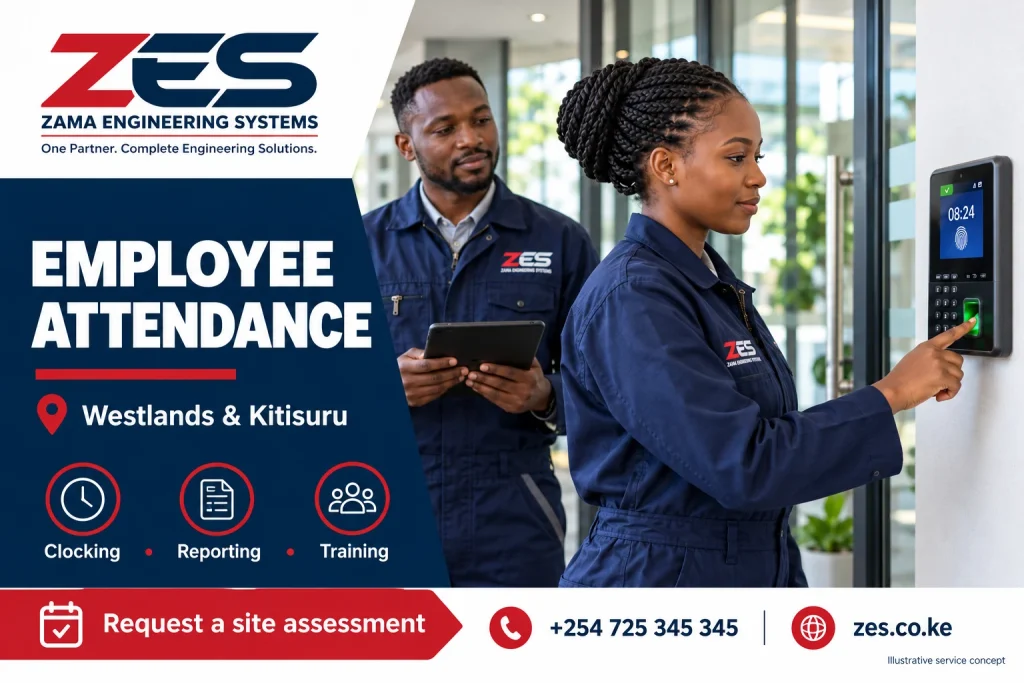
Employee Attendance System Westlands: An employee attendance system in Westlands should reflect approved working arrangements rather than reduce every attendance question to one clocking timestamp. Office meetings, off-site duties, branch visits and schedule changes can all create legitimate exceptions. This guide focuses on daily administration and report review after procurement. ZES can assess the device and software requirements, while the employer defines working rules, approval authority and decisions made using the records.

Employee Attendance System Westlands: Describe the approved working patterns
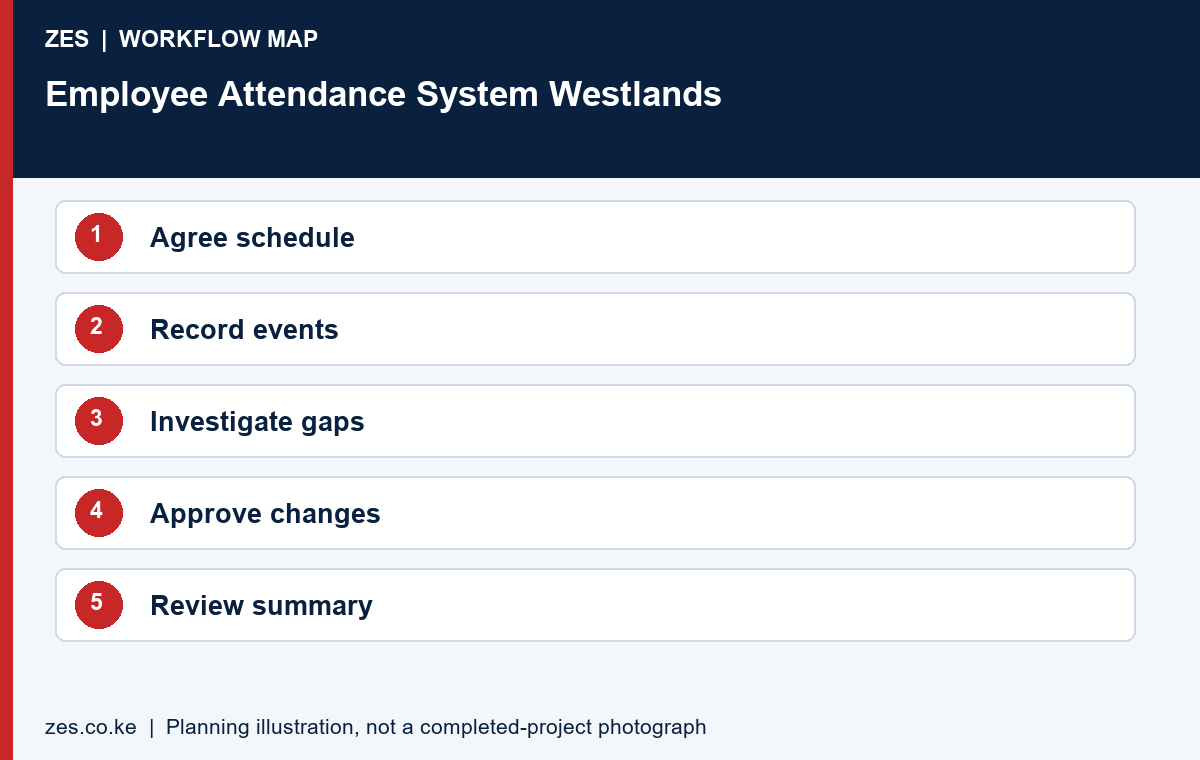
List normal office schedules and the authorised process for duties elsewhere. Clarify whether particular groups need different schedules or reporting. Do not configure an unapproved rule simply because it is the application’s default. Explain clocking expectations and how staff report a problem. A documented process reduces confusion when an employee attends a meeting outside the premises or changes location with approval. It also gives supervisors a consistent basis for reviewing apparent gaps.
Review exceptions every working day
Name a responsible administrator who checks missing events, duplicates and repeat recognition problems. Investigate whether a terminal, connection or schedule issue affects several people. Separate technical diagnosis from conclusions about individual conduct. A daily review prevents unresolved items accumulating until a payroll or management deadline. Make the escalation route clear, including the person who approves corrections and the information needed to support a change in the reviewed record.
Keep raw events distinct from approved summaries
Decide who needs event-level access and who should receive only a reviewed report. Use stable employee identifiers and clear dates and schedule references. Make unresolved items visible rather than forcing a result to make the spreadsheet look complete. Have actual users examine sample outputs. A report is operationally useful when its reader can understand which records were checked, what was corrected and who authorised the change.
Test off-site work and schedule changes
Use sample identities to demonstrate an ordinary day, a missed punch, an approved duty away from the office and a changed schedule. Check how corrections affect the report. If payroll output is required, define its field mapping and validation separately. An export is not automatically an integrated payroll workflow. The employer should approve its rules and obtain appropriate advice for employment decisions rather than treating the terminal as an independent authority.
Maintain continuity when administrators change
Keep the procedure, account ownership, backup responsibility and support route in organisational records. Review access when employees leave or change roles. Monitor recurring technical difficulty and the time spent rebuilding reports manually. ZES can assess configuration and supported-interface requirements against an agreed scope. Confirm Westlands site attendance directly. The aim is a process that authorised staff can operate and explain without depending on the original installer for every routine query.
A reporting review before the first live period
Ask the administrator to produce a sample attendance report for an agreed date range. Compare it with a small set of known events and approved schedules. Include an arrival, a departure, a missed event and a changed duty. Check how authorised corrections are recorded and reviewed. The report should help an employer investigate exceptions while preserving a clear distinction between recorded events and the employer decisions made from them.
Before introducing a payroll interface, agree its actual fields, format and ownership. Test sample exports with the receiving team and identify how rejected or incomplete records are handled. Do not assume that a device brand proves integration with an existing payroll application. Keep the initial reporting period manageable, nominate a reviewer and resolve discrepancies before relying on an automated transfer for operational decisions.
Employee Attendance System Westlands: supporting guidance
For privacy planning, consult the ODPC guidance notes, including its biometric data guidance. Check equipment and software behaviour against the documentation for the exact proposed version. ZKTeco publishes a ZKBio CVAccess user manual as one product-specific reference; it is not evidence that every device or platform has the same functions. Confirm the model and supported features in your quotation.
A worked example: office staff with approved off-site duties
Consider an illustrative employer whose staff sometimes attend customer meetings or work from another premises. A simple missing-clock report may not explain those duties. The attendance system brief should therefore identify the approved reporting process and the person who reviews exceptions. Start with the employer’s actual record problem rather than assuming that every blank field represents the same circumstance.
Prepare invented records for a normal office day, an approved off-site duty and an unexplained missed event. Ask the attendance system demonstration to preserve the distinction between the recorded event and the employer’s approved explanation. The reviewer should be able to retrieve the relevant information without treating the terminal as an independent decision-maker about work performed away from its location.
Agree reporting periods and responsibility for review
Define when daily exceptions are checked and when the attendance system period summary is prepared. Identify who provides explanations and who approves corrections. Allow realistic time for review before the information moves into another process. A system can expose gaps promptly while still requiring an authorised person to investigate what those gaps mean.
Use a sample period to check the proposed report. Confirm date boundaries, employee identifiers and department assignments. Ask how the attendance system handles a person changing duties or location partway through the period. The intended report should remain understandable to its recipients without requiring them to infer the meaning of undocumented status labels or default application settings.
Make corrections traceable and manageable
Demonstrate a correction from request through approval to the resulting summary. Ask the attendance system administrator to retrieve the original event and the available history. Record which software permissions support the process and which tasks depend on an operating procedure. An organisation should understand those boundaries before presenting the output as a fully reviewed record.
Include a rejected correction and a late request in the trial. Identify who decides how the organisation handles those cases under its approved approach. The attendance system should make the review practical; it should not silently remove the need for a decision. Give staff an understandable contact route for questions about records rather than relying on informal messages to whichever administrator happens to be present.
Test exports before promising a payroll connection
Ask the receiving payroll or reporting team for the actual format it needs. Compare a sample attendance system export with those requirements using invented identities. Check identifiers, date formats and the treatment of exceptions. Identify whether the purchased deliverable is a manual file, a supported connection or a separately designed integration with additional testing responsibilities.
For any proposed transfer, document how a failed or incomplete file is detected and reviewed. Agree how corrected attendance system records are reconciled after a transfer. Keep responsibility with named roles. A successful demonstration of a file opening in another application is useful, but it does not by itself prove that the entire recurring review and reconciliation process is complete.
Attendance system reporting: define the review cycle
An employee attendance system should fit the organisation’s actual reporting cycle. Identify who checks daily exceptions, who reviews period summaries and who approves information for the next process. Describe the required outputs with anonymised examples. A terminal’s list of recognition events and a manager’s reviewed attendance summary are different deliverables. The attendance system proposal should state which outputs are included and what administration is required to produce them.
Define the meaning of attendance system fields before importing or exporting records. Check employee identifiers, department assignments, date ranges, work locations and status labels. Ask what happens when a person changes department or works an approved duty at another premises. A field called overtime, absence or late arrival should not be assumed to implement the organisation’s policy without review. The employer remains responsible for its approved rules and consequential decisions.
Attendance system corrections and disputed events
Agree how an attendance system missed event is reported and reviewed. Keep the original event, the requested explanation and the approved correction distinguishable wherever the application supports it. Identify who can make a change and who can review the history. Use invented records to demonstrate a normal correction, a rejected request and an entry submitted after the reporting period. This exposes practical limitations before users depend on the workflow.
Provide an attendance system route for staff questions. Explain the clocking method, the person to contact and the information needed to investigate a discrepancy. Avoid presenting the machine as an infallible account of every activity performed that day. Review equipment problems, approved off-site work and changed duties through the organisation’s process. A reasonable operating guide helps staff distinguish a failed attempt from a recorded event that still requires managerial interpretation.
Compare attendance system exports with downstream requirements
Before promising a payroll connection, compare the attendance system output with the receiving application’s documented requirements. Ask the receiving team to check a sample file using invented identities. Confirm date formats, identifiers, blank fields and the treatment of approved changes. Identify whether the proposed deliverable is a manual export, a supported interface or a separately scoped integration. These options involve different responsibilities and should not be described as interchangeable.
Test an attendance system export through one complete sample reporting period. Check that the selected date range matches the intended records and that the receiving team can identify exceptions. Record any manual steps and who performs them. If automatic transfer is proposed, specify how failures are detected and how corrected records are reconciled. A successful one-off transfer is useful evidence, but it does not remove the need for ongoing ownership and exception handling.
Keep the attendance system usable after handover
Attendance system continuity should include account ownership, routine exports, support escalation and administrator cover. Train more than one authorised person where the organisation needs cover for leave or staff changes. Keep the instructions short enough to use during an actual reporting deadline. Identify which tasks require technical support and which are ordinary administration. The customer should understand the application and licence arrangement before it becomes essential to a recurring business process.
Review the attendance system after the first live period. Compare its output with the agreed examples and list the causes of unresolved discrepancies. Check whether staff know how to raise a missed event and whether reviewers have enough time to act. Adjust the approved process through a documented change rather than silently rewriting past results. Measure success against usable, reviewable records and manageable administration, rather than the number of features displayed in a product brochure.
Provide administrator cover and a usable operating guide
Select the people who will operate the attendance system during ordinary work, leave and staff changes. Give them a short guide covering daily checks, missed events, period exports and support requests. Ask the backup administrator to perform a sample task during handover. This reveals gaps that may be missed when only the primary operator receives training.
Keep sensitive administration information private and assign account ownership clearly. Identify which records and configuration references the customer needs for ongoing management. Confirm the licence and hosting arrangement. An attendance system that depends on an undocumented account owned only by an individual supplier contact can become difficult to manage when that person’s responsibilities change.
Review reports with the intended managers
Ask the managers who will receive attendance system reports to inspect an anonymised sample. Check whether the summary answers the original question and whether exceptions are visible enough to investigate. Avoid presenting an overly detailed event list when the requirement is a reviewed departmental summary, or an unexplained total when the reviewer needs the underlying events.
Record which report changes are configuration, which require another licence and which need separate development. Ask the proposer to demonstrate the agreed output rather than promise that any requested layout can be produced automatically. A clear attendance system reporting specification helps the customer compare proposals and prevents later disagreement about whether an export met the original brief.
Measure success after one complete reporting cycle
At the end of the first cycle, compare the attendance system output with the agreed sample cases. Count unresolved operational questions for internal review without inventing a public performance claim. Identify whether the cause is training, configuration, equipment or the organisation’s process. Assign a responsible person and decide which changes require another test.
Keep the review focused on usability and traceability. Can an authorised person retrieve the report, explain an exception and identify an approved change? Are recurring tasks manageable within the organisation’s working routine? A successful attendance system should support those outcomes. The number of menu options or the presence of a sophisticated dashboard is not enough to establish them.
Prepare the Westlands employee attendance enquiry
Send ZES the required reporting outputs, approximate workforce, locations and existing applications. Explain approved off-site duties or variable working arrangements that the attendance system needs to represent. Share anonymised examples rather than operational employee records. Identify the HR, IT and management contacts responsible for reviewing the proposed workflow.
Ask the quotation to identify equipment, software, configuration, interfaces, training and support. Confirm assessment and delivery arrangements directly for the actual site. This guide uses illustrative office situations and does not claim an existing Westlands customer deployment, a guaranteed payroll integration or an unverified reduction in administrative cost.
A private and usable project handover
Keep a private implementation file alongside the public buying guide. It should identify the supplied equipment, application arrangement, account owner, support contact and agreed acceptance results. Separate public marketing material from operational configuration and employee records. For an initial enquiry, anonymised examples are usually more useful than a large collection of personal records because they show the required output without exposing information unrelated to the purchase decision.
Ask the responsible organisation to review the purpose, necessity and handling of biometric information with appropriate advisers before live enrolment. The selected product documentation should explain its actual supported functions, but a technical specification does not by itself establish that every proposed use is appropriate. Confirm responsibilities for administration, access to reports, profile withdrawal and the organisation’s approved retention arrangements. Keep those decisions connected to the intended workflow rather than relying on a generic claim that a device is compliant.
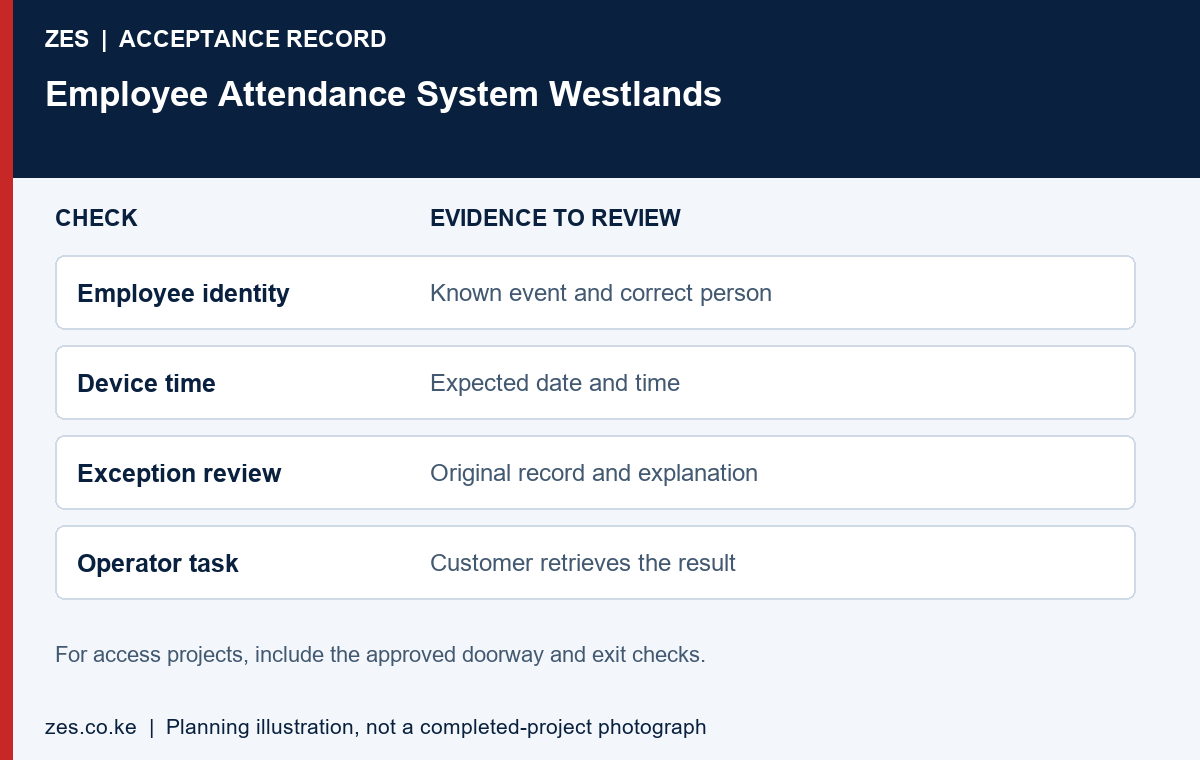
Use a short readiness and acceptance record. Before work, confirm the site contact, approved position, enabling tasks and application access. During testing, record the expected result, observed result and unresolved item. At handover, identify who owns the next action and how it will be reviewed. This gives the customer a practical basis for accepting the actual scope, while avoiding a vague completion statement that cannot be compared with the original requirement.
The proposal should also explain how later changes are managed. A new premises, additional users, changed working patterns or another reporting application can create a different requirement. Keep equipment references and the approved scope available for that review. Ask for revised terms and tests where necessary instead of assuming that the original purchase includes every future alteration. Clear documentation is useful to both the customer and the supplier when the people involved in the original project change.
Information to include in your enquiry
Share the site location, organisation type, staff numbers, clocking points or controlled doors, existing devices and software, and the required outcome. Include available layouts and sample reports with personal information removed. Identify the person who approves building access and the person who will administer the system. Ask the quotation to identify assumptions, exclusions, recurring charges, testing and handover responsibilities.
Frequently asked questions
Does a missing event prove an employee was absent?
No. Review approved work, schedules, equipment issues and the employee’s explanation through the agreed process.
Should every supervisor see all attendance information?
The organisation should define proportionate report access according to role and approved purpose.
Related Westlands biometric guides
- Biometric Machine Suppliers Westlands: Compare Devices, Licences and Installed Quotations
- Biometric Installation Westlands: Fit-Out Coordination, Cabling and Commissioning
Discuss your requirement with ZES
ZES is based in Kamakis, Ruiru and reviews Westlands enquiries before confirming the appropriate assessment and delivery arrangements. Travel, installation timing, equipment availability and support commitments are agreed directly for the actual scope.
Biometric attendance services · Access-control services · Request a quotation · Request a site assessment