
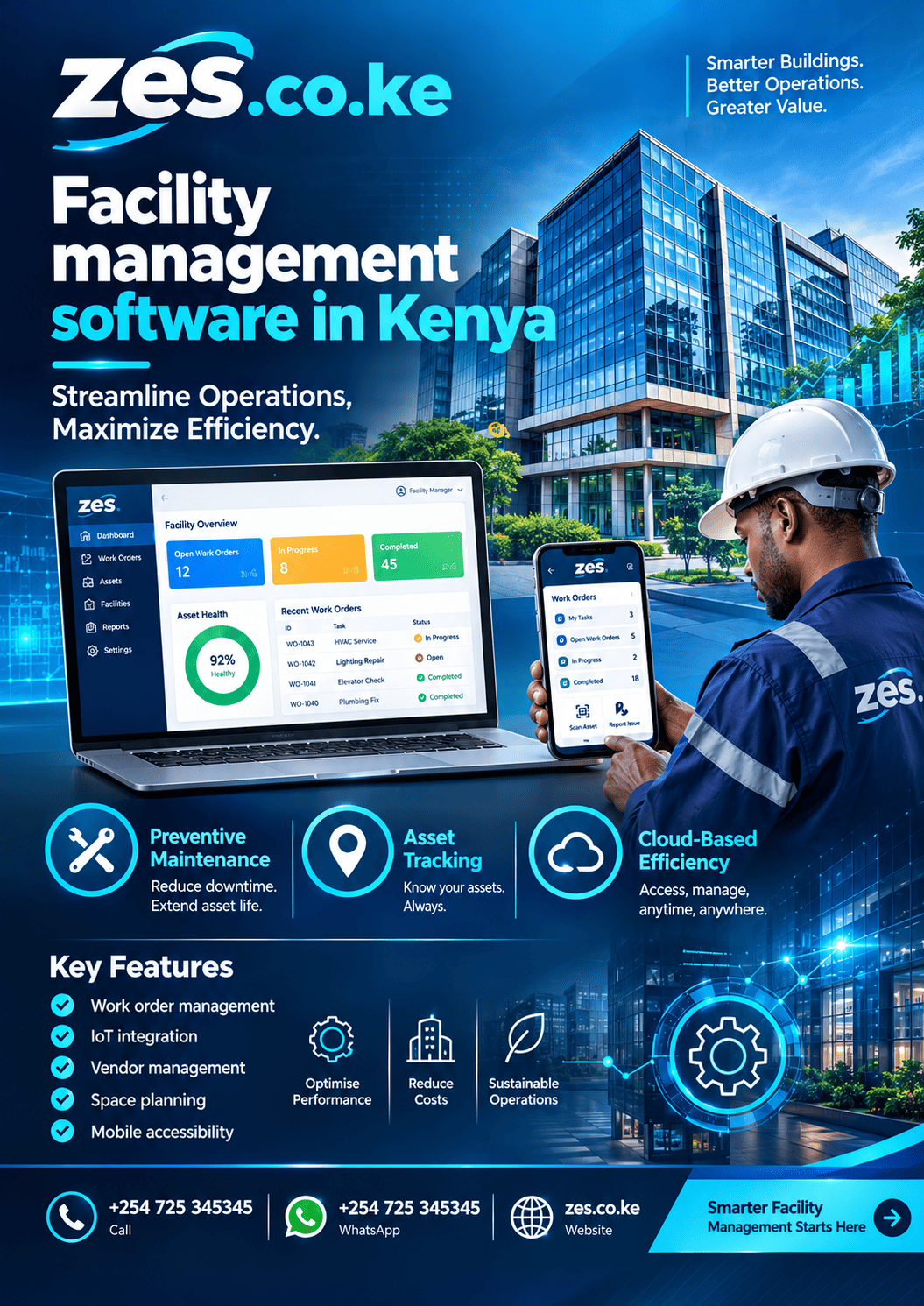
Facility management software in Kenya has become the central nervous system for modern organizations seeking to maintain operational excellence, control maintenance costs, and manage sprawling physical assets. At zes.co.ke, we understand that managing a facility manually—using spreadsheets, paper logs, and fragmented communication—is a recipe for inefficiency and unexpected downtime.
Investing in Facility management software in Kenya allows organizations to transition from reactive firefighting to proactive, data-driven building management. It connects your maintenance teams, vendors, and building occupants on a single, unified platform.
When evaluating Facility management software in Kenya, it is essential to look beyond basic ticketing systems. A truly robust platform handles asset lifecycles, space management, vendor contracts, and predictive maintenance scheduling.
Deploying Facility management software in Kenya requires a deep understanding of your specific workflows. No two facilities are identical, and your software must be configured to match the unique operational rhythms of your team.
A comprehensive implementation of Facility management software in Kenya bridges the gap between your IT department, your facilities team, and your finance department, ensuring that every maintenance task is tracked and every shilling is accounted for.
Choosing the right Facility management software in Kenya partner ensures that your data migration, user training, and system integrations are handled seamlessly without disrupting daily operations.
Robust Facility management software in Kenya empowers facility managers with real-time dashboards, allowing them to instantly identify bottlenecks, track key performance indicators (KPIs), and monitor energy consumption across multiple sites.
Scalable Facility management software in Kenya grows alongside your organization. Whether you are managing a single commercial building in Westlands or a nationwide portfolio of retail branches, the platform adapts to your expanding footprint.
Secure Facility management software in Kenya utilizes role-based access controls, ensuring that sensitive building data and financial records are only accessible to authorized personnel.
Advanced Facility management software in Kenya integrates seamlessly with IoT (Internet of Things) sensors, enabling automated alerts when HVAC systems fail, or when water leaks are detected.
Professional Facility management software in Kenya deployment includes comprehensive staff training. Even the most powerful software is useless if your technicians do not know how to use it effectively in the field.
Customized Facility management software in Kenya solutions cater to specific industry verticals, whether you need to manage the clinical compliance of a hospital, the complex logistics of a warehouse, or the tenant comfort of a commercial office block.
Complete Facility management software in Kenya packages encompass the initial software licensing, hardware integration, custom workflow configuration, and ongoing technical support.
Enterprise-grade Facility management software in Kenya is engineered for high availability, ensuring that your critical maintenance operations continue to run smoothly even during peak usage or unexpected network fluctuations.
The physical integration of Facility management software in Kenya often involves linking the platform with mobile devices, allowing technicians to receive work orders and update job statuses directly from their smartphones while on the move.
The right Facility management software in Kenya delivers a rapid return on investment by reducing equipment downtime, extending the lifespan of your assets, and optimizing the productivity of your maintenance workforce.
Why Facility management software in Kenya is Essential for Your Business
The transition to digital facility management is no longer a luxury; it is a strategic necessity. By utilizing Facility management software in Kenya, businesses can eliminate the data silos that typically exist between different departments.
When your HR team, IT team, and facilities team are all working from the same data platform, communication improves dramatically. Work orders are processed faster, and accountability is built into every interaction.
According to global facilities management experts like IFMA, Facility management software in Kenya is critical for establishing a clear picture of total cost of ownership for every physical asset.
Technical resources like Wikipedia’s article on facility management explain that Facility management software in Kenya encompasses a wide range of functions, from space planning to maintenance management and environmental sustainability.
Furthermore, adherence to international standards, such as those outlined by ISO 41001, requires the systematic tracking and reporting that only Facility management software in Kenya can provide.
Occupational safety regulators, including OSHA, emphasize that proper maintenance tracking through Facility management software in Kenya is essential for reducing workplace accidents and ensuring compliance.
The Core Modules of a Comprehensive Platform
To understand the value, it is helpful to break down the platform. A modern Facility management software in Kenya typically consists of several interconnected modules:
Computerized Maintenance Management System (CMMS): This is the engine of the software. It schedules preventive maintenance, tracks reactive repairs, and manages work orders.
Asset Management: This module creates a digital twin of your physical assets, tracking purchase dates, warranties, maintenance histories, and depreciation.
Space Management: For large corporate campuses, this module helps track how floor space is utilized, facilitating desk booking and office moves.
Vendor Management: It tracks vendor performance, manages contracts, and streamlines the procurement of external services.
The Transition to Predictive Maintenance
Traditional maintenance is reactive—you wait for something to break, and then you fix it. Facility management software in Kenya allows for preventive maintenance, where tasks are scheduled based on time or usage intervals.
The future, however, is predictive maintenance. By integrating Facility management software in Kenya with smart sensors, the system monitors the actual condition of equipment. When a motor begins to vibrate abnormally or draw excess current, the software automatically generates a work order before the machine fails completely.
{{VIDEO_EMBED: Insert a 2-minute video here showing a facility manager using a tablet to scan a QR code on an HVAC unit, instantly pulling up its maintenance history and generating a new work order on the screen.}}
Improving the Occupant Experience
Facility management is not just about buildings; it is about the people inside them. Modern Facility management software in Kenya often includes a tenant or employee portal.
This portal allows occupants to report issues quickly (like a broken light or a leaking tap) by simply scanning a QR code in their area. They can then track the progress of their request in real-time, leading to higher satisfaction and better communication.
Navigating the Installation and Configuration Process
Deploying Facility management software in Kenya is a significant IT project. It begins with a thorough audit of your existing processes. We sit down with your team to understand how you currently handle work orders, inventory, and vendor management.
Next, we configure the software to match these workflows. We customize the dashboards, set up user roles, and import your existing asset data into the new system.
Finally, we conduct rigorous testing and training. We run pilot programs to ensure the software works flawlessly on your site’s network and mobile devices before a full company-wide rollout.
Common Mistakes to Avoid
When investing in Facility management software in Kenya, organizations often stumble by trying to customize the software too much from day one. It is better to adopt the software’s built-in best practices and adapt your processes to the system.
Another common mistake is failing to secure executive buy-in. If leadership does not champion the new Facility management software in Kenya, the team will resist the change and revert to old habits.
Finally, neglecting data cleanliness is a major pitfall. If you import messy, inaccurate asset data into your new system, you will get messy, inaccurate reports. Data cleansing must happen before deployment.
Applications Across Kenyan Sectors
The demand for Facility management software in Kenya spans multiple industries:
Commercial Real Estate: Property managers use the software to manage tenant requests, schedule janitorial services, and track building systems.
Healthcare: Hospitals use it to ensure critical medical equipment is serviced on time and to maintain strict regulatory compliance.
Education: Universities manage sprawling campuses, tracking everything from dormitory maintenance to lecture hall AV equipment.
Manufacturing: Factories rely on the software to maximize machine uptime and manage spare parts inventory efficiently.
Cost Considerations and ROI
While specific pricing is not provided here, the investment in Facility management software in Kenya varies based on the number of users, the number of facilities, and the modules required.
However, the return on investment is well documented. By reducing equipment failures and optimizing staff efficiency, most organizations see a full return on their software investment within the first 12 to 24 months of deployment.
Ensuring Long-Term Success
To ensure long-term success, your Facility management software in Kenya must be continuously evaluated. We recommend holding quarterly reviews to look at usage data. Are your technicians actually using the mobile app? Are you closing work orders within your target SLA?
By treating the software as an evolving tool rather than a static purchase, you ensure that your facility operations continually improve.
Frequently Asked Questions
Q: Can the software work offline?
A: Many modern platforms offer mobile apps with offline modes. Technicians can view work orders and log updates in basements or dead zones, and the app will sync automatically when connectivity is restored.
Q: How long does implementation take?
A: A standard deployment for a single facility can take 2 to 4 weeks. Enterprise multi-site deployments can take several months depending on the complexity of data migration.
Q: Will this replace our existing accounting software?
A: No. It is designed to integrate with your existing ERP and accounting software (like QuickBooks or SAP) to streamline billing and procurement.
Q: Is the data hosted locally or in the cloud?
A: We offer both cloud-based and on-premise deployments. Cloud-based systems are increasingly popular due to lower upfront IT costs and easier remote access.
Investing in professional Facility management software in Kenya is a strategic move that transforms your operations from chaotic to streamlined. At zes.co.ke, we provide the expertise, the software, and the support to make your digital transformation a success.
By choosing a professional partner like zes.co.ke, you ensure your Facility management software in Kenya deployment is perfectly tailored to your operational needs. Contact us today to schedule a comprehensive demonstration and take control of your facility’s future.