
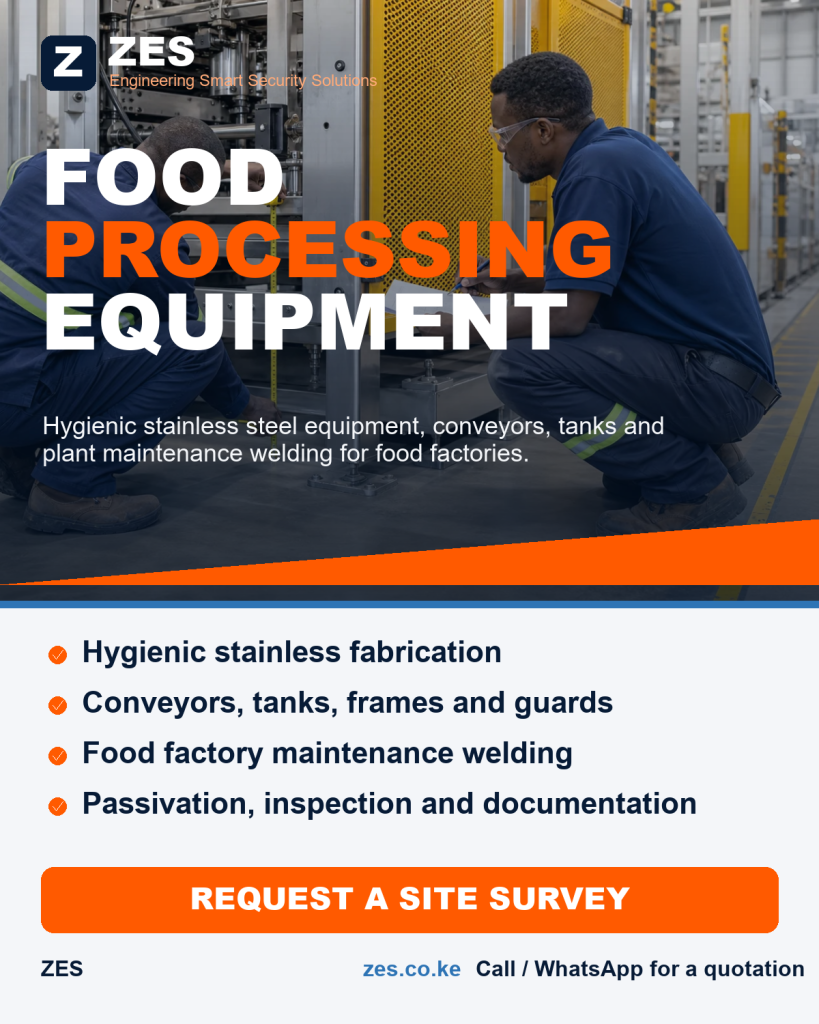
Food processing is one of the most demanding environments for fabricated equipment. Machinery runs for long shifts, contacts food directly or indirectly, is washed down with water and chemicals, and must meet hygiene standards that protect consumers and the brand.
Food processing equipment fabrication in Kenya is the discipline of designing and building stainless steel tables, conveyors, tanks, hoppers, chutes, frames, guards, platforms, racks and wash stations that meet those demands. It also includes the maintenance welding that keeps a food factory running when equipment fails or needs modification.
This guide explains how food-grade fabrication differs from general metalwork, the materials and design principles that matter, how food safety standards shape the work, how factory maintenance welding is managed safely, and how to choose a fabricator who understands food plants.
It is written for factory managers, production engineers, quality and food safety teams, maintenance managers and business owners in the food and beverage sector.
What Food Processing Equipment Fabrication Covers
Food factories need a wide range of fabricated equipment.
Process tables and workstations. Stainless tables for sorting, trimming, inspection, packing and assembly.
Conveyors and transfer systems. Frames, supports, guides and chutes for moving product between stages.
Tanks and vessels. Storage, mixing, holding and processing tanks, subject to the required standards.
Hoppers and chutes. For feeding, dosing and transferring ingredients and product.
Equipment frames and skids. Bases and frames for machines, motors, pumps and process equipment.
Machine guards. Safety guards that protect operators without compromising cleaning.
Platforms and access structures. Mezzanines, walkways and stairs for access to equipment.
Racks and shelving. For ingredients, packaging, trays and work-in-progress.
Wash stations and sinks. For equipment, utensils and staff hygiene.
Ducting and extraction. For ventilation, dust and fume control.
Custom modifications. Adaptations for new products, lines or capacity.
Each item must be designed for the food environment, not just for strength.
Why Food-Grade Fabrication Is Different
General fabrication focuses on strength, cost and appearance. Food-grade fabrication adds hygiene, cleanability and food safety.
Cleanability. Surfaces must be smooth, accessible and free of crevices where bacteria can grow.
Corrosion resistance. Water, steam, acids, salts and cleaning chemicals attack ordinary steel. Stainless steel is the default.
Non-toxicity. Materials in contact with food must be suitable for food contact.
No contamination. Fabrication must not introduce lubricants, metal particles, paint or other contaminants.
Drainage and moisture control. Standing water creates microbial growth and corrosion.
Pest and foreign-body control. Hollow sections, gaps and rough welds create risks.
Maintainability. Equipment must be serviceable without contaminating production.
These requirements shape the design, the materials, the welding and the finishing.
Materials for Food Processing Equipment
Material selection is central to food safety and durability.
Stainless Steel 304
Grade 304 is the standard food-grade stainless. It offers good corrosion resistance and is suitable for most tables, frames, conveyors, chutes and guards.
Stainless Steel 316
Grade 316 contains molybdenum for improved resistance to chlorides and aggressive environments. It is used in dairy, meat, seafood, brine and chemical-cleaning environments.
Surface Finish
Smooth, cleanable finishes are essential. Rough surfaces harbour bacteria and are harder to clean. Brushed or polished finishes may be specified depending on the application.
Plastics and Other Materials
Food-grade plastics, elastomers and coatings may be used for guides, seals and contact surfaces, provided they are suitable for food contact and cleaning.
Supporting Steel
Mild steel may be used for non-contact structural elements, but it must be protected and kept out of splash and washdown zones where possible.
A fabricator should be able to explain which material is used where and why.
Hygienic Design Principles
Hygienic design is a set of principles that reduce contamination risk.
Smooth surfaces. Avoid rough welds, pits and scratches.
No crevices. Open seams, lap joints and gaps trap food and moisture.
Radiused corners. Where surfaces meet, rounded details are easier to clean.
Sloped surfaces. Liquids should drain away, not pool.
Accessibility. Equipment should be accessible for cleaning and inspection.
Minimal horizontal surfaces. Flat tops collect dust and debris.
Sealed or open construction. Either seal completely or leave fully open for cleaning — avoid partially enclosed spaces.
Leg and support design. Allow cleaning underneath.
Fasteners. Minimise exposed threads and dirt traps.
Dismantling. Where required, equipment should be easy to dismantle for cleaning.
These principles should be visible in the design drawings.
Food Safety Standards and Compliance
Food processing operates within a regulated environment.
HACCP. Hazard analysis and critical control points require control of biological, chemical and physical hazards. Equipment design should support control measures.
Good Manufacturing Practice. GMP covers hygiene, maintenance and operating practices.
KEBS standards. The Kenya Bureau of Standards publishes requirements relevant to food contact materials and equipment.
Public health requirements. County public health authorities inspect food premises.
Customer and retailer standards. Buyers may impose their own audits and requirements.
Traceability. Equipment and processes should support batch traceability.
Documentation. Material certificates, drawings and inspection records support audits.
A fabricator who understands these requirements designs equipment that is easier to approve and operate.
The Fabrication Process
Professional food equipment fabrication follows a structured sequence.
1. Brief and site assessment. Understand the process, product, cleaning regime and constraints.
2. Hygienic design. Develop the design with cleanability, drainage and access in mind.
3. Drawings. Produce fabrication drawings with dimensions, materials and finishes.
4. Material selection. Confirm grades and finishes for each component.
5. Cutting and forming. Accurate cutting and forming for fit and finish.
6. Welding. Appropriate process for the material, with controlled heat input.
7. Finishing. Grind, polish, clean and passivate as required.
8. Inspection. Check dimensions, welds, finish and hygiene details.
9. Trial assembly. Confirm fit and function before delivery.
10. Installation and commissioning. Install, connect and test in the factory.
Each stage should be documented.
Welding Quality and Finishing
Welding is the most critical fabrication step in food equipment.
Joint preparation. Clean, properly fitted joints.
Heat control. Excessive heat causes distortion and reduces corrosion resistance.
Filler selection. Matched to the base material and application.
Weld profile. Smooth, continuous welds where food contact or cleaning requires.
Heat tint removal. Discolouration should be removed to restore corrosion resistance.
Passivation. Restores the protective oxide layer after welding.
Surface finish. Grinding and polishing to a cleanable finish.
Cleanliness. Remove swarf, spatter and fabrication debris.
Poor welding and finishing are the most common causes of corrosion and hygiene problems in food equipment.
Factory Maintenance Welding Services
Food factories need ongoing welding and repair support.
Planned maintenance. Inspection and repair of frames, guards, conveyors, chutes and supports during planned downtime.
Breakdown response. Urgent repairs when equipment fails and production stops.
Shutdown work. Larger repairs and modifications during planned shutdowns.
Modifications. Changes to lines, guards, supports and equipment as products change.
Fabrication of replacement parts. When original parts are unavailable or unsuitable.
Corrosion repair. Addressing rust and pitting before it becomes structural.
Hygienic repairs. Repairs that maintain cleanability and food safety.
Documentation. Records of work, materials and recommendations.
Factories need a contractor who can work safely in a live production environment.
Working Safely in a Live Factory
Maintenance welding in a food factory requires discipline.
Permits. Hot-work permits and isolation procedures.
Lock-out/tag-out. Isolate energy sources before work.
Screens and protection. Protect nearby product, equipment and surfaces.
Fume and dust control. Extract fumes and control grinding dust.
Fire safety. Clear combustibles, fire watch and extinguishers.
Hygiene. Clean and inspect before production resumes.
Access control. Restrict access to the work area.
Coordination. Work with production and quality teams.
Documentation. Record work, materials and sign-off.
Safety and hygiene failures during maintenance can cause incidents, contamination and recalls.
Installation and Commissioning
Installation determines whether equipment performs safely.
Positioning. Equipment placed according to layout and services.
Connections. Power, water, drainage, steam or air as required.
Alignment. Conveyors and transfer points aligned to avoid product damage.
Guards. Safety guards fitted and tested.
Testing. Equipment tested with product or simulated product.
Cleaning validation. Confirm equipment can be cleaned effectively.
Training. Operators and maintenance staff trained.
Handover. Documentation and records.
Installation should be planned with production to minimise downtime.
Quality Inspection
Inspection should cover both fabrication and function.
Material checks. Grade and thickness.
Dimensional checks. Fit and alignment.
Weld inspection. Continuity, finish and cleanliness.
Surface inspection. Smoothness, scratches and heat tint.
Hygiene inspection. Crevices, seams and dirt traps.
Functional checks. Operation, movement and safety.
Cleaning checks. Confirm cleaning access and drainage.
Documentation. Records of inspection and corrections.
Documented inspection supports food safety audits and customer approvals.
What Affects Food Equipment Fabrication Cost
Cost depends on design, materials and installation.
Design complexity. Simple frames cost less than hygienic equipment.
Material grade and thickness. 316 and heavier gauges cost more.
Finishing. Polishing and passivation add cost.
Tolerance and inspection. Higher standards add cost.
Automation and moving parts. Conveyors and mechanisms add complexity.
Installation and downtime. Working in a live factory adds constraints.
Site access. Difficult access increases labour.
Timeline. Urgent work costs more.
Documentation. Quality records add value.
A good quotation itemises materials, fabrication, finishing, delivery, installation and commissioning.
How to Choose a Food Equipment Fabricator
Use this checklist.
1. Do they understand food safety? Hygienic design and HACCP awareness.
2. Do they specify materials? Grade, thickness and finish.
3. Do they explain hygienic design details? Crevices, drainage, access.
4. Do they control welding and finishing? Heat, passivation and cleanliness.
5. Can they work in a live factory? Permits, isolation and hygiene protection.
6. Do they provide documentation? Drawings and inspection records.
7. Can they maintain and repair? Ongoing support.
8. Do they have relevant experience? Similar food processes.
9. Are they safe? Hot work, LOTO and safety practices.
10. Do they show comparable work? References in food plants.
Common Mistakes in Food Equipment Fabrication
Using general fabrication standards. Hygiene and cleanability are overlooked.
Wrong grade. 304 where 316 is needed, or thin material.
Rough welds and crevices. Dirt traps and corrosion.
No passivation. Welds corrode quickly.
Ignoring drainage. Standing water and microbial growth.
Poor access for cleaning. Equipment cannot be kept hygienic.
No guards. Safety risks for operators.
Unsafe maintenance. Hot work without permits or protection.
No documentation. Difficult to audit or maintain.
Choosing only on price. Cheap fabrication costs more over its life.
Food Processing Sectors
Dairy: stainless tanks, tables, pipelines, hygienic welds and passivation.
Meat and poultry: tables, conveyors, wash stations and hygienic design.
Bakery: tables, racks, conveyors and ovens supports.
Beverages: tanks, pipework, platforms and hygiene-critical fabrication.
Grain and milling: hoppers, chutes, ducting and structural steel.
Oils and fats: tanks, pipework and corrosion-resistant fabrication.
Fruit and vegetables: wash stations, conveyors and sorting tables.
Confectionery: tables, frames and hygienic equipment.
Each sector has specific requirements, and a good fabricator adapts.
Conveyors and Transfer Systems
Conveyors are the backbone of many food lines, and their fabrication affects hygiene and reliability.
Frame design. Open frames are easier to clean than enclosed structures. Avoid hollow sections that can trap product or moisture.
Belting interface. The frame must support the belt type and tension without creating gaps.
Guides and rails. Adjustable guides should be cleanable and secure.
Transfer points. Chutes and transfers should prevent product damage and accumulation.
Drainage. Liquids should drain away rather than pool on the frame.
Access. Conveyors should allow cleaning and maintenance access along their length.
Safety. Guards and emergency stops are essential.
Alignment. Poor alignment causes belt tracking problems and downtime.
A conveyor that cannot be cleaned properly becomes a contamination source across the whole line.
Tanks, Hoppers and Vessels
Tanks and vessels require particular care.
Material grade. Often 304 or 316 depending on the product and cleaning chemicals.
Welds. Internal welds should be smooth and cleanable, with proper finishing and passivation.
Corners. Radiused internal corners reduce dirt traps.
Drainage. Outlets and slopes should allow complete drainage.
Covers. Should prevent contamination while allowing access for cleaning and inspection.
Vents. Appropriate venting to avoid pressure issues and contamination.
Supports. Engineered for weight and stability.
Inspection. Access for inspection and testing.
Standards. Some vessels may be subject to specific standards and testing.
Tanks and vessels that are hard to clean or inspect create persistent food safety risk.
Machine Guards and Safety
Fabricated guards protect operators without compromising hygiene.
Design. Guards should prevent access to dangerous parts while allowing necessary operation and cleaning.
Materials. Stainless or suitable materials, cleanable and durable.
Fixings. Secure but easy to remove for maintenance.
Visibility. Guards should allow operators to see the process where required.
Interlocks. Where required, guards should integrate with safety interlocks.
Edges. Smooth and safe.
Hygiene. Guards should not create dirt traps.
Standards. Guarding should meet workplace safety requirements.
Safety and hygiene must be designed together, not traded off.
Clean-in-Place and Washdown
Many food plants clean equipment with water, chemicals or clean-in-place systems.
Washdown environments. Equipment must withstand water jets and chemicals. Stainless grade and sealing matter.
Electrical protection. Motors, sensors and connections must be protected.
Drainage. Floors and equipment should drain effectively.
Chemical resistance. Materials must resist the cleaning chemicals used.
Access. Equipment should allow cleaning of all surfaces.
Drying. Design should allow equipment to dry and avoid standing water.
Validation. Cleaning effectiveness should be verifiable.
Equipment designed for washdown lasts longer and is easier to keep hygienic.
Maintenance Planning and Shutdowns
Food factories need planned maintenance to avoid unplanned downtime.
Asset register. List equipment and critical components.
Inspection schedule. Regular checks of frames, guards, conveyors, tanks and supports.
Condition monitoring. Watch for corrosion, wear, cracks and alignment issues.
Shutdown planning. Schedule larger repairs and modifications during planned shutdowns.
Spares. Keep critical spares available.
Contractor coordination. Plan with production and quality teams.
Documentation. Records of work and recommendations.
Review. Use records to plan replacements and improvements.
Preventive maintenance is cheaper than breakdowns and recalls.
Quality and Traceability Documentation
Documentation supports audits and customer confidence.
Material certificates. Evidence of grade and thickness.
Drawings and specifications. Approved design records.
Weld and finishing records. Process, filler and passivation.
Inspection reports. Dimensional, weld and hygiene checks.
Cleaning validation. Evidence that equipment can be cleaned.
Installation records. Connections, tests and commissioning.
Maintenance history. Work performed and parts replaced.
Traceability. Links to batches or products where relevant.
Good documentation makes audits easier and protects the business.
Designing for Hygiene: A Practical Checklist
Designers and buyers can use a simple checklist to test hygienic design.
Can every surface be seen? If a surface cannot be inspected, it cannot be verified clean.
Can every surface be reached? Cleaning access matters more than appearance.
Does it drain? Liquids should not pool anywhere.
Are there crevices? Open seams, lap joints and gaps are risk points.
Are corners radiused? Rounded details clean more easily.
Are fasteners exposed? Threads and recesses trap dirt.
Are hollow sections sealed or open? Avoid partially enclosed spaces.
Can it be dismantled? Where required, easy dismantling supports cleaning.
Is the material suitable? Food contact, chemicals and temperature.
Are welds smooth and clean? Especially on contact surfaces.
Are guards hygienic? Safety guards must also be cleanable.
Is there a cleaning procedure? Equipment should be designed with cleaning in mind.
If the answer to any of these is no, the design should be revisited.
Materials and Welding: Common Failure Modes
Most food equipment failures trace back to a few causes.
Wrong grade. Using 304 where 316 is needed leads to corrosion.
Thin material. Undersized thickness causes distortion and fatigue.
Poor weld preparation. Contamination and poor fit lead to defective welds.
Excess heat. Distortion and reduced corrosion resistance.
No passivation. Welds corrode at the heat-affected zone.
Rough finish. Surface roughness harbours bacteria and is hard to clean.
Trapped moisture. Crevices and poor drainage cause corrosion.
Galvanic corrosion. Mixed metals in contact in wet environments.
Mechanical damage. Impact and abrasion create sites for corrosion.
Understanding these failure modes helps buyers ask the right questions.
Upgrading an Existing Line
Many factories need to upgrade rather than build new.
Assess the existing equipment. Condition, materials, hygiene and capacity.
Identify bottlenecks. Where the line slows or fails.
Plan modifications. Guards, frames, conveyors, tables and supports.
Maintain hygiene. Modifications must not create contamination risks.
Minimise downtime. Plan work around production and shutdowns.
Test and validate. Confirm performance and cleanability.
Document changes. Update drawings and records.
Train staff. Ensure operators understand changes.
Upgrades are often more cost-effective than full replacement, if planned well.
Working with Quality and Production Teams
Food equipment projects affect production, quality and maintenance. Coordination matters.
Production. Understand product flow, changeovers and downtime constraints.
Quality and food safety. Review hygienic design and cleaning validation.
Maintenance. Plan access, spares and serviceability.
Engineering. Confirm services, loads and safety.
Procurement. Ensure specifications and documentation are met.
Management. Approve scope, budget and timeline.
Early involvement of these teams reduces rework and improves acceptance.
Frequently Asked Questions
What is food processing equipment fabrication?
It is the design and fabrication of stainless steel tables, conveyors, tanks, hoppers, chutes, frames, guards, platforms and racks for food factories, built for hygiene, durability and food safety.
Which stainless steel grade is used in food processing?
Grade 304 is common, while 316 is used where higher corrosion resistance is required, such as dairy, meat, seafood and aggressive cleaning environments.
What is hygienic design?
Design that minimises contamination risk through smooth surfaces, no crevices, radiused corners, drainage, accessibility and cleanable details.
Do you provide maintenance welding in food factories?
Yes. Planned maintenance, breakdown repairs, shutdown work and modifications can be carried out, with proper permits, isolation and hygiene protection.
Can you work during production?
Where required, work can be planned around production with isolation, screening and cleaning. Some work is better done during shutdowns.
Do you passivate welds?
Yes, where required. Passivation restores corrosion resistance after welding, which is important in food environments.
How long does fabrication take?
It depends on complexity and scope. Simple items take days; complete equipment can take weeks. Installation and commissioning add time.
Can you fabricate replacement parts?
Yes. Replacement parts and modifications can be fabricated when originals are unavailable.
Do you supply drawings?
Yes. Fabrication drawings and documentation can be provided for approval and records.
Do you work outside Nairobi?
Yes. Projects can be delivered across Kenya, with logistics reflected in the quotation.
A Final Pre-Purchase Checklist
Before approving food equipment fabrication, confirm the following. Make sure the process, product and cleaning regime are understood. Check that the design addresses hygienic details. Confirm the material grade and finish. Ask how welding and passivation will be controlled. Confirm inspection and documentation. Ask how installation and downtime will be managed. Confirm safety and hygiene controls for factory work. Ask about maintenance and spares. Finally, compare quotations against the same specification and food safety requirements.
A fabricator who explains these points clearly is usually the one worth trusting in a food plant.
Conclusion
Food processing equipment fabrication in Kenya is a hygiene and engineering discipline. The difference between equipment that passes audits and lasts, and equipment that causes corrosion, contamination and downtime, is the material, the hygienic design, the welding, the finishing, the installation and the maintenance.
If you are planning food processing equipment or plant maintenance, start with the process and the cleaning regime. Then insist on hygienic design, correct materials, controlled welding, documented inspection and safe working practices.
ZES fabricates and maintains stainless steel food processing equipment, frames, conveyors, guards, tanks and supports for food factories across Kenya. If you would like a practical assessment and a clear, itemised quotation, start with a site survey.
Request a food processing fabrication assessment and quotation from ZES