
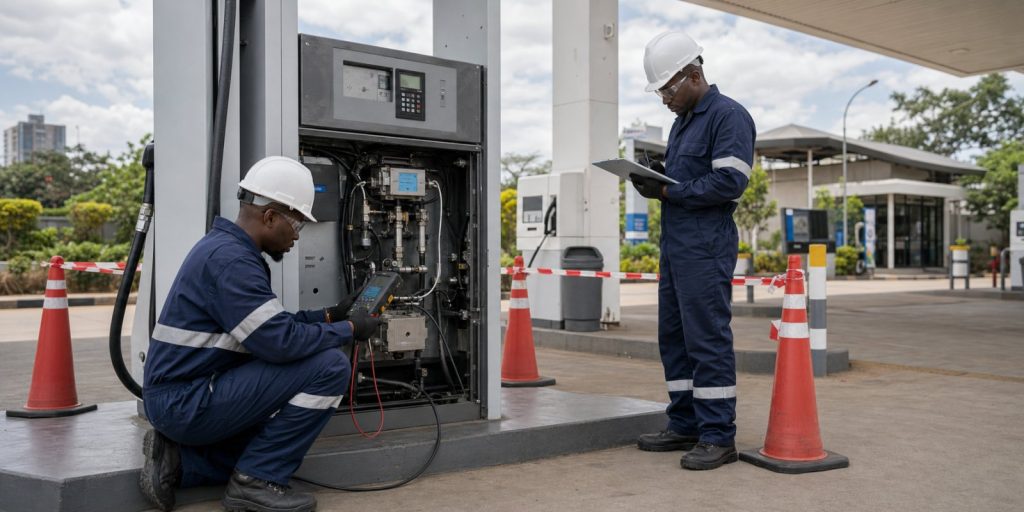
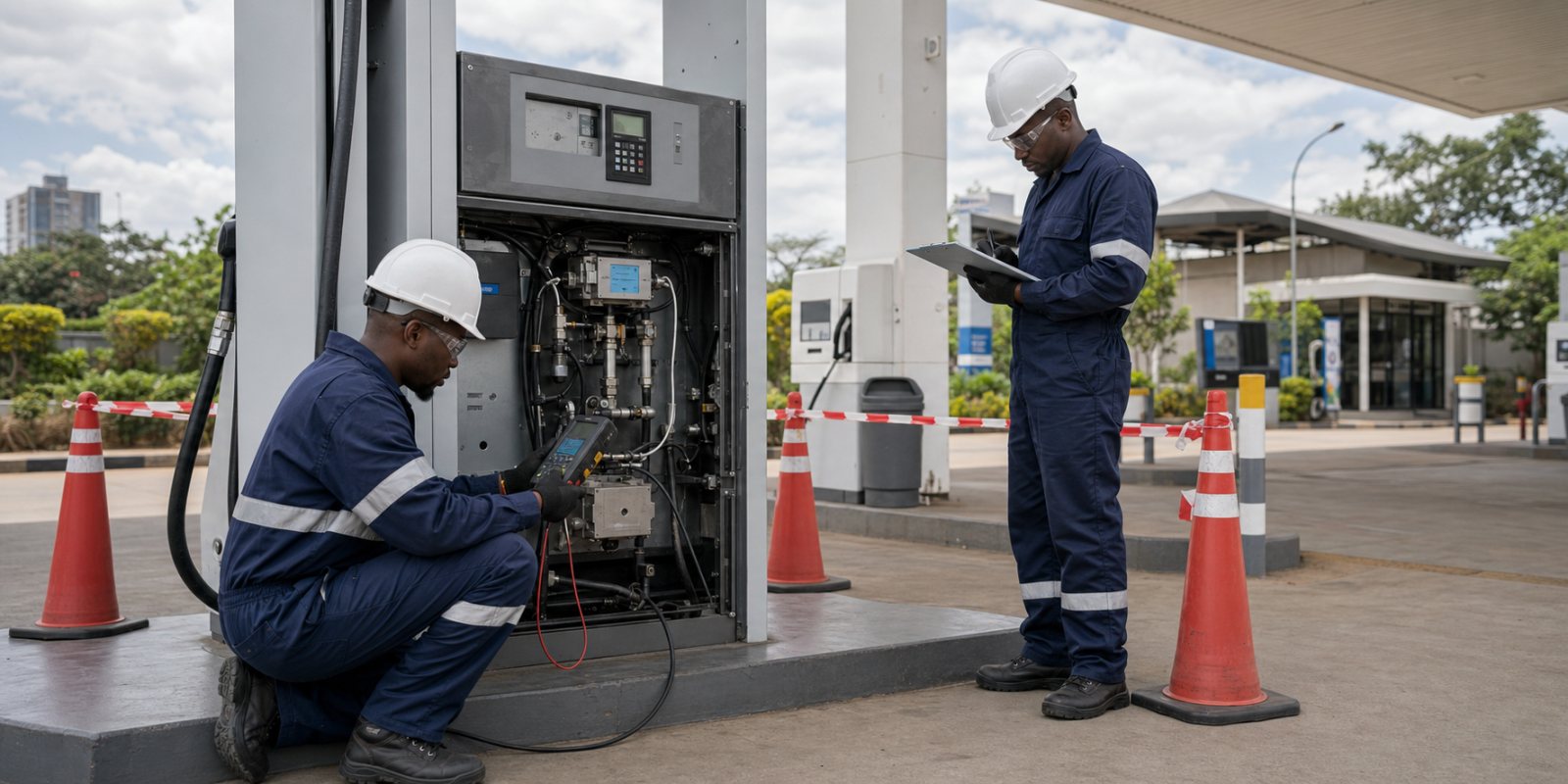
Fuel dispenser repair services in Kenya should begin with safe isolation and model-specific fault diagnosis. A dispenser problem can be hydraulic, mechanical, electrical, electronic, metrological or communications-related. Opening a cabinet, breaking a seal or repeatedly resetting a fault without understanding it can create a safety, measurement or inventory problem.
This buyer’s guide explains the warning signs that require attention, the information a technical team needs, how repair differs from maintenance and calibration, and what records should be available before a dispenser returns to service.
Safety first: visible fuel, impact damage, a damaged hose or breakaway, burning smell, unsafe electrical symptoms or suspected measurement error should trigger the station’s isolation and escalation procedure. Station staff should not open the dispenser, bypass a safety device, break a metrology seal or attempt an internal repair.
When should a fuel dispenser be taken out of service?
The exact response follows the site’s emergency and operating procedures, but warning signs that need competent assessment include:
- visible fuel, wetness, staining or a strong unexplained product odour;
- a split, abraded, kinked or drive-off-damaged hose, swivel, nozzle or breakaway;
- impact damage to the cabinet, island, anchoring or protective barrier;
- failure to reset, authorize, display correctly or complete a transaction;
- repeated electrical trips, unusual noise, overheating or intermittent shutdown;
- slow flow, no flow, pulsation or repeated filter-related symptoms;
- suspected short measure, damaged seals or unexplained stock variance;
- fuel or liquid found in the dispenser sump or at the cabinet base.
Attendants can record safe external observations and keep customers away. Internal diagnosis and repair should be handled by appropriately trained personnel with the model information, tools, isolation controls and legal authority required for the task.
Repair is not the same as installation, maintenance or calibration
| Service | Primary purpose | Typical trigger |
|---|---|---|
| Repair | Diagnose and correct a specific fault or damage | Leak, drive-off, failed component, error code or malfunction |
| Preventive maintenance | Inspect and service equipment on a planned schedule | Manufacturer/site maintenance plan |
| Calibration and verification | Confirm measurement performance and applicable legal-metrology requirements | Scheduled verification, adjustment or repair affecting measurement |
| Installation | Fit and commission a new or replacement dispenser | New site, capacity change, replacement or upgrade |
These services can occur in sequence, but they should not be confused. When work meets the Weights and Measures Rules’ definition of repair, the repairer must submit the instrument for verification and stamping before it returns to trade use. A recurring fault may reveal a maintenance, piping, tank, power or control-system issue rather than a dispenser-only problem.
Information to provide before a technician visits
Good fault information reduces guesswork and helps confirm whether the right parts and expertise are available. Share:
- site location and safe contact person;
- dispenser make, model and serial number;
- affected side, hose, nozzle and product grade;
- the exact symptom, display message or error code;
- whether there is a leak, impact or recent drive-off event;
- when the problem started and whether it is intermittent;
- the forecourt controller or POS environment;
- last service, repair and calibration information;
- safe external photographs, if permitted by site procedure.
ZES should confirm technical coverage and parts availability after the equipment is identified. No responsible provider should promise repair of every brand and model without this information.
Common symptoms and the systems that may be involved
| Observed symptom | Possible systems to assess | Do not assume |
|---|---|---|
| Slow or no flow | Product supply, filter/strainer, valve, pump or motor, line condition and product state | That replacing a filter will solve every slow-flow fault |
| No reset or authorization | Nozzle-boot switch, power, dispenser logic, controller and communications | That the dispenser is the only failed component |
| Display or price mismatch | Configuration, electronics, controller, POS and communications | That manual adjustment is safe or authorized |
| Quantity variance | Meter performance, calibration, leakage, receipts, tank data and reconciliation | That every variance is theft or a bad meter |
| Fuel at the base or sump | Hydraulic component, connection, impact damage, sump or associated piping | That tightening a visible fitting is a complete diagnosis |
| Drive-off damage | Hose, breakaway, nozzle, cabinet, anchoring, safety valve and sump | That reconnecting the hose is sufficient |
These are diagnostic categories, not remote repair instructions. The installed model’s manual, test results and physical condition determine the correct action.
A safe fuel dispenser repair workflow
- Receive and classify the fault: identify whether leakage, impact, electrical symptoms or measurement concerns require urgent isolation.
- Control the work area: apply the station’s shutdown, barricading, authorization and escalation procedures.
- Verify equipment information: confirm model, configuration, product, controller and maintenance history.
- Diagnose systematically: inspect and test using the correct procedures and equipment rather than changing parts by guesswork.
- Agree the repair scope: state parts, labour, related defects, exclusions and whether further specialist work is required.
- Use compatible parts and procedures: follow the applicable manufacturer information and authorized change controls.
- Test the repaired system: complete relevant leak, function, safety, communications and measurement checks.
- Complete calibration and verification: where the work qualifies as repair under the Weights and Measures Rules, submit the repaired instrument for verification and stamping before return to trade use.
- Document return to service: provide the service record, parts information, results and outstanding recommendations.
Kenya calibration, verification and repair records
Fuel dispensers used for trade are measuring instruments. Kenya’s Weights and Measures Rules establish requirements for repairers, verification and stamping of measuring instruments. The Weights and Measures Act provides the wider legal-metrology framework.
The Rules define when an instrument is treated as repaired and require the repairer to submit a repaired instrument for verification and stamping before it returns to trade use. Confirm the applicable licensed repair, calibration and inspection sequence for the work performed. A contractor’s internal test or service certificate does not replace an official function where the law requires one.
ZES’s separate fuel pump calibration guide covers measurement accuracy. This repair article focuses on fault assessment and the controls around corrective work.
Repair or replace the dispenser?
Repair can be appropriate where the fault is isolated, safe access is possible, compatible parts and technical information are available, and stable operation and measurement can be restored. Replacement may be more practical where the model is unsupported, faults recur across several systems, damage or corrosion is extensive, calibration cannot remain stable, or the dispenser is incompatible with the required forecourt control.
The decision should compare total scope: parts, labour, downtime, testing, verification, future support, energy use, integration and expected service life. For replacement scope, see fuel dispenser installation.
Return-to-service acceptance checklist
The exact checks depend on the fault and model. A documented handover may include:
- no observable leakage under the defined test conditions;
- correct product mapping, display and price configuration;
- normal reset, authorization, dispensing and transaction completion;
- hose, nozzle, swivel and breakaway condition;
- relevant emergency and safety-device function;
- communications with the forecourt controller or POS;
- calibration and required verification or stamping records;
- repairer service record, parts used and configuration changes;
- updated maintenance log and operator briefing.
Any unresolved recommendation should be recorded with its operating restriction and responsible action.
Preventing repeat dispenser faults
Use the installed model’s maintenance manual and the station’s risk-based plan. Record recurring errors instead of repeatedly resetting them. Inspect permitted external items such as hoses, nozzles, breakaways, cabinet condition and signs of leakage at the defined interval.
Analyse whether repeated symptoms originate in power quality, communications, product supply, tank condition, piping or inventory procedures. Link scheduled work to a petrol station preventive maintenance plan, and review forecourt management integration when the fault involves authorization or transaction data.
What determines fuel dispenser repair cost?
Repair cost depends on the diagnosis, make and model, parts, damage, access, travel, isolation requirements, related system faults, calibration and verification. A reliable quotation normally follows initial fault information and, where necessary, an on-site assessment.
Ask the quotation to distinguish diagnosis, parts, labour, testing, calibration, official verification, transport, taxes and exclusions. Avoid a fixed remote price when the fault has not been identified.
Frequently asked questions
Can station attendants repair a fuel dispenser?
Attendants can make safe external observations allowed by site procedure, but should not open cabinets, break seals, bypass controls or adjust measuring components.
Must a repaired dispenser be re-verified?
Yes, when the work meets the Weights and Measures Rules’ definition of repair. The repairer must submit the repaired instrument for verification and stamping before it returns to trade use.
Is calibration the same as repair?
No. Repair corrects a defect; calibration addresses measurement performance. The two can be required in sequence.
Can a leaking dispenser remain in service?
Follow the station’s isolation and emergency procedure and keep it out of use until competent assessment and repair confirm a safe return to service.
Does ZES repair every dispenser brand?
Technical coverage and parts availability depend on the make, model, configuration and fault. Send those details so ZES can confirm the appropriate next step.
Fuel dispenser repair services Kenya should begin with safe isolation and fault evidence. A symptom such as slow flow, an error code, missing display, communication loss or unexplained variance can originate in different mechanical, electrical or control components. The service provider should record the condition before changing parts and state when an authorized measurement or sealing party must be involved.
Buy diagnosis and repair as traceable work
A call-out request should identify dispenser make, model and serial, affected nozzle, product, fault time, recent maintenance, error messages and whether the unit is isolated. The quotation or work order should separate diagnosis, labour, travel, parts, software or configuration, formal verification and excluded damage. Compare recurring faults with the wider preventive maintenance plan.
Replacement parts should have a clear description and source, and removed components should be accounted for. Where age or obsolescence makes repair uneconomic, use the dispenser installation requirements to compare a compatible replacement. No technician should bypass emergency, metrology or audit controls merely to return a unit to service quickly.
Require a functional return-to-service test
Acceptance should verify that the original fault is absent and that related safety and transaction functions remain intact. Depending on the work, test hose and nozzle operation, flow, display, price and volume, leaks, emergency stop, controller communication and POS capture. Any legally required calibration, verification or resealing must be completed by the authorized party before commercial use.
The repair report should contain fault findings, readings, parts used, photographs, test results, outstanding recommendations, technician and customer sign-off and warranty on the work. Send ZES the dispenser details and fault history for a scoped response rather than a speculative parts list.
Repeat-fault checkpoint
When the same dispenser returns to service more than once for a similar symptom, the maintenance manager should open a repeat-fault review. Compare error history, replaced parts, configuration changes, power or communication events, flow conditions and verification records. Ask whether the repaired component was the cause or only the visible failure. The decision may be further diagnosis, an upstream correction, planned overhaul or replacement. Tracking repeat faults protects the owner from paying for an endless sequence of isolated call-outs and gives procurement reliable evidence when comparing the cost of continued repair with a compatible new unit.
Request a fuel dispenser fault assessment
Send ZES the site location, make, model, serial number, affected product and hose, exact symptom, error code, leak or impact status and last service or calibration information.