
Gate Automation Services Kitisuru — planning, quotation and owner guidance
You may need a completely new automatic gate, or you may simply want the existing entrance to work better. Perhaps visitors cannot contact anyone inside, too many remotes are unaccounted for, or an old installation no longer suits the property. Gate automation services in Kitisuru should begin with that practical problem.
Zama Engineering Systems (ZES) brings gate automation into the wider access-control discussion. The objective is an entrance that fits your property, gives authorised users a convenient way in and remains manageable after installation.
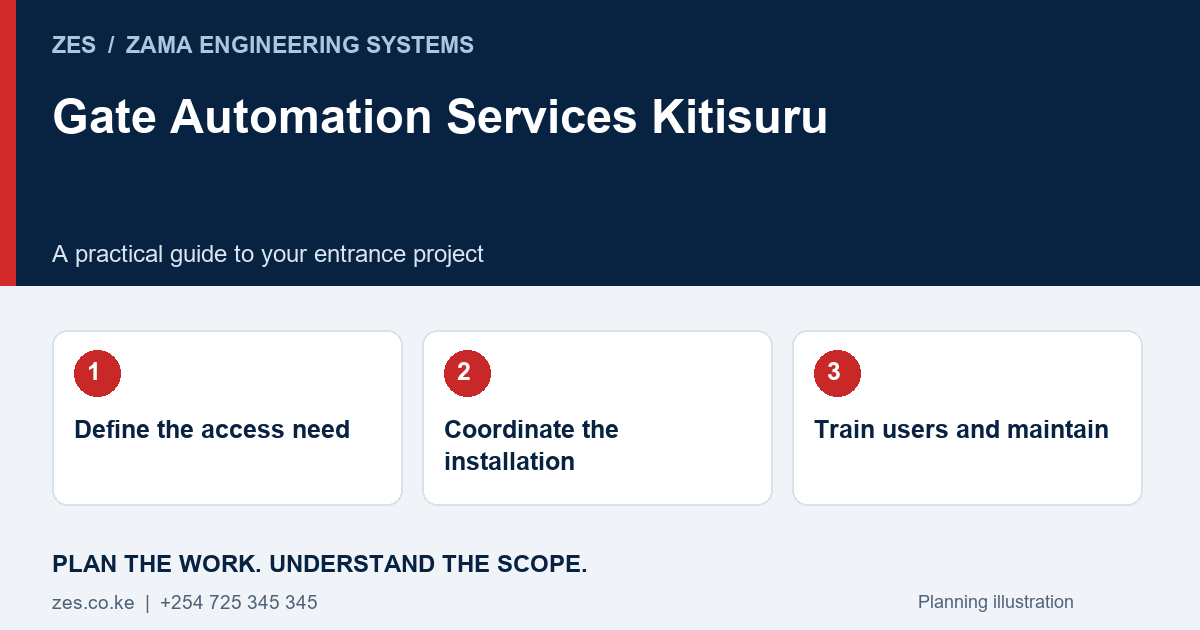
Gate automation services Kitisuru: choose the right starting point
Different entrance problems call for different work. Before comparing equipment packages, identify which situation best describes your project.
| Your situation | A useful starting service |
|---|---|
| New entrance under construction | Layout and automation planning |
| Suitable manual gate | Assessment for an automation retrofit |
| Faulty automatic gate | Diagnosis and a repair proposal |
| Working gate with awkward visitor access | Review of controls and intercom options |
| More users than before | Review of operating demand and access administration |
| Several planned building changes | Coordination of gate, power and site work |
This approach helps you spend on the part of the system that needs attention. A new motor will not, by itself, solve an unclear visitor-entry process.
New installations: plan the whole entrance
For a new installation, establish the gate arrangement and the space needed for movement. Sliding and swing gates use the driveway differently, and the surrounding structures can influence which works best.
The installation also needs supporting infrastructure. Discuss power provision, equipment positions, access controls and any civil works before finishes are complete. If a builder or fabricator is involved, make sure the responsibilities are agreed.
ZES can assess the entrance as part of its access-control services. The final proposal should identify the equipment and supporting work for the actual site.
Upgrading an existing gate
An upgrade does not necessarily mean replacing everything. Existing components can be considered for retention where their condition and compatibility suit the proposed system.
Explain what currently works and what frustrates users. Do you need another opening method? Better visitor communication? A clearer way to manage access when staff or occupants change? Those answers give the assessment a purpose.
For retrofit projects, the ZES gate automation upgrade guide provides useful background. The site assessment determines what can remain and what must change.
Access controls that suit your users
The best control arrangement is one people can operate and administer consistently. Remotes can be convenient for a small group. A shared entrance may need more structured permissions or a defined visitor process.
If an intercom is proposed, decide who receives calls and what happens when that person is unavailable. If phone-based control is proposed, ask about connectivity, account ownership and recurring charges. These details matter just as much as the opening feature shown in a demonstration.
Name the person responsible for adding users, removing lost devices and keeping the system information. Without that ownership, even a well-installed entrance can become difficult to manage.
Coordinate work across contractors
Gate projects often involve more than one trade. The fabricator may supply the gate, an electrician may provide power and another contractor may finish the driveway. The gaps between those responsibilities deserve attention.
Agree who handles bases, routes, connections and making good. Identify which work must be complete before the next contractor starts. Share changes to gate dimensions, levels or positions before they affect completed installation work.
If you plan a later intercom or other accessory, discuss provision now. Compatibility and future work still need confirmation, but early planning can reduce avoidable disruption.
What should the quotation include?
Ask for the proposed equipment, labour, supporting works, controls and commissioning to be clearly identified. State the required remote quantities and any integration requirements so competing offers cover the same outcome.
The quotation should distinguish confirmed work from provisional items. It should also explain exclusions, taxes, payment stages and the process for approving changes.
A budget discussion is most productive when it separates the essential installation from optional convenience features. Ask what can be phased without leaving the first installation incomplete.
Support after the installation
A useful handover explains daily operation and gives authorised users the information they need. Keep equipment details, release keys and administrative access with the responsible property contact.
Discuss maintenance according to the actual equipment, use and environment. Ask how faults are reported and what the written support terms cover. Maintenance and clear records help future technicians understand the installation and previous work.
Frequently asked questions
Can ZES assess an existing installation?
Yes. Share the available equipment details, condition and intended changes when enquiring so the assessment can be planned.
Can I combine gate automation with other access controls?
Compatible systems can be planned together. The proposal should confirm the required interfaces and responsibilities before integration is promised.
Can the work be completed in stages?
Discuss the priorities and future plans during assessment. The initial stage should be a complete, usable installation with later additions clearly defined.
Seven easy checks for a coordinated gate automation project
These checks help organise a project that may involve equipment, building work and user administration. They are useful whether the entrance serves one household or several authorised users.
1. Describe the result before choosing devices
Begin with the problem: a manual gate is inconvenient, visitor calls go unanswered, user devices are difficult to manage, or an existing system no longer suits the property.
Describe what a successful day would look like. Who arrives, who opens the entrance and who deals with visitors? The answer gives the gate automation proposal an operational purpose.
Avoid starting with a long list of features copied from unrelated systems. Some may be useful, while others introduce accounts or controls that no one wants to manage. Ask the supplier to connect each proposed feature to a stated requirement.
A clear outcome also helps compare quotations. If one proposal solves visitor communication and another only supplies an operator, they are different projects. Agree the intended result first so the access control and automation work can be evaluated against the same brief.
2. Audit the existing entrance and equipment
List what is already installed: gate structure, operator, power provision, controls, intercom and any related access control devices. Record known faults and available model information.
Ask which items can be retained and which require assessment. Existing components should not be replaced automatically, but they should not be assumed suitable merely because they are present.
For a retrofit, the condition of the gate and its movement can be as important as the electronic controls. Separate mechanical preparation from the gate automation equipment so the responsibilities are clear.
Keep previous installation and service records if available. They help the assessor understand changes made over time. An entrance with several additions may need a review of compatibility and administration, not simply another accessory attached to the existing arrangement.
3. Assign responsibilities across the project
Identify the people supplying fabrication, electrical work, civil work and automation. One project contact should hold the current scope and coordinate decisions.
For each task, record who performs it, what information they need and when it must be complete. A cable route, equipment base or restored finish should not fall between two quotations because both contractors assume the other includes it.
Ask how site readiness will be confirmed before installation. If one stage changes, tell the other contractors before their work proceeds. This is particularly important when gate dimensions, levels or positions change.
Gate automation can be delivered through coordinated trades without every task being supplied by one company. The essential point is that the interfaces are agreed. A clear responsibility list makes the finished entrance easier to deliver and gives the owner a practical way to resolve questions.
4. Design access around users and visitors
Create a user list that distinguishes regular access from occasional entry. Explain whether residents, staff, guards or a facilities team will manage the entrance.
For visitor communication, decide who receives calls and what happens when that person is unavailable. Ask which functions the proposed intercom actually supports. Do not assume a marketing description establishes every call-handling feature.
For managed access control, identify who adds and removes users. Lost devices, staff changes and property handovers should have an understood process. Keep administrative credentials under appropriate owner control.
If connected gate automation is proposed, ask about network requirements, account ownership and ongoing charges. Convenience should remain manageable when a phone is replaced or a usual administrator is away. The proposal should explain both the everyday experience and the responsibilities behind it.
5. Plan phases without leaving gaps
A staged project can help manage a budget, but the first stage should be a complete usable installation with its required supporting work. Optional future additions need to be clearly distinguished.
Ask which provisions make sense during initial construction. An agreed route or space allowance may reduce later disruption, but it does not prove that every future accessory will be compatible.
For each later stage, record what is included now and what remains to be selected. Avoid vague promises that an entrance is “ready for everything.” Future gate automation and access control changes still depend on equipment, condition and requirements.
Keep the phasing plan with the quotation. If priorities change, the document helps the team understand the original assumptions. This is more useful than removing items from an offer without considering whether another part of the installation depends on them.
6. Define integration precisely
If the gate is to work with another system, name both systems and the intended behaviour. “Integration included” is too broad when the owner expects a particular visitor or access process.
Ask who verifies compatibility and which interfaces or supporting work are required. The final proposal should explain responsibilities across suppliers where more than one system is involved.
Describe the useful result in ordinary terms. For example, the property may want an authorised person to approve entry after speaking to a visitor. The supplier should then explain the compatible equipment and operating arrangement.
Do not assume an access control feature guarantees a security outcome beyond its actual design. Gate automation is one part of how the entrance is managed. A precise integration scope helps the owner judge whether the additional complexity provides a practical benefit.
7. Prepare the owner for handover and maintenance
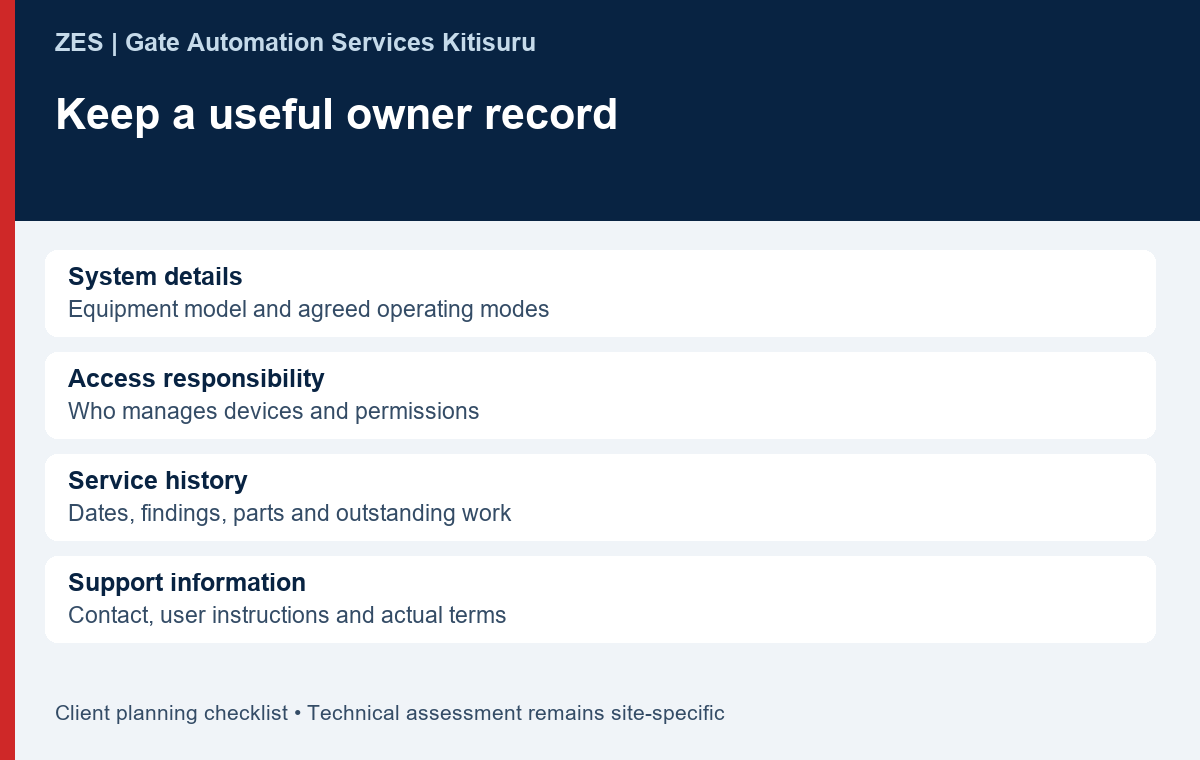
Arrange a demonstration for the people who will operate and administer the system. They should understand the agreed functions, relevant user instructions and the process for reporting a problem.
Collect the equipment list, account responsibilities, release keys and service information. Keep sensitive credentials secure and distinguish them from general project documents.
Ask for the applicable commissioning checks and any outstanding work to be recorded. The completion record should show what was delivered against the agreed scope, including controls and supporting work.
Discuss maintenance according to the actual gate automation equipment, usage and environment. Review the arrangement when the property changes. New users, revised parking or a different visitor process may affect the installation or its administration. A useful handover gives the owner enough information to manage those later conversations.
A practical way to compare service proposals
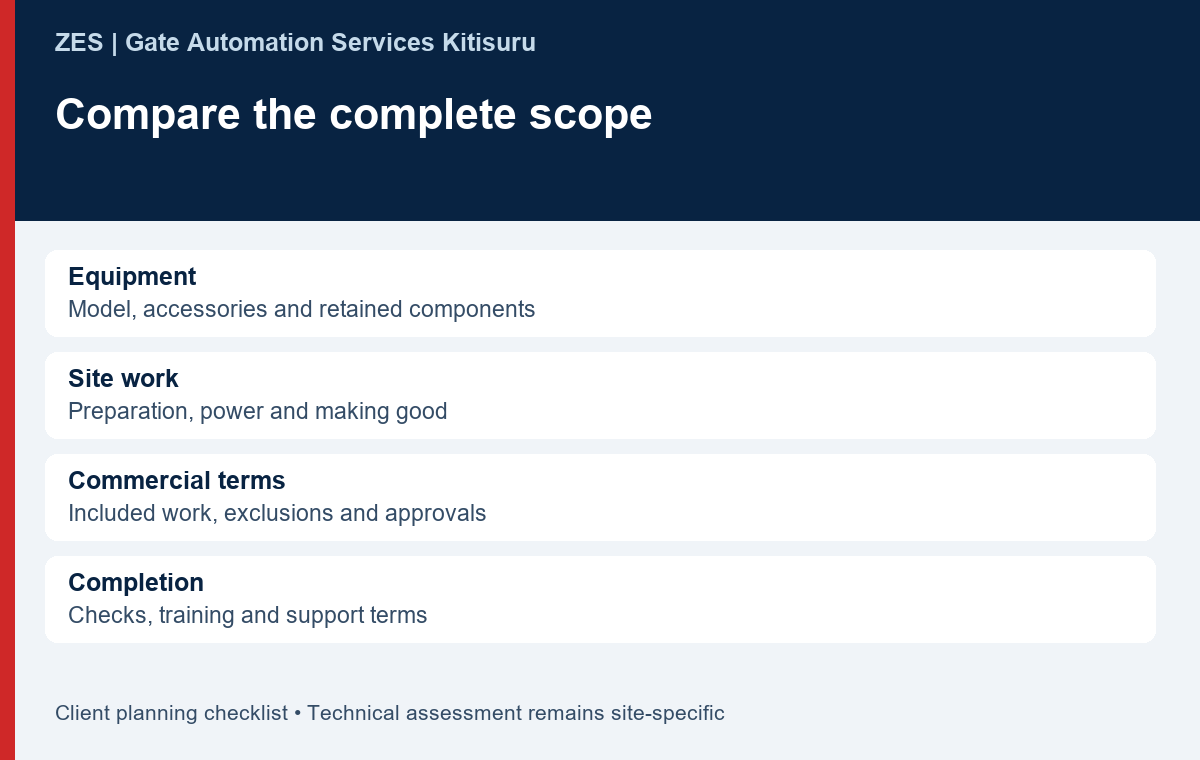
Create a comparison sheet with a column for each supplier and rows for the required outcome, retained equipment, preparation, operator, controls, electrical work and handover.
Mark exclusions explicitly. An item left blank should prompt a question rather than an assumption. Include taxes, assessment charges and any provisional work in the discussion.
Then compare how each proposal handles coordination. Who confirms readiness? Who approves changes? Who trains users? These responsibilities can affect the project even where equipment appears similar.
The comparison does not need to select the longest equipment list. It should reveal which proposal addresses the same defined requirement and what the owner must arrange separately. That gives a gate automation decision a more reliable basis than a headline package price.
An example of an access upgrade
A property may have a working automatic gate but an inconvenient visitor process. The owner initially asks for a new motor, assuming that newer equipment will solve the problem.
A better assessment begins with how visitors announce themselves and who can approve entry. The relevant work may involve compatible communication or access control features, while a suitable existing operator remains in use.
This is an illustrative planning example, not a statement about a particular installation. Its value is the distinction between movement and access management. Improving one does not automatically improve the other.
Explain the operational problem to ZES before choosing hardware. The proposal can then identify the appropriate assessment and the work that responds to the intended result.
Information to collect before the first visit
Prepare the site location, overall entrance photographs and a description of the current gate automation or manual arrangement. Include available equipment records and known defects.
List the regular user groups, visitor process and desired changes. If building work is underway, provide the relevant schedule and contractor contacts through the appropriate private project channel.
State the budget range if you have one, together with the priorities it must cover. This helps distinguish an essential initial scope from future options without guessing at your preferences.
Avoid sharing access codes or account credentials in general enquiry attachments. The initial brief should describe the requirement while keeping sensitive operating information restricted.
Review the system when responsibilities change
A property handover, staffing change or new management arrangement is a useful time to review who controls the entrance. Confirm ownership of connected accounts and the records of issued devices.
Ask for guidance where access permissions need to be changed. Do not leave a former administrator as the only person who understands the installation.
Update the service record when equipment is altered and keep the current support contact available. Gate automation works best as a maintained property system with clear ownership, rather than a collection of devices whose settings are known only to the original installer.
Keep a decision log for a multi-stage project
When several people contribute to a gate automation project, a short decision log can prevent conflicting instructions. Record the date, the decision, the responsible person and the drawing or quotation version affected.
Useful entries include an agreed equipment position, a revised route, a change in remote quantity or a confirmed visitor-call arrangement. The log should explain changes without becoming a substitute for the technical documents.
Share relevant updates with the contractors whose work is affected. A decision about paving may matter to the installer; a change in access control requirements may matter to the person providing connectivity.
At handover, retain the final version with the owner records. This makes later support easier because the property can distinguish what was originally proposed from what was actually approved.
The log need not be complex software. A clearly maintained document can be sufficient. The important point is that gate automation and access control decisions are made consistently, with the current scope available to the people delivering and managing the entrance.
Discuss your Kitisuru entrance with ZES
Tell us what you want the entrance to do better. Send the location, photographs, existing equipment information and any building schedule. Request a site survey or ask for a tailored quotation for installation, upgrades or support.
Further reading: HSE powered-gate safety guidance explains why the complete installation needs assessment. This is UK technical background, not a statement of Kenyan legal requirements.
Gate Automation Kitisuru: keep changes traceable
Gate Automation Kitisuru projects may involve a new system, an upgrade or changes to an existing entrance. Keep the equipment details and agreed scope together so later service decisions can refer to what was actually installed. Record changes to controls, supplied parts and operating arrangements.
If several contractors work on the entrance, identify responsibility for the gate, electrical preparation and access interfaces. A change by one provider may need review by another. Share relevant records without distributing access credentials unnecessarily.
Electric Gate Repair Kitisuru: investigate recurring faults
An Electric Gate Repair Kitisuru enquiry should state the current symptom and include relevant earlier service findings. A repeated symptom does not automatically mean the same part has failed again. The technician needs to assess the current installation and explain the conclusion.
Record when the problem occurs, which controls are affected and whether any construction, impact or equipment change preceded it. Avoid repeated cycling to reproduce abnormal movement. Safely taken photographs and existing records are useful; opening live enclosures for information is not necessary for an initial enquiry.
Ask for a completion report listing the work, parts, relevant checks and remaining recommendations. If further work is optional or requires another trade, keep it separate from the approved repair. The electric gate troubleshooting guide explains owner-facing reporting questions. Request an assessment quotation from ZES with your location and fault description.