
Gate Automation Spring Valley decisions often involve an existing system: retain it, repair it, improve its controls or replace the gate motor. Those choices should follow the condition of the entrance and the owner’s current requirement. ZES can assess gate automation and Gate Motor Repair Spring Valley enquiries and explain the proposed work before equipment is ordered.
This guide is about comparing repair and upgrade options fairly. It does not assume that an older motor is beyond repair or that a new operator will solve every problem. the automatic gate, controls and relevant power arrangement need to be considered together.
Gate Automation Spring Valley: 7 easy repair-or-upgrade checks
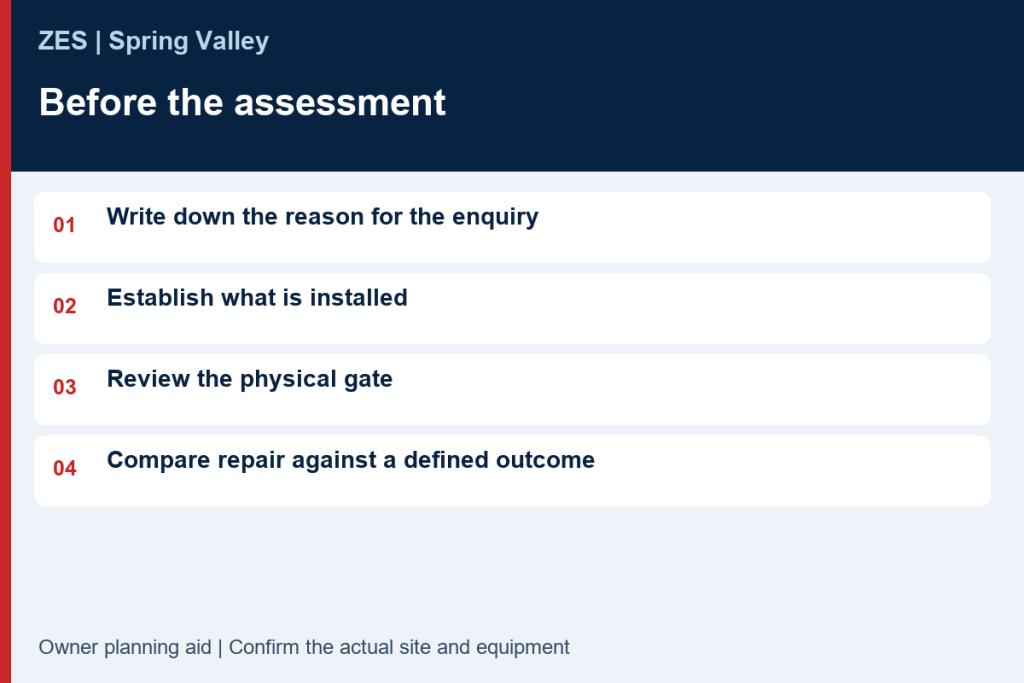
1. Write down the reason for the enquiry
Separate an actual fault from a desired improvement. A gate that stops during travel, a lost remote and a wish to add visitor communication are different requirements. Record each one so the proposal can explain which work addresses which need.
Describe the observed response rather than guessing the failed part. Include when the issue began and any known previous work. If the automatic gate behaves unpredictably, keep people clear and seek assessment rather than repeatedly triggering it.
2. Establish what is installed
Use existing manuals, invoices and safely accessible labels to identify the gate motor and connected equipment. Record a separate receiver or intercom separately. Past modifications can mean the original motor label does not describe the complete current arrangement.
If information is missing, say so. Do not open electrical enclosures to collect photographs for a quotation. A technician can identify inaccessible details during the appropriate assessment.
3. Review the physical gate
Ask the assessor to explain any mechanical or structural work required. A motor should not be selected to force a gate through an unresolved movement problem. Visible damage, scraping, support movement or a changed surrounding surface should be reported.
The repair and replacement options should address necessary gate work consistently. Otherwise, the owner may be comparing two proposals that promise different completed conditions.
4. Compare repair against a defined outcome
A useful repair proposal states the finding, parts and labour, retained equipment and completion checks. Ask what the work is intended to restore and what remains uncertain. If a staged investigation is needed, agree that stage before treating the scope as final.
Parts availability and supplied terms should be confirmed for the identified model. No article can guarantee that every component is in stock. See the gate spare-parts guide for ordering information.
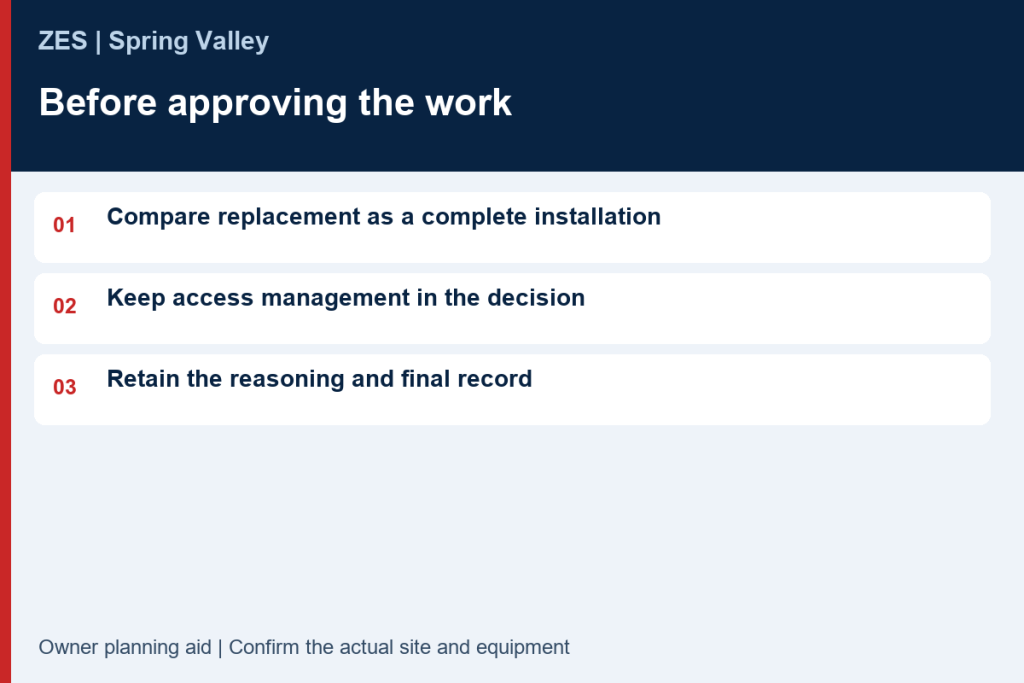
5. Compare replacement as a complete installation
If replacement is recommended, ask why and what else must change. Remotes, receivers, mounting arrangements and power components may need compatibility review. A bare motor price is not directly comparable with a completed repair or replacement project.
Explain any change in the property’s use. More users or a different operating pattern may affect the equipment proposal. Like-for-like replacement should not be automatic when the entrance requirement has changed.
6. Keep access management in the decision
Identify who controls the devices and approves new access. If a replacement changes the receiver arrangement, plan how users move to the new controls. Ask what happens to old or missing devices where the gate automation system supports access removal.
For a shared property, nominate one person to coordinate decisions and user communication. A technically completed upgrade can still be difficult to use if nobody knows which controls work or who manages them.
7. Retain the reasoning and final record
Keep the diagnosis, quotation, approved changes and equipment details together. The handover should explain normal operation and actual support terms. Record outstanding work separately from the accepted outcome.
If the symptom returns, the previous finding and work record help the next assessment. A service history is more useful than a sequence of invoices that simply say gate repair without explaining what was done.
Gate Motor Repair Spring Valley: questions for the technician
Ask what finding supports the recommended repair. The answer should connect the reported complaint to the proposed action in plain language. A diagnosis is not established by the age of the gate motor or by a familiar symptom alone.
Ask which parts are being replaced and which remain. Confirm compatibility, availability and any installation or programming requirements. If an alternative part is proposed, request a clear description and actual terms before approving supply.
For an intermittent fault, agree what can be established at the visit and how recurrence should be reported. Do not insist on a guessed replacement simply because the symptom does not appear during one appointment. The troubleshooting guide explains useful owner observations.
A comparison example without invented prices
Consider an illustrative owner who receives a repair proposal for a confirmed component fault and a second proposal for an entirely new operator. The useful comparison starts with what each option delivers. Does the repair retain suitable equipment? Does the replacement include changes to controls, mounting or power? Is necessary gate work included in both?
The owner asks for parts availability, completion checks and support terms to be stated. If a replacement changes the user controls, that transition is included in the plan. If the repair leaves another identified issue unresolved, the outstanding work is clearly listed.
The final decision can then consider the complete scopes and actual prices. The example does not imply that repair is always cheaper or replacement always better. It shows how to avoid comparing a limited intervention with a different completed installation.
A practical options table
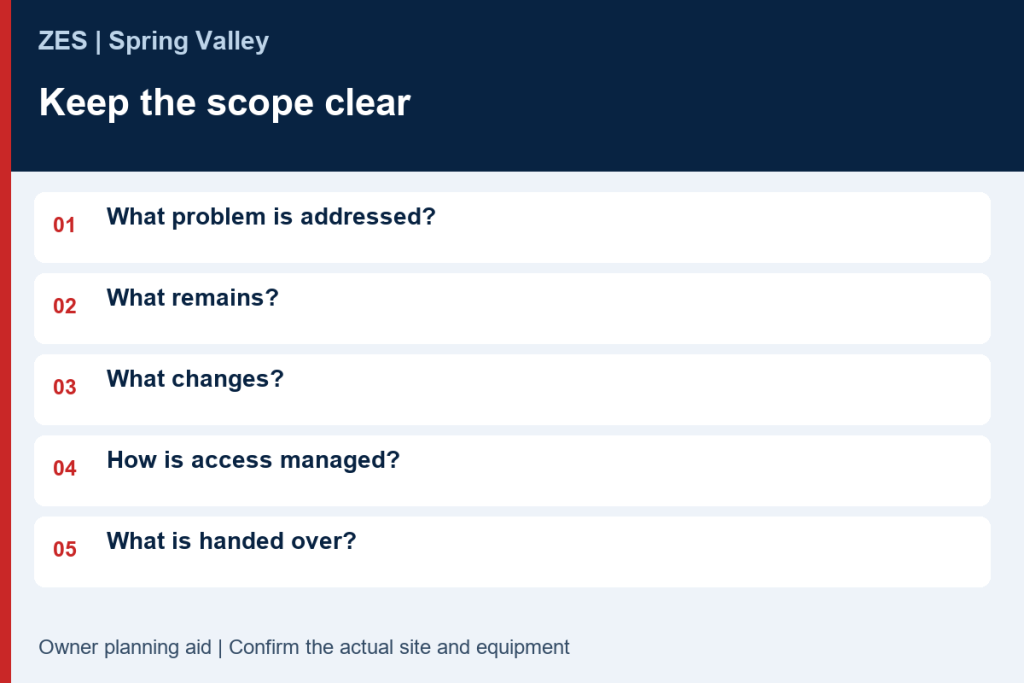
| Question | Repair proposal | Upgrade or replacement proposal |
|---|---|---|
| What problem is addressed? | Confirmed fault and intended correction | Condition or new requirement driving the change |
| What remains? | Retained operator and accessories | Retained gate and compatible components |
| What changes? | Identified parts and work | New equipment and related installation work |
| How is access managed? | Existing or revised user procedure | Device transition and administration |
| What is handed over? | Findings, checks and actual terms | Equipment record, checks and actual terms |
Use the actual supplier proposals to fill the table. Mark missing information as unconfirmed rather than inventing an allowance. Ask ZES to clarify its proposed scope before approval.
Planning work at an occupied property
Explain how the entrance is used and whether another approved route exists. Confirm the site contact and appointment arrangements. The owner or manager should decide how users are informed and who may authorise additional work.
If a part must be sourced, discuss the next step and how the entrance should be managed in the meantime. Do not improvise a mechanical or electrical workaround. The actual condition, manufacturer instructions and site procedure determine appropriate owner actions.
Record any change to the programme or scope. A clear approval process helps avoid confusion about work that was discussed but not authorised. It also makes the final invoice easier to compare with the agreed proposal.
Common questions about an older installation
Does an old motor always need replacement?
No universal age rule is given here. Condition, diagnosis, suitability and parts availability matter. Ask for the reason behind the recommendation and compare the complete options where both are practical.
Can the existing remotes be kept?
Possibly, subject to the receiver and supported arrangement. Confirm compatibility before ordering a new motor or controls. Similar appearance does not establish that a handset will work with the proposed system.
What if previous repairs were undocumented?
Share what is known and arrange assessment of the current installation. Begin a useful record with the new findings. Do not guess a controller revision or part number simply to complete an enquiry form.
Where should model information come from?
Use existing records, safely accessible labels and the competent assessment. Manufacturer resources such as Centurion technical support can help identify the relevant documentation.
Repair, partial upgrade or full replacement?
An established automatic gate may offer more than two choices. A defined fault might be repaired, a particular part of the gate automation system might be upgraded, or a broader replacement might be appropriate. The assessment should establish the condition and suitability of the actual equipment before the owner chooses between those scopes.
Ask for the repair option to identify the confirmed fault and the work needed to address it. A separate upgrade option should explain what additional function or equipment change it provides. This prevents an optional improvement from being presented as though it is automatically required for every gate repair.
Compare like-for-like deliverables
If a new gate motor is proposed, identify the included accessories, retained controls, preparation, fitting and checks. A motor-only price cannot be compared fairly with a complete gate automation quotation. Include any work by another contractor in the overall project cost.
Ask what happens to the existing receiver and remotes. Retaining them may require confirmation of the supported arrangement; replacing them may affect every authorised user. Record that consequence before approving equipment, particularly at a shared entrance.
Consider the remaining installation
A new operator does not renew the track, hinges, supports or other retained parts of an automatic gate. Ask the assessor to identify relevant mechanical work and outstanding recommendations. Conversely, a mechanical repair does not mean an unrelated controller or power issue has been resolved.
Keep the final decision with the assessment findings and actual warranty terms. Record why a gate motor was retained or replaced and which limitations remain. These records help the next service discussion stay focused on evidence. They also help a future owner understand whether the last project was a narrow gate repair or a more extensive change to the gate automation system.
Request a Spring Valley assessment
Send ZES your enquiry with the location, gate type, known model and the fault or improvement you want assessed. Call or WhatsApp +254 725 345 345 to discuss attendance and the next step. A clear brief supports a repair or upgrade decision based on the actual entrance.