
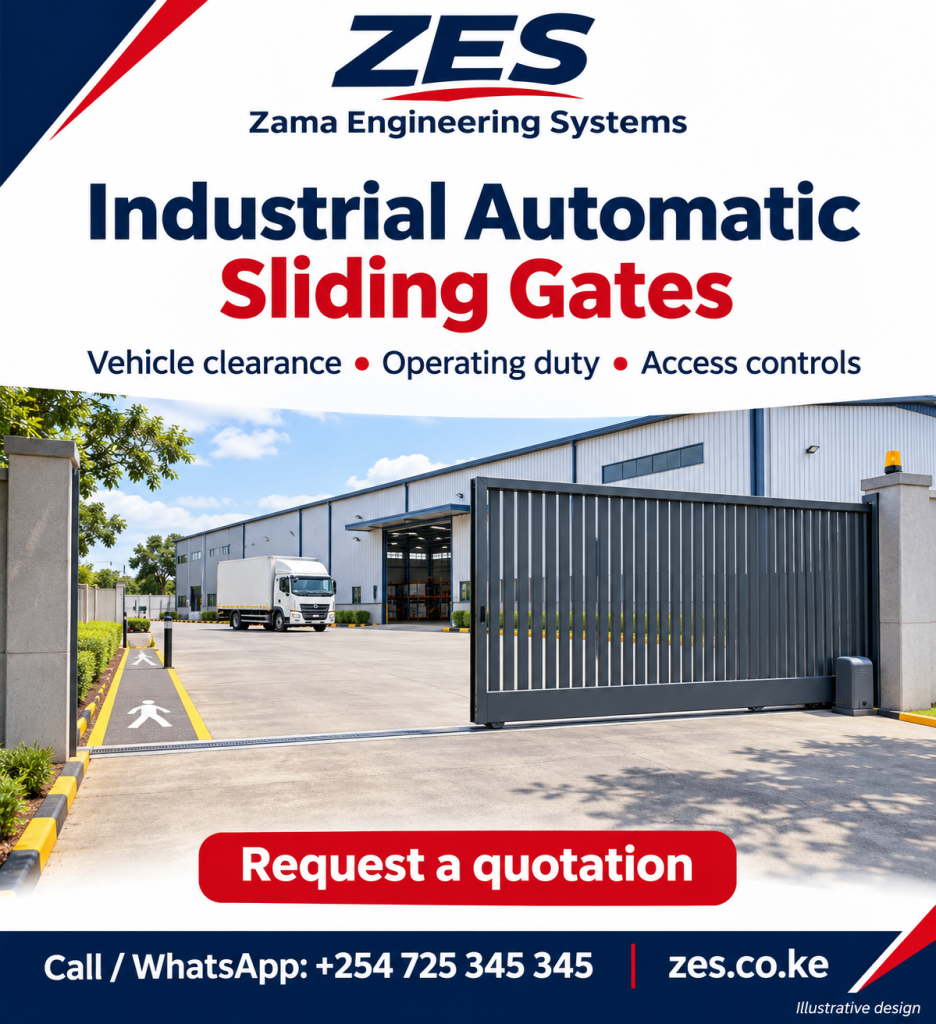
Industrial Automatic Sliding Gates should be planned around the vehicles, people and operating procedures at the site. ZES can assess automation requirements with the responsible facilities team and define the proposed work and interfaces. A wide entrance alone does not establish the correct operator or a complete industrial access design.
Industrial Automatic Sliding Gates: 7 essential site checks
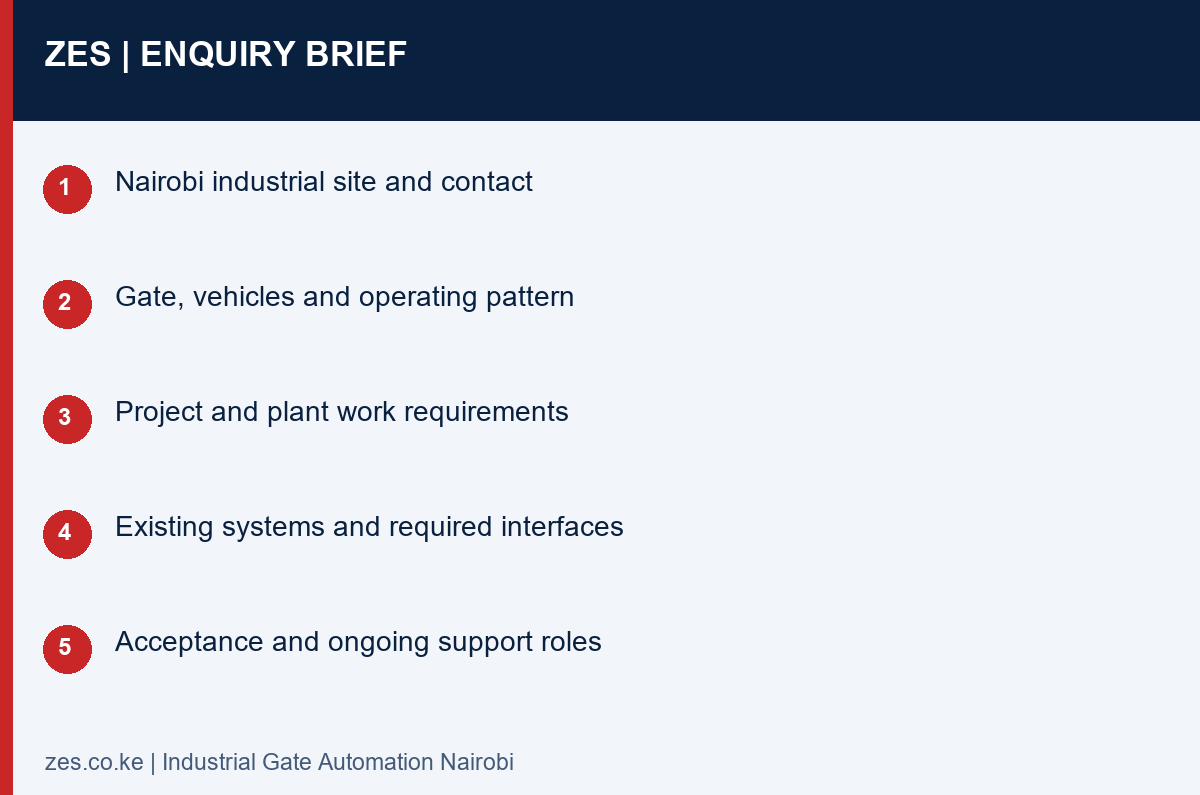
1. Define the vehicle movement
Describe the largest vehicles, approach direction, turning constraints and available waiting space. Include delivery patterns and any need to separate incoming and outgoing traffic. Gate opening dimensions should be assessed against the actual movement plan, not chosen only from the width of a typical car.
2. Record operating demand
Identify peak periods, shift changes and repeated delivery movements. Ask how the proposed equipment suits that duty. A quiet average day can hide a demanding short period. Planned site expansion should also be discussed before the installation scope is fixed.
3. Assess the industrial gate and civil interfaces
The gate structure, supports, running arrangement, drainage and mounting work require clear responsibility. Identify which work belongs to the fabricator, civil contractor and automation installer. Existing drawings and site records can help, but the actual condition still needs assessment.
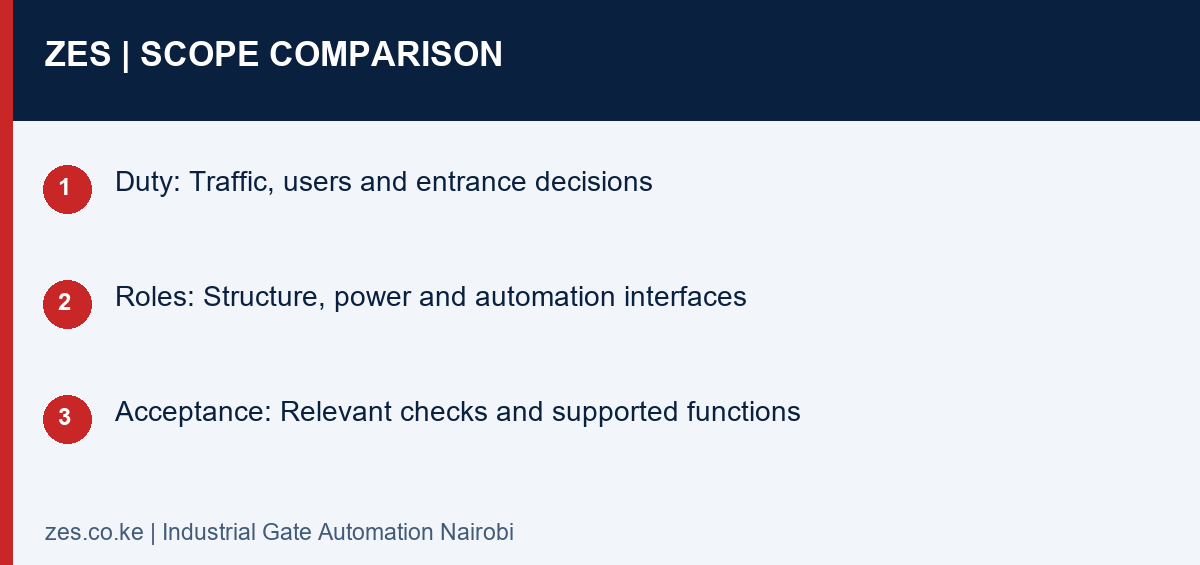
4. Separate pedestrian routes
Explain where staff, contractors and visitors walk. The vehicle entrance should be assessed with those movements in mind, including waiting areas and crossing points. Appropriate protective measures must be considered for the complete site arrangement, not only the motor enclosure.
5. Specify control and security interfaces
State whether guards, access-control equipment or another authorised system will operate the industrial gate. Name the existing equipment where possible and describe the required action. Confirm compatibility, approval responsibility and who will demonstrate the complete interface at commissioning.
6. Plan work and outage procedures
Industrial premises may have permits, induction requirements and restricted work periods. Tell ZES about these before scheduling. Agree how vehicle access will be managed during installation or repair and who may approve changes. Operational continuity requires a site plan rather than an unsupported promise of no disruption.
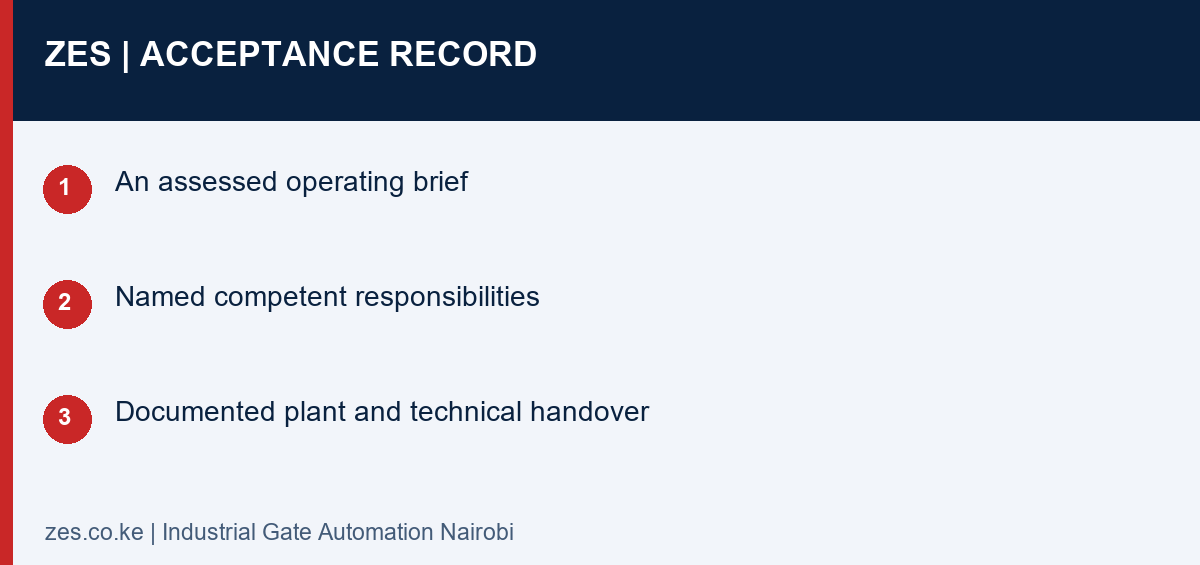
7. Define acceptance and maintenance records
Agree what operation will be demonstrated, who attends acceptance and which documents the facilities team receives. Keep equipment details, user instructions, service findings and actual support terms. Record outstanding work separately so an incomplete interface is not mistaken for an accepted installation.
What belongs in the industrial quotation?
Ask for the proposed equipment, structural or civil interfaces, electrical work, controls, protective provisions, commissioning and exclusions. Identify any work supplied by other contractors. For procurement, include the site location, scope reference and relevant access requirements in the enquiry.
Request a ZES industrial assessment
Arrange a site survey or send your project brief. Include gate photographs, vehicle types, operating periods, current drawings where available and the responsible site contact. ZES can then discuss the assessment and proposed automation scope.
Turning an industrial entrance brief into a workable scope
Start with the operational problem. A warehouse may need to manage delivery arrivals, a factory may need to handle a shift change, and a shared compound may need to distinguish tenants from visitors. These are different requirements. Describe the desired behaviour before selecting equipment or a control method.
The facilities team should identify who owns the project, who approves the work and who will operate the entrance after installation. Include the security team and relevant site contractors in the discussion. A gate project is easier to commission when each interface has a named responsible party.
Provide drawings where available, but distinguish existing records from verified current conditions. A drawing may not show later paving, drainage changes or equipment additions. The site assessment should establish the actual entrance and any preparation needed for the proposed work.
Vehicle dimensions, queues and waiting space
List the vehicle types that use the entrance, including occasional larger deliveries. Explain their approach and turning requirements. A gate opening should be considered with the usable route through it; a wide opening alone does not guarantee an easy approach for a long vehicle.
Describe where a vehicle waits while its access is approved. Queues should be considered in the site’s traffic arrangements and relevant access requirements. Do not assume a faster motor will solve a waiting-space or visitor-processing problem. The operational procedure may need attention as well as the equipment.
If incoming and outgoing vehicles use one opening, explain how priority is managed. If a separate lane is planned, show its location. These details help the responsible designer and installer assess the required control arrangement without promising a universal solution.
Tracked and cantilever arrangements
An industrial sliding gate may use different supporting arrangements depending on the site and design. The structural and mechanical requirements must be assessed by the responsible competent parties. Ask how the proposed gate is supported, guided and limited in travel, and what civil work is required.
Existing tracks and foundations should be assessed for condition and suitability before automation. Drainage, debris and the surrounding surface can affect maintenance and operation. Tell the assessor about recurring site conditions rather than presenting only a clean photograph on the day of the visit.
If the industrial gate is being fabricated, coordinate the design with the automation requirements before manufacture. Ask who confirms the interfaces between the gate structure, operator, rack and foundations. A clear division of work should still lead to one understood completed arrangement.
Selecting equipment for the operating duty
The installer needs the industrial gate characteristics and usage pattern to propose suitable equipment. Give peak activity and any long operating periods. Ask for the proposed model and the basis of selection. Do not assume that an industrial label means unlimited operation in every environment.
Discuss future changes that are reasonably known, such as an additional tenant or delivery shift. The proposal can then identify the assumptions it uses. Avoid paying for an undefined promise of future proofing; specify the actual expected change and ask how it affects the design.
Manufacturer documentation should support the selected equipment and configuration. The FAAC documentation resources and Centurion technical resources are examples of model-specific information sources. The installed model determines which documents apply.
Working with guards and access-control systems
Explain whether a guard initiates movement, an authorised credential requests access or another supported system is involved. State the intended sequence rather than simply asking for smart access. The required function, equipment compatibility and approval process should be clear.
If a system is managed by another provider, identify who can approve and configure its connection. The quotation should distinguish the industrial gate installation from external software, licensing or network work. Do not assume that every existing product can be connected without changes.
At acceptance, the responsible parties should demonstrate the agreed end-to-end function. Record any interface that remains incomplete. A motor working from its local control does not prove that the complete access-management requirement has been delivered.
People around an industrial gate
Staff, contractors and visitors may approach an entrance on foot even when it is mainly intended for vehicles. Identify their route, waiting area and crossing points. The gate’s movement and the surrounding traffic should be included in the site assessment.
Ask the competent installer to explain the proposed protective provisions and their role in the complete entrance. Do not ask for protective functions to be disabled to improve throughput. A queue or nuisance stop should be assessed rather than hidden by an unsafe adjustment.
Operating instructions should be usable by the people who control the industrial gate. Where several shifts are involved, arrange an appropriate handover process rather than training only one person and assuming the information will reach everyone else.
Planning installation without losing control of access
Explain induction, permit and site-access requirements before scheduling work. Identify restricted periods, deliveries and other contractors working near the entrance. The proposed work plan should state how the area and access will be managed during installation.
Agree who may approve variations when unexpected conditions are found. A facilities contact should be available to resolve decisions without leaving technicians to guess the owner’s priorities. Keep changes to the scope and programme documented.
No blanket promise of uninterrupted access is made here. The practical arrangement depends on the site, work and alternative routes. Discuss those details with ZES before agreeing an installation date.
Power interruptions and abnormal operation
State the required outage behaviour and available alternative access. Ask what the proposed equipment supports and what its limitations are. Battery or solar provisions need a defined equipment arrangement and operating assumptions, not a generic promise that the industrial gate will always work.
The nominated users should receive the correct instructions for normal and abnormal conditions. Do not improvise a manual-release or electrical procedure. If the industrial gate is damaged or unpredictable, keep people clear and seek competent assistance.
Retain the equipment documentation where the facilities team can find it. An outage or breakdown is a poor time to discover that the only manual or contact details were held by a former employee.
Procurement and acceptance worksheet
| Topic | Record before approval |
|---|---|
| Site requirement | Vehicle types, peak demand and access procedure |
| Mechanical scope | Gate, supports, running arrangement and repairs |
| Equipment | Proposed model and supplied accessories |
| Interfaces | Power, controls and work by other contractors |
| Work plan | Site rules, access arrangements and approval contact |
| Acceptance | Demonstration, documentation and outstanding items |
| Support | Actual warranty, maintenance and service terms |
Use this worksheet to compare supplier offers against the same requirement. Mark an unclear item as unconfirmed rather than treating it as included. Ask for clarification before comparing the final totals.
At handover, retain the final agreed scope and record changes made during the work. This gives maintenance staff an accurate starting point and helps future procurement distinguish a repair, an upgrade and a new installation.
Industrial gate questions
Can an existing manual sliding gate be automated?
It may be possible after assessment of its condition, supporting arrangement and intended use. The proposal should identify preparation or repairs. Automation should not be selected to force a defective gate through its travel.
Is a boom barrier the same as a sliding gate?
No. They can serve different access-management functions. Explain the site’s requirement so the responsible parties can assess whether one or both are appropriate. This article does not claim crash-rated or anti-ram performance for ordinary gate equipment.
Can the system connect to existing access control?
Potentially, subject to the supported interface and the existing equipment. Provide the model and desired function. Confirm who handles configuration and who demonstrates the completed interaction at acceptance.
How do we arrange an assessment?
Send ZES the location, entrance photographs, vehicle types, usage pattern and responsible contact. Include relevant site rules and drawings where available. Request an industrial gate quotation or book a site survey to discuss the proposed work.
Further guidance for your entrance
Example: a warehouse entrance with delivery queues
In an illustrative warehouse project, trucks wait while a guard confirms delivery details. The owner asks for a faster industrial gate. Before selecting equipment, distinguish the industrial gate movement time from the visitor-processing and waiting-space issues. A different motor may not resolve a queue caused by the approval procedure.
Record vehicle types, peak arrivals and where vehicles wait. Explain whether staff or visitors cross the entrance on foot. The responsible site team can then assess the movement plan and the automation requirement together. The proposed industrial sliding gate should support that plan rather than stand in for it.
If another access-control system is involved, identify the intended sequence and who maintains it. Ask the proposal to define the interfaces and demonstration at acceptance. The completed function should be clear enough that the facilities team can verify it against the brief.
This example is not a claim about a completed ZES project or a guaranteed reduction in waiting time. It illustrates the questions that separate an equipment purchase from an operational problem requiring a wider assessment.
Example: automation added to an existing factory gate
A factory may have a manually operated sliding gate and want controlled vehicle access. The first task is to assess the industrial gate, supports, running arrangement and intended duty. Existing equipment should not be declared suitable merely because it has served as a manual entrance for years.
Ask the relevant competent parties to identify necessary preparation and allocate responsibilities. If the industrial gate needs fabrication or civil work, coordinate it with the automation requirements. The operator quotation should state what condition the entrance must be in before fitting and commissioning.
Explain site rules, work permits and restrictions before scheduling. The work plan should identify the responsible contact and how access is managed while the installation is incomplete. A factory entrance may affect several teams, so the approval process should not depend on conflicting informal instructions.
At handover, record the supplied equipment and retained components. Include the relevant operating instructions and outstanding work. The facilities team should be able to understand the final arrangement without relying on the memory of the person who supervised installation.
Example: a shared industrial compound
A shared compound may have several tenants with different delivery schedules. Agree who administers access, who approves changes and how visitor requests are handled. The industrial gate controls should support a defined management process rather than create several independent, undocumented access arrangements.
Provide the expected operating demand and any planned changes in occupancy. Ask how those assumptions affect equipment selection. Where tenants use different systems, compatibility and integration responsibilities need explicit review; universal integration should not be assumed.
Keep an equipment and service record at the compound-management level. Individual tenants may change, but the entrance remains a shared asset. A named responsible team can preserve the records and make later repair enquiries more accurate.
If the industrial gate develops a fault, gather observations through one contact. Explain the access situation and existing alternatives. This helps a repair discussion start from the actual complaint and site procedure, rather than several conflicting descriptions of the same event.
Reviewing an industrial gate quotation internally
Procurement, facilities and operations may each focus on different aspects of the offer. Use the same scope document for all three. Procurement needs the supplied items and terms; facilities needs equipment and maintenance information; operations needs the agreed movement and access arrangement.
Ask for unclear exclusions to be resolved before comparing totals. A quotation that assumes civil work, power and external-system configuration are provided by others must identify those responsibilities. Missing interfaces can delay acceptance even when the motor itself has been fitted correctly.
Record who approves the final scope and any variations. If the equipment or operating requirement changes, update the proposal so the acceptance criteria still describe the work being delivered. Keep the final version with the asset record.
Preparing for future service
Retain model details, manuals, completed checks, actual warranty terms and the service contact. Record significant changes to controls or the industrial gate structure. Where other systems are connected, keep the responsible provider’s details and the agreed function.
If operating demand changes, review the entrance requirement rather than assuming the original selection remains suitable indefinitely. A new delivery shift or tenant can alter the usage pattern. Discuss the actual change with a competent assessor before requesting an equipment upgrade.
A useful service record does not promise that faults will never occur. It helps the responsible team report problems accurately, compare repair options and approve work against known equipment and site requirements.
Related ZES gate guides
FAAC installation · Gate spare parts · Automatic gate prices · Request a quotation