
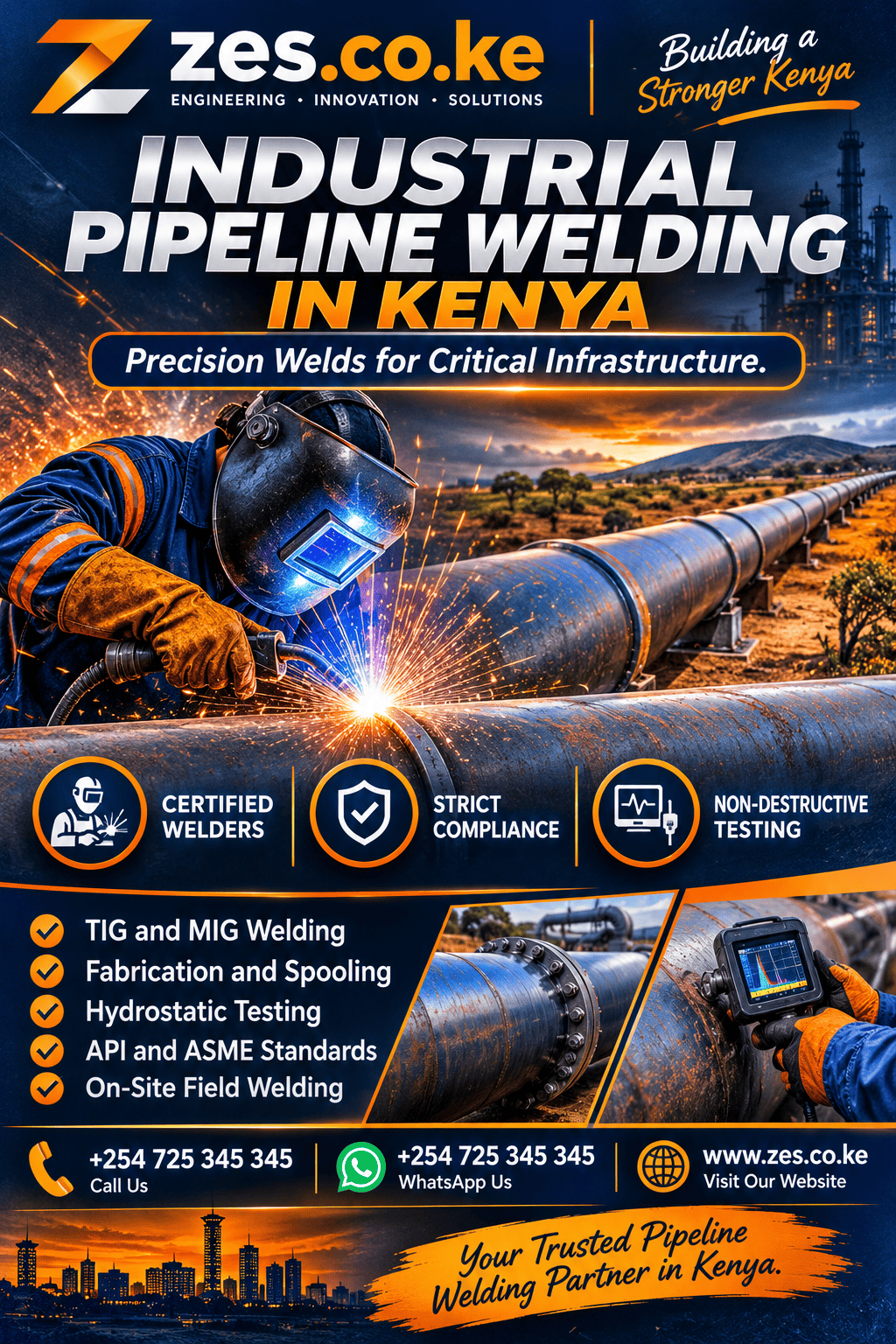
Industrial pipeline welding in Kenya requires a unique blend of technical expertise, safety awareness, and strict adherence to international standards. At zes.co.ke, we understand that the integrity of your fluid and gas transport systems depends entirely on the quality of the welds. Whether you are constructing a new water treatment facility in Nairobi, expanding a fuel depot in Mombasa, or maintaining an industrial plant in Thika, mastering the nuances of Industrial pipeline welding in Kenya is critical for operational safety and longevity.
When you evaluate Industrial pipeline welding in Kenya, you must consider the specific environmental conditions and regulatory frameworks that apply locally. The demand for Industrial pipeline welding in Kenya has grown rapidly alongside the country’s infrastructure development. Professional Industrial pipeline welding in Kenya ensures that high-pressure systems and hazardous material pipelines are constructed without flaws.
At zes.co.ke, we specialize in comprehensive Industrial pipeline welding in Kenya services that meet the stringent requirements of the Energy and Petroleum Regulatory Authority (EPRA) and the Kenya Bureau of Standards (KEBS). Quality Industrial pipeline welding in Kenya prevents catastrophic failures, environmental contamination, and costly downtime. Engaging certified professionals for Industrial pipeline welding in Kenya is not just a regulatory requirement; it is a fundamental risk management strategy.
The process of Industrial pipeline welding in Kenya involves selecting the right welding procedure for the specific material and application. We approach Industrial pipeline welding in Kenya with a strict focus on metallurgy and joint preparation. Every aspect of Industrial pipeline welding in Kenya, from root pass to cap, must be executed flawlessly. Our teams ensure that all Industrial pipeline welding in Kenya complies with ASME and API codes.
For industries requiring high-purity piping, Industrial pipeline welding in Kenya using TIG (Tungsten Inert Gas) processes is often the preferred method. Advanced Industrial pipeline welding in Kenya techniques prevent contamination and ensure smooth internal surfaces. Before commencing any Industrial pipeline welding in Kenya, a rigorous Welding Procedure Specification (WPS) must be developed and qualified. Reliable Industrial pipeline welding in Kenya requires continuous inspection and non-destructive testing.
The importance of Industrial pipeline welding in Kenya cannot be overstated in sectors dealing with water, gas, and petroleum. According to standards set by the American Petroleum Institute (API), Industrial pipeline welding in Kenya must adhere to strict quality control measures. Furthermore, guidance from Wikipedia’s article on pipeline transport highlights that the integrity of these systems relies entirely on the welder’s skill. For global best practices in Industrial pipeline welding in Kenya, professionals often refer to the American Welding Society (AWS) standards. The Kenya Bureau of Standards (KEBS) provides local regulations that apply to Industrial pipeline welding in Kenya.
{{VIDEO_EMBED: Insert a 2-minute video here showing a certified welder performing a root pass on a large-diameter steel pipe, followed by a Non-Destructive Testing (NDT) inspector using an ultrasonic flaw detector.}}
The Core Welding Processes Used
Executing successful Industrial pipeline welding in Kenya relies on selecting the appropriate welding process. The environment, pipe material, and fluid being transported dictate the method used.
Shielded Metal Arc Welding (SMAW): Often called stick welding, this is a versatile and widely used method in Industrial pipeline welding in Kenya. It is highly portable and effective in outdoor environments, making it ideal for remote pipeline routes. The flux coating on the electrode protects the weld pool from atmospheric contamination, which is crucial when working in dusty Kenyan conditions.
Gas Tungsten Arc Welding (GTAW/TIG): When precision is paramount, TIG welding is the gold standard for Industrial pipeline welding in Kenya. It uses a non-consumable tungsten electrode and a separate filler rod. This process is slower but provides superior control, making it the preferred choice for the root pass on high-pressure pipelines and for welding stainless steel or specialized alloys.
Flux-Cored Arc Welding (FCAW): For large-diameter pipes and high-productivity requirements, FCAW is frequently utilized in Industrial pipeline welding in Kenya. It offers high deposition rates and is less sensitive to wind than MIG welding, making it suitable for field operations where conditions are less than ideal.
Gas Metal Arc Welding (GMAW/MIG): Known for its speed and ease of automation, MIG welding is often used for pipeline fabrication in shop environments. However, its susceptibility to wind means it requires protective shelters when deployed in the field.
Material Selection and Metallurgy
The materials used in Industrial pipeline welding in Kenya must be carefully matched to the transported medium. Carbon steel remains the most common material for water and oil pipelines due to its strength and cost-effectiveness. However, stainless steel is required for food processing, chemical transport, and pharmaceutical applications to prevent corrosion and maintain purity.
When planning Industrial pipeline welding in Kenya, engineers must consider the pipe’s wall thickness, diameter, and operating pressure. The welding procedure must account for the heat input to prevent microstructural changes that could lead to cracking or reduced toughness in the heat-affected zone.
Quality Assurance and Non-Destructive Testing
No project involving Industrial pipeline welding in Kenya is complete without rigorous quality assurance. Visual inspection is the first line of defense, checking for surface defects like undercuts, porosity, or poor bead profiles.
However, internal defects cannot be seen by the naked eye. This is where Non-Destructive Testing (NDT) becomes vital for Industrial pipeline welding in Kenya. Techniques such as Radiographic Testing (X-ray) and Ultrasonic Testing (UT) allow inspectors to look inside the weld without destroying it.
Hydrostatic testing is another critical phase. The completed pipeline is filled with water and pressurized to levels higher than its intended operating pressure. This test proves the structural integrity of the Industrial pipeline welding in Kenya and identifies any leaks or weak points before the system goes live.
Safety and Environmental Considerations
Safety is the overriding priority in Industrial pipeline welding in Kenya. Welders face hazards ranging from intense heat and UV radiation to toxic fumes and confined spaces. Proper Personal Protective Equipment (PPE), including auto-darkening helmets, fire-resistant clothing, and respiratory protection, is mandatory.
Environmental protection is equally important. Spills of oil, chemicals, or fuel can have devastating ecological impacts. Therefore, Industrial pipeline welding in Kenya must incorporate secondary containment measures, leak detection systems, and emergency shut-off valves into the overall design.
Regulatory Compliance in Kenya
Navigating the regulatory landscape is a key part of Industrial pipeline welding in Kenya. The Energy and Petroleum Regulatory Authority (EPRA) dictates strict guidelines for fuel pipelines, storage, and dispensing.
Additionally, the National Construction Authority (NCA) and the Directorate of Occupational Safety and Health Services (DOSHS) oversee the safety and structural integrity of industrial installations. Working with a partner that understands these regulations is essential for avoiding fines and ensuring operational continuity.
Applications Across Kenyan Industries
Oil and Gas: The transport of refined petroleum products from depots to retail stations relies on robust Industrial pipeline welding in Kenya.
Water Treatment: Municipal water supply systems require massive networks of welded pipes. The quality of Industrial pipeline welding in Kenya here directly impacts public health, as leaks can lead to contamination.
Manufacturing: Factories use complex piping systems to transport steam, compressed air, and process chemicals.
Agriculture: Irrigation systems and food processing plants require specialized welding to ensure watertight and hygienic conditions.
Pipeline Fabrication and Shop Welding
While field welding is common, much of the preliminary work in Industrial pipeline welding in Kenya happens in a controlled fabrication shop. Pipes are cut, bevelled, and joined into spools. These spools are then transported to the site for final assembly.
Shop welding allows for better quality control, as environmental factors like wind and rain are eliminated. Automated welding machines are often used in the shop to ensure consistent quality and high production rates.
The Economics of Quality Welding
While the initial cost of Industrial pipeline welding in Kenya might seem high, the long-term economic benefits are undeniable. A failed weld can result in thousands of shillings in lost product, environmental clean-up costs, and downtime.
By investing in high-quality Industrial pipeline welding in Kenya, companies reduce their maintenance costs over the life of the pipeline. A properly welded joint can last for decades, far outlasting mechanical fittings or inferior welds.
Common Mistakes to Avoid
When seeking services for Industrial pipeline welding in Kenya, organizations often make the mistake of prioritizing cost over quality. Hiring uncertified welders can lead to catastrophic failures.
Another common error is inadequate joint preparation. Failing to clean the pipe ends, ensure proper alignment, or apply the correct bevel can result in incomplete fusion.
Finally, skipping the post-weld inspection phase is a critical error. Visual inspection alone is insufficient; relying on certified NDT professionals is a mandatory step in all industrial projects.
The Future of Industrial Pipeline Welding
The technology surrounding Industrial pipeline welding in Kenya is constantly advancing. Automated orbital welding systems are becoming more accessible, offering precision and speed that manual welding cannot match.
Furthermore, the use of advanced materials, such as high-density polyethylene (HDPE) and composite pipes, is increasing. While these require different joining techniques (like butt-fusion), the foundational principles of joint integrity remain the same.
Selecting the Right Partner
Choosing the right partner for Industrial pipeline welding in Kenya is the most critical decision you will make. Look for a firm with certified welding inspectors (CWI), proven experience in your specific sector, and a strong safety record.
At zes.co.ke, we bring unparalleled expertise to every project. We understand the local environment, the regulatory requirements, and the technical demands of creating leak-proof, high-pressure systems. We ensure that our clients receive the highest quality Industrial pipeline welding in Kenya available.
Frequently Asked Questions
Q: How long does it take to weld a pipeline?
A: The timeline depends entirely on the diameter of the pipe, the total length of the run, and the welding process used. Large-scale projects can take months, while smaller installations can be completed in days.
Q: What is the typical lifespan of a welded pipeline?
A: With proper design, correct material selection, and high-quality welding, an industrial pipeline can last 30 to 50 years. Regular inspection and maintenance are key to achieving this lifespan.
Q: Can you weld in the rain?
A: Generally, no. Rain can compromise the weld pool and introduce hydrogen into the metal, causing cracking. Proper shelters must be erected for field welding in wet conditions.
Q: Why is NDT necessary?
A: Non-Destructive Testing ensures that internal defects (like porosity or lack of fusion) are detected before the pipeline is pressurized. It is a mandatory safety and quality assurance measure.
Q: What is a WPS?
A: A Welding Procedure Specification is a formal document detailing the exact parameters (materials, heat, voltage, speed) required to make a specific weld. It ensures consistency and repeatability.
Investing in professional Industrial pipeline welding in Kenya is the only way to ensure the safety, efficiency, and longevity of your fluid transport systems. From the initial design phase to the final NDT inspection, every step must be executed with precision.
At zes.co.ke, we provide the expertise and technical capability required for complex welding projects. We ensure that your installations meet all regulatory standards and perform flawlessly under pressure.
For more information about our Industrial pipeline welding in Kenya services and to schedule a free site assessment, contact zes.co.ke today. Let our experts build the backbone of your industrial operations.