
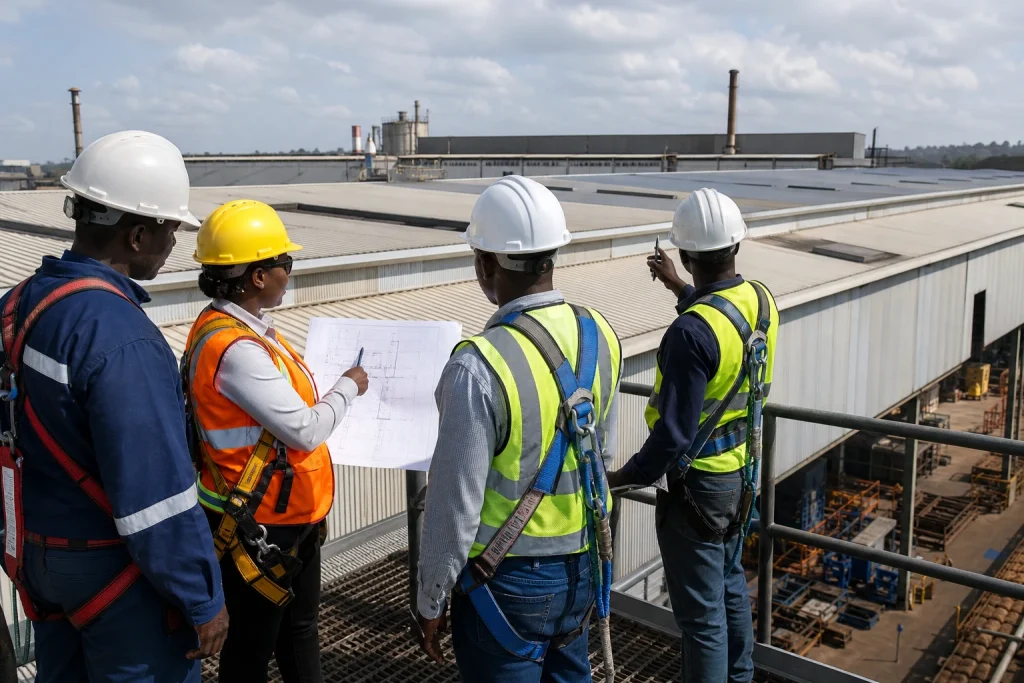
Industrial rooftop solar installation Kenya buyers are considering should begin with the building, electrical demand and operating constraints—not with a panel count copied from another site. A factory or warehouse roof is already part of a working asset. Its condition, drainage, structure, warranties, fire routes, maintenance access and relationship to production all influence whether a proposed photovoltaic system is practical.
This guide helps owners, facilities managers, engineers and procurement teams prepare a site-specific enquiry. It complements ZES information on industrial electrical services. ZES can consider an enquiry and help define what must be surveyed, but the written quotation must identify the responsible parties, licensed arrangements and approved technical information for the actual project.
For the cluster-wide procurement and licensing framework, review solar installation services Kenya; the sections below concentrate on industrial roof, load and operating-site interfaces.
What industrial rooftop solar installation Kenya buyers should define
Start with the business outcome. Is the priority to serve predictable daytime demand, reduce reliance on one supply source, support selected critical loads, prepare for later storage, or coordinate solar with an existing generator? These are different design problems. A project brief should state normal operating hours, seasonal production changes, planned expansion, shutdown periods and any loads that must not be disturbed.
Collect at least a representative history of electricity bills and, where available, interval or demand data. Bills show cost and consumption, but a design also needs to understand when energy is used. A large monthly total does not prove that the roof generation profile will match the site. Record weekday, weekend, night-shift and holiday operation rather than assuming one typical day.
Separate essential and discretionary objectives. Solar generation depends on weather and system availability. It should not be described as guaranteed uninterrupted power. If continuity is required, define the loads, duration and acceptable transfer behaviour so grid, generator, uninterruptible power supply and battery options can be assessed deliberately.
Survey the roof as an operating asset
A rooftop survey should document roof type, age, visible defects, previous repairs, drainage paths, penetrations, skylights, vents, smoke outlets and safe access. It should also record equipment that casts shade now or may be added later. Photographs need location references so a designer can relate an observation to the roof plan.
Structural suitability cannot be assumed from appearance. The appropriate building and structural professionals should confirm available information, loading, connection details and any strengthening or repair requirement. The solar scope should not hide unresolved roof work. Clarify whether a landlord, tenant, insurer, roof manufacturer or other party must approve an alteration, and how roof warranties will be protected.
Plan inspection routes around the array. Maintenance teams may need access to gutters, roof sheets, vents, lightning-protection components and other services throughout the system life. Modules should not turn an ordinary roof repair into an unsafe improvisation. Include fall-protection arrangements, lifting routes and the method for keeping unauthorised people away from the work area.
Map electrical capacity and connection interfaces
The electrical survey should identify the point of connection, service arrangement, transformers where relevant, main switchboards, protection, earthing, metering, available space and cable routes. Record generator, automatic-transfer, power-factor-correction and power-quality equipment that could interact with the proposal. Existing drawings should be checked against the installed condition rather than accepted automatically.
Ask for a preliminary single-line diagram and a schedule of interfaces. The design should show how the photovoltaic source is isolated, protected, labelled and monitored, and how it behaves during loss and restoration of other supplies. Cable containment, fire stopping, voltage-drop assumptions and equipment environmental ratings belong in the coordinated scope.
Kenya’s EPRA business-process page lists processes for solar PV contractor and worker licensing, while the EPRA renewable-energy page links to renewable-energy information and registers. Project-specific licensed solar PV contractor, solar worker and electrical arrangements must be confirmed in the written quotation before regulated work begins. This draft does not represent ZES as holding any particular solar licence.
Build a comparable procurement scope
A useful request for quotation gives each bidder the same baseline: site and roof plans, electricity information, intended operating mode, known structural information, proposed connection point, access hours and required completion window. It also identifies information that remains provisional. This makes exclusions visible and reduces misleading comparisons based only on nominal system capacity.
Request a component schedule without prescribing unsupported brands. The schedule can cover modules, inverters, mounting, protection, isolation, cabling, monitoring, labels and any weatherproof enclosures. Ask bidders to state design assumptions, equipment availability, warranty issuer, warranty conditions, expected documentation and who provides after-sales response.
Clarify responsibilities for roof repair, structural verification, permits, utility engagement, scaffolding or access systems, electrical shutdowns, data connectivity and waste removal. If future battery storage is contemplated, ask whether the connection arrangement and monitoring architecture preserve a sensible expansion path; do not pay for vague claims of being “battery ready.”
Control installation around production
Industrial installation planning should protect staff, production, stock and visitors. Agree delivery routes, lifting zones, roof access, temporary storage, work hours and isolation windows. Identify combustible materials, dusty processes, food or clean areas and any permit-to-work requirements. The facility remains responsible for coordinating its internal operational controls with the appointed contractor.
Sequence work so roof preparation and hidden electrical defects are resolved before equipment is committed. Pre-assemble where appropriate, but retain traceability between approved drawings and installed locations. Penetrations, cable entries and fire barriers should be closed and inspected as work progresses rather than deferred to the final day.
Prepare contingency decisions for rain, inaccessible routes, roof damage or a switchboard condition that differs from drawings. A programme should allow a safe pause and technical review. Production pressure must not become permission for an unapproved connection or uncontrolled live work.
Commission, hand over and maintain the system
Commissioning should follow the approved design, equipment instructions and applicable requirements. The agreed records may include inspection results, test sheets, protection settings, updated single-line diagrams, equipment schedules, labels, photographs, monitoring access and outstanding-item tracking. The owner should know who accepts each result and what must be closed before operational handover.
Train nominated facilities personnel on normal status, safe isolation boundaries, alarms, monitoring, cleaning constraints and escalation. Training does not authorise unqualified staff to undertake regulated work. Define the maintenance scope, access method, reporting format and responsibility for coordinating roof and electrical inspections.
Measure performance against an agreed baseline and the actual operating context. Weather, shutdowns, new loads, curtailment, dirt and equipment availability can change results. Do not treat an indicative simulation as a guaranteed output, saving or payback period.
Consider net metering only through the current process
The Energy (Net-Metering) Regulations, 2024 establish requirements for eligible arrangements, including limits and application conditions. Their existence does not mean every industrial project is automatically eligible or approved. Confirm current utility, technical, metering, agreement and regulatory requirements for the actual customer before including export in the business case.
A base design can instead be assessed around verified on-site demand while any proposed export arrangement is treated as a separate dependency. The quotation should state whether net-metering support is included, excluded or subject to another party, without describing ZES as an approval agent.
Coverage across Kenya’s 47 counties
Baringo, Bomet, Bungoma, Busia, Elgeyo-Marakwet, Embu, Garissa, Homa Bay, Isiolo, Kajiado, Kakamega, Kericho, Kiambu, Kilifi, Kirinyaga, Kisii, Kisumu, Kitui, Kwale, Laikipia, Lamu, Machakos, Makueni, Mandera, Marsabit, Meru, Migori, Mombasa, Murang’a, Nairobi City, Nakuru, Nandi, Narok, Nyamira, Nyandarua, Nyeri, Samburu, Siaya, Taita-Taveta, Tana River, Tharaka-Nithi, Trans Nzoia, Turkana, Uasin Gishu, Vihiga, Wajir and West Pokot.
ZES can consider enquiries across Kenya subject to scope, logistics, site access, responsible licensed arrangements, equipment availability and scheduling. This national coverage statement does not imply that ZES has an office, installer, stock, completed solar project or immediate availability in every county.
Frequently asked questions
Can roof area alone determine the system size?
No. Usable roof area is one input. Roof condition, structural review, shading, setbacks, access, electrical capacity, daytime demand and the intended operating mode also affect a responsible design.
Must production stop for installation?
Not for every activity, but connection and testing can require planned isolations. The project team should separate roof work from electrical shutdown tasks and agree safe windows with the facility before mobilisation.
Does rooftop solar keep a factory running during a grid outage?
Not automatically. Behaviour during an outage depends on the approved inverter, protection, storage, generator and control design. Continuity must be specified for named critical loads rather than assumed.
Can the quotation promise savings or payback?
A quotation can disclose assumptions and provide a project-specific model, but it should not guarantee a saving or payback. Tariffs, weather, production schedules, system availability and future energy use can change.
What should be available for the first site survey?
Prepare electricity bills, operating hours, known roof drawings, roof-repair history, main electrical information, generator details, expansion plans, access rules and the names of people responsible for facilities, finance and production decisions.
To turn these inputs into a controlled enquiry, request a ZES site survey, submit a quotation brief or contact ZES. ZES will need to confirm scope and responsible licensed arrangements before any regulated solar work proceeds.