
Updated 1 November 2026 · Zama Engineering Systems buyer guide
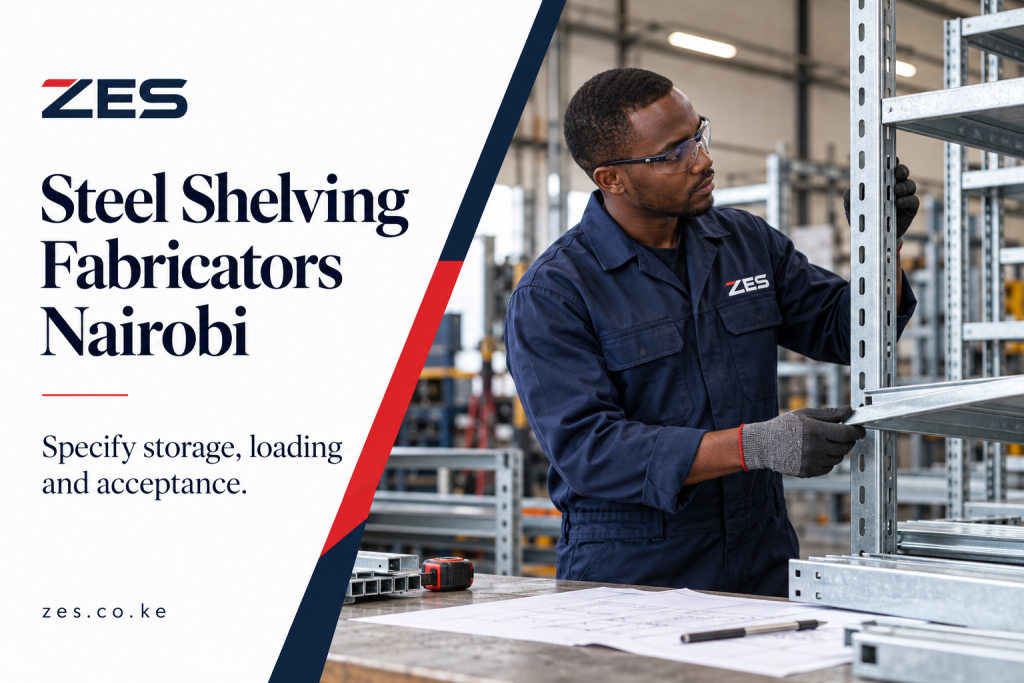
Steel shelving fabricators Nairobi enquiries should define the stored items, arrangement and required performance before selecting a shelf design. A neat display or a thick-looking section does not establish a safe capacity. This procurement section extends the existing industrial-shelving guide and explains how customers can compare material, installation and acceptance responsibilities without inventing load ratings.
Describe the stored items and working routine
Share the item types, sizes and how staff place or retrieve them. Explain whether loads are distributed, concentrated or change through the working day so the responsible designer can assess them. Keep shelf storage distinct from pallet racking or other specialist systems. A generic furniture sketch should not silently become a specification for industrial storage duty.
Steel shelving fabricators Nairobi: establish loading information
The responsible competent party should define and substantiate the required loading and use restrictions for the actual assembly. Do not copy a capacity label from a different product or infer one from material appearance. Ask what evidence and records support the proposed system. Any required labels and instructions should correspond to the installed configuration, not a general website claim.
Coordinate layout, access and stability
Describe room dimensions, aisles, doors and relevant handling equipment. The appropriate installation requirements depend on the actual system and site. Identify who assesses the supporting floor and any securing arrangements. Do not treat a freestanding appearance as proof of stability. The storage arrangement should preserve the agreed circulation and access rather than maximise the number of shelves in isolation.
Specify construction, finish and accessories
Ask for the proposed members, shelf surfaces, connections, finish and supplied accessories against the assessed requirements. Record how alternatives and changes are reviewed. A common scope makes quotations comparable. Confirm whether protective elements, dividers or other additions are included. Installing an apparently similar component later should not be assumed acceptable without review of the actual system.
Define installation and acceptance
Agree who delivers, assembles and completes any required securing work. Specify inspection and acceptance evidence appropriate to the project. Receiving staff should check the delivered items against approved information and record damage or missing parts. Do not improvise loading tests from a blog. The responsible technical party should define any required testing and the conditions for release to use.
Keep storage changes under review
Retain the approved use information, records and maintenance contact. Report damage and unusual movement through the responsible site process. Changes in shelf configuration, stored items or handling methods may need review. Avoid informal repairs that alter the approved arrangement. A useful handover helps the customer understand limits rather than encouraging a belief that every steel shelf can carry whatever fits on it.
Compare the project scope
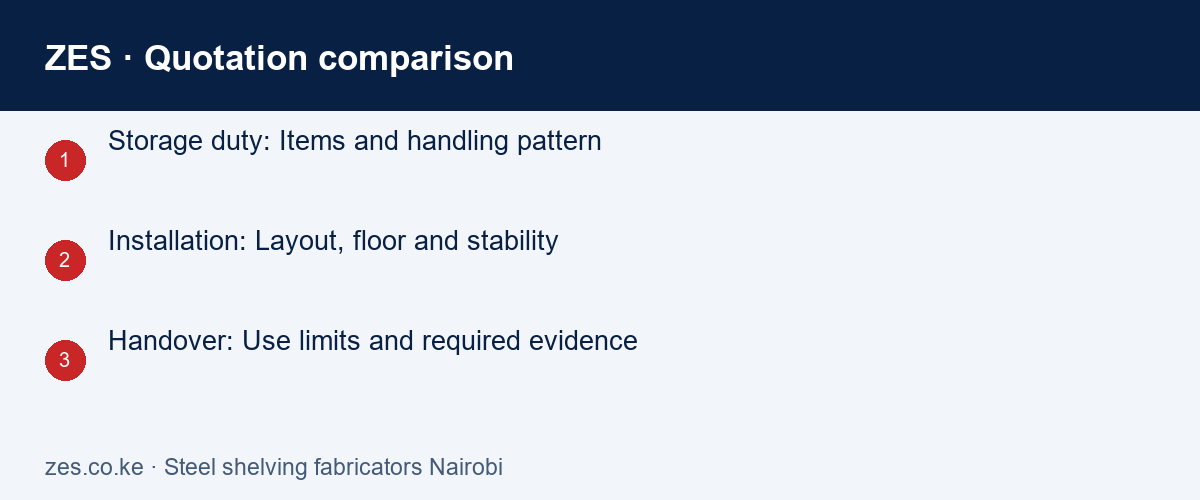
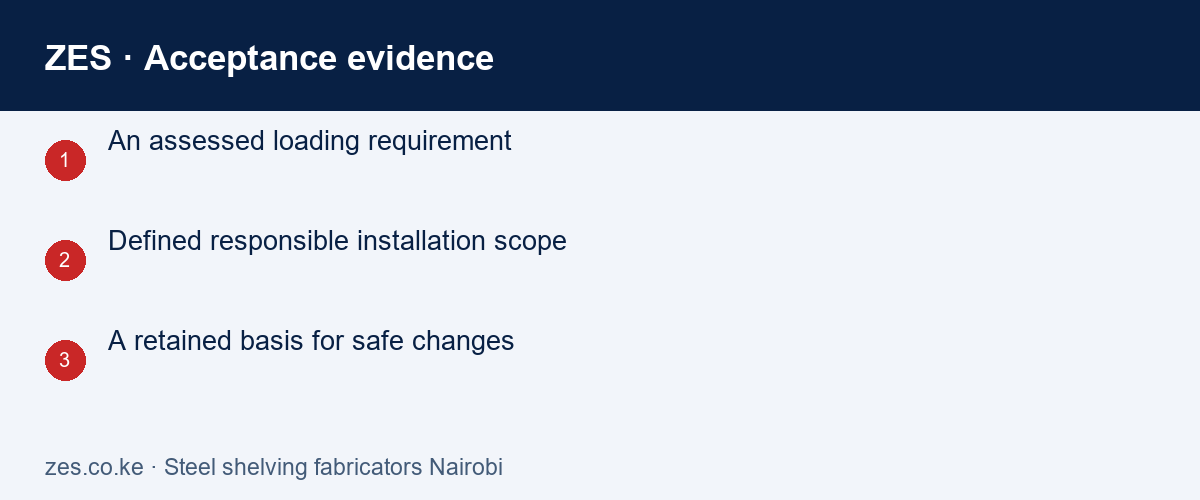
| Decision | Information to confirm | Useful acceptance evidence |
|---|---|---|
| Storage duty | Items and handling pattern | An assessed loading requirement |
| Installation | Layout, floor and stability | Defined responsible installation scope |
| Handover | Use limits and required evidence | A retained basis for safe changes |
A practical planning example
A store changes from light boxed items to dense components. The existing shelves should not be assumed suitable simply because the new items fit. This illustrates why stored-item changes need appropriate review, not a capacity calculation for a particular shelf.
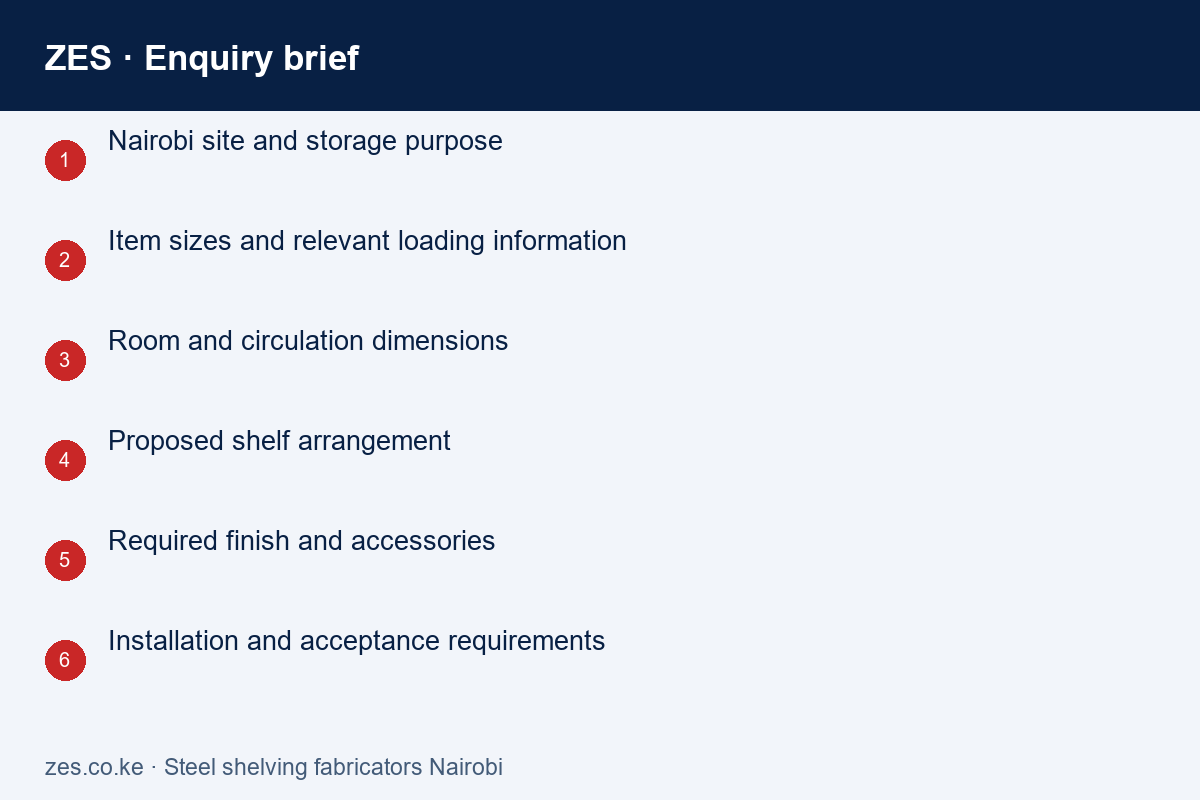
Steel shelving fabricators Nairobi: enquiry checklist
- Nairobi site and storage purpose
- Item sizes and relevant loading information
- Room and circulation dimensions
- Proposed shelf arrangement
- Required finish and accessories
- Installation and acceptance requirements
Related enquiry: Custom steel shelving Nairobi. Include the location and the intended outcome so the proposed scope can address the actual requirement.
Frequently asked questions
Can ZES quote custom shelving?
Submit the stored-item, layout and duty requirements so the appropriate assessment and proposal scope can be confirmed.
Does a strong-looking shelf prove a load rating?
No. The actual system and installed arrangement need relevant competent assessment and supporting information.
Can shelves be rearranged later?
Use the supplied instructions and obtain review where the change affects the assessed configuration or duty.
Steel shelving fabricators Nairobi: discuss the scope with ZES
Read the related ZES project planning guide and explore welding and metal fabrication services. Share the site, quantities, existing equipment and required outcome. Assessment, availability, delivery responsibilities and commercial terms are confirmed in the written proposal.
Request a scoped quotation · Request a site assessment · Call +254 725 345 345
Further reference: NCA contractor information. Product instructions and project-specific specialist advice remain important for the actual equipment and work.
More detailed project planning
Every store, workshop, warehouse and factory needs shelving. It holds stock, tools, spare parts, packaging, records and equipment. When shelving is strong, well laid out and properly installed, storage is efficient and safe. When it is improvised from weak material or overloaded, it becomes a hazard and a source of constant frustration.
Industrial steel shelving fabrication in Nairobi covers the design, fabrication and installation of shelving systems for industrial and commercial use. That ranges from light-duty shelving in a store room to heavy-duty pallet racking in a distribution warehouse. The principles are similar — strength, stability, access and safety — but the engineering and materials differ with the load.
This guide explains the types of industrial steel shelving, how load ratings work, how to plan a layout, how shelving is fabricated and installed, what affects cost, and how to choose a fabricator who understands industrial storage.
It is written for warehouse managers, stores controllers, factory engineers, procurement officers and business owners.
What Is Industrial Steel Shelving?
Industrial steel shelving is a storage system made from steel components — uprights, beams, shelves, braces and connectors — designed to hold goods safely and accessibly.
It differs from domestic shelving in several ways:
Load capacity. Industrial shelving is rated for much heavier loads, from a few hundred kilograms to several tonnes per bay.
Modularity. Systems are designed to be extended, reconfigured and relocated.
Engineering. Uprights, beams and connections are engineered for the loads and conditions.
Safety. Stability, anchoring and load limits are critical.
Durability. Industrial environments demand robust materials and finishes.
Integration. Shelving must work with forklifts, pallet trucks, aisles and building structures.
Understanding these differences helps buyers specify the right system.
Types of Industrial Steel Shelving
Different storage needs require different systems.
Light-Duty Shelving
Suited to small parts, records, stationery and light stock. Typically boltless or clip-together, with shelf capacities in the tens to low hundreds of kilograms.
Medium-Duty Shelving
Suited to stores, workshops and spare parts. Stronger uprights and beams, with higher shelf capacities.
Heavy-Duty Shelving
Suited to heavy components, tools and bulk stock. Engineered for high loads per shelf.
Boltless Shelving
Assembled with clips or rivets rather than bolts. Quick to install and reconfigure, and widely used in stores and workshops.
Long-Span Shelving
Designed for wide bays and long items, such as timber, pipes and panels.
Pallet Racking
Heavy-duty racking designed for palletised loads, usually accessed by forklifts. This is covered separately but is part of the broader storage family.
Cantilever Racking
Designed for long, awkward items such as pipes, timber and profiles, with arms extending from a central column.
Mezzanine and Multi-Tier Systems
Shelving combined with raised platforms to use vertical space.
Mobile and Compactus Systems
Shelving on rails that moves to create an aisle where needed, maximising storage density.
The right system depends on what is stored, how it is handled and how much space is available.
Materials and Finishes
Material and finish determine strength, durability and appearance.
Mild steel is the most common material for industrial shelving. It is strong, weldable and cost-effective, but requires protection against corrosion.
Galvanised steel offers good corrosion resistance and is common in cold stores, outdoor stores and humid environments.
Powder-coated steel provides a durable, attractive finish in a range of colours, often used for visible shelving and light industrial applications.
Stainless steel is used where hygiene or corrosion resistance is critical, such as food stores, hospitals and washdown areas.
Thickness and section. Uprights, beams and shelves must be sized for the load. Thin material may look similar but fail under load.
Fixings. Bolts, clips and connectors must be suitable and corrosion-resistant.
A fabricator should state the material, thickness and finish for each component.
Load Ratings and Safety
Load ratings are the most important specification for industrial shelving.
Shelf capacity. The maximum uniformly distributed load a shelf can carry.
Bay capacity. The maximum load for the complete bay.
Point loads. Heavy items concentrated in one spot can exceed a shelf's capacity even if the total load is within rating.
Dynamic loads. Forklift or pallet truck impacts can exceed static ratings.
Deflection. Shelves may deflect under load; acceptable limits depend on the application.
Stability. Tall or heavily loaded shelving must be stable and anchored.
Seismic and wind. In some locations or structures, additional considerations apply.
Safety factors. Engineering includes margins for uncertainty and wear.
Buyers should insist on load ratings and should never exceed them.
Planning a Shelving Layout
A good layout improves efficiency and safety.
Measure the space. Length, width, height, doors, columns and obstructions.
Identify what is stored. Item sizes, weights, quantities and turnover.
Determine access method. Manual picking, pallet truck, forklift or ladder.
Plan aisle widths. Enough for people, trolleys and equipment.
Plan heights. Safe reach and stable stacking.
Group by use. Fast-moving items near the point of use.
Allow clearance. Space from walls, ceilings and sprinklers.
Plan for growth. Space for additional bays or higher loads.
Consider safety. Emergency exits, fire equipment and visibility.
A layout that ignores access or safety will fail in daily use.
The Fabrication Process
Steel shelving fabrication follows a structured sequence.
1. Brief and site measurement. Understand loads, space and access.
2. Design. Produce a layout and component drawings with load ratings.
3. Material selection. Confirm steel sections, thickness and finish.
4. Cutting and forming. Accurate cutting, punching and forming.
5. Welding and assembly. Weld frames and brackets as required.
6. Finishing. Paint, galvanise or powder coat.
7. Inspection. Check dimensions, welds, finish and load capacity.
8. Delivery and installation. Assemble, level and anchor.
9. Handover. Explain load limits and safe use.
Skipping design or load rating is a safety risk.
Installation and Anchoring
Installation determines whether shelving is safe.
Levelling. Shelving must sit level and stable.
Anchoring. Uprights should be anchored to the floor or wall where required.
Bracing. Diagonal or horizontal bracing prevents racking and collapse.
Alignment. Bays should align for safe access and appearance.
Clearance. Maintain distances from walls, ceilings and services.
Protection. Column guards and corner protection reduce impact damage.
Testing. Check stability and load capacity after installation.
Handover. Train staff on safe loading.
Poor installation can turn good shelving into a hazard.
Inspection and Maintenance
Shelving needs regular inspection.
Visual checks. Look for damage, corrosion and deformation.
Load checks. Confirm shelves are not overloaded.
Fixings. Check bolts, clips and anchors.
Uprights. Look for bends, cracks and impact damage.
Beams and shelves. Check for deflection and damage.
Corrosion. Address rust before it weakens the structure.
Repainting. Maintain protective coatings.
Records. Log inspections and repairs.
Replacement. Replace damaged components promptly.
Regular inspection prevents accidents.
Compliance and Workplace Safety
Industrial shelving is subject to workplace safety expectations.
Load limits. Displayed and respected.
Stability. Anchored and braced.
Access. Safe access for picking and restocking.
Fire safety. Clearance from sprinklers and exits.
Housekeeping. Clear aisles and safe stacking.
Training. Staff understand safe loading and use.
Inspections. Documented and regular.
Incident reporting. Damage and near-misses recorded.
Compliance protects workers and the business.
What Affects Steel Shelving Cost in Nairobi
Cost depends on specification and scale.
Load rating. Heavier-duty shelving requires more material.
Size and number of bays. More bays and larger sizes cost more.
Material and finish. Galvanised and powder-coated cost more than painted mild steel.
Construction. Boltless, welded and modular systems vary.
Accessories. Dividers, bins, labels, guards and decking add cost.
Installation. Assembly, anchoring and levelling add scope.
Site access. Difficult access increases labour.
Timeline. Urgent work may cost more.
Documentation. Load ratings and drawings add value.
A good quotation itemises components, materials, finish, delivery and installation.
How to Choose a Steel Shelving Fabricator
Use this checklist.
1. Do they ask about load and use? Shelving must match the load.
2. Do they provide load ratings? Essential for safety.
3. Do they provide drawings? Layout and component details.
4. Do they specify material and finish? Thickness and coating matter.
5. Do they handle installation? Levelling, anchoring and bracing.
6. Do they offer modular or adjustable systems? For flexibility.
7. Do they provide accessories? Bins, dividers, labels and guards.
8. Do they offer inspection and maintenance? Ongoing safety.
9. Are they insured and safe? Confirm practices.
10. Do they show comparable work? References in similar stores.
Common Mistakes in Steel Shelving
Buying without load ratings. Overloading causes collapse.
Undersizing material. Thin shelves sag and fail.
Poor layout. Aisles too narrow or access difficult.
No anchoring. Tall shelving tips.
Ignoring fire clearances. Sprinklers and exits blocked.
Wrong finish. Corrosion in humid or washdown areas.
No accessories. Inefficient storage and lost items.
No inspection. Damage goes unnoticed.
Choosing only on price. Cheap shelving costs more over time.
Shelving Applications by Sector
Warehouses: pallet racking and heavy-duty shelving.
Stores and stockrooms: boltless and medium-duty shelving.
Workshops: heavy-duty shelving for tools and parts.
Factories: shelving for components, spares and packaging.
Supermarkets: back-store shelving and storage.
Hospitals: shelving for supplies, linen and records.
Schools: store room and library shelving.
Offices: archive and record shelving.
Each sector has specific needs, and a good fabricator adapts.
Pallet Racking versus Shelving
Buyers often confuse shelving and pallet racking. They serve different purposes.
Shelving is typically loaded by hand. Shelves are closer together, and loads are lighter. It suits small parts, cartons, records and components.
Pallet racking is loaded by forklift or pallet truck. Beams support pallets, and loads are much heavier. It suits bulk storage and distribution.
Selectivity. Pallet racking may be selective (direct access to every pallet) or high-density (less access, more capacity).
Aisle requirements. Pallet racking needs wider aisles for handling equipment.
Safety. Pallet racking requires impact protection and rigorous inspection.
Choosing the wrong system wastes space or creates safety risks. A fabricator should help you match the system to the handling method.
Designing Aisles and Access
Aisle design determines whether storage is efficient and safe.
Handling equipment. Manual picking needs less width than forklifts.
Turning circles. Forklifts and pallet trucks need space to manoeuvre.
Two-way traffic. Where equipment passes in both directions, wider aisles are needed.
Emergency access. Aisles must allow evacuation and access for firefighting.
Picking efficiency. Fast-moving items should be near the aisle and at accessible heights.
Restocking. Space for restocking without blocking picking.
Lighting. Adequate lighting in aisles.
Floor condition. Smooth, level floors for safe movement.
Aisle widths should be confirmed with the people who will operate the store.
Column Guards and Impact Protection
Industrial storage is vulnerable to impact damage.
Column guards. Protect uprights from forklift and trolley impacts.
Corner protection. Protect exposed corners.
End-of-aisle barriers. Prevent vehicles from striking rack ends.
Bollards. Protect structures and equipment.
Signage. Warn of clearance limits and hazards.
Inspection. Check guards and racking after impacts.
Replacement. Replace damaged guards promptly.
Training. Operators should understand the risks.
Impact protection is cheaper than replacing damaged racking or dealing with a collapse.
Fire Safety and Sprinkler Clearance
Storage affects fire safety.
Sprinkler clearance. Shelving must not obstruct sprinkler spray patterns or clearances.
Stacking height. High stacks can block sprinklers and delay suppression.
Aisle access. Firefighters need access to the fire.
Combustible storage. Some goods increase fire load; design and storage should reflect it.
Ignition sources. Keep storage away from heat and electrical equipment.
Emergency exits. Never block exits with storage.
Signage. Fire safety signage and equipment must remain visible.
Inspections. Fire safety checks should include storage areas.
Storage design and fire safety must be coordinated.
Storage Density and Vertical Utilisation
Space is expensive, and shelving can help use it better.
Vertical storage. Use height safely, with proper access equipment.
Narrow aisles. Reduce aisle width where handling equipment allows.
Mobile shelving. Create aisles only where needed.
Mezzanines. Add a second level for light storage.
High-bay racking. Use tall racking with suitable handling equipment.
Slotting. Place items according to size, weight and turnover.
Modular systems. Reconfigure as needs change.
Safety. Density should never compromise stability or access.
Better density can reduce the need for additional space.
Specifying Shelving for Tenders
Clear specifications make procurement fair.
Dimensions. Bay width, depth, height and shelf spacing.
Load ratings. Per shelf and per bay.
Material. Steel type, thickness and finish.
Construction. Boltless, welded or modular.
Accessories. Decking, dividers, bins, labels and guards.
Installation. Assembly, anchoring and levelling.
Safety requirements. Bracing, guards and fire clearances.
Documentation. Drawings, load ratings and certificates.
Warranty. Coverage and duration.
A clear specification allows comparable quotations and protects the buyer.
Repair and Reconfiguration
Shelving systems change with the business.
Reconfiguration. Bays can be moved and shelves adjusted.
Adding bays. Modular systems can be extended.
Replacing components. Damaged beams, shelves and uprights can be replaced.
Repainting. Protective coatings can be renewed.
Inspection after changes. Confirm stability and load ratings.
Documentation. Update drawings and records.
Training. Staff should understand changes.
Safety. Never mix incompatible components.
Reconfiguration is cheaper than replacement if the system is designed for it.
Warehouse Layout and Slotting
Good storage is about layout as much as steel.
Slotting. Place fast-moving items in the most accessible positions.
Product families. Group related items together.
Weight distribution. Heavy items low, light items high.
Aisle discipline. Keep aisles clear and marked.
Labelling. Clear location labels speed picking and restocking.
Receiving and dispatch. Position storage near goods-in and goods-out.
Inventory accuracy. Layouts that support counting and control.
Safety. Escape routes and fire equipment remain accessible.
Review. Adjust slotting as demand changes.
Layout improvements often deliver more value than additional shelving.
Safety Inspections and Damage Reporting
Regular inspection keeps storage safe.
Inspection frequency. Based on use and risk; high-traffic areas need more frequent checks.
What to check. Uprights, beams, shelves, bracing, anchors, guards and floor.
Damage reporting. Staff should report damage immediately.
Tagging. Damaged components should be tagged and taken out of service.
Repair. Repairs should restore full strength, not just appearance.
Records. Keep inspection and repair records.
Training. Train staff to spot damage.
Review. Use records to identify recurring impacts.
Damage that is ignored can lead to collapse.
Choosing Between Shelving and Racking
The choice depends on handling and load.
Choose shelving when: items are picked by hand, loads are lighter, and space is limited.
Choose pallet racking when: loads are palletised, handled by forklift, and heavier.
Choose cantilever when: items are long and awkward.
Choose mobile systems when: space is very limited and access can be shared.
Choose mezzanine when: vertical space can be used for light storage.
Choose a mix when: different product types need different solutions.
A fabricator should help match the system to the operation, not sell the same product to everyone.
Materials Handling and Load Placement
Safe storage depends on how goods are placed.
Uniform loads. Distribute weight evenly across shelves.
Point loads. Use spreader boards or suitable supports for concentrated loads.
Stacking. Do not stack above safe heights.
Pallet condition. Damaged pallets can collapse or damage racking.
Handling equipment. Use the right equipment for the load.
Training. Operators should understand load limits and safe practice.
Signage. Display load limits clearly.
Supervision. Monitor loading practices.
Good handling protects people and equipment.
Cost Planning and Phased Installation
Storage investments can be phased.
Priority areas. Install shelving where the need is greatest first.
Modular growth. Add bays as demand increases.
Standard components. Reduce cost and simplify spares.
Refurbishment. Repair and repaint existing shelving where safe.
Layout review. Improve layout before buying more shelving.
Budget. Include installation, accessories and inspection.
Whole-life cost. Cheap shelving may cost more through damage and replacement.
Documentation. Keep drawings and load ratings.
Phased planning matches expenditure to need.
Frequently Asked Questions
What is industrial steel shelving?
It is a modular steel storage system designed to hold goods safely, with load-rated shelves, uprights and beams suited to industrial and commercial use.
How much weight can steel shelving hold?
It depends on the system and specification. Light-duty shelving may hold tens of kilograms per shelf; heavy-duty systems can hold much more. Always confirm load ratings.
What is boltless shelving?
Shelving assembled with clips or rivets rather than bolts, allowing quick assembly and reconfiguration.
Do you provide load ratings?
Yes. Load ratings per shelf and per bay should be provided for safety.
Can shelving be anchored to the floor?
Yes. Anchoring is recommended for tall or heavily loaded shelving to prevent tipping.
Can you fabricate custom sizes?
Yes. Custom fabrication allows shelving to fit specific spaces and loads.
Do you install shelving?
Yes. Delivery, assembly, levelling and anchoring can be included.
Can shelving be extended later?
Modular systems can be extended with additional bays and shelves.
Do you work outside Nairobi?
Yes. Delivery and installation can be arranged across Kenya.
How do you ensure safety?
Through load ratings, proper design, anchoring, bracing, inspection and staff training.
A Final Pre-Purchase Checklist
Before approving an industrial steel shelving quotation, confirm the following. Make sure the loads and items to be stored are known. Check that the quotation itemises bays, shelves, material, finish, accessories, delivery and installation. Confirm load ratings per shelf and bay. Ask for layout drawings. Confirm anchoring and bracing. Ask about fire clearances and aisle widths. Confirm inspection and maintenance options. Finally, compare quotations against the same specification.
A fabricator who explains these points clearly is usually the one worth trusting with industrial storage.
Conclusion
Industrial steel shelving fabrication in Nairobi is a safety and efficiency discipline. The difference between shelving that performs and shelving that fails is the load rating, the material, the layout, the installation and the inspection.
If you are planning shelving, start with what you store and how much it weighs. Then insist on load ratings, drawings, proper installation and regular inspection.
ZES fabricates and installs industrial steel shelving and storage systems for warehouses, factories, stores and institutions in Nairobi and across Kenya. If you would like a practical assessment and a clear, itemised quotation, start with a site survey.