
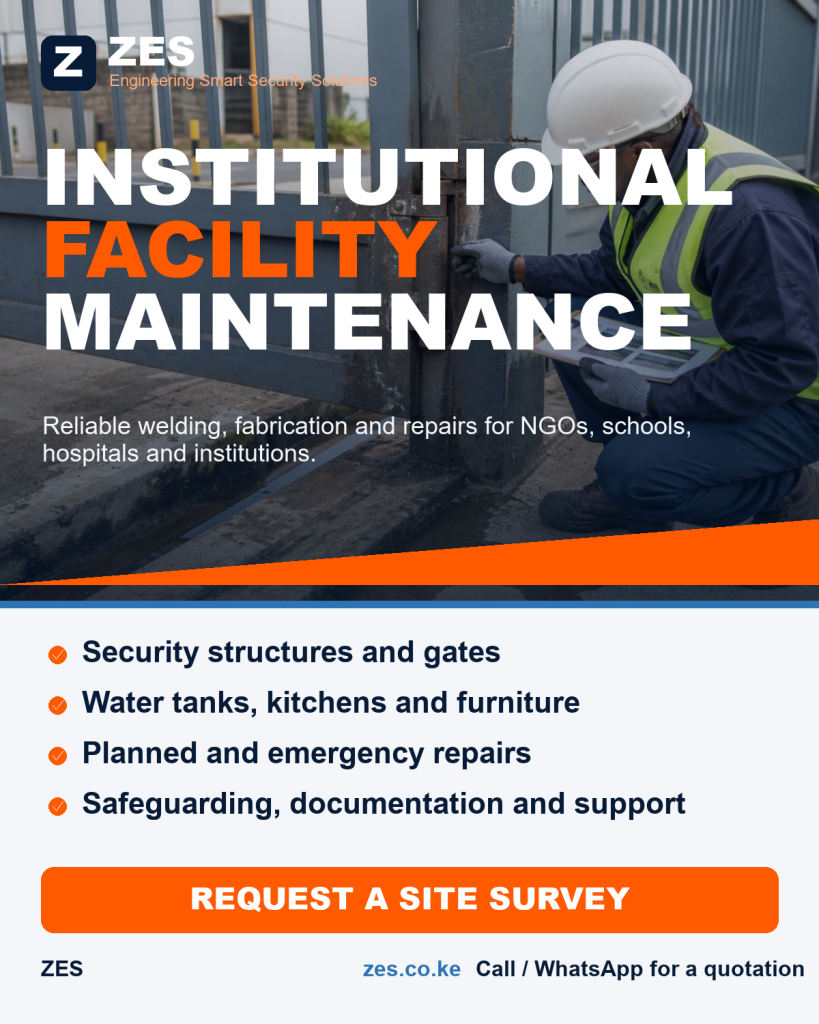
NGOs, schools, hospitals, colleges and community institutions operate buildings and facilities that must remain safe, functional and welcoming. Gates, grilles, fences, water tanks, kitchen equipment, roofs, playgrounds, furniture, signage and security structures all need maintenance, repair and occasional fabrication.
For many institutions, finding reliable contractors is a persistent challenge. Good maintenance contractors are not just welders; they understand occupied facilities, safeguarding, donor accountability, tight budgets and the need to work without disrupting services.
This guide explains what institutional and NGO facility maintenance involves, the common needs, how planned and reactive maintenance work, how to manage work in occupied facilities, how to procure responsibly, and how to choose a contractor who will still be available when something breaks.
It is written for NGO operations managers, school administrators, hospital facilities teams, programme managers, procurement officers and boards.
What Facility Maintenance Covers
Institutional facility maintenance spans a wide range of metalwork and general repairs.
Security structures. Gates, grilles, fences, electric fence posts, strong-room structures and locks.
Water systems. Tanks, stands, supports, pipework and brackets.
Kitchen and catering facilities. Tables, sinks, racks, stands, trolleys and cooking supports.
Roofing and structures. Canopies, walkways, shelters, trusses and supports.
Furniture. Desks, benches, beds, lockers and storage.
Playgrounds and outdoor equipment. Swings, frames, climbing structures and seating.
Signage. Signs, frames and supports.
Doors and windows. Frames, hinges, grilles and security bars.
Laboratory and workshop equipment. Benches, fume supports, frames and guards.
General repairs. Welding, fabrication and modification as needs arise.
Good maintenance keeps these assets safe and functional.
Why NGOs and Institutions Need Reliable Contractors
Institutional maintenance has specific challenges.
Occupied facilities. Schools, hospitals and community centres are usually in use. Work must be planned around people, especially children and patients.
Safeguarding. Contractors working in schools and children's facilities must be vetted and supervised.
Budget constraints. NGOs and institutions operate within tight budgets and need value for money.
Donor accountability. Funded projects often require documentation, transparency and quality evidence.
Compliance. Public health, safety and building requirements apply.
Multi-site operations. NGOs and school networks may manage many facilities across counties.
Urgency. A broken gate, tank or kitchen table can stop services.
Sustainability. Repairs should last, not just patch.
A reliable contractor reduces risk and administrative burden.
Common Facility Maintenance Needs
Institutional facilities share a predictable set of maintenance needs.
Gates and perimeter security. Hinges, welds, locks, automation and alignment.
Window and door grilles. Rust, broken bars and failed welds.
Water tank stands. Corrosion, stability and access.
Kitchen equipment. Tables, sinks, racks and stands.
Canopies and walkways. Rust, loose fixings and damaged roofing.
Furniture repairs. Desks, benches and beds.
Playground equipment. Safety checks, repairs and repainting.
Fencing and electric fence structures. Posts, supports and repairs.
Signage. Frames, posts and supports.
Laboratory benches and fume supports. Stability and safety.
Drainage grilles and covers. Safety and function.
Modifications. New classrooms, wards, offices or programme spaces.
A maintenance contractor who can handle these needs reduces the number of suppliers an institution must manage.
Planned versus Reactive Maintenance
Both matter, and the balance affects cost and risk.
Planned maintenance is scheduled inspection and repair before failures occur. It reduces emergencies, extends asset life and supports budgeting.
Reactive maintenance responds to failures. It is sometimes unavoidable but usually more expensive and disruptive.
Condition-based maintenance uses inspection findings to decide when work is needed.
Preventive maintenance follows a schedule based on time or usage.
Deferred maintenance is work postponed due to budget constraints. It accumulates risk and cost.
A good programme combines planned inspection with reliable reactive response.
Building a Maintenance Programme
Institutions can build a practical maintenance programme.
Asset register. List buildings, structures and equipment.
Inspection schedule. Regular checks by staff and periodic professional inspections.
Priority ranking. Identify critical assets whose failure would stop services or create safety risks.
Budget. Allocate funds for planned maintenance and a contingency for emergencies.
Contractor panel. Establish reliable contractors before emergencies.
Work orders. Track requests, approvals and completion.
Records. Keep maintenance history for each asset.
Review. Use records to plan replacements and improvements.
Reporting. Provide evidence to management, boards and donors.
A programme turns maintenance from crisis management into planned asset care.
Education Infrastructure Welding Services
Schools and education institutions have specific welding and fabrication needs.
Gates and perimeter security. Protecting learners and assets.
Window and door grilles. Security without blocking ventilation.
Desks and benches. Repair and fabrication for classrooms.
Laboratory benches and supports. Stability and safety for science teaching.
Canopies and walkways. Shade and weather protection.
Playground equipment. Safe, durable structures.
Water tank stands. Safe, stable support for water storage.
Kitchen equipment. Tables, sinks and storage for feeding programmes.
Signage and notice boards. Frames and supports.
Security structures. Strong rooms, stores and offices.
Work in schools requires safeguarding checks, scheduling around school terms and careful supervision.
Safeguarding and Working in Schools
Contractors working in schools must meet safeguarding expectations.
Vetting. Contractors and workers should be vetted and identifiable.
Supervision. Work should be supervised and access restricted.
Scheduling. Where possible, work during holidays or outside learning hours.
Separation. Keep work areas separate from learners.
Safety. Tools, materials and hot work must be secured.
Behaviour. Contractors should follow the school's code of conduct.
Reporting. Any safeguarding concern should be reported immediately.
Documentation. Records of who was on site and when.
Safeguarding is non-negotiable in education settings.
Working in Occupied Facilities
Many institutions cannot close for maintenance.
Planning. Schedule work around services, clinic hours, school terms and events.
Phasing. Break work into stages that allow continued use.
Isolation. Screen work areas and control access.
Noise and disruption. Minimise impact on patients, learners and staff.
Safety. Protect occupants from tools, hot work and falling objects.
Cleaning. Clean thoroughly after work.
Communication. Keep staff informed about timing and restrictions.
Handover. Confirm areas are safe before use.
Planning around occupants is a core contractor skill.
Multi-Site Maintenance Programmes
NGOs and networks often manage many sites.
Standard specifications. Common standards for repairs and fabrication.
Standard rates. Agreed pricing for common tasks.
Scheduling. Route-based or clustered visits to reduce travel costs.
Local contractors. Where possible, use local contractors for routine work.
Quality assurance. Consistent inspection across sites.
Reporting. Site-by-site records and photos.
Spares. Common parts available across sites.
Escalation. Clear process for major repairs.
A multi-site programme improves consistency and value.
Procurement and Documentation
Institutions and NGOs must procure responsibly.
Scope of works. Clear description of what is required.
Specifications. Materials, dimensions, finishes and standards.
Quotations. Itemised pricing for comparability.
References. Past experience in similar facilities.
Contracts. Terms, timelines, warranties and payment.
Quality checks. Inspection and acceptance criteria.
Documentation. Records for donors and auditors.
Asset records. Updated maintenance history.
Good procurement protects the institution and the people it serves.
What Affects Institutional Maintenance Cost
Cost depends on scope and conditions.
Type of work. Simple repairs cost less than fabrication or structural work.
Materials. Stainless, galvanised and painted steel vary in cost.
Access. Difficult locations take longer.
Occupied facilities. Working around people adds time and planning.
Urgency. Emergency work costs more.
Travel. Remote sites increase logistics costs.
Documentation. Reporting adds value and cost.
Scale. Multi-site programmes can reduce unit costs.
A clear quotation helps institutions budget and compare.
How to Choose a Maintenance Contractor
Use this checklist.
1. Do they understand institutional settings? Schools, hospitals or NGOs.
2. Are they vetted and safe? Safeguarding and safety practices.
3. Can they handle multiple trades? Welding, fabrication and general repairs.
4. Do they provide itemised quotations? Transparent pricing.
5. Are they reliable? Response times and references.
6. Do they document work? Reports and records.
7. Can they work in occupied facilities? Planning and isolation.
8. Do they offer planned maintenance? Not just emergency repairs.
9. Do they work across counties? If required.
10. Do they provide warranties? On work and materials.
Common Mistakes in Institutional Maintenance
Reactive-only maintenance. Costs rise and risks accumulate.
No asset register. Unknown assets cannot be planned.
Choosing the cheapest quote. Poor work costs more over time.
Ignoring safeguarding. Contractors in schools must be vetted.
Poor scheduling. Work disrupts services unnecessarily.
No documentation. Donors and auditors need records.
No budget for maintenance. Repairs become emergencies.
Unsafe work practices. Hot work and heights create risks.
No follow-up. Repairs fail and are repeated.
Institutional Maintenance by Sector
Schools: gates, grilles, desks, lab benches, canopies, kitchen equipment.
Hospitals: security structures, water systems, kitchen equipment, benches.
Colleges: workshops, laboratories, furniture and security.
NGOs: community facilities, offices, programme sites and multi-site networks.
Churches: gates, roofs, seating and community halls.
Community centres: furniture, kitchens, security and accessibility.
Children's homes: safeguarding-critical repairs and safe structures。
Each sector has specific priorities, and a good contractor adapts.
Preventive Maintenance Schedules by Asset
Different assets need different inspection cycles.
Gates and perimeter structures. Monthly checks of hinges, welds, locks and alignment; repainting or treatment as needed.
Window and door grilles. Quarterly checks for rust, loose fixings and damaged bars.
Water tank stands. Quarterly checks for corrosion, stability and access; annual structural inspection.
Kitchen equipment. Monthly checks of tables, sinks, racks and stands; immediate attention to leaks or instability.
Canopies and walkways. Quarterly checks for rust, loose fixings, roofing damage and drainage.
Furniture. Termly or quarterly checks of desks, benches and beds; repairs before they become hazards.
Playground equipment. Regular safety inspections, especially before school terms.
Fencing and electric fence structures. Monthly checks of posts, supports, tension and repairs.
Signage. Periodic checks of frames, posts and fixings.
Laboratory benches and fume supports. Annual inspection and immediate attention to instability or damage.
Drainage covers and grilles. Quarterly checks for damage and blockage.
A schedule makes maintenance predictable and budgetable.
Repair versus Replacement
Institutions must decide when to repair and when to replace.
Repair is usually right when: the asset is structurally sound, the failure is local, and repair restores safe function at reasonable cost.
Replacement is usually right when: the asset is unsafe, extensively corroded, repeatedly failing, or at the end of its life.
Safety-critical assets should be replaced or repaired immediately if there is any doubt about their integrity.
Heritage or unique assets may justify specialist repair.
Budget cycles sometimes favour phased replacement rather than sudden capital expenditure.
Whole-life cost should guide decisions: cheap repairs that fail repeatedly are not economical.
A good contractor will advise honestly rather than always recommending replacement or always repairing.
Budgeting and Cost Planning for Maintenance
Maintenance budgets are often neglected, which creates emergencies.
Asset register. Know what you have and its condition.
Condition assessment. Estimate remaining life and likely repairs.
Planned budget. Allocate funds for scheduled maintenance.
Contingency. Keep a reserve for emergencies.
Prioritisation. Fund safety-critical and service-critical assets first.
Whole-life costing. Compare repair and replacement over time.
Donor funding. Align maintenance with programme budgets and donor requirements.
Records. Track actual costs to improve future budgeting.
Review. Adjust budgets based on experience.
A modest, consistent maintenance budget usually saves far more than sporadic emergency spending.
Health and Safety in Institutional Works
Contractors working in institutions must protect occupants and workers.
Risk assessment. Identify hazards before work starts.
Hot work. Permits, fire watch and clearance of combustibles.
Working at height. Scaffolding, harnesses and safe access.
Tools and equipment. Guarded, maintained and used correctly.
Electrical safety. Isolated and protected.
Chemicals and fumes. Ventilation and PPE.
Site security. Tools and materials secured, especially in schools.
Occupant protection. Barriers, signage and supervision.
Emergency procedures. Clear response arrangements.
Reporting. Incidents and near-misses recorded.
Safety failures in institutions can harm vulnerable people and damage trust.
Water, Sanitation and Hygiene Facilities
WASH facilities are critical in schools, hospitals and communities.
Water tanks and stands. Stable, corrosion-resistant and accessible.
Hand-wash stations. Durable and easy to maintain.
Toilets and sanitation structures. Doors, frames and grilles.
Drainage. Proper flow and covers.
Pumps and pipework supports. Secure and accessible.
Maintenance access. Cleaning and repair access.
Hygiene promotion. Facilities that support good practice.
Climate resilience. Structures that withstand weather.
WASH maintenance directly affects health and attendance.
Security and Access Control Structures
Institutions need security that protects without creating hazards.
Gates and barriers. Sturdy, well-hinged and easy to operate.
Grilles and bars. Secure but safe, with escape considerations.
Strong rooms and stores. Secure fabrication for valuables and records.
Fencing and perimeter. Durable and maintained.
Access control integration. Where required, with doors and gates.
Emergency egress. Security must not block escape routes.
Visibility. Security should not create hidden areas.
Maintenance. Locks, hinges and structures checked regularly.
Security structures should balance protection, safety and dignity.
Community Engagement and Local Labour
NGO and community projects often involve local labour and community expectations.
Local sourcing. Where appropriate, use local labour and materials.
Skills development. Train local workers where possible.
Community consultation. Understand needs and priorities.
Transparency. Clear communication about scope and timelines.
Quality control. Local labour must be supervised and inspected.
Sustainability. Build capacity for future maintenance.
Fair payment. Prompt and fair compensation.
Documentation. Records for accountability.
Community engagement improves ownership and sustainability.
Managing Contractor Relationships
Good contractor relationships reduce risk and cost.
Clear expectations. Scope, standards, timelines and behaviour.
Written agreements. Terms, rates, warranties and responsibilities.
Induction. Site rules, safeguarding and safety.
Supervision. Someone from the institution should oversee work.
Communication. Regular updates and a clear escalation path.
Payment. Prompt, fair and linked to milestones where appropriate.
Performance review. Assess quality, timeliness and conduct.
Feedback. Discuss issues openly and resolve them.
Repeat work. Reliable contractors become long-term partners.
A good relationship is built on clarity and consistency.
Asset Registers and Condition Assessment
An asset register is the foundation of maintenance planning.
What to record. Asset type, location, condition, age, value and maintenance history.
Condition rating. A simple scale (good, fair, poor, replace) helps prioritisation.
Photographs. Visual records support planning and reporting.
Inspection dates. When the asset was last inspected and by whom.
Repair history. What was done and at what cost.
Criticality. Which assets are essential to services or safety.
Replacement planning. Estimated replacement dates and budgets.
Ownership. Who is responsible for each asset.
Review. Update the register regularly.
Condition assessment turns guesswork into planning.
Emergency Preparedness for Facilities
Institutions need plans for urgent failures.
Critical asset list. What must be fixed immediately.
Contact list. Contractors and suppliers for emergencies.
Temporary measures. How to secure or bypass a failed asset safely.
Budget. Access to emergency funds.
Communication. Who to inform and how.
Safety. Immediate actions to protect occupants.
Documentation. Records of the incident and response.
Review. Learn from each emergency.
Preparedness reduces the impact of failures.
Sustainability and Repainting Programmes
Preventive repainting and treatment extend asset life.
Repainting schedules. Based on environment and condition.
Surface preparation. Cleaning and rust removal before painting.
Suitable coatings. Appropriate for the environment and use.
Galvanising. For structures exposed to weather.
Records. Track treatment and repainting.
Budget. Include repainting in maintenance plans.
Training. Staff can identify early corrosion.
Environmental considerations. Responsible disposal of old coatings.
Preventive treatment is far cheaper than structural replacement.
Working with Donors and Reporting
Donor-funded institutions need clear reporting.
Scope and budgets. Agreed in advance.
Work plans. Timelines and responsibilities.
Progress reports. Regular updates with photos.
Quality evidence. Inspection records and certificates.
Financial records. Receipts and reconciliations.
Completion reports. What was done, when and at what cost.
Lessons learned. What worked and what should change.
Sustainability. How assets will be maintained after the project.
Good reporting builds trust and supports future funding.
Frequently Asked Questions
What do NGO facility maintenance contractors do?
They repair, fabricate and maintain metal structures and equipment for NGOs, schools, hospitals and institutions, including gates, grilles, water tanks, kitchen equipment, furniture and security structures.
Can you work in schools during term time?
Yes, with planning, safeguarding checks, supervision and separation from learners. Where possible, major work is scheduled during holidays.
Do you offer planned maintenance?
Yes. Scheduled inspection and maintenance reduce emergencies and extend asset life.
Can you handle multiple sites?
Yes. Multi-site programmes can be planned with standard specifications, scheduling and reporting.
Do you provide documentation for donors?
Yes. Work records, photos, specifications and reports can be provided for donor and audit requirements.
Are your workers vetted?
Safeguarding requirements can be met, including vetting, identification and supervision.
Do you fabricate replacement parts?
Yes. Replacement parts and modifications can be fabricated when originals are unavailable.
How do you price institutional work?
Through itemised quotations based on scope, materials, access and urgency.
Do you work outside Nairobi?
Yes. Work can be arranged across Kenya, with logistics reflected in the quotation.
Can you respond to emergencies?
Emergency response can be arranged, subject to availability, with priority for safety-critical repairs.
A Final Pre-Purchase Checklist
Before engaging an institutional maintenance contractor, confirm the following. Make sure they understand your setting and safeguarding requirements. Check that they are vetted and safe. Confirm their experience and references. Ask for itemised quotations. Confirm documentation and reporting. Ask about planned maintenance options. Confirm how work will be scheduled around occupants. Ask about warranties and follow-up. Finally, compare quotations against the same scope and standards.
A contractor who explains these points clearly is usually the one worth trusting with a facility that serves vulnerable people.
Conclusion
NGO and institutional facility maintenance is about keeping essential services safe and running. The difference between a well-maintained facility and one that constantly fails is the planning, the quality of repairs, the safeguarding, the documentation and the reliability of the contractor.
If you manage an institution, start with an asset register and a maintenance plan. Then build relationships with reliable contractors before emergencies occur.
ZES provides welding, fabrication, repairs and maintenance for NGOs, schools, hospitals and institutions across Kenya. If you would like a practical assessment and a clear, itemised quotation, start with a site survey.
Request an institutional maintenance assessment and quotation from ZES