

Petrol Station Staff Access Control Kenya projects should distinguish staff permissions from visitor handling and general attendance reporting. The operator needs to identify which openings are controlled, who approves access and how the actual doorway will operate. This guide covers permission planning and acceptance. ZES can review the technology requirement; hardware, safe exit arrangements and specialist responsibilities must be assessed for the actual premises and confirmed in the project scope.

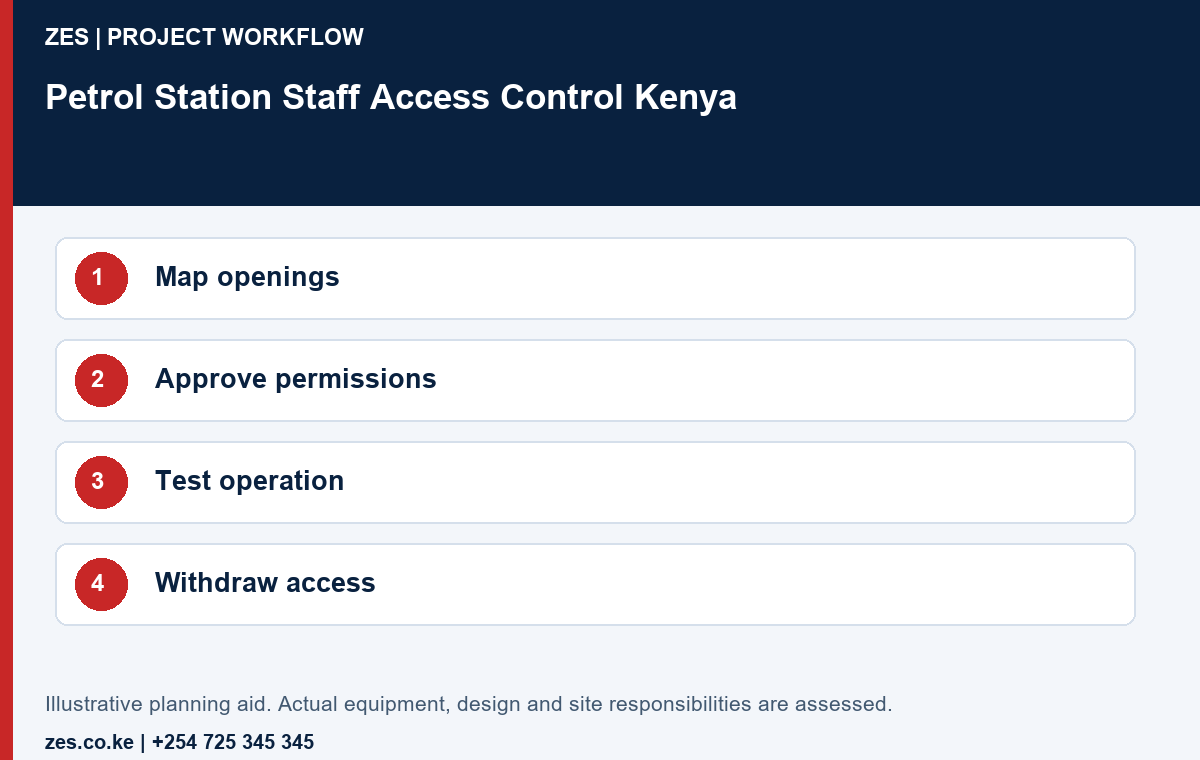
1. Define the controlled areas
List the specific doors or areas included in the enquiry. Distinguish an office, store or administrative room from the wider property boundary. Identify the party authorised to approve changes at each opening. A quotation for one reader should not be interpreted as a commitment to control every entrance or restricted function at the station.
2. Prepare a permission matrix
Identify employee groups, temporary staff and contractors and describe the areas and schedules they are authorised to use. Name the person who approves changes. Ask the selected application to demonstrate the required distinctions with sample identities. Record any requirement that depends on an operating procedure rather than a built-in software restriction.
3. Assess the actual opening
The reader must be considered with the door or gate, locking, release and supporting power. Assign competent review of exit arrangements and relevant interfaces. Do not select hardware from a photograph alone or treat a recognition feature as proof that a component is suitable for the opening. Fuel-site equipment suitability and operating responsibilities need specific assessment.
4. Plan exceptions and interruptions
Agree the approved response to an unsuccessful credential or unavailable device. Identify who can authorise an exception and how the temporary arrangement ends. Demonstrate the selected configuration’s approved interruption behaviour with the responsible site team. A convenient workaround should not silently create permanent unrestricted access or substitute for the station’s established incident arrangements.
5. Test permissions and user removal
Use invented identities to show authorised entry, rejected access, a schedule restriction and withdrawal of a sample user. Check the available event and administration records. If several openings are included, test the agreed differences between them. A successful demonstration at one door does not establish that every permission change reaches every part of the proposed installation.
6. Keep attendance and security purposes clear
An entry event does not automatically provide a complete attendance record. Describe any proposed use of access data separately and review it through the organisation’s responsible team. Keep permissions, record access and biometric-data handling aligned with the approved purpose. ODPC guidance is a useful reference when the organisation assesses its responsibilities and the selected product’s actual controls.
7. Transfer usable administration information
Identify customer account ownership, equipment references, licences and support routes. Demonstrate ordinary permission changes with the intended operator. Keep sensitive configuration information private and document the approval process for future alterations. Review the arrangement when staffing or premises change, rather than assuming that the original permission map covers every later operating requirement.
Petrol Station Staff Access Control Kenya: demonstration and review workbook
Imagine an office, stockroom and staff entrance with different authorised users. The enquiry is for staff access control, while visitor management and attendance reporting are separate questions. Use invented profiles for a supervisor, an ordinary employee and a temporary contractor. Ask the selected configuration to demonstrate each approved permission and its withdrawal. The responsible site team must assess the actual openings, exit arrangements and supporting hardware; the example does not prescribe a locking method or permit an alteration to an occupied doorway.
The following cases help the buyer specify and compare the actual project. Agree which apply to the proposed access control scope and record any exclusions before acceptance. They are hypothetical review prompts, not evidence of a completed ZES client project. The responsible site team and relevant competent parties approve any physical tests or changes to live operations.
Opening register
Give each included door or gate a reference and agreed purpose. Identify the responsible approver, existing condition and supporting interfaces before selecting access-control components.
Permission groups
Prepare the sample groups and allowed areas. Ask the application to demonstrate the differences, identifying any requirement that must be enforced by an operating procedure instead.
Schedule restriction
If required, demonstrate a sample authorised schedule and the result outside it. Confirm how a later schedule change is approved and propagated to the included opening.
Temporary access
Issue an approved sample temporary permission and demonstrate its intended ending. Avoid leaving a contractor’s credential active because responsibility for withdrawal was never assigned.
Rejected attempt
Observe a permitted example of rejected access and retrieve the available event. Train staff on the approved exception route without creating an informal permanent bypass.
Door operation
Have the responsible competent parties verify the approved doorway arrangement. Recognition, lock operation, release and safe exit are related requirements that need an assessed complete access control scope.
Interruption behaviour
Document the approved behaviour for relevant power or communication interruptions. Any demonstration must use the responsible site’s agreed method and protect ongoing operations and exit arrangements.
User withdrawal
Withdraw a sample permission and verify the included openings. A profile change in one screen does not establish that every affected component has received the intended update.
Administrative record
Show the available permission-change history and authorised roles. Identify who can approve, apply and review a change, rather than giving every operator unrestricted administrative access.
Related records
If attendance use is proposed, assess its purpose and event meaning separately. An authorised door entry can be relevant context without automatically representing a complete staff attendance record.
Detailed buyer questions
Does one reader supply a complete controlled entrance?
No. The access control scope must consider the actual opening, compatible hardware, supporting power, release arrangements and responsibilities. Ask for assessment of the complete requirement rather than buying solely from a reader photograph.
Can visitor and staff access use the same rules?
The organisation should define the appropriate workflows separately. Demonstrate the selected access control product’s actual support and identify who approves temporary permissions, supervises exceptions and withdraws access.
How can the buyer verify ordinary access control administration?
Ask the intended authorised operator to create, change and withdraw sample permissions after training. Retain the observed results and unresolved limitations in the controlled acceptance record.
Make the employee workflow clear before selecting a terminal
Employee attendance, identity recognition and permission to open a door are related but different requirements. Attendance concerns the employer’s use of time records. Recognition associates an attempt with a profile. Access control applies an approved permission at an opening. A single access control product may support some combination, but the proposal must demonstrate each required workflow. Avoid buying one function and assuming the other two will appear automatically.
Prepare invented employee examples instead of sending live biometric records with the enquiry. Describe ordinary duties, a missed event, a change of shift and a person moving between sites where applicable. Include the administrator’s task as well as the employee’s action. A successful recognition attempt does not establish that an attendance report is correct or that the intended access permission has been applied to every included opening.
The employer should decide how raw events are interpreted. A device can record a time without deciding why someone arrived, whether a changed duty was authorised or how a payroll rule applies. Demonstrate the selected software using the employer’s approved examples. Record which conclusions are calculated, which require review and who can approve a correction. An unexplained system label should not substitute for the organisation’s decision process.
Trial the whole process with the intended administrator
For an authorised representative trial, agree who participates, what information is collected and what happens to test profiles afterward. Identify the actual terminal, application and configuration used. Ask the intended operator to perform the ordinary task after training. Sales staff completing the demonstration themselves can conceal a workflow that is difficult for a station administrator to repeat without assistance.
Test continuity using a planned and permitted method appropriate to the selected arrangement. State the reporting result expected during or after an interruption. Trace known sample events through recovery and check whether duplicates, gaps or delayed permissions require attention. Do not interrupt live security or attendance operations casually to prove a feature. The responsible site team must approve the method and any temporary operating arrangement.
Review the full identity lifecycle: approval to enrol, association with the correct person, authorised changes, exceptional use and withdrawal. If a access control product offers an alternative credential, document its actual support and the organisation’s approval process. Avoid an informal shared identity that defeats attribution. Historical attendance records and active permission are different matters; the responsible organisation must decide how each is handled.
Biometric information requires a deliberate organisational assessment. Review the purpose, necessity, people affected, authorised access and appropriate information handling with the responsible advisers and relevant ODPC guidance. A claim that a reader is compliant does not settle every proposed use. Establish customer ownership of administrative accounts, restrict access to sensitive records and keep employee templates or personal details out of public handover examples and promotional images.
Build a proposal that can be compared and accepted
A useful specification separates the result the station wants from the access control product a supplier proposes. Start with a short statement of the operational problem, the people affected and the evidence that would show improvement. Give each requested deliverable a reference. A supplier can then identify the equipment, labour, configuration, documentation and customer dependencies against that reference. This makes it easier to compare offers without assuming that similar item names describe the same complete service.
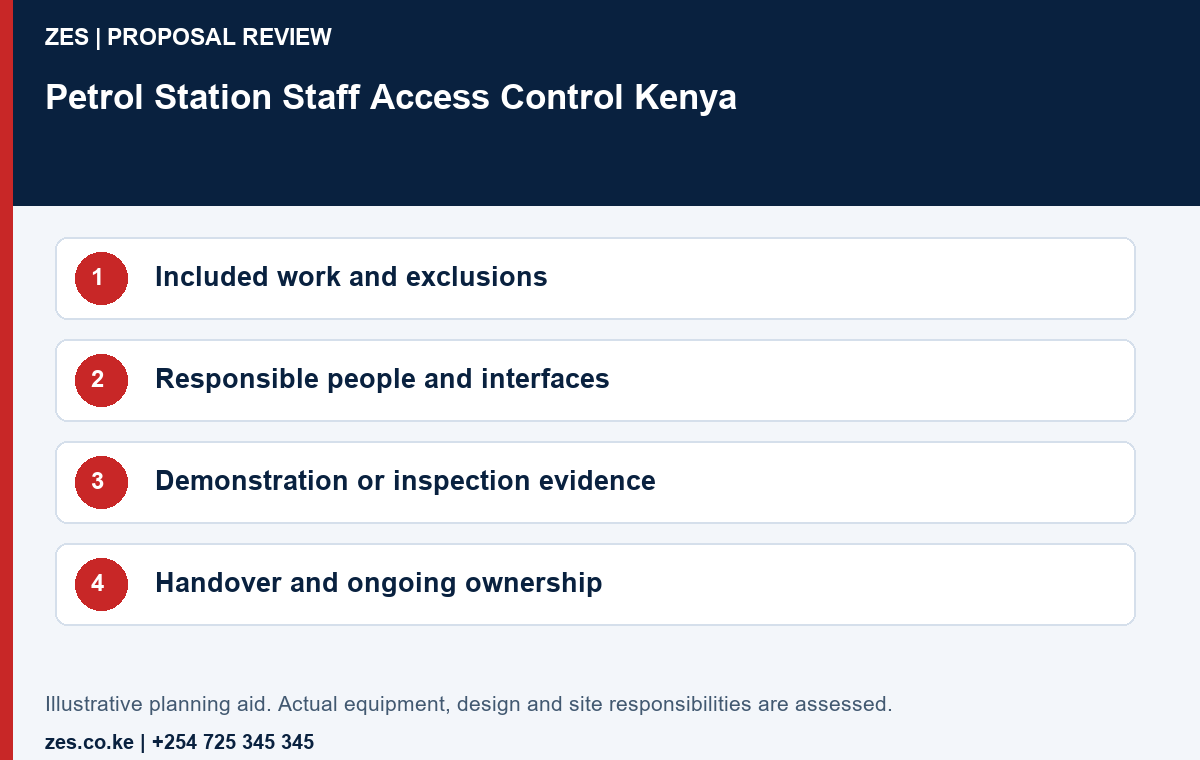
Keep a simple comparison register with columns for requirement, included work, excluded work, customer action, acceptance evidence and price basis. An item marked included should have enough detail to distinguish supply alone from installation, configuration or commissioning. An exclusion is not necessarily a poor offer; it becomes a problem when the station discovers it only after work starts. Clarify unanswered questions in writing and attach the clarification to the agreed proposal.
The station should nominate one commercial contact and the operational or technical people who can approve their respective parts. A cashier may explain a daily workflow without having authority to approve a system change. A premises manager may approve access while another party owns an interface or structure. Record these boundaries early. Give the supplier a coordinated response instead of several conflicting instructions from people who assume somebody else has approved the change.
Use a dependency list before agreeing an implementation date. Examples include approved access, available records, enabling works, an authorised test window and attendance by another supplier. For each dependency, identify who provides it and how readiness will be confirmed. Separate the proposed working duration from the full calendar programme. A short installation task can still depend on an assessment, procurement or approval that has not yet been completed.
Use an evidence register rather than a completion claim
Create one acceptance entry for each important requirement. Record the agreed condition, the expected result, the observed result, the person witnessing it and any remaining action. Use the selected access control product documentation and approved design to decide what is appropriate to test. The examples in this guide are purchasing questions, not permission to carry out hazardous operations or alter live station equipment. Tests must be planned and performed by the responsible people under the site’s arrangements.
An entry should be specific enough for another manager to understand later. An observation such as tested successfully does not explain what was tested. A clearer entry identifies the relevant asset or sample record, the conditions checked and the evidence retained. Do not publish sensitive configuration, employee information or security layouts in a public project gallery. Keep the operational evidence in the customer’s controlled handover file, with access appropriate to its contents.
Distinguish a defect from an agreed exclusion, a customer dependency and a later improvement request. Each needs a different decision. Assign an owner and review date to unresolved matters. If an issue affects the safe or intended use of the delivered work, the responsible parties must decide the appropriate restriction and resolution before treating the affected access control scope as accepted. A signature should record an informed decision rather than conceal an incomplete requirement.
Customer acceptance and a supplier invoice serve different purposes. An invoice identifies a commercial charge; it does not replace the technical evidence agreed for the project. Similarly, a photograph can show a visible installation without establishing its configuration, structural adequacy or reporting behaviour. Retain the relevant inspection, demonstration or test record alongside the commercial documents so that future reviews do not depend on recollection.
Plan ownership, changes and the next review
Ask for a handover index before completion. Depending on the access control scope, it may list equipment references, approved drawings, configured functions, maintenance information, licences, acceptance records and support contacts. Mark documents as supplied, not applicable or outstanding. Keep passwords and sensitive access arrangements separate from general manuals. The customer should know who controls each account and how authorised access will be transferred when an employee or contractor changes.
The person expected to use or maintain the result should demonstrate the ordinary task during handover. A presentation to the purchasing team is useful, but it is not the same as the nominated operator retrieving a report, identifying an asset or following the approved support route. Arrange cover for that role. Record the limits of the training and the subjects that still require a competent specialist rather than encouraging staff to improvise repairs.
Compare ongoing obligations as carefully as the initial price. Identify recurring licences, replacement consumables, support arrangements, inspection responsibilities and customer-provided services where relevant. Ask what happens if a renewal is not made, an account changes or an additional site is added. Do not assume that a one-time purchase includes every later configuration change, site visit or third-party service. Request current written commercial terms for the actual access control scope.
Schedule a review after a representative operating period. Compare the original requirement with actual use, note unresolved findings and decide whether the proposed improvement achieved its purpose. If the station changes layout, staffing, operating hours or another connected system, review the affected assumptions. Keep the approved baseline and later changes together. This gives future suppliers a reliable starting point and reduces the risk of replacing working equipment simply because its documentation has been lost.
A practical enquiry example
An access control brief can be organised by opening: identify the door reference, approved user groups and the decision owner. Ask the access control supplier to explain the proposed hardware and software boundary, including interfaces owned by other parties. Keep the access control design review separate from the ordinary demonstration of a credential. Access control acceptance needs the complete approved doorway arrangement, not only a successful recognition message.
The operator should also receive an access control administration schedule. It identifies who approves permissions, who applies changes and who reviews exceptions. Use the access control demonstration to practise an ordinary change and a leaver withdrawal with invented profiles. Confirm how the access control record is retained in the private handover and what triggers another assessment when the premises or operating arrangements change.
Prepare a clear enquiry for ZES
Share the station location, the problem or intended outcome, relevant quantities and the existing equipment or application references. Include available approved plans or anonymised examples where useful. Identify the person who can authorise site access and the contacts responsible for operations and technical interfaces. Keep credentials, employee biometric records and confidential transaction information out of a general enquiry.
Ask the written proposal to identify the supplied work, exclusions, customer dependencies, current commercial terms and the evidence used for acceptance. Confirm specialist responsibilities and relevant credentials for the actual scope. ZES can review the brief and confirm the appropriate assessment and proposal arrangements. Site attendance, timing, product availability and support commitments are agreed directly rather than promised solely because a project names a particular county or town.
Compare the same complete scope
- Equipment or materials: identify the actual model, specification and documentation.
- Supporting tasks: record enabling work, site access and customer-supplied dependencies.
- Configuration or fabrication: state the work and the responsible approving party.
- Acceptance: agree the demonstration, inspection or verification evidence required.
- Ownership: confirm accounts, records, recurring charges and the future support route.
Frequently asked questions
Can access-control events replace a staff attendance process?
Not automatically. Review event meaning, reporting requirements and the separately approved purpose.
Does a reader supply a complete controlled doorway?
No. Assess the actual opening, compatible hardware, release arrangements and supporting systems.
Reference information: ODPC biometric-data guidance.
Related ZES service · Petrol-station engineering enquiries · Request a scoped quotation · Request a site assessment · Call +254 725 345 345