
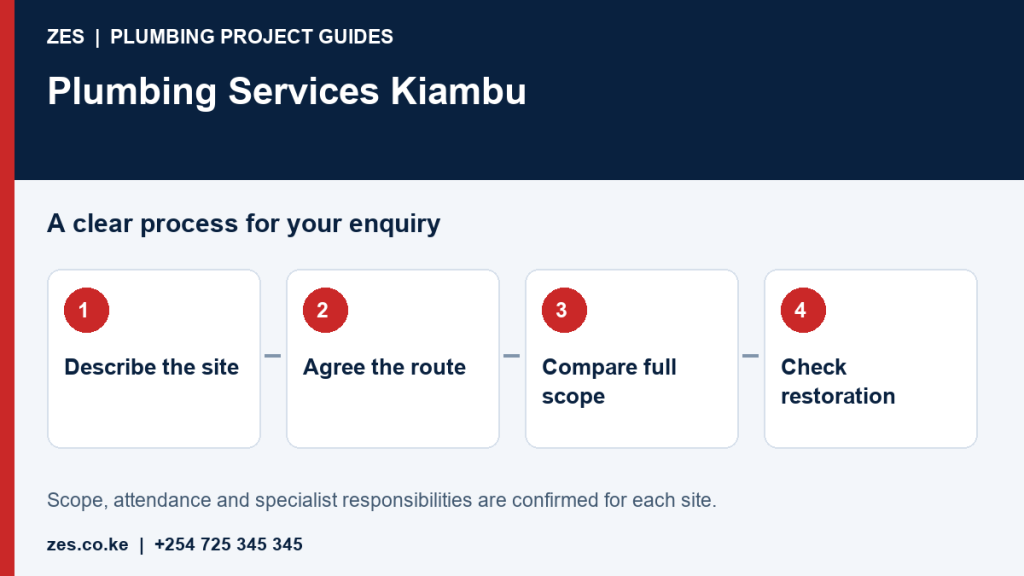
Plumbing services in Kiambu should respond to the actual property rather than treating a whole county as one installation type. Home renovations, rental buildings, institutions and dispersed commercial properties can have different sources, storage and disposal arrangements. This guide helps owners describe the requirement and compare a complete scope. ZES accepts enquiries from Kiambu locations and confirms survey, travel, installation and maintenance arrangements for the particular site.
Describe the existing water arrangement
Give the town or locality, building use, occupancy and the problem or intended change. Explain whether supply is direct, stored, pumped or drawn from multiple sources. If the source or disposal arrangement is uncertain, say so. Existing sketches, accessible photographs and labels help the initial review. A single-fixture fault differs from interruption across a property. The assessment should establish enough of the current installation to avoid planning repairs around an incorrect account of where the water comes from or which outlets share a pipe.
Account for access, terrain and service routes
A tank, pump and occupied building may be separated by a long route or level difference. Access and buried services can affect investigation and installation. Record vehicle access, known routes and surfaces needing reinstatement. Underground work needs coordination with existing services and authorised excavation. An available path is not automatically an approved route. Supports and other specialist design responsibilities should be assigned before equipment is ordered. Site information helps determine whether a proposed installation can be built, inspected and serviced in its intended location.
Treat renovation as a coordinated alteration
Replacing fittings differs from adding bathrooms or moving a kitchen. Record the current condition and proposed layout. Review supply, drainage, maintenance access and affected finishes. Extensions that increase occupancy may need assessment of storage and disposal capacity by appropriate professionals. Avoid connecting simply to the nearest available pipe. Agree a drawing or measured sketch and material basis. State the intended use so acceptance can address operation. This makes the quotation easier to compare and helps the installer identify design questions before materials are purchased.
Price supporting work and logistics
Request labour, quantities, material specification, travel, access, testing and exclusions. Confirm survey and mobilisation arrangements for the actual locality. A photograph-based estimate should identify what remains provisional. Hidden conditions require a documented change before additional work. Compare the total result rather than only a day rate. Opening and reinstating a paved route can matter as much as the pipe itself. State who removes old materials and who restores finishes so owners do not discover essential enabling work missing from the contract after installation begins.
Verify the affected scope
Witness the agreed leak, flow, drainage and equipment checks. Confirm areas isolated and valves changed. Keep photographs of concealed routes and appropriate component information. Included pumps and tanks need their defined operating sequence checked by competent personnel. Record unresolved items until closed. Flowing water alone does not demonstrate that every drainage route, control or connection works as intended. Acceptance should match the actual scope and the documented method, including any service limits or unfinished reinstatement that the owner must arrange separately.
Plan for changing use and occupancy
Letting, holiday periods and business changes can alter system duty. Keep records and investigate unexplained consumption, refill-time or pump-behaviour changes. Arrange care according to condition and manufacturer guidance. Seek appropriate advice when water source or intended use changes. Make accessible isolation information available to authorised staff. A consistent history helps successive technicians work from the same information. It also supports planned renewal by showing whether faults are isolated incidents or a pattern that warrants a broader repair strategy.
Information to include in your project brief
- Town, property type and occupancy
- Source, storage and disposal arrangement
- Existing and proposed layout
- Access, travel and reinstatement scope
Frequently asked questions
Does ZES accept enquiries across Kiambu?
Yes. Send the actual locality and requirement so attendance, survey and travel arrangements can be confirmed.
Can one quote cover several buildings?
Yes, if quantities and boundaries are defined. Separate common systems from building-specific work.
Can an old drawing be used?
It is useful background, but it should be checked against the present installation before work proceeds.
Related plumbing planning guides
- School Plumbing Contractors Kenya: Water, Washrooms and Maintenance Planning
- Plumbing Contractors Kenya: Procurement and Project Delivery Checklist
Discuss your plumbing requirement with ZES
Share the location, property use, symptoms or proposed work, and available drawings or photographs. ZES will review the information and confirm the suitable scope, any assessment arrangements and current attendance availability. Materials, responsibilities, programme and applicable terms are agreed in the written quotation.
Explore ZES plumbing services · Request a plumbing quotation · Call +254 725 345 345