
Updated 1 November 2026 · Zama Engineering Systems buyer guide
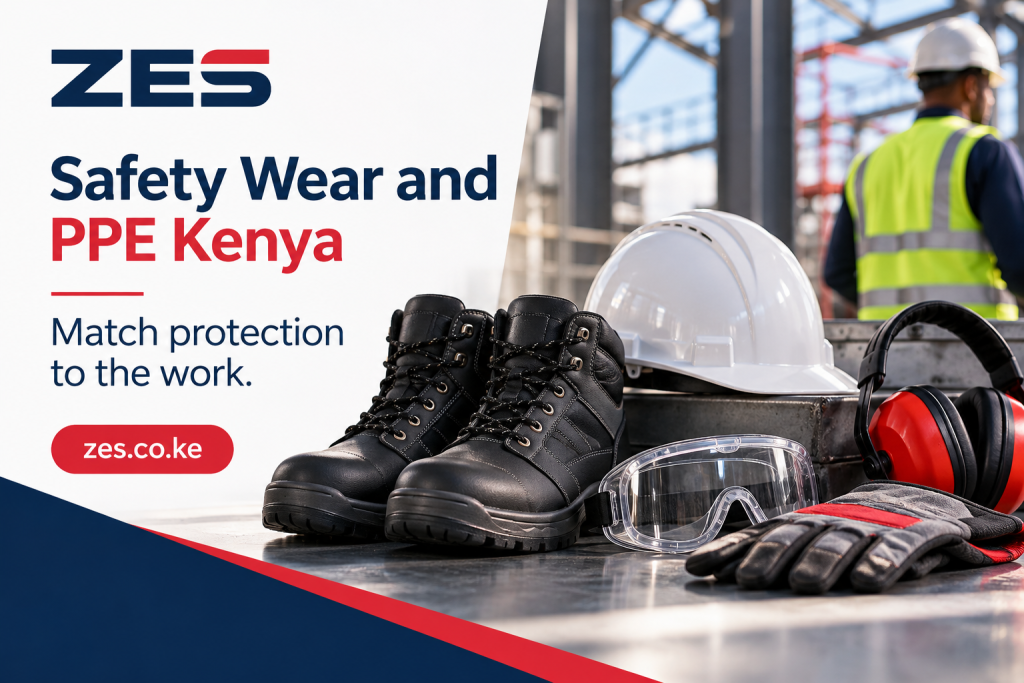
Safety Wear and PPE Kenya enquiries should match protective equipment to the work, users and assessed hazards. A uniform gives a consistent appearance, but it is not automatically protective equipment. Before choosing boots, gloves, helmets or eye protection, agree the relevant specification with the responsible safety personnel. This guide helps procurement teams describe an order and compare evidence rather than rely on an attractive product image.
Begin with tasks and assessed hazards
Describe the work activities, conditions and users. Welding, cleaning, material handling and general site visits can present different protection needs. The responsible safety assessment should determine the required equipment and other controls. PPE should not be treated as a substitute for eliminating or controlling a hazard where practical. Request a task-based specification instead of ordering identical items for every department without review.
Safety Wear and PPE Kenya: request product evidence
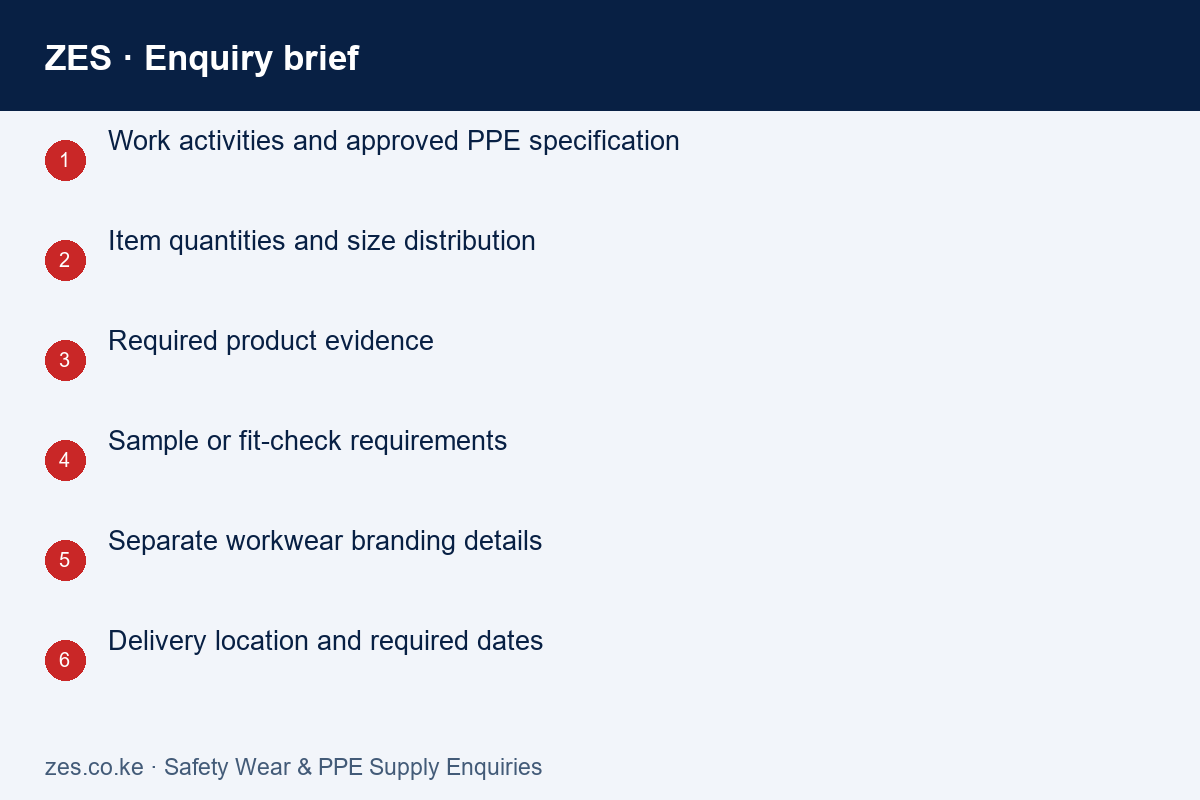
Ask for the exact manufacturer, model and relevant product documentation. Where a particular standard or performance class is specified, obtain evidence applicable to the actual item supplied. A catalogue claim should not be assumed to cover a substitute. Record the approved product on the purchase order and agree how alternatives will be reviewed. Do not invent certification based on a familiar-looking label or marketing artwork.
Consider fit, comfort and compatibility
Sizes, adjustments and compatibility affect whether users can wear equipment as intended. Goggles, hearing protection and head protection may need to be assessed together rather than separately. For larger orders, an approved sample or size exercise can reduce unsuitable deliveries. Keep the process respectful and practical. A low unit price becomes less useful if staff receive equipment that cannot be used correctly for the assigned task.
Separate workwear branding from protection
Safety Wear Suppliers Nairobi enquiries may include branded overalls as well as protective items. Describe fabric, sizing, colour and branding separately from any claimed protective performance. Ordinary overalls should not be presented as specialised flame-resistant clothing without suitable evidence. Confirm that added logos or alterations do not conflict with the approved specification. For public marketing, use illustrations honestly rather than suggesting that a pictured garment has a certification it does not have.
Compare the delivered order, not only unit prices
Include quantity, size distribution, approved model, documentation, delivery and any sample-approval process in the enquiry. Ask how unavailable sizes or proposed substitutions will be handled. Availability and lead times belong in the actual quotation. A procurement comparison should include the same specification and quantities across offers. Keep approved samples or records where useful, so the receiving team knows what it is accepting.
Plan issue records, care and replacement
The employer's responsible team should establish instructions, storage, inspections and replacement arrangements for the selected items. Follow the actual manufacturer's information and applicable site requirements. A general article should not prescribe one replacement interval for every helmet, glove or boot. Record what has been issued and provide suitable user instruction. Damaged or unsuitable equipment needs review through the responsible safety process rather than an informal workaround.
Compare the project scope
| Decision | Information to confirm | Useful acceptance evidence |
|---|---|---|
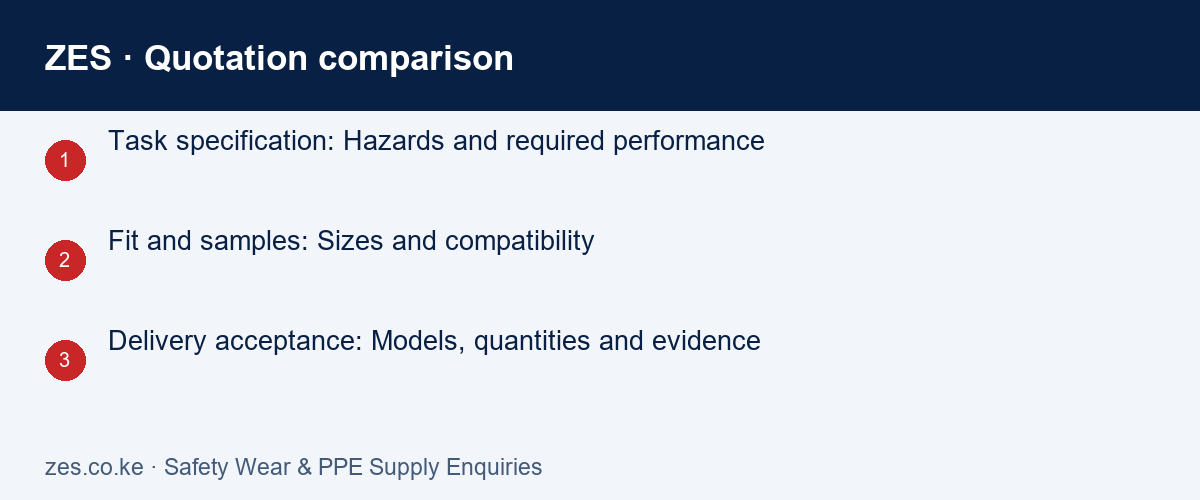
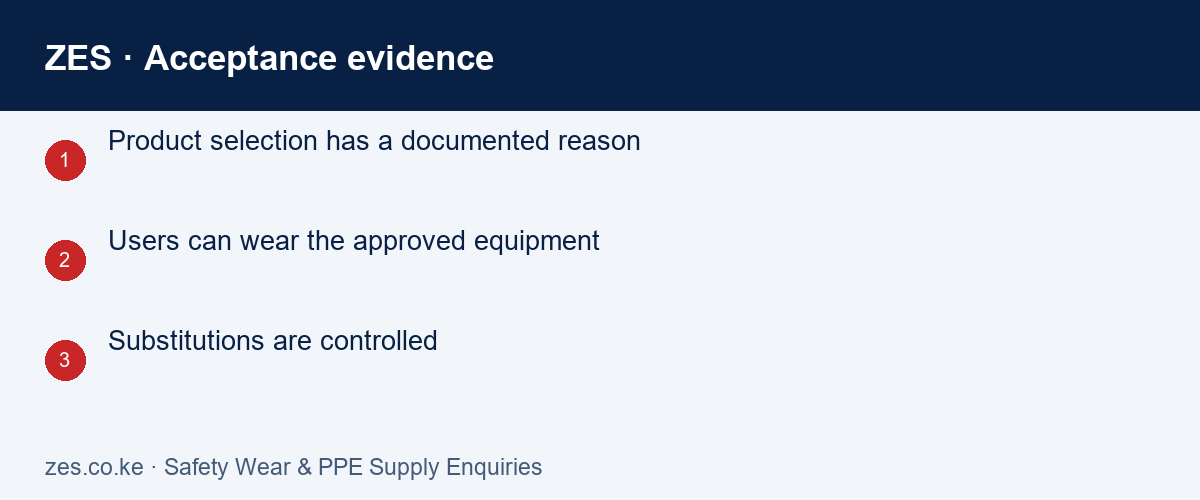
| Task specification | Hazards and required performance | Product selection has a documented reason |
| Fit and samples | Sizes and compatibility | Users can wear the approved equipment |
| Delivery acceptance | Models, quantities and evidence | Substitutions are controlled |
A practical planning example
A contractor may order branded general workwear for one group and separately specified protective equipment for a particular task. Keeping these requirements distinct avoids assuming that a logo makes a garment suitable for specialist work. This is an illustrative procurement example.
Safety Wear and PPE Kenya: enquiry checklist
- Work activities and approved PPE specification
- Item quantities and size distribution
- Required product evidence
- Sample or fit-check requirements
- Separate workwear branding details
- Delivery location and required dates
Related enquiry: Safety Wear Suppliers Nairobi. Include the location and the intended outcome so the proposed scope can address the actual requirement.
Frequently asked questions
Can ZES supply branded overalls?
Submit the quantity, sizing and branding requirements. Availability, specification and commercial terms are confirmed in the proposal.
Can cheaper alternatives be accepted?
Only through the customer's approved review process. The alternative should meet the actual required specification, not just resemble the original.
Does this guide replace a safety assessment?
No. The responsible competent assessment and product instructions determine the appropriate equipment and use.
Safety Wear and PPE Kenya: discuss the scope with ZES
Explore the Safety Wear & PPE Supply Enquiries service enquiry page or all specialist service categories. Share the site, quantities, existing equipment and required outcome. Assessment, availability, delivery responsibilities and commercial terms are confirmed in the written proposal.
Request a scoped quotation · Request a site assessment · Call +254 725 345 345
Further reference: ILO occupational safety and health resources. Product instructions and project-specific specialist advice remain important for the actual equipment and work.